• ABOUT
  • BIRDING 2018
  • Birding 2019
  • BLOG POSTS
  • Butterflies 2018
  • Resources

earthstar

~ a celebration of nature

earthstar

Author Archives: sconzani

First Blackcap

20 Monday Mar 2023

Posted by sconzani in birds, spring

≈ Leave a comment

Tags

bird migration, birding, birdwatching, Blackcap, British birds, spring migration

I heard him before I saw him – in fact, it took a while to spot this little chap, who was mostly hidden amongst the greenery as he sang his little tune. Was he celebrating the fact that he’d finally arrived on land after his long migration flight? Or was he practising his melody in preparation for trying to woo a potential mate? Though some Blackcaps now over-winter here, they are mostly to be found feeding in people’s gardens, taking advantage of the goodies on offer from feeders. This little fellow was by the sea, with no houses or gardens nearby, which is why I’m fairly sure he was a newly arrived migrant. And he was my first Blackcap of the year. I look forward to seeing more.

230320 first blackcap

Like Loading...

Small white brassicas

19 Sunday Mar 2023

Posted by sconzani in wildflowers

≈ Leave a comment

Tags

Arabidopsis thaliana, Brassicas, brassicas with white flowers, British wildflowers, Capsella bursa-pastoralis, Cardamine flexuosa, Cardamine hirsuta, Cochlearia danica, Common whitelowgrass, Danish scurvygrass, Erophila verna, Hairy bitter-cress, Shepherd's purse, Thale cress, Wavy bitter-cress

This week I decided to have a go at the wildflower hour challenge to find the six brassica species that have small white flowers. Yesterday, when I wrote the first draft of this post, I had managed to locate five of them. During today’s walk, most unexpectedly, I found the sixth. You can find a pdf of the list, with photos and tips on how to identify each species, on dropbox (courtesy of the lovely botanist Dinky Moira).
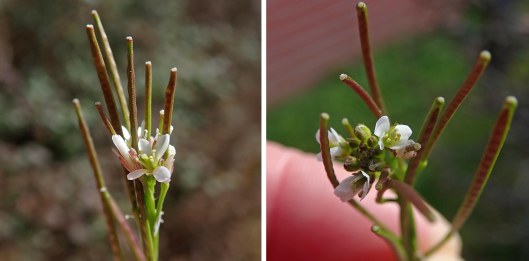
230319 bitter-cress hairy and wavy

On the left above is Hairy bitter-cress (Cardamine hirsuta), whose flowers have four stamens and whose seed pods stand straight up, and on the right is Wavy bitter-cress (Cardamine flexuosa), with its six stamens and ‘sticky-out seed pods’ (Moira’s very apt description).

230319 common whitlowgrass

Common whitlowgrass (Erophila verna) seems to be everywhere at the moment, in particular alongside paths and at the edges of back lanes. It’s tiny but worth bending over for a look.

230319 shepherd's-purse

Shepherd’s-purse (Capsella bursa-pastoralis) is so named because of the shape of its seed pods, though, personally, I think they look like tiny hearts. Shepherd’s-heart anyone?

230319 thale cress

Thale cress (Arabidopsis thaliana) is a new plant for me so I was very chuffed to find this one. It’s rather like Shepherd’s purse but has slender rod-shaped seedpods.

230319 danish scurvygrass

And this is today’s find: Danish scurvygrass (Cochlearia danica), which I had seen before in Cardiff, alongside the River Taff near the city centre, but I hadn’t ventured that far during yesterday’s walk. Today, I found it on the edge of a pavement near Cardiff Bay, just one plant, but one is all I needed to complete this challenge.

Like Loading...

Have you seen a bumblebee yet?

18 Saturday Mar 2023

Posted by sconzani in insects, spring

≈ 3 Comments

Tags

Bombus lapidarius, British bumblebees, Red-tailed bumbelbee, willow catkins

I’ve seen a couple of Buff-tailed bumblebees (Bombus terrestris) but didn’t manage to get photos of those, so I was delighted yesterday to find a Red-tailed bumblebee (Bombus lapidarius), which was so busy feasting on the pollen of willow catkins that it stayed still for some pics.

230318 red-tailed bumble

Like Loading...

New fungus: Linospora saligna

17 Friday Mar 2023

Posted by sconzani in fungi, trees

≈ Leave a comment

Tags

British fungi, fungi on Salix leaves, fungi on willow leaves, fungus on leaf, Linospora saligna

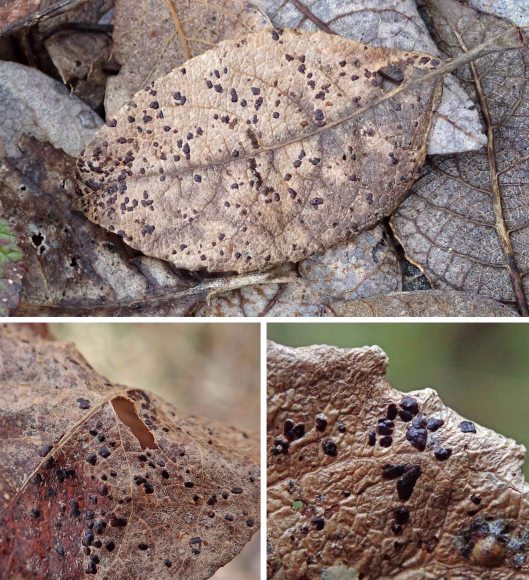
Inspired by Gwent birder and naturalist Lee Gregory’s recent (3 March) first record for Wales of the fungus Linospora saligna, which looks like small dark speckles on dead Salix leaves, I went searching last Saturday morning in areas where I knew Willow trees grow. And I was a little surprised at how easy they were to find. I spotted the fungus at two locations along the path around Cardiff’s Grangemoor Park, and I’ve also since found it under Salix trees near Cardiff Bay’s Barrage. Although Lee’s record was a Welsh first and the NBN Atlas shows very few confirmed records for the rest of Britain, this is obviously another instance where a species is under-recorded, presumably because no one knows to look for it. I’m aware that Lee has already found several further records, and I will certainly continue to check for these speckled leaves wherever I see Willow trees.

230317 Linospora saligna

Like Loading...

His gift

16 Thursday Mar 2023

Posted by sconzani in birds

≈ 4 Comments

Tags

birding, birdwatching, British birds, courtship feeding in birds, robin, robin courtship feeding

I was seconds too slow to catch the actual moment Mr Robin presented his potential mate with this courtship gift, a gigantic Ivy berry. From what I’ve read, this behaviour may help to convince the female of the male’s suitability as a mate and, according to the RSPB website, the feeding continues through the nest building phase and while the female is laying her eggs, one a day for 4 to 6 days, helping the female maintain her body weight.

230316 robin

With the feeding I witnessed, I’m not sure whether the courtship was successful. The male had rather overestimated the size of the female’s mouth and, from the look on her face, she didn’t know whether to be flattered or insulted. The moment the male flew away, she let the berry drop to the ground.

Like Loading...

On fire

15 Wednesday Mar 2023

Posted by sconzani in birds

≈ Leave a comment

Tags

birding, birdwatching, British birds, Firecrest

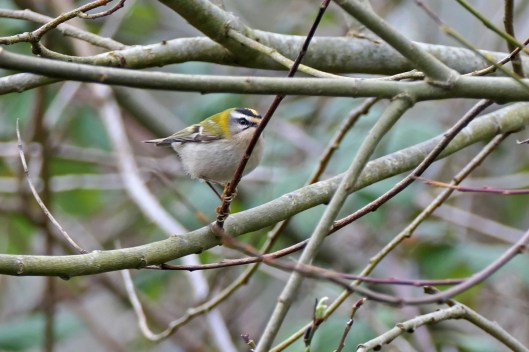
I was not long home from my first walk when Owen, one of my fellow local nature enthusiasts, posted on Twitter about the Firecrest he’d found on a local path, so my cup of tea was quickly abandoned and I was out the door again in record time. And result! Another birder had made it there before me and was searching further along the path to no avail when the gorgeous little bird popped up at the start of the path right in front of me. This wasn’t my first Firecrest of the year but they are always brilliant birds to see, and this was no exception. We watched it busily flitting to and fro in the scrub as it searched for tiny insects, until a band of heavy showers had me heading for home again.

230315 firecrest

Like Loading...

Meliscaeva auricollis

14 Tuesday Mar 2023

Posted by sconzani in insects, nature

≈ Leave a comment

Tags

British hoverflies, hoverfly, Meliscaeva auricollis

In just a few days we’ve gone from sleet and snow to a high of 11ºc. We humans can easily change our clothes to suit the conditions but the see-sawing temperatures must be creating problems for the insect world.

230313 meliscaeva auricollis (1)

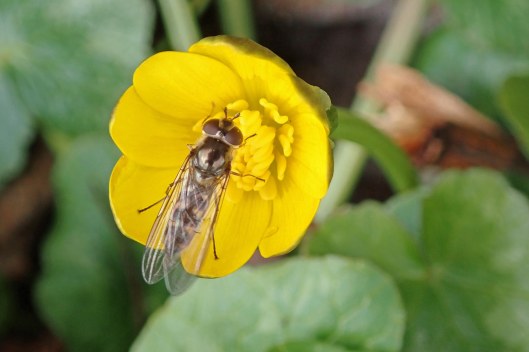
Some, like these Meliscaeva auricollis hoverflies, emerge from their winter hibernation when the temperatures start to rise, then get knocked sideways when the mercury plummets and the snow starts to fall. Hopefully, they’re able to find shelter from the icy blasts so they can re-emerge at a later date.

230313 meliscaeva auricollis (2)

Like Loading...

Wild words: nictitating membrane

13 Monday Mar 2023

Posted by sconzani in birds

≈ 2 Comments

Tags

bird's eyelid, birding, birdwatching, British birds, Carrion crow, crow, nictitating membrane

Nictitating membrane: noun, zoology; ‘a whitish or translucent membrane that forms an inner eyelid in birds, reptiles, and some mammals. It can be drawn across the eye to protect it from dust and keep it moist’ (Oxford Dictionary).
When I was taking photographs of one of my local Crow friends last week, I caught a couple where its nictitating membrane was showing well, so thought I’d share.

230313 nictitating membrane

Like Loading...

Alder flowers

12 Sunday Mar 2023

Posted by sconzani in flowers, trees

≈ Leave a comment

Tags

Alder, Alder flowers, female Alder flowers, tree flowers

It’s almost two months to the day since I blogged about the first Hazel I’d seen with both the male and female flowers open (Flowers and catkins, 15 January). Perhaps I’ve been remiss in looking for these, but yesterday I spotted my first Alder tree where both types of flowers had opened. The reproductive systems of the two plants are remarkably similar, both with long dangling pollen-shedding male catkins and much smaller pink anemone-like female flowers, except that the female Hazel flowers develop into a nut and the female Alder into a cone. It’s the female flowers that I find particularly eye-catching.

230312 alder female flowers

Like Loading...

The Coot and the Zebra mussels

11 Saturday Mar 2023

Posted by sconzani in birds, molluscs

≈ Leave a comment

Tags

birding, birdwatching, British birds, Cardiff Bay birding, Coot, Coot diet, Coot eating mussels, Dreissena polymorpha, Zebra mussel

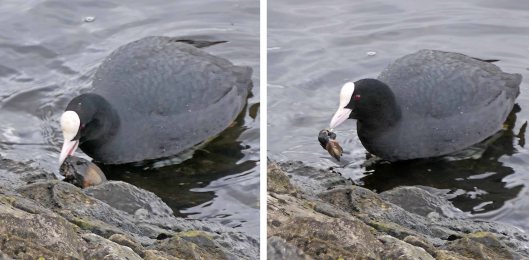
I’ve been learning a lot about mussels this week, in particular about the Zebra mussel (Dreissena polymorpha). This invasive mollusc is native to the Caspian and Black Seas, spread from there to western Europe during the 19th century, and was first noted in Britain around 1824. By the 1970s it had spread extensively, through rivers and other waterways, around the coastline, into lakes and harbours. According to Cardiff University’s Professor Steve Ormerod, Cardiff ‘Bay has somewhere between 10 and 35 million of them covering every hard surface.’

230311 coot and zebra mussel (1)

The reason I have been learning about Zebra mussels is because of the Coot in my photographs and my curiosity about what it had found and was eating. I asked the question on Twitter and information came pouring in, in particular thanks to Steve Ormerod, who confirmed the identification and provided a link to a research paper he co-authored about the rapid colonisation of Cardiff Bay by these mussels when the Bay was first formed (see details and link below). Steve was able to tell me that Tufted ducks are the ‘classic predators’ of these mussels, and he was a little surprised to see a Coot also predating them, though did say that the mussels are ‘a lipid, protein and calcium-rich source for waterfowl’.

230311 coot and zebra mussel (2)

As for my Coot, it seemed to have worked that out for itself. Having dived for the mussel, it swam over to the water’s edge and proceeded to pull off all the vegetation and, presumably, any smaller mussels attached to the big one and ate all that. It then bashed the bigger one on the rocks like a Song thrush smashes snails on a stone, and down the hatch that went too. Happy Coot, and happy me, after watching and learning about something new!

230311 coot and zebra mussel (3)

Alix, Muriel, Richard J. Knight & Steve J. Ormerod, ‘Rapid colonisation of a newly formed lake by zebra mussels and factors affecting juvenile settlement‘, Management of Biological Invasions, 2016, Volume 7, Issue 4, pp. 405-18.

Like Loading...
← Older posts
Newer posts →

About me

sconzani

sconzani

I'm a writer and photographer; researcher and blogger; birder and nature lover; countryside rambler and city strider; volunteer and biodiversity recorder.

View Full Profile →

Follow earthstar on WordPress.com

Enter your email address to follow this blog and receive notifications of new posts by email.

Recent blog posts

  • The Fox and the crow May 2, 2026
  • More Green tigers May 1, 2026
  • Cute cootlet April 30, 2026
  • Blood bees April 29, 2026
  • Nesting material April 28, 2026

From the archives

COPYRIGHT

Unless otherwise acknowledged, the text and photographs on this blog are my own and are subject to international copyright. Nothing may be downloaded or copied without my permission.

Fellow Earth Stars!

  • Unknown's avatar
  • Unknown's avatar
  • Unknown's avatar
  • Unknown's avatar
  • Unknown's avatar
  • Unknown's avatar
  • Unknown's avatar
  • Unknown's avatar
  • Unknown's avatar
  • Unknown's avatar
  • Unknown's avatar
  • Unknown's avatar
  • Unknown's avatar
  • Unknown's avatar
  • Unknown's avatar
  • Unknown's avatar
  • Unknown's avatar
  • Unknown's avatar
  • Unknown's avatar
  • Unknown's avatar
  • Unknown's avatar
  • Unknown's avatar
  • Unknown's avatar
  • Unknown's avatar
  • Unknown's avatar
  • Unknown's avatar
  • Unknown's avatar
  • Unknown's avatar
  • Unknown's avatar
  • Unknown's avatar
  • Unknown's avatar
  • Unknown's avatar
  • Unknown's avatar
  • Unknown's avatar
  • Unknown's avatar
  • Unknown's avatar
  • Unknown's avatar
  • Unknown's avatar
  • Unknown's avatar
  • Unknown's avatar
  • Unknown's avatar
  • Unknown's avatar
  • Unknown's avatar
  • Unknown's avatar
  • Unknown's avatar
  • Unknown's avatar
  • Unknown's avatar
  • Unknown's avatar
  • Unknown's avatar
  • Unknown's avatar

Blog at WordPress.com.

Privacy & Cookies: This site uses cookies. By continuing to use this website, you agree to their use.
To find out more, including how to control cookies, see here: Cookie Policy
  • Subscribe Subscribed
    • earthstar
    • Join 643 other subscribers
    • Already have a WordPress.com account? Log in now.
    • earthstar
    • Subscribe Subscribed
    • Sign up
    • Log in
    • Report this content
    • View site in Reader
    • Manage subscriptions
    • Collapse this bar

Loading Comments...

You must be logged in to post a comment.

    %d