• ABOUT
  • BIRDING 2018
  • Birding 2019
  • BLOG POSTS
  • Butterflies 2018
  • Resources

earthstar

~ a celebration of nature

earthstar

Category Archives: fungi

Bird’s-nests with eggs!

31 Thursday Aug 2017

Posted by sconzani in fungi, nature

≈ 4 Comments

Tags

bird's nest fungus, British fungi, Common bird's-nest fungus, Crucibulum laeve, fungus, peridiole

How cool are these?
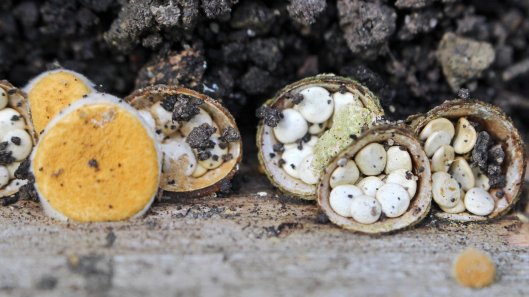
170831 Common bird's-nest fungus (1)

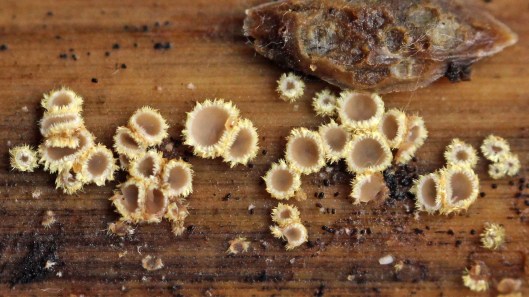
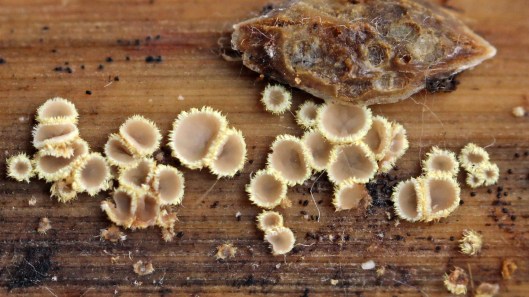
Of course, you’ve guessed it – I’m not talking about eggs in the nests of birds with feathers: these are fungi, but one of the most amazing types of fungi I know. And this was the first time I’d seen them with eggs in the nests and, indeed, it was the first time I’d seen them before the eggs were exposed. And there must have been hundreds of them, all growing along the planks of wood around a raised garden bed.

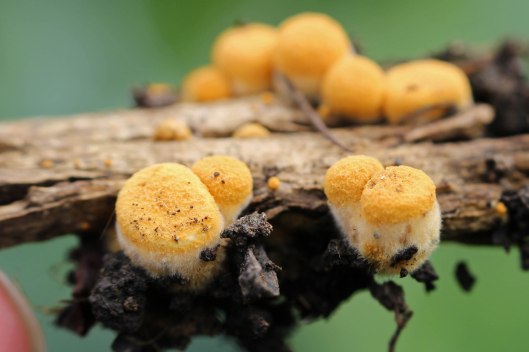
170831 Common bird's-nest fungus (3)170831 Common bird's-nest fungus (2)

This is the Common bird’s-nest fungus (Crucibulum laeve) and I think you can see where it got its common name. It starts off looking like small blobs of yellowy orange fur, then the furry membrane falls off to reveal its inner cupcake-shaped fruiting body and that’s where the eggs sit. Of course, they’re not eggs at all: the scientific name for them is peridioles. They’re effectively capsules full of spores that are activated when rain drops hit them, causing them to ‘leave the nest’ and begin the germination process. (If you’re as fascinated by these as I am, you can read more here.)

170831 Common bird's-nest fungus (5)170831 Common bird's-nest fungus (4)

Like Loading...

Fungi at Cefn Onn

08 Tuesday Aug 2017

Posted by sconzani in fungi, nature

≈ 2 Comments

Tags

bracket fungus, Cefn Onn, fungi, fungus, mushroom, slime mould, Smut on Red campion

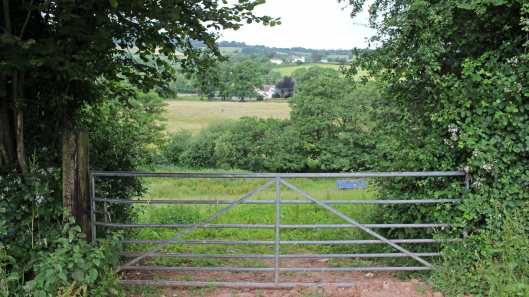
I braved the rain showers and intermittent rumbles of thunder for a wander around Cefn Onn Park, in north Cardiff, last weekend. I hadn’t been there for quite a while and, after the recent rains, I had an inkling there might be some fungi around. I was right! There were actually rather a lot of crusty, brackety, slimy, smutty and generally mushroomy things to be found. (No, I’m not going to ID them – I just enjoyed seeing some fungi again.)

170808 Bolete (1)
170808 Bracket (2)
170808 Bracket (3)
170808 Bracket
170808 Ganoderma sp
170808 Marasmius rotula
170808 Mushroom (2)
170808 Mushroom (3)
170808 Mushroom (4)
170808 Mushroom (6)
170808 Mushroom
170808 Slime Ceratiomyxa fruticulosa
170808 Slime Fuligo septica
170808 Smut on Red campion
Like Loading...

‘A Natural History of the Hedgerow’

08 Saturday Jul 2017

Posted by sconzani in animals, birds, fungi, nature, plants, trees, wildflowers

≈ 8 Comments

Tags

British countryside, British hedgerows, field boundaries, hedge, hedgerow, hedgerow trees

170708 hedgerows (1)

Reading John Wright’s excellent book A Natural History of the Hedgerow and ditches, dykes and dry stone walls (Profile Books, London, 2016) has led me to look at the countryside with slightly more knowledgeable eyes, at least when it comes to field boundaries.

170708 hedgerows (6)

Not only does Wright’s book provide a superbly researched history of the hedges, dykes, ditches and dry stone walls that divide up the countryside, it also provides detailed information on the plants, birds, invertebrates and animals that inhabit Britain’s hedgerows, as well as including practical details on how the various boundaries are constructed and maintained.

170708 hedgerows (2)
170708 hedgerows (3)
170708 hedgerows (5)

Now, when I go out on my rural rambles or I’m being transported through the countryside by train, car or bus, I can recognise where hedges must once have grown by the broken line of mature trees marching across a field, I shake my head at the neglect of the hedgerows on so many farms (though I can appreciate the sculptural beauty of ancient hedgerow trees), I can spot where farmers have removed existing boundaries to create huge open fields, and I can appreciate how well-maintained hedges add an extra dimension to the landscape.

170708 hedgerows (4)

Wales and England now have legislation in place to protect hedgerows that meet certain criteria but it would be good if all hedgerows were protected and if more was done to ensure existing hedges were also properly nurtured and maintained.

Like Loading...

Square-bashing: SS9073

02 Sunday Jul 2017

Posted by sconzani in fungi, insects, molluscs, nature, walks

≈ 2 Comments

Tags

biodiversity, biodiversity in Wales, biological diversity, biological recording, biological records, square-bashing

170702 Square-bashing SS9073 (1)

A few days ago I posted about my square-bashing adventure near Llanbeder, in Gwent. Hilary and I have now also square-bashed another under-biodiversity-recorded 1-km square, this time near St Brides Major in Glamorgan.

170702 Square-bashing SS9073 (2)

As the seagull flies we were within a kilometre of the sea and the geological substrate was very different, so the habitats we surveyed were more diverse. One public path led us down a heavily wooded driveway to an old house, another ran between the edge of that same woodland and fields sown with cereal crops (and there the hogweed was flowering which greatly improved my insect tally), and the third took us over paddocks of rough unimproved grassland, with patches of low rushes, all bordered by a wild old hedgerow.

170702 Square-bashing SS9073 (3)

Interestingly, this time Hilary’s plant list was about 20% lower than that from our previous square (though she still had around 80 species), whereas my list of everything else was about the same percentage higher (at around 100 species of insects, fungi and lichens, molluscs, etc).

170702 Banded burdock fly
170702 Bombus vestalis
170702 Cheilosia illustrata
170702 Chlorociboria sp Green elfcup
170702 Common marble moth
170702 Dark bush-cricket
170702 Fly
170702 fungi on cow dung Cheilymenia sp
170702 Horsefly
170702 Leptopterna dolabrata
170702 Small whites
170702 Snails and woodlice
Like Loading...

Square-bashing: ST3990

28 Wednesday Jun 2017

Posted by sconzani in fungi, insects, nature, walks

≈ 5 Comments

Tags

bioblitz, biodiversity, biodiversity in Wales, biological recording, biological records, SEWBReC, square-bashing

I spent last Friday square-bashing with my friend Hilary, and what a brilliant day we had.

170628 ST3990 square-bashing (1)

For the uninitiated, square-bashing consists of taking a square kilometre that has very few existing biological records and walking the roads, tracks and paths through that square to see what you can find. Each month, my local biodiversity records centre SEWBReC publishes the details of just such a square in the counties they cover, Glamorgan and Gwent, in the hope that keen folks like Hilary and I will rectify the lack of records.

170628 ST3990 square-bashing (2)

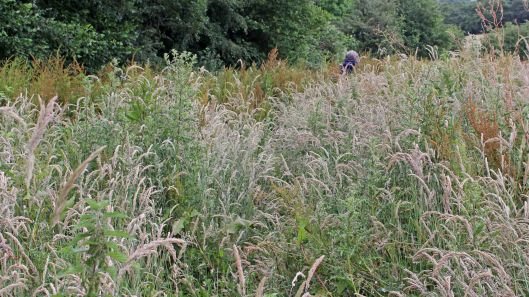
Although the term square-bashing is not meant to be taken literally, we did have to bash our way through one field in our square kilometre, where the public footpath was completely overgrown (spot Hilary in the photo below), but on the whole the countryside was beautiful, with rolling farmed fields, old narrow lanes and, the best part, an ancient holloway (more on that in a future post).

170628 ST3990 square-bashing (3)

Hilary’s something of a whizz when it comes to plants so she recorded those and I did everything else – insects, fungi, birds, you name it! As I’m not a whizz at anything, I mostly take lots of photos and then have to work out the IDs when I get home, which takes time but helps me learn. I have just a couple of outstanding queries but reckon my total will come to around 80 and Hilary has about 90 plants on her list, so it was a very good result indeed. Here are some of my finds – can you identify them?

170628 Beechmast candlesnuff Xylaria carpophila
170628 Common marble Celypha lacunana
170628 Cranefly Ptychoptera sp
170628 Eriophyes similis Gall mite
170628 Harlequin ladybird larva Harmonia axyridis
170628 Hawthorn shieldbug Acanthosoma haemorrhoidale
170628 Knot grass larva Acronicta rumicis
170628 Lagria hirta
170628 Meadow brown Maniola jurtina
170628 Pollen beetles Meligethes sp
170628 Snipe fly Rhagio tringarius
170628 Yellow dung fly Scathophaga stercoraria
Like Loading...

Fungi foray: Merthyr Mawr

08 Monday May 2017

Posted by sconzani in fungi, nature, parks, spring, walks

≈ Leave a comment

Tags

Daedaleopsis confragosa, fungi enthusiasts, fungi foray, Glamorgan Fungus Group, Kuehneola uredinis, Melampsora epita var epitea, Melampsora populnea, Merthyr Mawr National Nature Reserve, Microbotryum silenes-dioicae, Mollisia, Phellinus hippophaeicola, Phylloporia ribis, rust fungi, Synchytrium taraxaci

Saturday dawned fine and mostly sunny, good news for most but not such good news for fungi enthusiasts, who are already bemoaning the recent lack of rain. Still, keen-eyed fungi fans can always find something and our Glamorgan Fungus Group has some of the keenest in ‘Eagle-eyes’ Emma. Though we were just a small group of six and a half, we enjoyed a splendid day searching the woodland areas of Merthyr Mawr National Nature Reserve, and our limited numbers were, in fact, a bonus, as we had amongst us the county recorder for Orthoptera (grasshoppers and related insects) and an experienced botanist, so we were able to enjoy, discuss and identify a broad range of flora and fauna. As expected, our fungi finds were limited but we finished the day with a very respectable total of 21 species and had a great time along the way.

Here are some of our finds: the rust Melampsora populnea on Dog’s mercury; another rust Kuehneola uredinis, on Bramble; Microbotryum silenes-dioicae, a smut that occurs on the anthers of Red campion flowers; another rust Melampsora epita var. epitea on Spindle; fungi enthusiasts inspecting the one group of cap fungi (‘real mushrooms’) found this day; the ‘real mushrooms’ that must remain unidentified as they were much eaten and turning gloopy; likely one of the Mollisia species of Disco fungi; Phellinus hippophaeicola on Sea buckthorn; Phylloporia ribis on Spindle; a rather old and faded Blushing bracket Daedaleopsis confragosa; a Puccinia species of rust on Common ragwort – this needs microscope work to positively ID; and the pimple-like growths of Dandelion wart Synchytrium taraxaci on one of the gazillions of Dandelion species, so Taraxacum officinale agg.

170508 (1) Melampsora populnea on Dog's mercury
170508 (2) Kuehneola uredinis on Bramble
170508 (3) Microbotryum silenes-dioicae Smut on Red campion
170508 (4) Melampsora epita var epitea on Spindle
170508 (5) Fungi enthusiasts
170508 (6) Unidentified fungus
170508 (7) Mollisia sp
170508 (8) Phellinus hippophaeicola on Sea buckthorn
170508 (9) Phylloporia ribis on Spindle
170508 (10) Daedaleopsis confragosa Blushing bracket
170508 (11) Puccinia sp on Common ragwort
170508 (12) Synchytrium taraxaci on Taraxacum officinale agg
Like Loading...

Fungi Friday: The rust challenge

28 Friday Apr 2017

Posted by sconzani in fungi, nature, wildflowers

≈ 7 Comments

Tags

Bluebell, citizen science, Glamorgan Fungus Group, Lesser Celandine, Nettle, Puccinia urtica, rust, rust fungi, Uromyces dactylis, Uromyces muscari

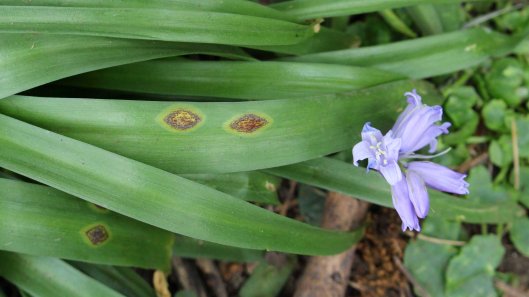
Back in January I posted about the Cobalt crust-finding challenge I was taking part in with my friends from the Glamorgan Fungus Group. This month we’ve been at it again but our challenge species are rusts, specifically Uromyces dactylis (below right) and Uromyces ficaria which are both found on Lesser Celandine; Puccinia urtica (below left) on Nettles; Uromyces muscari (the other four photos) on native, cultivated and hybrid Bluebells; and on Nipplewort Lapsana communis.

170428 Puccinia urtica on Nettle
170428 Uromyces dactylis on Lesser celandine

Though finding and photographing the Nettle rust is more for the masochist than the faint-hearted – our group has joked about buying thick rubber gloves up to our elbows(!), the other rusts are less dangerous though no less of a challenge. I’ve had most success with the Bluebell rust – probably a reflection of the fact that everyone loves Bluebells so they’ve been planted almost everywhere, but have found only one specimen of one of the rusts on Lesser Celandine, despite the flowers being very plentiful and numerous in my local parks and wild areas. And I have yet to find a specimen of Nipplewort rust – probably because I have yet to positively identify Nipplewort (this is why I’ve taken up a botany menteeship!).

170428 Uromyces muscari on bluebell (1)
170428 Uromyces muscari on bluebell (2)
170428 Uromyces muscari on bluebell (3)

Still, just as we did with Cobalt crust, our group members have thrown themselves into this challenge and, to date, our combined total stands at over 140 separate finds. And, just like last time, our finds are being fed into our local biodiversity database so our challenge is helping to increase the knowledge base for these under-recorded fungi. Citizen science rocks!

170428 Uromyces muscari on bluebell (4)

Like Loading...

A master of camouflage

15 Saturday Apr 2017

Posted by sconzani in fungi, nature

≈ 4 Comments

Tags

Cosmeston Lakes Country Park, fungus, Helvella acetabulum, Helvella fungi, Vinegar cup

170415 Helvella acetabulum Vinegar Cup (4)

I found these little fungi at Cosmeston Lakes Country Park during a long ramble on Thursday. So well camouflaged were they amongst the leaf litter and fallen branches that it wasn’t until I bent down to pick up a rotting branch to check for slime moulds that I spotted the first one. These are Vinegar cups (Helvella acetabulum) and, according to the Welsh biodiversity recording database, this is only the fourth recorded find in Wales. I imagine they’re not as rare as that makes them sound, but simply under-recorded – I blame their camouflage!

170415 Helvella acetabulum Vinegar Cup (3)
170415 Helvella acetabulum Vinegar Cup (2)
170415 Helvella acetabulum Vinegar Cup (1)

Luckily (actually, a huge relief!) these fungi could be identified using an excellent key on the Fungi of Great Britain and Ireland website (thanks to Brian Douglas of Kew for pointing that out). The key check went as follows:

(1) Stipe (stem) ribbed and furrowed over its entire length, internally chambered, quite short, but with ribs present on the underside of the cap; (2) cap cupulate; (3) Ribs on stipe extending conspicuously to the underside of the cap, usually to at least half way (4) Hymenium (interior of the cup) brown; cap externally dark brown above (these were partly eaten so hard to tell), (definitely) paler below. Ribs of stipe branching, sharp-angled, not interconnected by cross-veins, not reaching the margin of the cap. Fruiting in spring.

170415 Helvella acetabulum Vinegar Cup (5)
170415 Helvella acetabulum Vinegar Cup (6)

If only all fungi were that easy to identify! These lovely Helvellas can be found from April through to June, mostly on rich mouldy soil in deciduous forests, though they do also like calcareous soil conditions.

Like Loading...

Belonidium mollissimum

31 Friday Mar 2017

Posted by sconzani in fungi, nature

≈ 9 Comments

Tags

ascomycete, Belonidium mollissimum, cup fungi, fungi on umbellifers, fungus

I’ve been finding a lot of fungi recently on the bottoms of the dead stalks of last year’s umbellifers. They’re all exceedingly small and difficult to identify (which I find rather frustrating) but also rather gorgeous (which is why I have so far kept looking for them). This is one I was able to identify with help from my fungi friends and associates and a little microscope work. Its current name is Belonidium mollissimum (but it’s had a long list of other names – fungi keep being re-classified and renamed as researchers examine them and their DNA more carefully!) and the largest of its cups is just 1mm wide. This is a series of photos taken over the past two weeks to show how this tiny fungus has changed in that time.

170331 Belonidium mollissimum 17March

17 March, when first discovered

170331 Belonidium mollissimum 19March

19 March

170331 Belonidium mollissimum 25March

25 March

170331 Belonidium mollissimum 31March

31 March

Like Loading...

Grangemoor Park: a first look

11 Saturday Mar 2017

Posted by sconzani in fungi, insects, lichen, nature, parks, spring, wildflowers

≈ 4 Comments

Tags

biodiversity, Cardiff parks, Grangemoor Park, old rubbish tip, Penarth Moors, River Ely, signs of spring

I had my first wander around Grangemoor Park yesterday and I’ll definitely be going back, though perhaps when it’s a little drier underfoot. With an extensive area of grass and scrub that rises up to two central mounds (from which you get quite good 360-degree views over Cardiff), this land wasn’t always a park. You have only to look at old maps to see that, once upon a time, the River Ely meandered through Penarth Moors here but, once the river was realigned, the hollows thus created were used as one of Cardiff’s rubbish tips. When the tip was full, Cardiff Council had a load of underground drains built, as well as ventilation pipes to allow the methane to escape, covered the lot with tons of clay – hence the very soggy ground, edged it all around with a solid stone wall, and changed its designation to a park in 2000.

170311 Grangemoor (1)
170311 Grangemoor (2)
170311 Grangemoor (3)
170311 Grangemoor (4)
170311 Grangemoor (5)
170311 Grangemoor (6)

That may sound like a sad history but, according to locals, the park now hosts quite a broad range of flora and fauna, and I certainly saw many of the stirrings of Spring. There were bumblebees and flies, a butterfly and a ladybird, masses of primroses almost hidden under bushes, golden coltsfoot and dandelions in bloom all around and horsetail pushing through everywhere, as well as incredibly vibrant lichens and a healthy growth of Oak curtain crust fungi. I will be going back!

170311 Grangemoor (7)
170311 Grangemoor (8)
170311 Grangemoor (9)
170311 Grangemoor (10)
170311 Grangemoor (11)
170311 Grangemoor (12)
Like Loading...
← Older posts
Newer posts →

About me

sconzani

sconzani

I'm a writer and photographer; researcher and blogger; birder and nature lover; countryside rambler and city strider; volunteer and biodiversity recorder.

View Full Profile →

Follow earthstar on WordPress.com

Enter your email address to follow this blog and receive notifications of new posts by email.

Recent blog posts

  • Cuttlebones March 16, 2026
  • No woodland here March 15, 2026
  • Family comes first March 14, 2026
  • Local Little egrets March 13, 2026
  • Cormorants, young and old March 12, 2026

From the archives

COPYRIGHT

Unless otherwise acknowledged, the text and photographs on this blog are my own and are subject to international copyright. Nothing may be downloaded or copied without my permission.

Fellow Earth Stars!

  • Unknown's avatar
  • Unknown's avatar
  • Unknown's avatar
  • Unknown's avatar
  • Unknown's avatar
  • Unknown's avatar
  • Unknown's avatar
  • Unknown's avatar
  • Unknown's avatar
  • Unknown's avatar
  • Unknown's avatar
  • Unknown's avatar
  • Unknown's avatar
  • Unknown's avatar
  • Unknown's avatar
  • Unknown's avatar
  • Unknown's avatar
  • Unknown's avatar
  • Unknown's avatar
  • Unknown's avatar
  • Unknown's avatar
  • Unknown's avatar
  • Unknown's avatar
  • Unknown's avatar
  • Unknown's avatar
  • Unknown's avatar
  • Unknown's avatar
  • Unknown's avatar
  • Unknown's avatar
  • Unknown's avatar
  • Unknown's avatar
  • Unknown's avatar
  • Unknown's avatar
  • Unknown's avatar
  • Unknown's avatar
  • Unknown's avatar
  • Unknown's avatar
  • Unknown's avatar
  • Unknown's avatar
  • Unknown's avatar
  • Unknown's avatar
  • Unknown's avatar
  • Unknown's avatar
  • Unknown's avatar
  • Unknown's avatar
  • Unknown's avatar
  • Unknown's avatar
  • Unknown's avatar
  • Unknown's avatar
  • Unknown's avatar

Blog at WordPress.com.

Privacy & Cookies: This site uses cookies. By continuing to use this website, you agree to their use.
To find out more, including how to control cookies, see here: Cookie Policy
  • Subscribe Subscribed
    • earthstar
    • Join 668 other subscribers
    • Already have a WordPress.com account? Log in now.
    • earthstar
    • Subscribe Subscribed
    • Sign up
    • Log in
    • Report this content
    • View site in Reader
    • Manage subscriptions
    • Collapse this bar
 

Loading Comments...
 

You must be logged in to post a comment.

    %d