• ABOUT
  • BIRDING 2018
  • Birding 2019
  • BLOG POSTS
  • Butterflies 2018
  • Resources

earthstar

~ a celebration of nature

earthstar

Category Archives: fungi

Fungi Friday: Diplocarpa bloxamii

18 Friday Nov 2016

Posted by sconzani in fungi, nature

≈ 2 Comments

Tags

ascomycete, cup fungi, Diplocarpa bloxamii, Kew Mycology, SEWBReC

Considering I am exceedingly short-sighted, I am amazed at how many exceedingly tiny fungi I have been finding lately. More on those soon but today I want to share a rare one I found in one of my local Cardiff parks last week. In fact, my find is only the second record for Wales and was the first record in Wales in 42 years and 3 days. As Kew mycologist Brian Douglas wrote, ‘it’s not bad coming second to Derek Reid, ex-head of Kew Mycology’. Needless to say, I’m delighted, though I suspect this fungus is under-recorded rather than as rare as those statistics make it sound!
161118-diplocarpa-bloxamii-1

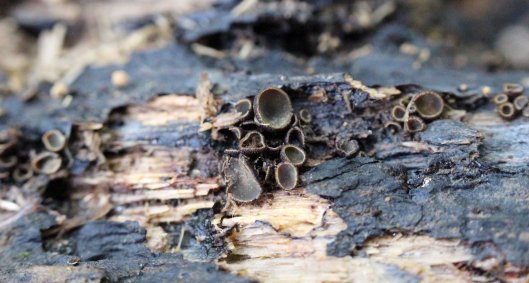
Diplocarpa bloxamii (no common name) is an ascomycete, a cup fungus, with an olive-black disc-shaped cup growing on a short stem. The external surface of the cup is pustulate (think coarse pimples, without the actual pus) and it has light brown hairs sprouting both from the pustules and around the edge of the cup, which is much lighter, almost beige, in colour. The cups are tiny – no more than 5mm across – I actually had my glasses off and my face about 15cms from the decaying piece of log, looking at something else, when I spotted them.

161118-diplocarpa-bloxamii-2
161118-diplocarpa-bloxamii-3
161118-diplocarpa-bloxamii-4

Of course, I had no idea what they were but took some macro photos to post that evening on Facebook. Luckily, Brian Douglas spotted my post, alerted me to what they might be, sent me some literature, and had me heading back to the woods the next day for a sample. Talk about looking for a needle in a haystack! Fortunately, I’ve been training myself to remember where I spot things so that I can later record my findings, so I found them again quite quickly.

161118-diplocarpa-bloxamii-5
161118-diplocarpa-bloxamii-6

I am very grateful to Brian for his help in determining the identity of my little fungi and to Amy Hicks, of SEWBReC, who very kindly undertook the microscope work needed to confirm their ID and provided me with the stunning photographs (above) that resulted from her work.

diplocarpa-bloxamii-heath-st179799-7

Like Loading...

Draethen Fungi Foray update

12 Saturday Nov 2016

Posted by sconzani in 'Dedicated Naturalist' Project, fungi, nature

≈ Leave a comment

Tags

British fungi, Dr Mary Gillham, Draethen woodlands, fungi foray, Mary Gillham Archive Project, Walking with Mary

When I posted about our ‘Walking with Mary’ fungi foray in Draethen Woodlands last Saturday, I said I would report back with our final species list. Just as Mary and her colleagues had walked these woods in both October and November, so did we, with a site recce on 19 October and then our group foray on 6 November, so this is actually the combined list for both walks. Mary had recorded more than 90 different species of fungi; our total is 79. Being optomistic, I think the lesser number can probably be attributed to our dry autumn weather this year rather than any species loss.

161112-draethen

Here are more photos of the fungi we found, followed by the full species list for any keen fungi fans out there. You can see details of the walk and Mary’s species lists on the Mary Gillham Archive Project website here.

161112-draethen-agaricus-sp
161112-draethen-cortinarius
161112-draethen-dog-stinkhorn
161112-draethen-dusky-puffball
161112-draethen-green-elfcup
161112-draethen-jelly-ear
161112-draethen-jellybaby
161112-draethen-mycena-sp-2
161112-draethen-mycena-sp
161112-draethen-porcelain
161112-draethen-sulphur-tuft
161112-draethen-turkeytail
Scientific name Common name
Agaricus sp.
Amanita sp. Possibly Death Cap Amanita phalloides
Amanita vaginata Grisette
Armillaria gallica Bulbous Honey Fungus
Armillaria mellea Honey Fungus
Ascocoryne sarcoides Purple Jellydisc
Auricularia auricula-judae Jelly ear
Bisporella citrina Lemon Disco
Bjerkandera adusta Smoky Bracket
Chlorociboria sp. Green elf cup
Clavaria vermicularis White Spindles
Collybia butyracea var. asema Butter cap
Collybia sp.
Coprinellus micaceus Glistening inkcap
Coprinus sp. Possibly Shaggy Inkcap
Coprinus sp. Possibly Common Inkcap
Cortinarius sp.
Crepidotus applanatus Flat oysterling
Crepidotus mollis Peeling oysterling
Cystolepiota seminuda
Daedaleopsis confragosa Blushing bracket
Daldinia concentrica King Alfred’s cakes
Diatrype disciformis Beech Barkspot
Exidia nucleata Crystal brain
Exidia sp. Either E. plana or E. glandulosa
Ganoderma sp. Either G. adspersum or G. applanatum
Gymnopus dryophilus Russet Toughshank
Hydnum sp. Possibly H. repandum Hedgehog Fungus
Hygrocybe conica Conical Wax-Cap
Hygrophorus discoxanthus Yellowing woodwax
Hygrophorus eburneus Ivory Woodwax
Hypholoma capnoides Conifer tuft
Hypholoma fasciculare Sulphur tuft
Hypholoma marginatum Snakeskin Brownie
Hypoxylon fragiforme Beech woodwart
Hypoxylon fuscum Hazel Woodwart
Kretzschmaria deusta Brittle cinder
Laccaria amethystina Amethyst deceiver
Lactarius aurantiacus Orange Milkcap
Leotia lubrica Jellybaby
Lepista sp. Possibly Lepista nuda Wood Blewitt
Lycogala sp. Orange slime mould
Lycoperdon excipuliforme Pestle puffball
Lycoperdon nigrescens Dusky puffball
Lycoperdon pyriforme Stump Puffball
Marasmius wynnei Pearly parachute
Mutinus caninus Dog stinkhorn
Mycena arcangeliana Angel’s bonnet
Mycena diosma
Mycena haematopus Burgundydrop bonnet
Mycena rosea Rosy bonnet
Mycena sp.
Mycena vitilis Snapping Bonnet
Oudemansiella mucida Porcelain Fungus
Phallus impudicus Stinkhorn
Pholiota squarrosa Shaggy Scalycap
Phragmidium bulbosum Rubus leaf rust fungus
Phragmidium violaceum Violet Bramble Rust
Piptoporus betulinus Birch polypore
Pluteus phlebophorus Wrinkled shield
Postia caesia Conifer blueing bracket
Postia sp. A crust fungus
Psathyrella sp. One of the Brittlestem fungi
Ramaria sp. Coral fungus
Rhodocollybia butyracea Butter cap
Rhytisma acerinum Sycamore Tarspot
Russula sp.
Sarea resinae
Scleroderma sp. Earthball
Stereum hirsutum Hairy curtain crust
Terana coerulea Cobalt crust
Thelephora terrestris Earth-Fan
Trametes gibbosa Lumpy Bracket
Trametes versicolor Turkey tail
Tricholoma terreum Grey Knight
Xylaria carpophila Beechmast Candlesnuff
Xylaria hypoxylon Candlesnuff
Xylaria longipes Dead Moll’s Fingers
Xylaria polymorpha Dead Man’s Fingers
Like Loading...

Green elfcups

10 Thursday Nov 2016

Posted by sconzani in fungi, nature

≈ 16 Comments

Tags

Chlorociboria aeruginascens, Chlorociboria aeruginosa, cup fungi, cup fungus, Elfcups, Green elfcup, Nant Fawr Woodlands, Turquoise elfcup

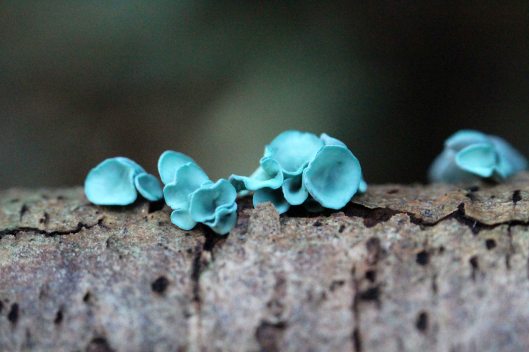
I’d seen these gorgeous little cup fungi a few times before but last Saturday was the first time I’d found them myself, in nearby Nant Fawr Woodlands, and it’s fair to say I was over the moon! They’re tiny – I deliberately took a photo of my hand holding the fallen branch they were growing on to show their size – but their colour is so unusual that it catches the eye, so they’re not that difficult to spot, though they’re also not very common.

green-elfcup-4

Now, I don’t know about you but I would describe their colour as turquoise, or near as dammit, but there are two very similar species of these cups and these are more likely to be Green elfcups (Chlorociboria aeruginascens) rather than Turqoise elfcups (Chlorociboria aeruginosa), as the latter are smaller and quite rare. Microscope work is needed to distinguish the two and even that is reported to be difficult.

green-elfcup-1

One fascinating thing about these beautiful fungi is the green staining they cause in wood, and, not surprisingly, that wood is highly prized by woodturners. In fact, in Victorian times, green-stained oak was one of the woods used to make Tunbridge ware, the name given to a type of inlaid decorative woodwork that haled originally from the towns of Tonbridge and Tunbridge Wells in Kent. The antique pieces are still highly sort after by collectors and just a little out of my price range but they certainly are lovely.

green-elfcup-2
green-elfcup-3
Like Loading...

‘Dedicated Naturalist’: Walking with Mary in Draethen Woodlands

06 Sunday Nov 2016

Posted by sconzani in 'Dedicated Naturalist' Project, autumn, fungi, nature, trees

≈ 2 Comments

Tags

Dr Mary Gillham, Draethen, Draethen woodlands, fungi foray, Glamorgan Fungus Club, Mary Gillham Archive Project, Walking with Mary

161106-draethen-walk-with-mary-1

Today I joined my fellow members of the Mary Gillham Archive Project, my friends in the Glamorgan Fungus Club, and members of the local Wildlife Trust and Cardiff Naturalists’ Society to walk in the footsteps of Mary Gillham in Draethen Woodlands. And what a fabulous day it has been!

Mary visited these woods many times from the 1960s to the 1990s, sometimes with friend and fungi expert Roy Perry, sometimes with groups similar to ours, and they recorded over 90 different species of fungi during the months of October and November. Our aim today was to recreate Mary’s walks, to see how many fungi species we could find, and to compare those past records with ours.

161106-draethen-walk-with-mary-3

It’s been a dry autumn in South Wales so we weren’t sure how much fungi we would find but, turns out, fungi are plentiful and fruiting well under the leafy boughs of this beautiful woodland. From the lower car park our group of almost 50 people strolled along the metalled forestry road, venturing left and right amongst the tall beech trees, eyes peeled for fungi, and we were not disappointed.

161106-draethen-walk-with-mary-6
161106-draethen-walk-with-mary-4

From the obvious mushroom shapes of the wood-rotting Honey fungi and the shelf-like protrusions of various brackets to the less easy to spot black blobs of Dead Moll’s Fingers, the common fungi species were what we’d expected to see and were relatively easy to find. We were delighted to also find some unexpected treasures: sprinklings of the charmingly named Jellybabies, a wealth of Earthfans carpeting a large area and the delicate bonnets of various Mycena species.

161106-draethen-walk-with-mary-5
161106-draethen-walk-with-mary-7
161106-draethen-walk-with-mary-2

We’ve still to collate and tally up our fungi finds, so I’ll report back in a couple of days with the full list and a few more photos. If you live in the area and want to do this walk for yourself, the details can be found here.

For the full story about the Mary Gillham Archive Project, check out our website,  and follow our progress on Facebook and on Twitter.

Like Loading...

Fungi Friday: Waxcaps

03 Thursday Nov 2016

Posted by sconzani in fungi, nature

≈ 4 Comments

Tags

Ballerina waxcap, Blackening waxcap, Fibrous waxcap, Golden waxcap, Hygrocybe, parrot waxcap, Persistent waxcap, Pink waxcap, Scarlet waxcap, Slimy waxcap, Snowy waxcap, waxcap

Waxcaps can be wavy, waxen, wanton, waterlogged, weathered, wee, weensy, wet, whimsical, winsome, wispy, withered, wing-like, willowy, windblown, wobbling, wonderful, worshipful, wordless, worshipped, wondrous, wonky, wraithlike, and wrinkly!

161103-waxcap-ballerina

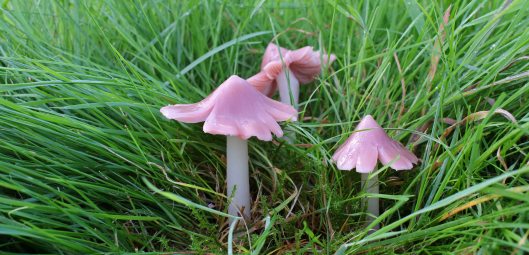
These beauties, and their friends and families, are displaying many of those characteristics right now at my local cemetery. They are the Blackening waxcap (Hygrocybe conica), Fibrous (Hygrocybe intermedia), Golden (Hygrocybe chlorophana), Parrot (Gliophorus psittacinus), Persistent (Hygrocybe acutoconica), Pink (Porpolomopsis calyptriformis), Scarlet (Hygrocybe coccinea), Slimy (Gliophorus irrigatus), and Snowy waxcap (Cuphophyllus virgineus).

161103-waxcap-blackening
161103-waxcap-fibrous
161103-waxcap-golden
161103-waxcap-parrot
161103-waxcap-persistent
161103-waxcap-pink
161103-waxcap-scarlet
161103-waxcap-slimy
161103-waxcap-snowy
Like Loading...

Once was a tree

30 Sunday Oct 2016

Posted by sconzani in fungi, nature, trees

≈ 8 Comments

Tags

Brittlestem, Burgundydrop bonnet, fungus, Hairy curtain crust, honey fungus, Oysterling, Porcelain Fungus, slime mould, Trichia varia, Turkeytail

It’s always sad to see a mighty old tree fall, no more to see its bare branches flush with green in early spring or hear the blackbird singing in the evening dusk from its high branches.

161030-once-a-tree-1

This huge old tree came down one wild and stormy night last winter and was soon sawn into manageable, though still huge logs by council staff. Fortunately, those logs were not removed, but merely hauled off the woodland path so, though the tree is dead, its wood is now home to an amazing display of fungi.

161030-once-a-tree-2
161030-once-a-tree-3
161030-once-a-tree-4

I suspect fungi may have contributed to its demise as there is an enormous amount of wood-rotting Honey fungus spouting forth around its roots. It’s a little difficult to separate out this tree and its branches from the surrounding small trees and old stumps but the whole small area is now awash with fungal growth, including Burgundydrop bonnet, Hairy curtain crust and Turkeytail, the Porcelain fungus that I blogged about recently, a species of Oysterling and another of Brittlestem, as well as at least one slime mould, Trichia varia. The poor old tree lives on by providing nutrients to all these other living organisms.

161030-once-a-tree-5
161030-once-a-tree-6
161030-once-a-tree-7
161030-once-a-tree-8
161030-once-a-tree-9
161030-once-a-tree-10
161030-once-a-tree-11
161030-once-a-tree-12
Like Loading...

Fungi Friday: Stump puffballs

28 Friday Oct 2016

Posted by sconzani in fungi, nature

≈ 4 Comments

Tags

biodiversity recording, biological recording, Lycoperdon pyriforme, SEWBReC, species of the month, Stump puffballs

I’m a dedicated wildlife recorder, inputting my sightings of flora and fauna into the database of my local records centre, SEWBReC (the South East Wales Biodiversity Records Centre). Each month the team at SEWBReC nominates a species that is poorly recorded in their system, in that hope that recorders like me will search high and low to help augment their records. The reason is that if record numbers are low, you can’t tell whether a species is endangered or just under-recorded, so it’s important to record even the most common things.

161027-stump-puffballs-1

The October species of the month is a case in point. The Stump puffball (Lycoperdon pyriforme) is really common throughout Britain, yet the SEWBReC database had only 167 records at the start of the month. Well, I can tell you it will have a whole lot more by the end of October, because I’ve seen them almost everywhere I go and I’ve been photographing and recording them all. It’s the only British puffball to grow on wood so it’s easy to identify, and it often grows in large colonies – as one fungi expert put it, it’s ‘the banana of the fungi world, its bunches create impressive vistas’.

161027-stump-puffballs-2
161027-stump-puffballs-3

For more on SEWBReC’s species of the month, see here. If you live in the area, or even if you’re just visiting, you can help by recording your sightings.

161027-stump-puffballs-4
161027-stump-puffballs-5
Like Loading...

Clubs at the cemetery

20 Thursday Oct 2016

Posted by sconzani in fungi, nature

≈ 4 Comments

Tags

Apricot Club, Cathays Cemetery, Clavulinopsis luteoalba

True story: It was last Sunday and I was at my local cemetery, almost prostrate on the grass getting these shots of Apricot Club fungi (Clavulinopsis luteoalba) when these two old women came up behind me.
“Are you okay, dear?” one asked.
“Oh, yes,” said I, “just getting photos of these fungi.”
“Oh, that’s good,” said the other old dear, looking rather dubious about the actual existence of any fungi, so small were they in the grass. “Neither of us knows CPR so we were wondering what we were going to do when we saw you lying there.”

As I read recently, ‘Fungi have a long history of zealous but misunderstood enthusiasts.…’

161020-apricot-club2
161020-apricot-club3

161020-apricot-club1

Like Loading...

The Witches’ Hats

16 Sunday Oct 2016

Posted by sconzani in autumn, fungi, nature

≈ 8 Comments

Tags

Blakcening waxcap, Cathays Cemetery, Hygrocybe, Hygrocybe conica, waxcap fungi, waxcaps, Witch's Hat, Witches' Hats

I make no apology for the fact that you will be seeing increasing numbers of fungi on this blog in the coming months. For me, they provide the cheery colours and intriguing shapes in the landscape after the glory of the wildflowers has faded and, even if you don’t particularly like fungi, there will be pretty pictures to peruse.

161016-blackening-waxcap-1

The Blackening waxcaps (scientific name Hygrocybe conica) have been some of the first to appear in my local waxcap hotspot, Cathays Cemetery. The fact that its 110-acre grounds have remained largely undisturbed since the cemetery closed to new burials about 35 years ago means its grassy spaces are ideal for waxcaps, as the hygrocybe species are sensitive both to pollution and to agricultural chemicals.

161016-blackening-waxcap-2
161016-blackening-waxcap-3

Blackening waxcaps start life in a variety of colours, from yellow and orange through to red – sometimes all those shades in just one little mushroom – then, as they age, they blacken, eventually turning jet black. As you might guess from the ‘conica’ in their scientific name, they have a conical shape, so I think you can see why they are often called the Witch’s Hat waxcap. Meetings of their covens are happening all over Europe right now!

161016-blackening-waxcap-4
161016-blackening-waxcap-5
Like Loading...

The fungus that looks like porcelain

10 Monday Oct 2016

Posted by sconzani in autumn, fungi, nature, parks, trees

≈ 8 Comments

Tags

beech trees, fungus, Heath Park, Oudemansiella mucida, Porcelain Fungus, strobilurins

I saw my very first Oudemansiella mucida, the Porcelain Fungus, last Friday, during a wander around Cardiff’s Heath Park and knew at once what it was. Such immediacy of identification does not happen often in the world of the fungi fanciers so this was a rare and much-valued moment. But this is one fungus that is easy to recognise.

161010-porcelain-fungus-1

Firstly, it lives exclusively on beech, and I have been keeping a close watch on a huge old beech tree that came down in a big storm last winter, which, much to their credit, was sawn into huge chunks and left at the woodland edge by Cardiff Council staff. The beech is now providing a home to many small creatures, not just to fungi. Secondly, it is a clean, almost translucent white, like my granny’s tea cups used to be, and its caps are frequently covered in a thin layer of slime (hence the second part of their scientific name: mucida refers to this transparent mucus). That’s not as revolting as it sounds – the shiny surface makes these little beauties shimmer in the sunshine.

161010-porcelain-fungus-2
161010-porcelain-fungus-3

Interestingly, this fungus produces chemicals called strobilurins, which have anti-fungal properties. The Porcelain Fungus uses them to inhibit and even attack opposition fungi in order to protect its territory but scientists have refined these same chemicals to produce anti-fungal agents that can protect crops from fungal attacks. Like so many fungi, the Porcelain fungus is beautiful and utile.

161010-porcelain-fungus-4
161010-porcelain-fungus-5
Like Loading...
← Older posts
Newer posts →

About me

sconzani

sconzani

I'm a writer and photographer; researcher and blogger; birder and nature lover; countryside rambler and city strider; volunteer and biodiversity recorder.

View Full Profile →

Follow earthstar on WordPress.com

Enter your email address to follow this blog and receive notifications of new posts by email.

Recent blog posts

  • Cuttlebones March 16, 2026
  • No woodland here March 15, 2026
  • Family comes first March 14, 2026
  • Local Little egrets March 13, 2026
  • Cormorants, young and old March 12, 2026

From the archives

COPYRIGHT

Unless otherwise acknowledged, the text and photographs on this blog are my own and are subject to international copyright. Nothing may be downloaded or copied without my permission.

Fellow Earth Stars!

  • Unknown's avatar
  • Unknown's avatar
  • Unknown's avatar
  • Unknown's avatar
  • Unknown's avatar
  • Unknown's avatar
  • Unknown's avatar
  • Unknown's avatar
  • Unknown's avatar
  • Unknown's avatar
  • Unknown's avatar
  • Unknown's avatar
  • Unknown's avatar
  • Unknown's avatar
  • Unknown's avatar
  • Unknown's avatar
  • Unknown's avatar
  • Unknown's avatar
  • Unknown's avatar
  • Unknown's avatar
  • Unknown's avatar
  • Unknown's avatar
  • Unknown's avatar
  • Unknown's avatar
  • Unknown's avatar
  • Unknown's avatar
  • Unknown's avatar
  • Unknown's avatar
  • Unknown's avatar
  • Unknown's avatar
  • Unknown's avatar
  • Unknown's avatar
  • Unknown's avatar
  • Unknown's avatar
  • Unknown's avatar
  • Unknown's avatar
  • Unknown's avatar
  • Unknown's avatar
  • Unknown's avatar
  • Unknown's avatar
  • Unknown's avatar
  • Unknown's avatar
  • Unknown's avatar
  • Unknown's avatar
  • Unknown's avatar
  • Unknown's avatar
  • Unknown's avatar
  • Unknown's avatar
  • Unknown's avatar
  • Unknown's avatar

Blog at WordPress.com.

Privacy & Cookies: This site uses cookies. By continuing to use this website, you agree to their use.
To find out more, including how to control cookies, see here: Cookie Policy
  • Subscribe Subscribed
    • earthstar
    • Join 668 other subscribers
    • Already have a WordPress.com account? Log in now.
    • earthstar
    • Subscribe Subscribed
    • Sign up
    • Log in
    • Report this content
    • View site in Reader
    • Manage subscriptions
    • Collapse this bar
 

Loading Comments...
 

You must be logged in to post a comment.

    %d