• ABOUT
  • BIRDING 2018
  • Birding 2019
  • BLOG POSTS
  • Butterflies 2018
  • Resources

earthstar

~ a celebration of nature

earthstar

Category Archives: insects

The Coconut grasshopper

28 Wednesday Sep 2016

Posted by sconzani in insects, nature

≈ 15 Comments

Tags

Cambodia, Cambodian insects, Coconut grasshopper, Pseudophyllanax imperialis

I’ve not been able to find out anything about the star of today’s world wildlife Wednesday post but I know one thing for sure – it’s a master of disguise!

160928-coconut-grasshopper-3

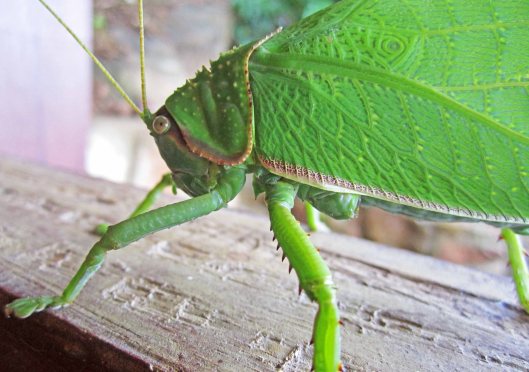
It’s a Coconut grasshopper (Pseudophyllanax imperialis) and I encountered it while on a brief holiday in the seaside town of Kep in Cambodia. Apparently, it’s one of the largest species of grasshopper in the world and can be found in other coconut-growing locations, like New Caledonia, in the Pacific.

160928-coconut-grasshopper-1
160928-coconut-grasshopper-2

I’m not sure in what ways it’s associated with coconut trees because its patterning and colouration make it look more like the leaf of an ordinary tree rather than the palm fronds of a coconut. Mind you, those jaws look like it could quite easily crack open a coconut. Though it looks rather fierce, these grasshoppers are harmless to humans, otherwise I wouldn’t have had it sitting on my hand!
160928-coconut-grasshopper-4

Like Loading...

First recorded sighting in Wales!

27 Tuesday Sep 2016

Posted by sconzani in insects, nature

≈ 9 Comments

Tags

Auchenorrhyncha, first biological record for Wales, leafhopper, Zyginella pulchra

I’m on a roll! Yesterday I told you about my fifth recorded sighting in Wales of a Mugwort Case-bearer moth; today I am thrilled to report a first recorded sighting for Wales!

160927-zyginella-pulchra-3

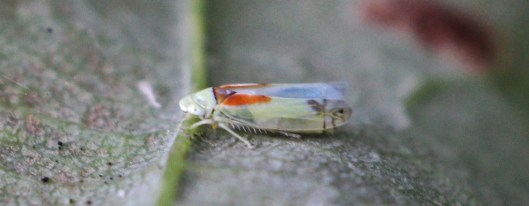
Now I must admit that I didn’t actually recognise this little creature when I first saw it at my local cemetery on 16 September and, as it was so tiny and my photos of it are not crisp, I almost didn’t record it. And, when I did, I wrongly recorded it as a nymph of the Rhododendron leafhopper (Graphocephala coccinea). 

160927-zyginella-pulchra-4
160927-zyginella-pulchra-1

Luckily, Alan Stewart, the national recorder for Auchenorrhyncha, realised my mistake and corrected my record. In his notification email, Alan wrote, ‘In fact, it’s more interesting because this is a species that arrived in Britain only recently and has gradually been spreading. Very interesting that it has arrived in Wales.’ That last sentence made me sit up and pay attention and, sure enough, when I checked with the team at SEWBReC, they confirmed that there were no recorded sightings so far in Wales. So, let me introduce you to Zyginella pulchra – it may be tiny but it is certainly not insignificant. When / if I can get better images, I will post them.

160927-zyginella-pulchra-2

Like Loading...

A rarely recorded moth

26 Monday Sep 2016

Posted by sconzani in insects, nature

≈ 4 Comments

Tags

Artemisia vulgaris, biodiversity in Wales, British moths, Coleophora artemisicolella, mugwort, Mugwort Case-bearer moth, UK moths, Welsh biodiversity

A few weeks ago, when I walked his butterfly transect with my colleague Dave Slade of SEWBReC, the South East Wales Biodiversity Records Centre, Dave stopped to inspect the seed heads of each mugwort (Artemisia vulgaris) plant we passed. Of course, I had to ask why and he explained that he was looking for signs of the rarely recorded Mugwort Case-bearer moth, Coleophora artemisicolella. As the UK Moths website explains, ‘The larva forms a case very closely resembling a seedhead, and moves from seed to seed leaving diagnostic small holes in the side of each one.’ Though it flies during the months of July and August, the moth itself is seldom seen (I certainly haven’t spotted it) and has previously been considered quite rare. It may be, however, that it is actually just rarely recorded as who but moth fanciers would know to look for it!

160926-coleophora-artemisicolella-2
160926-coleophora-artemisicolella-1
160926-coleophora-artemisicolella-3

I am not one to turn down a challenge and, after thoroughly checking every mugwort plant I found (not that many, to be honest) for the following three and a half weeks, I finally hit the jackpot at one of my local biodiversity hotspots, the Howardian Local Nature Reserve! These photos may not look exciting to you, but this is only the fifth recorded sighting of the Mugwort Case-bearer moth’s seed-head holes in the whole of Wales!

Like Loading...

One of Nature’s whodunnits

22 Thursday Sep 2016

Posted by sconzani in insects, nature, plants

≈ 6 Comments

Tags

galls, oak galls, observing nature, wasp

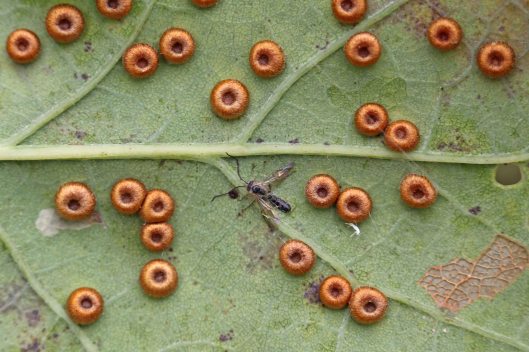
I sometimes get asked how I come up with enough ideas to post a blog every single day. This post goes some way to explaining how it works for me. I walk … a lot, and my camera is my constant companion, and I am by nature curious about … well, everything, really … and I’m also quite an observant person. So, for example, I went out for a wander around one of my local parks on Monday afternoon, thinking I would see if there were any fungi about, and also to get some photos of berries for a future blog. In the process of taking those photos, I noticed how many galls there were on this one particular oak tree so also took some photos of those … which then led me to check the neighbouring trees for galls. (If you’re not sure what galls are, there will now be a blog post on them as well!)

160922-whodunnit-1

When I got home and started going through my photos, this particular image really grabbed my attention because, for me, this is such a good example of one of Nature’s whodunnits. I look at this and my brain is immediately flooded with questions: how were these galls made? Why are they that shape? What is the creature that’s dead on the leaf? Is it a wasp? Did it make the galls? What killed it? It looks like it has white strands around it – a spider’s web or some kind of fungus? What created the bare patch where the leaf’s veins are showing? Was it the larvae of the wasp? What created the almost perfectly round hole in the leaf? Was that a leafcutter bee or something else? Was it the wasp? And what is the teeny weeny white thing? The shed skin of a larva perhaps?

160922-whodunnit-2
160922-whodunnit-3
160922-whodunnit

I don’t know the answers to any of these questions … yet. But, if I find out and if I can get more images related to the story, the result could be a blog or three from just this one photo. And so it goes on …

Like Loading...

Beetle mania!

20 Tuesday Sep 2016

Posted by sconzani in insects, nature

≈ 5 Comments

Tags

Bishop's mitre, British beetles, British bugs, Click beetle, Mint Leaf beetle, Potato capsid, Red lily beetle, Wasp beetle

Sorry, this has nothing to do with the Fab Four and, in fact, includes bugs as well as beetles but, as many of these cute little mini-beasties will soon disappear for the winter, I wanted to celebrate all those that have entertained me through the summer months but haven’t yet had their very own blog post (not because they’re boring, simply because I haven’t gathered enough good photos of them scurrying about their business in the flowers and bushes).

Little bugs and beetles, your time will come … but not till next year!
These have not all been identified to species but my list to date is: Bishop’s Mitre (Aelia acuminata); Click beetle (Elateridae family); Deraeocoris flavilinea; Heterotoma planicornis; Mint Leaf beetle (Chrysolina herbacea); Potato Capsid (Closterotomus norwegicus); Red lily beetle (Lilioceris lilii); four little unknowns; and, to finish, a Wasp Beetle (Clytus arietis).

160920-bishops-mitre
160920-click-beetle
160920-deraeocoris-flavilinea
160920-heterotoma-planicornis
160920-mint-leaf-beetle-chrysolina-herbacea
160920-potato-capsid-closterotomus-norwegicus
160920-red-lily-beetle-lilioceris-lilii
160920-unknown-1
160920-unknown-2
160920-unknown-3
160920-unknown-4
160920-wasp-beetle-clytus-arietis
Like Loading...

Spiders

19 Monday Sep 2016

Posted by sconzani in insects, nature

≈ 4 Comments

Tags

Araneus diadematus, Cross spider, Crowned orb weaver, Diadem spider, European garden spider, Garden spider, spiders

I don’t often share images of spiders because I don’t care for them much. I don’t mind large spiders because you can see them – most of the time you know exactly where they are. It’s the smaller spiders I don’t like, the ones that sneak around, hiding in dark corners or walking upside down on the bathroom ceiling, ready to abseil down when I’m having a shower. However, I know my feelings towards these mostly harmless little creatures are irrational so I’ve been making more of an effort lately to photograph them. And they can be really rather handsome.

160919-garden-spiders-1
160919-garden-spiders-3

Take this creature, for instance. This is the European garden spider, Araneus diadematus, also known as the Crowned orb weaver, the Diadem spider or the Cross spider. Although, as you can see from my photos, its colours are quite variable, the white markings on its abdomen form a distinctive cross pattern. And, although it’s called a garden spider, really much of Europe and North America is its garden. Also, from what I’ve seen of them, these spiders don’t try to hide – they sit quite blatantly in the centres of their webs, with that ‘I don’t know what you are. I don’t know what you want. But I will catch you. And I will suck the juices out of you’ kind of attitude!

160919 garden spiders (2)
160919 garden spiders (4)
Like Loading...

A (shield)bug’s life

15 Thursday Sep 2016

Posted by sconzani in insects, nature

≈ 14 Comments

Tags

Common Green Shieldbug, instar, Palomena prasina, shieldbug, shieldbug lifecycle

If you thought your life was complicated, think again.

160915-green-shieldbug-6-3rdinst

Though it has just one generation each year, like many bugs Palomena prasina, the Common Green Shieldbug, has a very complex life cycle. Between egg and adult, it goes through five transitional phases (called instars) and at each stage, as it grows into adulthood, it looks a little different, its patterning and colouration varying each time it moults. As its name implies it is mostly green, though it can also have black markings and, as it approaches the time for winter hibernation, the adult shieldbug often changes to a bronze-brown colour.

160915-green-shieldbug-1-3rdinst

Such variation can make Palomena prasina difficult to identify and their mostly green hues also act as good camouflage on the plants and bushes they inhabit so, although these bugs are supposedly common and widespread in Britain and at 12-14mm they’re relatively large, I haven’t seen as many as I expected. These are some I did manage to detect.

160915-green-shieldbug-2-2ndinst
160915-green-shieldbug-5
160915-green-shieldbug-3-3rdinst
160915-green-shieldbug-4
Like Loading...

The pleasure of the bee

10 Saturday Sep 2016

Posted by sconzani in flowers, insects, nature

≈ 4 Comments

Tags

bees, bumblebee, Kahlil Gibran, Megachile sp, the pleasure of the bee, The Prophet

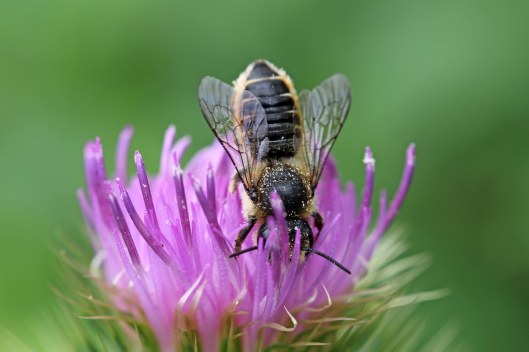
160910-bees-flowers-2

Go to your fields and your gardens, and you shall learn that
it is the pleasure of the bee to gather honey of the flower,
But it is also the pleasure of the flower to yield its honey to the bee.
For to the bee a flower is a fountain of life,
And to the flower a bee is a messenger of love,
And to both, bee and flower, the giving and the receiving of pleasure
is a need and an ecstasy.

from Kahlil Gibran, The Prophet

160910-bees-flowers-1

Like Loading...

No flies on me!

06 Tuesday Sep 2016

Posted by sconzani in insects, nature

≈ 6 Comments

Tags

Coenosia sp, Dagger fly, Empis sp, Eriothrix rufomaculata, Eurithia anthophila, Flesh fly, flies, fly, Graphomya maculata, Sarcophaga sp

Do you ever get the feeling you’re being watched? Often, when I’m out on my wanders with wildlife, I get a little tingling in the back of my neck as if my extra-sensory perception is trying to tell me I’m being stared at. When I look around, there’s never a person or a bird or an animal but there’s often a fly, just sitting quietly on a leaf or a twig, minding its own business though focussing its gigantic eyes in my direction. Is it wondering if I’d make a tasty meal? Is it curious about what I’m doing? Is it staring in case I might turn up something it could eat? Is it monitoring a potential threat? Do flies think?

160906 1 Sarcophaga sp Flesh fly
160906 2 Coenosia sp (Muscidae)

I will never know the answers to those questions but their watchfulness has made me notice the flies around me and, amazingly, some of them are rather lovely little creatures. May I present to you: a Flesh fly (Sarcophaga sp.); one of the Muscidae family, Coenosia sp.; Eurithia anthophila; Eriothrix rufomaculata; a Dagger fly (Empis sp.); and Graphomya maculata.

160906 3 Eurithia anthophila
160906 4 Eriothrix rufomaculata

(By the way, that feeling of being stared at has a label, scopaesthesia, and, despite several series of scientific lab experiments, the phenomenon remains unproven. In my case, the tingling is probably a tiny spider I’ve picked up amongst the bushes.)

160906 5 Daggerfly Empis sp
160906 6 Graphomya maculata
Like Loading...

The moths of Cwm Saerbren

04 Sunday Sep 2016

Posted by sconzani in insects, nature

≈ Leave a comment

Tags

bioblitz, Common carpet moth, Common rustic moth, Cwm Saerbren Woodland, Lesser broad-bordered yellow underwing, moth, Small fan-footed wave, Square-spot rustic, Yponomeuta

For me, one of the highlights of our bioblitz of the Cwm Saerbren Woodland last week was the night-time moth-trapping session. I say trapping though, in fact, there was no trap – a big white sheet was draped over a conveniently situated tall wire-mesh fence outside the hall we were using and two bright lights set blazing nearby. It rained steadily most of the evening, so the porch hall provided a convenient sheltering spot and, luckily, the moths weren’t put off.

160904 Common carpet (1)
160904 Common carpet (2)

It’s taken me a few days to identify, and get help with identifying, what we saw. Luckily one of my colleagues at SEWBReC, David Slade, is a moth expert, co-author of The Moths of Glamorgan, and Country recorder for moths – you couldn’t get much better help than that! Thanks, Dave.

Here then are some of our nocturnal visitors: Common carpet (Epirrhoe alternata) (2 photos at top), Common rustic (Mesapamea secalis agg.) (agg. because this species has now been separated into three sub-species which can only be identified through examination of the genitalia), Lesser broad-bordered yellow underwing (Noctua janthe), Small fan-footed wave (Idaea biselata), Square-spot rustic (Xestia xanthographa) (2 photos) and Yponomeuta cagnagella or malinellus or padella (these can’t be separated to exact species once they’ve reached adulthood). (Apologies for the poor photos – not easy conditions for photography.)

160904 Common Rustic agg
160904 Lesser Broad-bordered Yellow Underwing
160904 Small fan-footed wave
160904 Square-spot Rustic (1)
160904 Square-spot Rustic (2)
160904 Yponomeuta cagnagella or malinellus or padella
Like Loading...
← Older posts
Newer posts →

About me

sconzani

sconzani

I'm a writer and photographer; researcher and blogger; birder and nature lover; countryside rambler and city strider; volunteer and biodiversity recorder.

View Full Profile →

Follow earthstar on WordPress.com

Enter your email address to follow this blog and receive notifications of new posts by email.

Recent blog posts

  • The return of the Willow warblers April 23, 2026
  • Bug: Harpocera thoracica April 22, 2026
  • A female Tawny April 21, 2026
  • NFY: Orange-tip April 20, 2026
  • All the yellows April 19, 2026

From the archives

COPYRIGHT

Unless otherwise acknowledged, the text and photographs on this blog are my own and are subject to international copyright. Nothing may be downloaded or copied without my permission.

Fellow Earth Stars!

  • Unknown's avatar
  • Unknown's avatar
  • Unknown's avatar
  • Unknown's avatar
  • Unknown's avatar
  • Unknown's avatar
  • Unknown's avatar
  • Unknown's avatar
  • Unknown's avatar
  • Unknown's avatar
  • Unknown's avatar
  • Unknown's avatar
  • Unknown's avatar
  • Unknown's avatar
  • Unknown's avatar
  • Unknown's avatar
  • Unknown's avatar
  • Unknown's avatar
  • Unknown's avatar
  • Unknown's avatar
  • Unknown's avatar
  • Unknown's avatar
  • Unknown's avatar
  • Unknown's avatar
  • Unknown's avatar
  • Unknown's avatar
  • Unknown's avatar
  • Unknown's avatar
  • Unknown's avatar
  • Unknown's avatar
  • Unknown's avatar
  • Unknown's avatar
  • Unknown's avatar
  • Unknown's avatar
  • Unknown's avatar
  • Unknown's avatar
  • Unknown's avatar
  • Unknown's avatar
  • Unknown's avatar
  • Unknown's avatar
  • Unknown's avatar
  • Unknown's avatar
  • Unknown's avatar
  • Unknown's avatar
  • Unknown's avatar
  • Unknown's avatar
  • Unknown's avatar
  • Unknown's avatar
  • Unknown's avatar
  • Unknown's avatar

Blog at WordPress.com.

Privacy & Cookies: This site uses cookies. By continuing to use this website, you agree to their use.
To find out more, including how to control cookies, see here: Cookie Policy
  • Subscribe Subscribed
    • earthstar
    • Join 642 other subscribers
    • Already have a WordPress.com account? Log in now.
    • earthstar
    • Subscribe Subscribed
    • Sign up
    • Log in
    • Report this content
    • View site in Reader
    • Manage subscriptions
    • Collapse this bar
 

Loading Comments...
 

You must be logged in to post a comment.

    %d