• ABOUT
  • BIRDING 2018
  • Birding 2019
  • BLOG POSTS
  • Butterflies 2018
  • Resources

earthstar

~ a celebration of nature

earthstar

Category Archives: insects

Grangemoor Park: a first look

11 Saturday Mar 2017

Posted by sconzani in fungi, insects, lichen, nature, parks, spring, wildflowers

≈ 4 Comments

Tags

biodiversity, Cardiff parks, Grangemoor Park, old rubbish tip, Penarth Moors, River Ely, signs of spring

I had my first wander around Grangemoor Park yesterday and I’ll definitely be going back, though perhaps when it’s a little drier underfoot. With an extensive area of grass and scrub that rises up to two central mounds (from which you get quite good 360-degree views over Cardiff), this land wasn’t always a park. You have only to look at old maps to see that, once upon a time, the River Ely meandered through Penarth Moors here but, once the river was realigned, the hollows thus created were used as one of Cardiff’s rubbish tips. When the tip was full, Cardiff Council had a load of underground drains built, as well as ventilation pipes to allow the methane to escape, covered the lot with tons of clay – hence the very soggy ground, edged it all around with a solid stone wall, and changed its designation to a park in 2000.

170311 Grangemoor (1)
170311 Grangemoor (2)
170311 Grangemoor (3)
170311 Grangemoor (4)
170311 Grangemoor (5)
170311 Grangemoor (6)

That may sound like a sad history but, according to locals, the park now hosts quite a broad range of flora and fauna, and I certainly saw many of the stirrings of Spring. There were bumblebees and flies, a butterfly and a ladybird, masses of primroses almost hidden under bushes, golden coltsfoot and dandelions in bloom all around and horsetail pushing through everywhere, as well as incredibly vibrant lichens and a healthy growth of Oak curtain crust fungi. I will be going back!

170311 Grangemoor (7)
170311 Grangemoor (8)
170311 Grangemoor (9)
170311 Grangemoor (10)
170311 Grangemoor (11)
170311 Grangemoor (12)
Like Loading...

The curious case of the case-bearer

26 Thursday Jan 2017

Posted by sconzani in insects, nature

≈ 7 Comments

Tags

case-bearing caterpillar, case-bearing larva, Case-bearing moth, moth larva, Tinea pellionella, Tineola bisselliella

This afternoon I realised I was not living alone in my new flat – this tiny creature very stupidly decided to climb one of the walls, thus bringing upon itself a level of attention that would ultimately lead to its demise. It’s the larva of one of the Case-bearing moths (possibly Tinea pellionella or Tineola bisselliella, or maybe something else entirely) that likes to chew your carpets threadbare or devour the fibres in your favourite woollen jumper.

170126-case-bearing-moth-1
170126-case-bearing-moth-2

As you can see it’s constructed itself a cosy little home which it can very easily move around. The case is open-ended so, as I discovered when waiting for it to poke its head out one end, it can actually turn around inside and poke its head out the other end if danger (or a gigantic human with a camera lens) threatens.

170126-case-bearing-moth-4

I actually had the carpet professionally cleaned before I moved in here so this little fellow must’ve been hiding somewhere, or it came along for the ride from my old abode. Sweet as that may sound, I do not want to be its friend, and it has now left the building!

170126-case-bearing-moth-3

Like Loading...

World wildlife Wednesday: Cambodian butterflies

28 Wednesday Dec 2016

Posted by sconzani in insects, nature

≈ 3 Comments

Tags

Banteay Srey Butterfly Centre, butterfly, butterfly conservation, Cambodia, Cambodian butterflies, forest conservation

As today is the winter solstice I thought it would be nice to celebrate  world wildlife Wednesday in sunnier warmer climes. So, let’s head to Cambodia where, although this is the cool dry season – their equivalent of winter – temperatures are still averaging in the very pleasant mid-20-degree-Celsius range. And let’s pay a visit to the Banteay Srey Butterfly Centre, about 25 kilometres north of Siem Reap.

161221-cambodia-common-mime-1

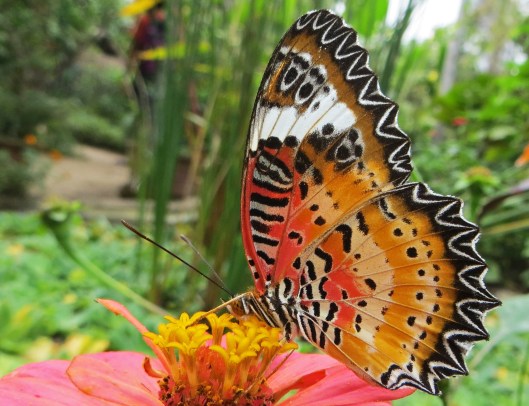
Not only does it have a large netted garden full of tropical flowers with hundreds of butterflies fluttering around, it also has a butterfly breeding programme. Egg-covered leaves are collected from the garden each day and stored in plastic tubs in a small propagation area. Once hatched the caterpillars, ranging in colour from the camouflaging pale greens to the bright red and black stripes of warning, are fed on their favourite plants until its time for their pupation. The butterflies, when they emerge, are equally varied, some vibrant reds and oranges, others plain black and white but intricately patterned, some large, others small and delicate. All are native to Cambodia.

161221-cambodia-leopard-lacewing-1

The friendly centre guides provide a short guided tour, sharing their knowledge of the different species and explaining the life cycle and peculiarities of each species. By training Cambodian people who reside near forested areas to farm butterflies, and employing locals as staff, the butterfly centre benefits local impoverished communities, encourages the preservation of native forests, and helps to conserve the native butterflies – a win, win situation!

151221-cambodia-common-evening-brown
161221-cambodia-caterpillar
161221-cambodia-common-birdwing
161221-cambodia-common-mime-2
161221-cambodia-leopard-lacewing-2
161221-cambodia-yellow-moth
Like Loading...

Holly leaf-miner

10 Saturday Dec 2016

Posted by sconzani in insects, nature, trees

≈ 5 Comments

Tags

biological recording, Holly, Holly leaf-miner, Phytomyza ilicis, SEWBReC

Following on from yesterday’s post where I (hopefully) sent you all on a quest to find the Holly parachute fungus, I thought I’d kill two biological records with one outing, and also get you to look for another species related specifically to holly.

161210-holly-leaf-miner-1

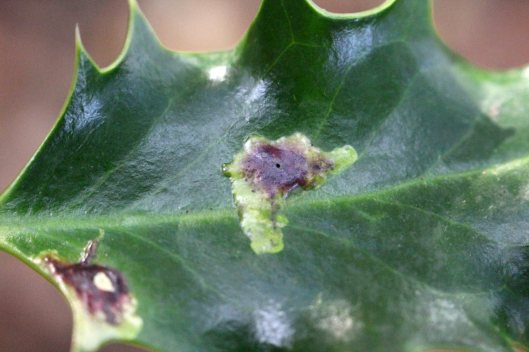
This is the Holly leaf-miner (Phytomyza ilicis), a small fly that lays its eggs inside the leaves of holly. ‘Inside’ may sound strange, but holly leaves are relatively thick and leathery so, once the eggs hatch, they make the perfect home for the fly’s larvae, which live out their lives feeding on the flesh of the leaves and making a little home for themselves in the process. Their feeding creates multi-coloured blotches on the leaves so, although you’ll probably never see the fly and probably not even the larvae (unless you slice open a leaf at the right time of year), you can always tell where they’ve been. Once they’ve eaten their fill, the larvae pupate inside their leafy homes, then open a small escape hole once their transformation is complete and fly away to start the process all over again.

161210-holly-leaf-miner-2
161210-holly-leaf-miner-3

Co-incidentally, the Holly leaf-miner is species of the month (really, two months – November and December) with SEWBReC, the South East Wales Biodiversity Records Centre. Like yesterday’s Holly parachute fungus, there are few biological records of the leaf-miner but it is almost certainly just under-recorded because, once you start looking for those tell-tale blotches, you quickly discover it’s almost everywhere. So, get looking and recording!

Like Loading...

The caring earwig mother

08 Tuesday Nov 2016

Posted by sconzani in insects, nature

≈ 2 Comments

Tags

Common earwig, earwig, earwig maternal care, earwig mothers and their young, earwig parental care, Forficula auricularia

As I’m sure you all know by now, I spend a couple of days each week volunteering at the Mary Gillham Archive Project, part of which involves extracting wildlife records from a huge number of folders absolutely stuffed full of the long lists of species Mary saw every time she stepped outside her house (and some inside her house as well). From attending lectures, watching television programmes, talking to people, reading journal articles, Mary also amassed a wealth of information about the flora and fauna of Britain so we learn a lot of fascinating details just from reading through all the paperwork.

161107-common-earwig-3

Today I was reading about the Common earwig (Forficula auricularia) and was struck by this incredible detail: ‘The earwig mother cares for her young. She licks them – very necessary to keep them free of fungal infection.’ Apparently, the female earwig, who can be recognised by her straight rear pincers (the male’s are curved), spends the wintertime in a tunnel in the soil looking after her eggs, restacking them, sometimes moving them to a different part of the tunnel, and cleaning them to keep them fungi free. From the time they are born until they reach the second instar stage and leave the nest, she brings them plant and animal matter to eat and also regurgitates food for them. Perhaps the gardeners among you will now look more kindly on the earwigs that are chewing your dahlias – they might just have babies to feed.

161107-common-earwig-1
161107-common-earwig-2
161107-common-earwig-4
Like Loading...

Dedicated to the Dock bug

17 Monday Oct 2016

Posted by sconzani in insects, nature

≈ 3 Comments

Tags

bugs on dock, Coreus marginatus, Dock bug, Squashbug

When the Dock bug found out that his cousin the Green shield bug had received a blog post all to himself, he was not amused. Was he not as lovely? Was he not as worthy of attention? Well, yes, angry little Dock bug, you most certainly are, so here is your moment in the spotlight!

161017-dock-bug-1

Coreus marginatus is the Dock bug’s scientific name, and he’s a largish (13-15mm), broadish, reddish-brownish sap-sucker. Luckily, his sap-sucking is restricted to the leaves of docks and sorrels so he’s not the pest that some other members of the squashbug (bugs on squash plants) family can be.

161017-dock-bug-2

Mr and Mrs Dock bug seek each other out in the springtime to create the new generation, then, once hatched, their offspring, like most True bugs, go through five nymph stages before emerging as adults from about August. I’ve only ever seen the adults, in the shrubs, bushes and hedgerows alongside many of my walking trails, but there are plenty around – three sitting close together on one sunny leaf just last week. As well as inhabiting much of southern Britain, the Dock bug can also be found throughout Europe, in many Asian countries and in parts of North Africa.

161017-dock-bug-3
161017-dock-bug-4
161017-dock-bug-5
Like Loading...

The curious conehead

11 Tuesday Oct 2016

Posted by sconzani in insects, nature

≈ 8 Comments

Tags

British cricket, bush cricket, Conocephalus discolor, cricket, Long-winged conehead

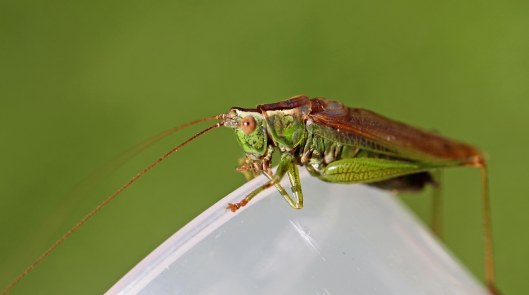
CC: ‘I didn’t much like being imprisoned in that white tub, you know.’
Me: ‘ Sorry! We just wanted to look at you more closely.’

161011-long-winged-conehead-1

CC: ‘Well, I don’t blame you. I am rather cute, aren’t I?’
Me: ‘You certainly are but that’s not why we wanted to look at you.’

161011-long-winged-conehead-2

CC: ‘Oh. What were you looking at me for then?’
Me: ‘We wanted to check what you were.’

161011-long-winged-conehead-3

CC: ‘And what am I?’
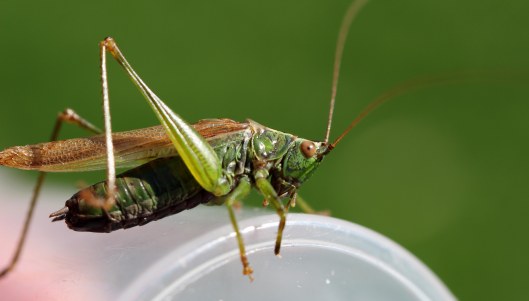
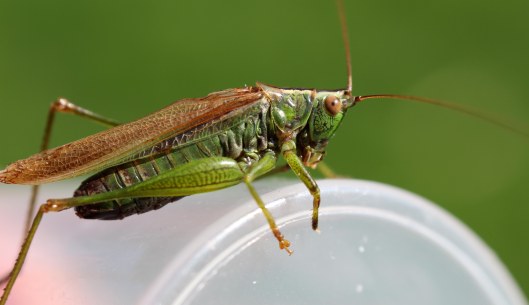
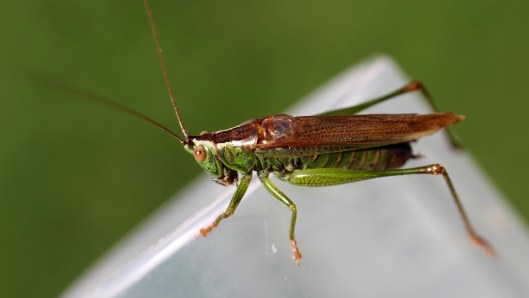
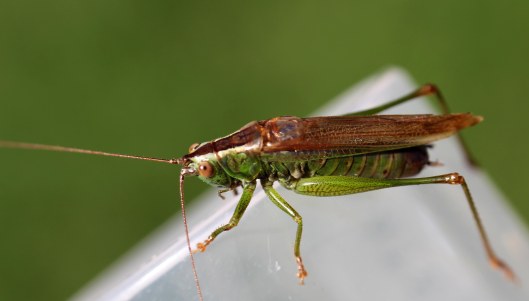
Me: ‘You’re a type of bush cricket called a Long-winged conehead.’

161011-long-winged-conehead-4

CC: ‘How can you tell that?’
Me: ‘Well, you have a green body and long, brown wings, a brown stripe down your back and a pointed head.’

161011-long-winged-conehead-5

CC: ‘I’m not sure I like the name conehead. Couldn’t you find me a better name than that?’
Me: ‘Well, your scientific name is Conocephalus discolor. Is that better?’

161011-long-winged-conehead-6

CC: ‘Oh, yes. That makes me sound very special. What else do you know about me?’
Me: ‘You mostly eat grass, though you don’t mind the odd small insect to snack on. You’re mostly found in the south of Britain, though some of your more adventurous friends are moving northwards. And you like living in a variety of places, from farm and grassland and wooded areas to coastal reedbeds and even boggy marshes.’

161011-long-winged-conehead-7

CC: ‘I can see I have no secrets from you.’
Me: ‘I’m sure there’s a lot I don’t know about you though, like you, I am curious about the world around me. Now I think it’s time you flew off and found a tasty bit of grass for your lunch.’

Like Loading...

An under-recorded square kilometre

07 Friday Oct 2016

Posted by sconzani in insects, nature

≈ 6 Comments

Tags

bioblitz, biodiversity, biodiversity in Wales, biological diversity, biological recording, biological records, SEWBReC

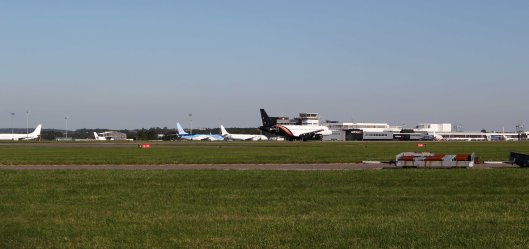
After our morning’s biodiversity recording session at Porthkerry and a rather scrummy pub lunch, our SEWBReC team took up the challenge of how many species we could discover in a one-kilometre square that borders Cardiff Airport, a square where only 15 species of anything had previously been recorded. Well, even a desert has more life in it than that, and we had fields and country lanes edged with hedgerows to explore so off we set.

161007-rhoose-bioblitz-2

Some of the hedgerows had recently been savagely trimmed and, though sunny, it was blowing a gale so conditions weren’t exactly perfect. But we are a dedicated team! We scanned and we scoured, we probed and we combed, we turned over and peered under, we inspected and we scrutinised. And at the end of two hours we had a preliminary list of 85 species, with some uncertainties to be verified, some ambiguities to be resolved and some experts to be consulted. What a thoroughly enjoyable, eminently satisfying day it was!

Each month SEWBReC provides maps and information about poorly recorded 1km squares in south east Wales, in the hope of filling in the gaps in their maps. If you live in the area, or even if you’re just visiting, you can help fill those gaps. See here for more information.

161007-rhoose-bioblitz-3
161007-rhoose-bioblitz-4
161007-rhoose-bioblitz-5
161007-rhoose-bioblitz-6
161007-rhoose-bioblitz-7
161007-rhoose-bioblitz-8
161007-rhoose-bioblitz-9
Like Loading...

Feasting on ivy flowers

30 Friday Sep 2016

Posted by sconzani in autumn, flowers, insects, nature

≈ Leave a comment

Tags

harlequin ladybird, ivy, ivy flowers, ladybird

160930-ladybird-on-ivy

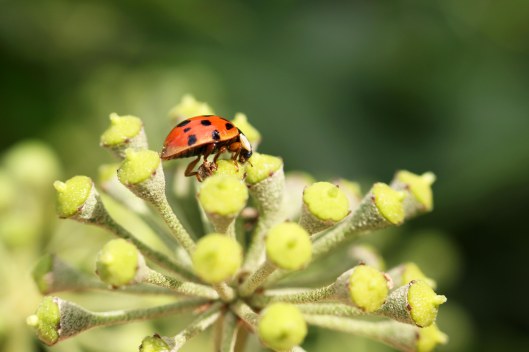
This little Harlequin ladybird was just one of the many insects – flies and hoverflies, honey bees, bumblebees and wasps, and a Red Admiral butterfly – that were enjoying the nectar and pollen to be found on these ivy flowers, an important source of food for so many insects in the autumn months.

Like Loading...

Bye bye butterflies

29 Thursday Sep 2016

Posted by sconzani in autumn, insects, nature

≈ 7 Comments

Tags

Brimstone butterfly, British butterflies, butterfly, Gatekeeper, Gonepteryx rhamni, Pyronia tithonus, Red Admiral, Vanessa atalanta

Though I love many things about the coming of autumn, it is also a time when many other things I love disappear for the year. The butterflies are one of those things. Gone now are the gorgeous Gatekeepers (Pyronia tithonus) that kept me company during my frequent wanders around my local cemetery.

160929-gatekeeper-1
160929-gatekeeper-2

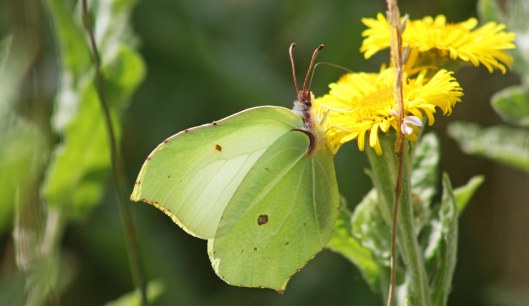
Gone too is the pale, subtle beauty of the Brimstone (Gonepteryx rhamni). Though I searched for more, I saw only one this year, at the Parc Slip Nature Reserve.

160929-brimstone

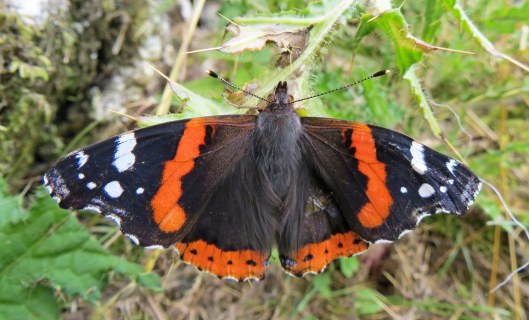
I have noticed, over the past couple of weeks, a little resurgence of Red Admirals (Vanessa atalanta), as they feast on the ivy flowers that are just beginning to bloom here in Cardiff and are providing a late season banquet for bees, hoverflies and butterflies. All too soon, these creatures will also fade away, hopefully to come again in the springtime when the temperatures begin to rise and the days to lengthen.

160929-red-admiral

Like Loading...
← Older posts
Newer posts →

About me

sconzani

sconzani

I'm a writer and photographer; researcher and blogger; birder and nature lover; countryside rambler and city strider; volunteer and biodiversity recorder.

View Full Profile →

Follow earthstar on WordPress.com

Enter your email address to follow this blog and receive notifications of new posts by email.

Recent blog posts

  • The return of the Willow warblers April 23, 2026
  • Bug: Harpocera thoracica April 22, 2026
  • A female Tawny April 21, 2026
  • NFY: Orange-tip April 20, 2026
  • All the yellows April 19, 2026

From the archives

COPYRIGHT

Unless otherwise acknowledged, the text and photographs on this blog are my own and are subject to international copyright. Nothing may be downloaded or copied without my permission.

Fellow Earth Stars!

  • Unknown's avatar
  • Unknown's avatar
  • Unknown's avatar
  • Unknown's avatar
  • Unknown's avatar
  • Unknown's avatar
  • Unknown's avatar
  • Unknown's avatar
  • Unknown's avatar
  • Unknown's avatar
  • Unknown's avatar
  • Unknown's avatar
  • Unknown's avatar
  • Unknown's avatar
  • Unknown's avatar
  • Unknown's avatar
  • Unknown's avatar
  • Unknown's avatar
  • Unknown's avatar
  • Unknown's avatar
  • Unknown's avatar
  • Unknown's avatar
  • Unknown's avatar
  • Unknown's avatar
  • Unknown's avatar
  • Unknown's avatar
  • Unknown's avatar
  • Unknown's avatar
  • Unknown's avatar
  • Unknown's avatar
  • Unknown's avatar
  • Unknown's avatar
  • Unknown's avatar
  • Unknown's avatar
  • Unknown's avatar
  • Unknown's avatar
  • Unknown's avatar
  • Unknown's avatar
  • Unknown's avatar
  • Unknown's avatar
  • Unknown's avatar
  • Unknown's avatar
  • Unknown's avatar
  • Unknown's avatar
  • Unknown's avatar
  • Unknown's avatar
  • Unknown's avatar
  • Unknown's avatar
  • Unknown's avatar
  • Unknown's avatar

Blog at WordPress.com.

Privacy & Cookies: This site uses cookies. By continuing to use this website, you agree to their use.
To find out more, including how to control cookies, see here: Cookie Policy
  • Subscribe Subscribed
    • earthstar
    • Join 642 other subscribers
    • Already have a WordPress.com account? Log in now.
    • earthstar
    • Subscribe Subscribed
    • Sign up
    • Log in
    • Report this content
    • View site in Reader
    • Manage subscriptions
    • Collapse this bar
 

Loading Comments...
 

You must be logged in to post a comment.

    %d