• ABOUT
  • BIRDING 2018
  • Birding 2019
  • BLOG POSTS
  • Butterflies 2018
  • Resources

earthstar

~ a celebration of nature

earthstar

Category Archives: insects

Checking out commas and dashes

01 Thursday Sep 2016

Posted by sconzani in insects, nature

≈ 4 Comments

Tags

Chrysotoxum bicinctum, Eupeodes corollae, Eupeodes luniger, hoverfly, Migrant hoverfly, Xanthogramma pedissequum

No, this is not a post about English grammar! I thought I would share more photos of hoverflies before they disappear for the year and it just so happens that today’s selection is not at all scientific – same genus, same habitats – they just all happen to be decorated with commas or dashes.

160901 Chrysotoxum bicinctum

First up is Chrysotoxum bicinctum, with the two yellow stripes across its abdomen making it quite a distinctive hoverfly and also more easily identifiable than many. Its antennae are a little longer than most hoverflies so this little critter is really trying very hard to imitate a wasp … but without the sting. Usually found in grassy habitats with nearby trees and shrubs for shelter, Chrysotoxum bicinctum can be seen from May to September in most parts of Britain.

160901 Eupeodes corollae (a)
160901 Eupeodes corollae (b)

Also known as the Migrant hoverfly because, despite its small size, it is migrates across Europe and North Africa, Eupeodes corollae is rather a pretty little hoverfly. It can be a little tricky to ID as the males and females have different yellow markings and, to further confuse things, it is also very similar to Eupeodes luniger, up next. Interestingly, E. corollae has been used as way to control insects and aphids on fruit plantations and in greenhouses … but it turns out they ate more fruit than aphids!
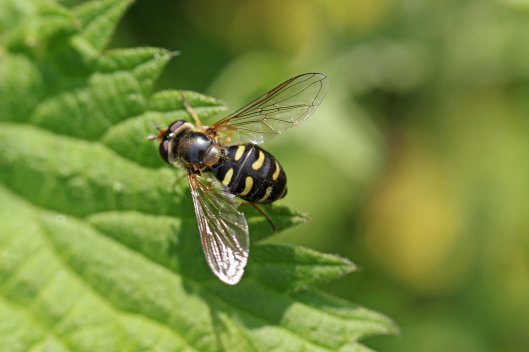
160901 Eupeodes luniger

The difference between E. corollae and Eupeodes luniger is in those commas that adorn their abdomens. In E. corollae the markings extend to the edge of the abdomen, whereas in E. luniger they do not. That sounds an easy way to identify them but these hoverflies are not huge critters and it’s not always easy to see those edges. Eupeodes luniger is another migrating species that is known to fly long distances. In Britain they are mostly found in the southern counties.

160901 Xanthogramma pedissequum

Last but certainly not least is Xanthogramma pedissequum, another striking wasp mimic, with characteristic vertical stripes on its thorax and horizontal dashes on its abdomen. Though peaking in June and July, it can be seen in southern Britain from May through to September, in grassy places and along tracks and trails where there is some bare dirt. Presumably, this is because their larvae feed on the aphids found in ants’ nests so they are looking along those pathways for suitable egg-laying places.
Like Loading...

Rocking the Rhodos

30 Tuesday Aug 2016

Posted by sconzani in insects, nature, parks, plants

≈ 7 Comments

Tags

Bute Park, Graphocephala fennahi, leafhopper, plant bug, rhododendron, rhododendron leafhopper

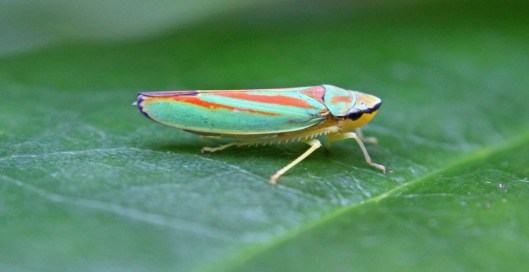
160830 Rhododendron leafhopper (2)

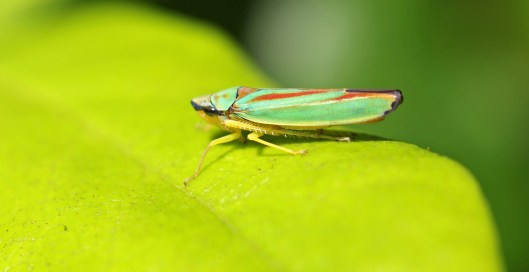
What dapper little critters these are, don’t you think? The fashionistas of the bug world in their pale-green orange-striped suits, with contrasting purple trim and coordinating pale yellow under-wear. No dull dark-grey pinstripes for these hoppers; they’re American immigrants and they’re happy to be noticed. It certainly makes them easy to identify, a huge bonus in the world of plant bugs!

160830 Rhododendron leafhopper (1)

Rhododendron leafhoppers (Graphocephala fennahi) were first introduced to Britain in the early 1900s and I was first introduced to them early last week, when walking a butterfly transect with a colleague, but I’ve been back twice to see them since then, just because they make me laugh. The ones in my pictures make their home in the rhododendron bushes in one small area of Cardiff’s Bute Park, and there are hundreds, if not thousands of them – so many, in fact, that you can actually hear the sproing as they flit from leaf to leaf. And, if you stand in front of the bushes, you’re in serious danger of straining your neck from watching them fly and spring back and forth. Yet another free entertainment package from Mother Nature (with a little voyeurism thrown in)!

160830 Rhododendron leafhopper (3)
160830 Rhododendron leafhopper (4)
160830 Rhododendron leafhopper (5)
160830 Rhododendron leafhopper (6)
Like Loading...

Bioblitzing Cwm Saerbren

27 Saturday Aug 2016

Posted by sconzani in birds, fungi, insects, nature, plants, wildflowers

≈ 5 Comments

Tags

bioblitz, biological diversity, biological recording, biological recording centre, Cwm Saerbren Woodland, Cwmsaerbren, SEWBReC

Each summer my local biological records centre, SEWBReC, runs a series of biological recording field days, partly to introduce members of the public to the world of biological recording, allowing them to rub shoulders with wildlife experts and learn species identification skills, and partly to record the biodiversity of particular areas. Last Thursday I went along to the field day-come-bioblitz at the Cwm Saerbren Woodland, adjacent to the small town of Treherbert at the top of the Rhondda Fawr Valley.

160827 Cwmsaerbren bioblitz (12)

This assumed unicorn was the star of the show!

Though the turnout from the locals was disappointing (not a single person!) and despite the sometimes heavy rain (a common feature up the Valleys), we had a great day. With the SEWBReC crew, a couple of guys from Natural Resources Wales, and a few of us volunteers from the Mary Gillham Archives Project, we stomped around the trails of Cwm Saerbren, recording all we saw. And, after meeting up back at the town to identify and write up our afternoon list and then filling up on hot chips from the local takeaway shop, we also got out with the bat recorder and had moth-attracting lights running to see what flying critters we might find. All up, once everything is IDed, I reckon our list will be well over 200 species. Not bad for a day’s work!

160827 Cwmsaerbren bioblitz (4)
160827 Cwmsaerbren bioblitz (2)
160827 Cwmsaerbren bioblitz (1)
160827 Cwmsaerbren bioblitz (10)
160827 Cwmsaerbren bioblitz (8)
160827 Cwmsaerbren bioblitz (11)
160827 Cwmsaerbren bioblitz (17)
160827 Cwmsaerbren bioblitz (15)
160827 Cwmsaerbren bioblitz (5)
160827 Cwmsaerbren bioblitz (9)
160827 Cwmsaerbren bioblitz (6)
160827 Cwmsaerbren bioblitz (7)
160827 Cwmsaerbren bioblitz (16)
160827 Cwmsaerbren bioblitz (3)
160827 Cwmsaerbren bioblitz (13)
Like Loading...

The Spotted longhorn beetle

25 Thursday Aug 2016

Posted by sconzani in insects, nature

≈ 4 Comments

Tags

Black and Yellow longhorn beetle, Longhorn beetle, Rutpela maculata, Spotted longhorn beetle

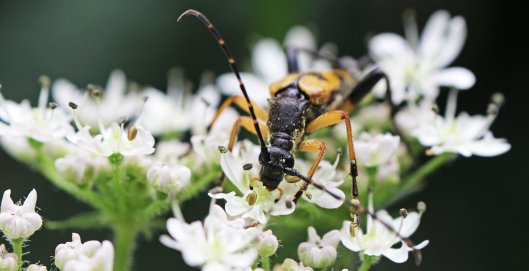
Let me introduce you to Rutpela maculata. It’s called a longhorn beetle, but really I would say it has long antennae rather than long horns, and its common name is the Spotted longhorn, but really it has spots and stripes, so its other common name of Black and Yellow longhorn seems more appropriate. Its colours and patterns roughly mimic those of wasps which, in theory, gives it protection from predators like birds.

160825 Longhorn beetle (1)

I was a little surprised, and somewhat saddened, to learn that the adult beetles have a very short life, of just two to four weeks, but this is actually quite common amongst insects. Most spend the majority of their lives as larvae.

160825 Longhorn beetle (2)
160825 Longhorn beetle (3)
160825 Longhorn beetle (4)

The adult longhorn beetles grow to between 13 and 20mm long, and can be seen any time from May to August, frequenting hedgerows and the edges of woodland trails, often enjoying a feed of pollen or nectar on umbellifers. I’ve only seen two so far, both pictured here, and you can see that the markings and colouration vary from beetle to beetle.

160825 Longhorn beetle (5)

Like Loading...

Camouflage

23 Tuesday Aug 2016

Posted by sconzani in insects, nature

≈ Leave a comment

Tags

Bindweed flower, camouflage, Crab spider, Eupeodes corollae, hoverfly, insect camouflage, Misumena vatia, sawfly larve

On the positive side … this Sawfly larva has its colour co-ordination working very well, though maybe needs to work on its choreography.

160823 camouflage (2)

On the negative side … or positive side, depending on whether you’re identifying with the Crab spider (probably Misumena vatia) using the large white Bindweed flower as its lair, or the spider’s victim, a hoverfly (probably Eupeodes corollae).

160823 camouflage (1)

Like Loading...

Horseflies love me

22 Monday Aug 2016

Posted by sconzani in insects, nature

≈ 13 Comments

Tags

cleg, Haematopota species, horsefly, Tabanidae

And I really wish they didn’t!

160822 Horsefly Haematopota sp (2)

It’s the female Horseflies that are the problem – they’re the biters, of humans, horses and other animals, to get the blood they need to aid egg production and, for some reason, they can smell my blood coming a mile away. I got several bites on my face during a recent fungi foray and had a nasty allergic reaction, was swollen and looked like I had some kind of infectious disease. Antihistamine meds don’t really agree with me, so I retreated from the world for a week till the worst of the swelling had gone down. (I got the bite in my photo four days ago. Luckily, Ms Horsefly was only on me for a second or two, before I noticed and flicked her off.)

160822 Horsefly Haematopota sp (3)
160822 Horsefly Haematopota sp (1)
160822 Horsefly bite

The trouble for me is that Horseflies (a large and diverse group called the Tabanidae family, and also known by the common name of Cleg) are rather lovely creatures and they have the most incredible eyes, so I’m driven to capture photos of them (perhaps I’m a masochist!). The Horsefly in my photos is one of the Haematopota species. They have compound eyes that appear brightly coloured and have incredible patterns – from other photos I’ve seen, each creature seems to have a different pattern, much like fingerprints or retina patterns. So, I will continue to seek them out, just as they continue to seek me out!

160822 Horsefly Haematopota sp (4)

Like Loading...

Bugs in the meadows

21 Sunday Aug 2016

Posted by sconzani in insects, nature

≈ 12 Comments

Tags

bugs in meadows, Leptopterna dolabrata, Meadow plant bug, plant bug

Look closely at the wildflowers and grasses in a meadow during the summer months and you might be surprised at how much life is thriving below the casual gaze of human passers-by. If you live in Britain, Europe or North America (where these critters were accidentally introduced in the 1830s), one of the bugs you are quite likely to see is this aptly named Meadow plant bug (Leptopterna dolabrata).

160820 Leptopterna sp nymph (6)
160820 Leptopterna sp nymph (7)

It’s tiny, only about ⅓ inch (8mm) long, and rather well camouflaged amongst the plant stems and leaves. As you might expect from the name plant bug, it feeds on plants. In fact, it’s an expert sucker, using its stylet (piercing mouthpart) to inject into the plant stem an enzyme-rich saliva, which begins to break down the plant tissues even before the bug sucks out the resulting plant soup.

160820 Leptopterna sp nymph (8)
160820 Leptopterna sp nymph (9)

Leptopterna dolabrata is sexually dimorphic so the males and females have slightly different colouring, plus the males are fully winged whereas the females are usually only partly winged. You can see the differences in the mating pair shown above. And below is a plant bug nymph, probably one of their offspring – I say probably because many of the nymphs look alike so it’s difficult to tell exactly which species they are.

160820 Leptopterna sp nymph (5)

Like Loading...

From photograph to painting

20 Saturday Aug 2016

Posted by sconzani in insects, nature

≈ 9 Comments

Tags

dragonflies, dragonfly, Southern hawker

A few days ago I posted a photo of a Southern hawker dragonfly on the UK Dragonflies & Damselflies page on Facebook, just to be sure of my identification of this beautiful creature.

160820 Southern Hawker (1)

Julie Horner was one of the people who liked my photo and she also commented, asking my permission to paint the dragonfly. I said yes, if she would give me permission to share her painting here on the blog. A deal was struck and I emailed Julie the images I shared on my Southern Hawker blog post last week.

160820 Souther Hawker Julie Horner painting

Yesterday, Julie completed the painting and I am really delighted to be able to share her work with you. I love how she has simplified the subject matter – the iris is the perfect flower for the dragonfly to perch on, I think, and I also admire how well she has captured the detail in the wings. I’m sure you’ll agree that Julie is a really talented artist and I’m thrilled at what this impromptu collaboration has produced. You can check out more of Julie’s gorgeous paintings on her Facebook page, Horner Art Studio, and on her Etsy page.

Like Loading...

Seven Sisters Country Park

16 Tuesday Aug 2016

Posted by sconzani in birds, insects, nature, parks, wildflowers

≈ 8 Comments

Tags

birding, birdwatching, British birds, chalk cliffs, Cuckmere River, East Sussex, Seven Sisters Country Park

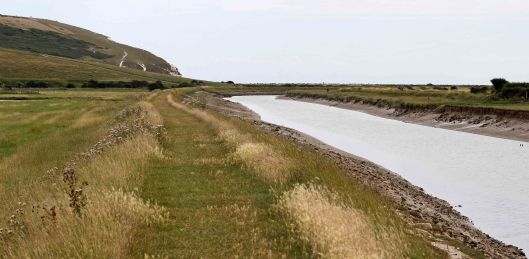
Last Wednesday Jill and I walked the full length of the Seven Sisters Country Park in East Sussex twice, down to the sea and back on one side of the river, followed by a break for a delicious lunch at the Cuckoo Inn, and then down to the sea and back on the other side of the river.

160816 7 sisters (1)

We did the same walk on 13 August 2014 and it was top of my list to do again on this visit. Rather than the cloudless, bright blue sky of two years ago, this time it was quite overcast though no less beautiful as the clouds lent a different atmosphere to the landscape, creating a more moody feel that I almost prefer.

160816 7 sisters (11)

The huge chalk cliffs were just as awe-inspiring, the cliff tops were covered with luxuriant wildflower growth, and we delighted in sightings of birds and insects. It was a magical day!

To walk the landscapes of the Seven Sisters Country Park, check out my Sconzani blog posts: this was on a blue-sky day in 2014 and this was last week.

160816 7 sisters (12)
160816 7 sisters (4)
160816 7 sisters (7)
160816 7 sisters (5)
160816 7 sisters (13)
160816 7 sisters (2)
160816 7 sisters (14)
160816 7 sisters (8)
160816 7 sisters (15)
160816 7 sisters (9)
160816 7 sisters (10)
160816 7 sisters (6)
160816 7 sisters (16)
160816 7 sisters (3)
Like Loading...

A Southern hawker

15 Monday Aug 2016

Posted by sconzani in insects, nature

≈ 1 Comment

Tags

Aeshna cyanea, dragonflies, dragonfly, Southern hawker

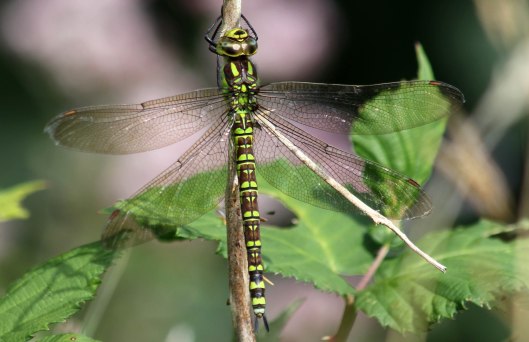
Although I’d seen a Southern hawker dragonfly (Aeshna cyanea) once before, I hadn’t managed to get any good photos until I spotted this little beauty while on an outing to Lewes in East Sussex during last week’s holiday. Though the spot where she settled meant she was slightly obscured by vegetation, she very obligingly stayed put while I got several shots.

160815 Southern Hawker (1)

At around 70mm (2¾ inches) long, Southern hawkers are reasonably large creatures, and my research tells me they can be very inquisitive, sometimes flying right up to the people watching them to check them out. I’ve yet to see a male but imagine them to be rather handsome as they have vivid blue and green colouring with similar dark patterning to the female.

160815 Southern Hawker (3)
160815 Southern Hawker (2)

Neither of the Southern hawkers I’ve seen was near water and this is quite common, apparently. Though they need well-vegetated ponds in which to lay their eggs, they can often be seen hawking for food along tree-lined paths and woodland rides. These dragonflies are common in southern parts of England and Wales, hence the name Southern hawker.

160815 Southern Hawker (4)

Like Loading...
← Older posts
Newer posts →

About me

sconzani

sconzani

I'm a writer and photographer; researcher and blogger; birder and nature lover; countryside rambler and city strider; volunteer and biodiversity recorder.

View Full Profile →

Follow earthstar on WordPress.com

Enter your email address to follow this blog and receive notifications of new posts by email.

Recent blog posts

  • The return of the Willow warblers April 23, 2026
  • Bug: Harpocera thoracica April 22, 2026
  • A female Tawny April 21, 2026
  • NFY: Orange-tip April 20, 2026
  • All the yellows April 19, 2026

From the archives

COPYRIGHT

Unless otherwise acknowledged, the text and photographs on this blog are my own and are subject to international copyright. Nothing may be downloaded or copied without my permission.

Fellow Earth Stars!

  • Unknown's avatar
  • Unknown's avatar
  • Unknown's avatar
  • Unknown's avatar
  • Unknown's avatar
  • Unknown's avatar
  • Unknown's avatar
  • Unknown's avatar
  • Unknown's avatar
  • Unknown's avatar
  • Unknown's avatar
  • Unknown's avatar
  • Unknown's avatar
  • Unknown's avatar
  • Unknown's avatar
  • Unknown's avatar
  • Unknown's avatar
  • Unknown's avatar
  • Unknown's avatar
  • Unknown's avatar
  • Unknown's avatar
  • Unknown's avatar
  • Unknown's avatar
  • Unknown's avatar
  • Unknown's avatar
  • Unknown's avatar
  • Unknown's avatar
  • Unknown's avatar
  • Unknown's avatar
  • Unknown's avatar
  • Unknown's avatar
  • Unknown's avatar
  • Unknown's avatar
  • Unknown's avatar
  • Unknown's avatar
  • Unknown's avatar
  • Unknown's avatar
  • Unknown's avatar
  • Unknown's avatar
  • Unknown's avatar
  • Unknown's avatar
  • Unknown's avatar
  • Unknown's avatar
  • Unknown's avatar
  • Unknown's avatar
  • Unknown's avatar
  • Unknown's avatar
  • Unknown's avatar
  • Unknown's avatar
  • Unknown's avatar

Blog at WordPress.com.

Privacy & Cookies: This site uses cookies. By continuing to use this website, you agree to their use.
To find out more, including how to control cookies, see here: Cookie Policy
  • Subscribe Subscribed
    • earthstar
    • Join 642 other subscribers
    • Already have a WordPress.com account? Log in now.
    • earthstar
    • Subscribe Subscribed
    • Sign up
    • Log in
    • Report this content
    • View site in Reader
    • Manage subscriptions
    • Collapse this bar
 

Loading Comments...
 

You must be logged in to post a comment.

    %d