• ABOUT
  • BIRDING 2018
  • Birding 2019
  • BLOG POSTS
  • Butterflies 2018
  • Resources

earthstar

~ a celebration of nature

earthstar

Category Archives: insects

National Dragonfly Week: The Common Darter

25 Monday Jul 2016

Posted by sconzani in insects, nature

≈ 3 Comments

Tags

Common Darter, dragonflies, dragonfly, National Dragonfly Week 2016, Sympetrum striolatum

Did you know that the dragonfly is one of the fastest flying insects in the world? The Smithsonian says that, with a speed of 56 kms (35 miles) per hour, it is actually the fastest but other sources say the Horsefly is faster – no wonder I can never escape being bitten by those nasty but beautiful flies! Dragonflies also have amazing manoeuvrability, hovering like helicopters, dive-bombing their prey, and even flying backwards.
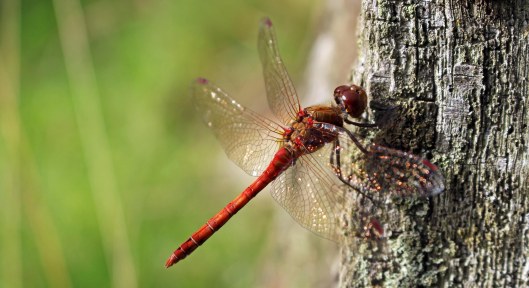
160725 (1) Common darter male

For day three of our celebration of dragon and damselflies, let me introduce you to one of these incredibly speedy dive-bombing hoverers, the Common Darter (Sympetrum striolatum). As their name suggests they are exceedingly common in England and Wales, though they shy away with the colder climes further north, and, yes, they do dart, particularly when pursuing insects to eat. They can appear quite similar to Ruddy Darters, but those dragonflies have a ‘waisted’ abdomen and black legs whereas the Commons have yellow-striped legs.

160725 (2) Common darter imm male

My photos are only of males – they are lighter in colour when immature – and show them in very typical positions, perched on logs, fences, twigs, wires and farm gates while they keep an eye out for passing insects. Though they need the water of ponds, canals, lakes, even ditches to lay their eggs in, they can often be seen away from water. They are not territorial so they do, apparently, assemble in quite large numbers, with ‘groups of several hundred in a single field’ having been recorded and ‘lines of insects … seen along the top of field gates’. Oh to see such a sight!

160725 (3) Common darter male
160725 (4) Common darter imm male
Like Loading...

National Dragonfly Week: Large Red damsel

24 Sunday Jul 2016

Posted by sconzani in insects, nature

≈ 5 Comments

Tags

damselflies, damselfly, Large Red damselfly, National Dragonfly Week 2016, Pyrrhosoma nymphula

For day two of National Dragonfly Week we have another damselfly, the Large Red (Pyrrhosoma nymphula). Of the 20 species of damselfly found in Britain, there are only two that are red and the other, the Small Red, is rare and confined to specific heathland areas, so the chances are that if you see a mainly red damselfly (the females have varying amounts of red and black on their abdomens), it is the Large Red. If only all damselfly identification were so easy!

160724 Large red (1)

The Large Red is one of the first damselflies to appear each spring, flying from early to mid April through to September, and can be found throughout Britain wherever there’s fresh water – ponds, canals, lakes, boggy areas and slow-moving rivers (not fast) – with some vegetation around for it to perch on.

160724 Large red (2)

Mr Large Red can be quite aggressive, buzzing other males foolish enough to invade his territory. When they mate, the male clamps on to the female just behind her head, as you can see in my photo above, and she would normally then bend her body around to attach to his reproductive organs, thus forming the ‘mating wheel’. Maybe this female just wasn’t that into him!

160724 Large red (3)
160724 Large red (4)
Like Loading...

National Dragonfly Week: Beautiful Demoiselle

23 Saturday Jul 2016

Posted by sconzani in insects, nature

≈ 6 Comments

Tags

Beautiful Demoiselle, British Dragonfly Society, Calopteryx Virgo, damselfly, dragonflies, dragonfly, National Dragonfly Week 2016

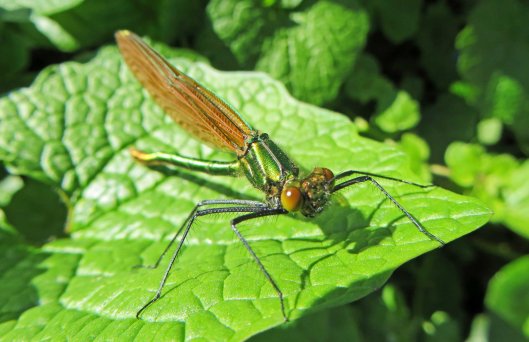
Back at the end of April I wrote about my first dragonfly sighting of the year – only it turned out to be a damselfly, not a dragonfly, and I blogged about my first lesson in telling the two families apart. That gorgeous creature was a female of the very aptly named Beautiful Demoiselle (Calopteryx Virgo) species. Since then I’ve been lucky enough to see many more Beautiful Demoiselles, including the equally handsome metallic blue-green male of the species. I’ve also seen many other types of damselflies and some, though not as many, dragonflies (the 4-spotted chaser featured in one blog, and the Broad-bodied chaser in another).

160723 damsel Beautiful Demoiselle female

You may not know it but today is the first day of National Dragonfly Week 2016, which this year runs from Saturday 23rd to Sunday 31st July. It’s the brainchild of the British Dragonfly Society, which exists to record dragonfly numbers and to educate people about dragonflies and their habitats in order to aid with their conservation. The society and other wildlife groups will be holding events throughout the week to raise awareness of damsel and dragonflies – you can see more on the BDS website – and I will be highlighting a different species each day this week as my own way of celebrating these heavenly creatures.

160723 damsel Beautiful Demoiselle male

Like Loading...

Innominate flies

21 Thursday Jul 2016

Posted by sconzani in insects, nature

≈ 4 Comments

Tags

diptera, flies, fly, fly quotations, quotes about flies

Flies may not be everybody’s favourite mini-beasties but they come in amazing colours and patterns, and you might be surprised how many famous people have mentioned them in their quotations.

160720 flies (1)

‘A closed mouth catches no flies.’ ~ Miguel de Cervantes

160720 flies (2)

‘As flies to wanton boys, are we to the gods; they kill us for their sport.’ ~ William Shakespeare

160720 flies (3)

‘Laws are spider webs through which the big flies pass and the little ones get caught.’ ~ Honore de Balzac

160720 flies (4)

‘A spoonful of honey will catch more flies than a gallon of vinegar.’ ~ Benjamin Franklin

160720 flies (5)

‘Flies, worms, and flowers exceed me still.’ ~ Isaac Watts

Like Loading...

The Silver Y moth

18 Monday Jul 2016

Posted by sconzani in insects, nature

≈ 6 Comments

Tags

Autographa gamma, British moth, migratory moth, moth, Silver Y, Silver Y moth

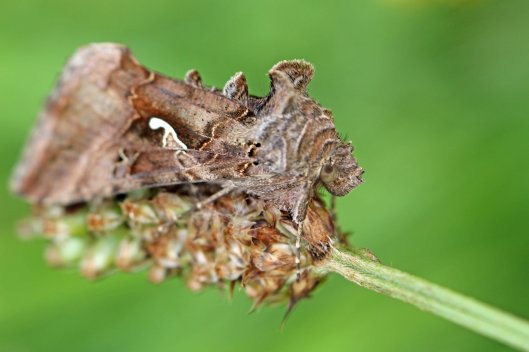
When I first spotted this little moth clinging upside down to a flowerhead of Ribwort plantain, I thought it was a pupa of some kind. It was only when I got really close with my camera that I noticed a little eye watching me. Though it must’ve been a bit shocked to see a giant with a black box looming over it, it didn’t move. Even as I rotated the stem this way and that to get photos from different angles, it stayed perfectly still. Maybe it was petrified or maybe it just felt assured that its perfect camouflage meant it wouldn’t be harmed – and it certainly wasn’t harmed. And I was overjoyed to see such a gorgeous creature.

160718 silver y moth (2)

It’s a Silver Y moth (Autographa gamma), named for the little white marking on its forewings that looks like a Y or, if you know your Greek alphabet, a gamma. Though they can be found in the warmer parts of Britain all year round, these little creatures (with a wingspan of 30-45mm) are also migratory. In spring, they fly from the southern parts of Europe and from north Africa as far north as Greenland, Iceland and the Scandinavian countries, sometimes arriving in Britain in their thousands. Look for them on their favourite food plants, the clovers, Common nettle, and the peas and cabbages in your vegetable garden.

160718 silver y moth (1)
160718 silver y moth (3)
Like Loading...

Brown is the new black

16 Saturday Jul 2016

Posted by sconzani in insects, nature

≈ 9 Comments

Tags

Aphantopus hyperantus, butterflies, butterfly, Cathays Cemetery, Maniola jurtina, Meadow Brown, Ringlet

160716 Meadow Brown (1)

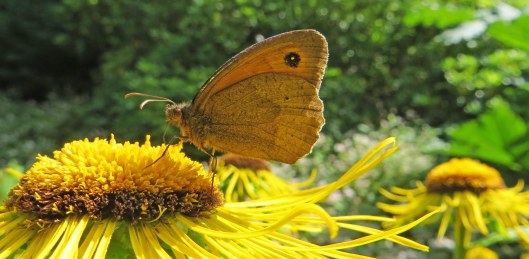
The two butterflies I see most often at the moment are fifty shades of brown and, when flying, very difficult to tell apart. Both enjoy the sheltered areas of tall grass and wildflowers in the conservation areas of Cathays Cemetery and, on a sunny day, I might see a combined total of perhaps thirty. Both are difficult to photograph as they rarely keep still long enough for me to reach them, let alone get focused shots, and they often settle down low in areas of long grass so, even at my most stealthy, I can seldom step through the greenery without disturbing them.

160716 ringlet (1)
160716 ringlet (2)

The Ringlet (Aphantopus hyperantus) is not a Shirley Temple lookalike – its common name comes from the series of little ring markings on its hind wings. One of the advantages of being brown is that it is more easily able to warm itself up so can still be seen flying on overcast days. Common throughout Britain (except for the northernmost parts of Scotland), it tends to live in colonies, sometimes numbering up to several thousand individuals – what a sight that would be!

160716 Meadow Brown (2)
160716 Meadow Brown (3)

As its name suggests, the Meadow Brown (Maniola jurtina) is brown and lives in meadows, and it’s one of the most common, widespread and least endangered of British butterflies. There are, in fact, four separate sub-species, differentiated by location and extremely subtle variations in markings but I’m not going to venture in to that level of specialisation (there’s a wealth of information on the UK Butterflies website if you’re tempted).

Like Loading...

Get a gryp–o!

14 Thursday Jul 2016

Posted by sconzani in insects, nature

≈ 5 Comments

Tags

Calocoris (Grypocoris) stysi, Grypocoris (Lophyromiris) stysi, Grypocoris stysi, leaf bug, Miridae, plant bug

A Grypocoris (Lophyromiris) stysi that is – the bug formerly known as Calocoris (Grypocoris) stysi. Though it’s a relatively common bug and can be found throughout Britain, this little dude has no common name so I’ve taken to calling it Grypo – those Latin names are just too long-winded to get my tongue around and not so easy on the memory either.

160714 grypocoris stysi (1)

So, the Grypos are out in force at the moment. Their eggs hatch in May, they eat up large during June and July – mostly on nettles and umbellifers, though the odd snack of aphid also goes down a treat – and by the end of August they’re gone. They’re wee things, between 6 and 8mm long, so not always easy to spot but their distinctive patterning means they are, at least, easy to identify – not the case with many of Britain’s bug community.

160714 grypocoris stysi (2)
160714 grypocoris stysi (3)
160714 grypocoris stysi (4)

Grypo is one of the myriad Miridae family, which includes more than 10,000 species of plant / leaf / grass bugs. As many members of Grypo’s extended family are stem-piercing sap-sucking plant pests, they frequently suffer from bad press. Rest assured, little Grypo is one of the good guys.

160714 grypocoris stysi (5)
160714 grypocoris stysi (6)
160714 grypocoris stysi (7)
Like Loading...

It’s a Comma!

11 Monday Jul 2016

Posted by sconzani in insects, nature

≈ 8 Comments

Tags

butterfly, Comma, Comma butterfly, Comma butterfly pupa, Polygonia c-album, pupa

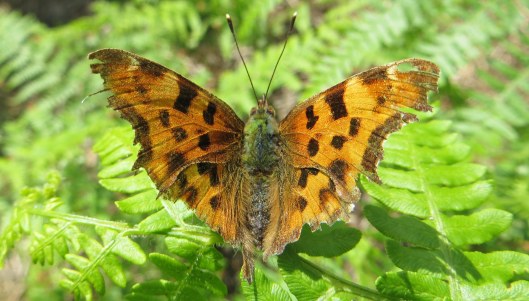
I’d seen the stunning Comma butterfly (Polygonia c-album) before, when I lived in Cheshire for 6 months, but this was my first in Wales and the first for 2016. And, surprisingly for a butterfly that can be quite skittish, it was very amenable to photography, fluttering off and coming back to a nearby leaf and changing its pose so I could get a variety of shots – a born model!

160711 Comma (1)

Named for the small white comma-shaped mark on the underside of its wings, the Comma is a resilient species. The main food plant for its caterpillars used to be the hops used in brewing beer so the butterfly’s numbers dwindled perilously when hop farming declined in the 1800s. For some reason, the Comma has changed its larval food plant to the Common nettle so, since the 1960s, both its numbers and the extent of its range have increased dramatically. It’s a born survivor!

160711 Comma (2)
160711 Comma (3)

You can just see the little white comma on the underwide of the wing in the photo above left. On the right is the pupa – a beautifully textured structure, with small silver highlights. And below is a rather battered-looking older specimen, seen when I lived in Cheshire.

160711 Comma (4)

Like Loading...

The 5-spot Burnets

09 Saturday Jul 2016

Posted by sconzani in insects, nature

≈ 10 Comments

Tags

5-spot Burnet, Cathays Cemetery, Common bird's foot trefoil, moth, Zygaena trifolii

I thought after yesterday’s post you might like to see the moth that little Henderson Cuthbert the caterpillar will, hopefully, develop into. As you can see, the 5-spot Burnet moth (Zygaena trifolii) is a real beauty.

160710 5-spot burnet (1)

Its preferred habitats are marshlands and boggy heaths, so I’m not entirely sure how they came to live in Cathays Cemetery, though the shade provided by the many tall, mature trees does tend to keep the uncut grass of the conservation areas quite damp so perhaps that serves them just as well. There is also plenty of Common bird’s foot trefoil (the yellow flower shown in one of my photos), which is their favourite food plant.

160710 5-spot Burnet (2)
160710 5-spot Burnet (4)

The 5-spots are certainly plentiful at the moment – when I wander around the cemetery paths, it’s not unusual to see half a dozen at a time. I hope my little friend H. C. will soon join his relations, buzzing about the graves like little pink-winged bumblebees.

160710 5-spot Burnet (3)

Like Loading...

When is a 5-spot not?

08 Friday Jul 2016

Posted by sconzani in insects, nature

≈ 17 Comments

Tags

5-spot Burnet, 5-spot Burnet moth caterpillar, caterpillar, Cathays Cemetery, moth, Narrow-bordered 5-spot

Meet Henderson Cuthert. He’s a 5-spot Burnet moth caterpillar and, though he will never know it, he has been a brilliant help to me in determining whether all the Burnet moths I keep seeing at my local cemetery are 5-spot Burnets or Narrow-bordered 5-spot Burnets. The two moths are almost impossible to tell apart but the length of the hairs on their caterpillars is a determining factor – short for 5-spot, long for Narrow-bordered 5-spot. And it’s likely that there is a colony of just one species at the cemetery rather than both.

160709 5-spot Burnet caterpillar  (1)

You may well wonder why my little friend is called Henderson Cuthbert (and you may well think me more than a little crazy when I explain). The events were as follows:
Day 1: Caterpillar spotted in front of grave of a husband and wife named Henderson. Photos taken, name filed in memory so I could remember where he was located.
Day 2: I had a sneaky feeling he was getting ready to pupate so returned to see what was happening … and he was, though he had only spun the thinnest of coverings at that stage. The weather was lousy and he looked like getting hammered by a nearby bush so I relocated his piece of grass to the grave opposite. The surname on that headstone was Cuthbert (thus Henderson Cuthbert).

160709 5-spot Burnet caterpillar (2)
160709 5-spot Burnet caterpillar (3)
160709 5-spot Burnet pupa (1)

But wait, there’s more …
Day 3: Initially, I thought the pupa had to be examined to determine species, so I returned again and carefully brought Henderson Cuthbert home with me, though I was rather devastated that he might have to sacrifice his life in the name of biological recording.
Day 4: I discovered my mistake, sent photos rather than pupa for identification, and little H.C. gets to live to be a moth. Delight!
Day 5: That’s tomorrow. I will take H.C. back to the cemetery so he can complete his life cycle in peace.

Many thanks to County Recorder Dave Slade for help in identifying Henderson Cuthbert.

Like Loading...
← Older posts
Newer posts →

About me

sconzani

sconzani

I'm a writer and photographer; researcher and blogger; birder and nature lover; countryside rambler and city strider; volunteer and biodiversity recorder.

View Full Profile →

Follow earthstar on WordPress.com

Enter your email address to follow this blog and receive notifications of new posts by email.

Recent blog posts

  • The return of the Willow warblers April 23, 2026
  • Bug: Harpocera thoracica April 22, 2026
  • A female Tawny April 21, 2026
  • NFY: Orange-tip April 20, 2026
  • All the yellows April 19, 2026

From the archives

COPYRIGHT

Unless otherwise acknowledged, the text and photographs on this blog are my own and are subject to international copyright. Nothing may be downloaded or copied without my permission.

Fellow Earth Stars!

  • Unknown's avatar
  • Unknown's avatar
  • Unknown's avatar
  • Unknown's avatar
  • Unknown's avatar
  • Unknown's avatar
  • Unknown's avatar
  • Unknown's avatar
  • Unknown's avatar
  • Unknown's avatar
  • Unknown's avatar
  • Unknown's avatar
  • Unknown's avatar
  • Unknown's avatar
  • Unknown's avatar
  • Unknown's avatar
  • Unknown's avatar
  • Unknown's avatar
  • Unknown's avatar
  • Unknown's avatar
  • Unknown's avatar
  • Unknown's avatar
  • Unknown's avatar
  • Unknown's avatar
  • Unknown's avatar
  • Unknown's avatar
  • Unknown's avatar
  • Unknown's avatar
  • Unknown's avatar
  • Unknown's avatar
  • Unknown's avatar
  • Unknown's avatar
  • Unknown's avatar
  • Unknown's avatar
  • Unknown's avatar
  • Unknown's avatar
  • Unknown's avatar
  • Unknown's avatar
  • Unknown's avatar
  • Unknown's avatar
  • Unknown's avatar
  • Unknown's avatar
  • Unknown's avatar
  • Unknown's avatar
  • Unknown's avatar
  • Unknown's avatar
  • Unknown's avatar
  • Unknown's avatar
  • Unknown's avatar
  • Unknown's avatar

Blog at WordPress.com.

Privacy & Cookies: This site uses cookies. By continuing to use this website, you agree to their use.
To find out more, including how to control cookies, see here: Cookie Policy
  • Subscribe Subscribed
    • earthstar
    • Join 642 other subscribers
    • Already have a WordPress.com account? Log in now.
    • earthstar
    • Subscribe Subscribed
    • Sign up
    • Log in
    • Report this content
    • View site in Reader
    • Manage subscriptions
    • Collapse this bar
 

Loading Comments...
 

You must be logged in to post a comment.

    %d