• ABOUT
  • BIRDING 2018
  • Birding 2019
  • BLOG POSTS
  • Butterflies 2018
  • Resources

earthstar

~ a celebration of nature

earthstar

Category Archives: insects

Death in the cemetery

07 Thursday Jul 2016

Posted by sconzani in insects, nature

≈ 4 Comments

Tags

Cathays Cemetery, Cinnabar moth, Common blue damselfly, Common crab spider, Leptopterna species, micro moth, Xysticus cristatus, Xysticus species

The association of death with a cemetery is not exactly unexpected but, in this case, I’m documenting the death of wildlife rather than humans because, just as I see the beginnings of life happening in the cemetery (those Common red soldier beetles were just one example!), so I also see its ending.

160707 death Cinnabar & Common crab CathaysCem

Here a beautiful Cinnabar moth (Tyria jacobaeae) has met its end in the fangs of a spider, probably a Common crab spider (Xysticus cristatus) but please correct me if I’m wrong. I’m not good at identifying spiders. It seems the spider pounced while the moth was concentrating on laying her eggs on the undersides of these leaves.
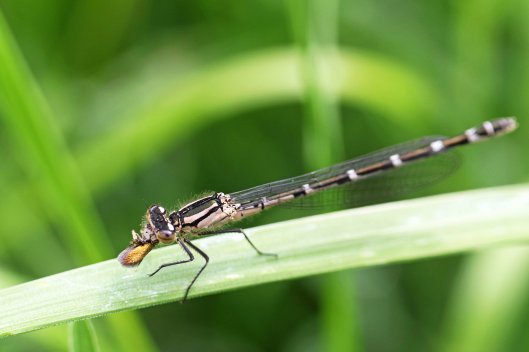
160707 death Common Blue female CathaysCem

Common blue damselflies (Enallagma cyathigerum) are quite small but this female’s lunch is even smaller and is probably a micro moth, but, as there are 1627 species of micro moths in the British Isles, I’m not even going to hazard a guess as to which one this is.
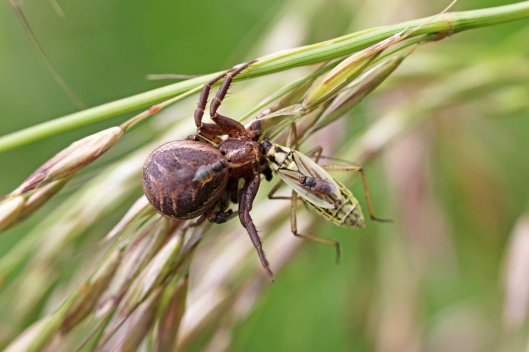
160707 death Xysticus sp & Leptopterna sp nymph CathaysCem

Once again, a lurking spider has successfully captured its next meal. I’m reliably informed this is also one of the Xysticus species of crab spiders, and its victim is a nymph of the Leptopterna species of grass bugs. The tiny flies are an intriguing mystery – they appeared to be travelling around with the spider like the pilot fish that live as ectoparasites in the company of sharks.

Like Loading...

Aye, aye, skipper!

05 Tuesday Jul 2016

Posted by sconzani in insects, nature

≈ 4 Comments

Tags

butterflies, butterfly, Large skipper, Ochlodes sylvanus, Small skipper, Thymelicus sylvestris

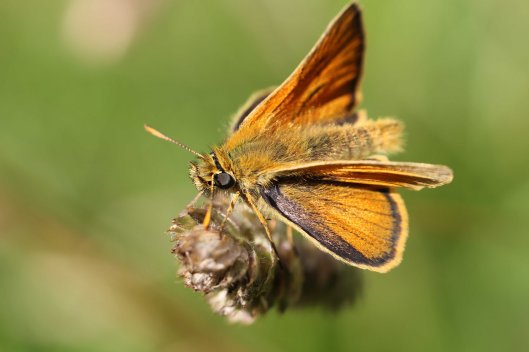
A couple of weeks ago I posted about several recent butterfly sightings, including one of the Large skipper (Ochlodes sylvanus). Today we have my first 2016 sighting of a Small skipper (a completely separate species, Thymelicus sylvestris), which I was lucky enough to see and photograph at the cemetery last Sunday. It’s often difficult to tell the Large (below, left) and Small (below, right) apart when they’re flying but, in these photos, you can clearly see the differences in the markings on their upper wings. The colours of both skippers remind me of golden amber, especially when the sunshine touches them.

160705 Large Skipper
160705 Small skipper (1)

Apparently, the Small skipper’s eggs usually hatch in late summer, after which the wee caterpillars overwinter within the grass stalk where their eggs were originally laid. Come spring, they spin themselves a little grass shelter that helps protect them from predators, initially only popping out at night to feed but emerging more often during the day as they grow larger. They pupate in May and June, before appearing, often in large numbers, as beautiful butterflies in July. My Small skipper was true to form, basking on grass in the warm sunshine, allowing me to get lots of lovely photos.

160705 Small skipper (3)160705 Small skipper (2)

Like Loading...

Sex in the cemetery

04 Monday Jul 2016

Posted by sconzani in flowers, insects, nature

≈ 5 Comments

Tags

beetles, Cathays Cemetery, Common red soldier beetle, Rhagonycha fulva

I popped in to the new section of Cardiff’s Cathays Cemetery yesterday for a mooch. Around the old graves, where last week there had been a colourful mix of long grasses and wildflowers, the strimmers had been in and done their destructive work (why? why? why?) so there wasn’t much insect life to be found. However, I spotted a burst of bright yellow – one of the Santolina species of shrubs – in the middle of an adjoining section so, thinking there might be a bee or two, I went to investigate.

160704 red soldier beetles (7)

Well, I couldn’t believe my eyes! It was seething with Common red soldier beetles (Rhagonycha fulva). There must’ve been hundreds of them, scurrying from flower to flower, feasting on the obviously delicious pollen and nectar, and … um … creating more soldier beetles. Everywhere I looked there were couples. As I later read on the Wildlife Trust website, the ‘adults spend much of their short, summer lives mating and can often be seen in pairs.’ Ain’t that the truth!

160704 red soldier beetles (1)
160704 red soldier beetles (2)
160704 red soldier beetles (3)
160704 red soldier beetles (4)
160704 red soldier beetles (5)
160704 red soldier beetles (6)
Like Loading...

The photo-bombing beetle

03 Sunday Jul 2016

Posted by sconzani in fungi, insects, nature

≈ 10 Comments

Tags

beetle, fungus, inkcap, insect photobomber, mossy log, Red-headed Cardinal beetle, Rhydypennau Wood

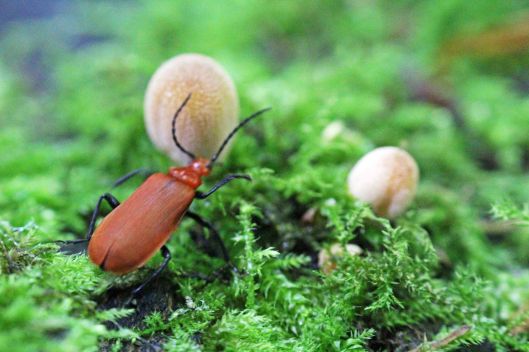
During yesterday’s walk to the stunning wildflower meadows neighbouring Cardiff’s Llanishen Reservoir, I detoured through Rhydypennau Wood to see what fungi might be about. There wasn’t a lot but I spotted some inkcaps sprouting amongst the moss on a fallen log so thought I’d get some photos.

160703 photobombing beetle (1)

The camera was out, I was kneeling in the leaf litter, leaning on the log, and had just taken my first shot when …

160703 photobombing beetle (2)

‘Oi, lady photographer leaning all over MY mossy log, I’m coming through!’, squeaked the Red-headed cardinal beetle.

160703 photobombing beetle (3)

It tootled along the log, through my shot, over MY inkcaps, and on its merry way.

160703 photobombing beetle (4)

And it left me laughing in its wake. Best photo bomb ever!

Like Loading...

All spit and no cuckoo

30 Thursday Jun 2016

Posted by sconzani in insects, nature

≈ 8 Comments

Tags

Cercopis vulnerata, cuckoo spit, froghopper, red-and-black froghopper, spittle bug

What an intriguing insect this is! I’d heard of spittle bugs, of course, but didn’t really know anything about them until I started researching their story to go with my photos. Briefly, here’s what I’ve discovered …

160630 Red-and-black Froghopper (1)

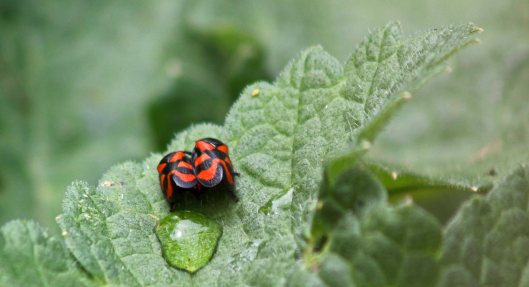
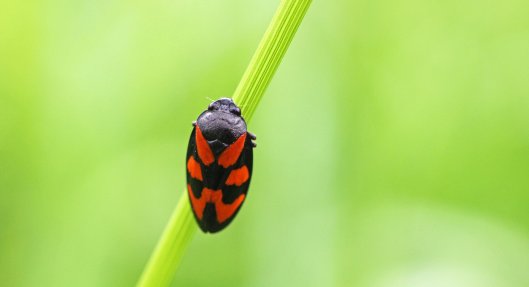
The Red-and-black froghopper, scientific name Cercopis vulnerata, spends most of its life as a nymph living around the roots of trees, and the adults only appear above ground for a few short weeks in the summer.

160630 Red-and-black Froghopper (2)

So many British insects are hard to identify but the colours of this froghopper make it truly unmistakable – good news when it’s looking for a mate. Please excuse yet another voyeuristic photo of insects in copula!

160630 Red-and-black Froghopper (3)

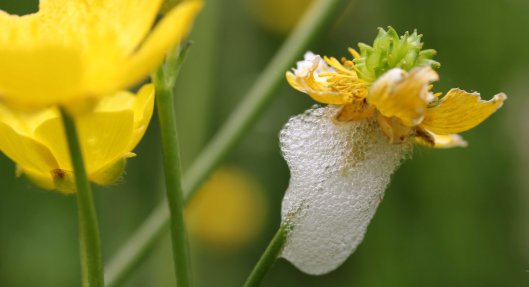
Now comes the weird bit, the ‘cuckoo spit’, so named because it appears about the same time cuckoos reappear in Britain and can be heard broadcasting their characteristic call, though why the spittle is referred to as their spit escapes me. And it’s not really spit at all – it’s produced by the tiny froghopper nymph to protect itself from drying up and as a place to hide from predators.

160630 Red-and-black Froghopper (4)

This cute little nymph actually mixes a fluid from its anus with a secretion from its abdominal glands and then blow bubbles into the mixture from a valve on its tummy. (And I touched that stuff!) After hanging out in its bubble sac for a while, the nymph heads underground, where it sheds its skin several times before changing into its red-and-black adult form and starting the process all over again.

160630 Red-and-black Froghopper (5)

Oh, and the froghopper part of its name comes from the way it imitates a frog by leaping away from danger, though I’ve never seen one do that. Maybe my camera and I don’t look all that dangerous.

Like Loading...

The B-B C, but not as you know it

26 Sunday Jun 2016

Posted by sconzani in insects, nature

≈ 6 Comments

Tags

Broad-bodied Chaser, dragonflies, dragonfly, dragonfly ovipositing, Libellula depressa, National Insect Week

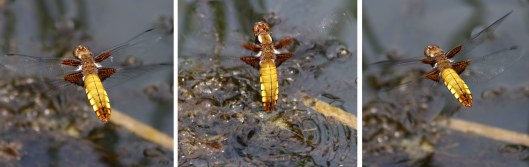
For this last day of National Insect Week 2016 we have one of my favourite types of insect, the dragonfly. Meet the Broad-bodied Chasers (or Libellula depressa to the scientifically minded). If we’re being politically correct, we won’t call them fat – they just happen to be a bit wider in the body than most other dragonflies. Both male and female start off a golden brown colour, but Mr B-B C soon develops a rather dapper layer of blue powdery granules (pruinescence) which matches perfectly with the yellow dots they both have along the sides of their abdomens.

160626 Broad-bodied chaser male

I’ve seen two pairs of Broad-bodied Chasers so far this year, both around small ponds which the males regularly patrol to ensure no intrusions into their territories. I’ve also been privileged to see them mating, a rather brief in-flight encounter, and then to see the female ovipositing – dipping her lower abdomen quickly into the water while in flight, to deposit her eggs into vegetation below the water level (as shown in the photos below). If you’re in southern England or Wales, these beauties will be around till September so go check out the show.

160626 Broad-bodied chaser female ovipositing

Like Loading...

The scorpion that doesn’t sting

25 Saturday Jun 2016

Posted by sconzani in insects, nature

≈ 7 Comments

Tags

National Insect Week, Panorpa communis, Panorpa species, scorpion fly

When is a scorpion not a scorpion? When it’s a fly, with a tail that looks like a scorpion – but only in the males and, even then, the sting can’t actually sting – it is, in fact, his genitals! This may be Panorpa communis but there are three species of scorpion fly in Britain and to distinguish between them you need to examine – you guessed it! – their genitals! (In the photos below, the male is on the left.)

160626 scorpion fly (3)
160626 scorpion fly (2)

While we’re on the subject of genitals, mating can be very risky for the male of the species, as females have been known to kill their mates. To divert the females, it seems the males have a trick up their sleeves under their wings – to woo the fly of their dreams, they offer up a gift of their own saliva which, apparently, works a treat.

160626 scorpion fly (1)

Lurking in hedgerows and woodlands, and particularly partial to nettle-filled areas, scorpion flies feed on dead insects. They are also known as hanging flies, from their habit of camouflaging themselves by dangling from leaves and twigs in order to pounce on the small unsuspecting critters that pass by. They are truly bizarre-looking creatures but completely harmless and rather comical to watch.

Like Loading...

Fluttering butterflies, no.2

24 Friday Jun 2016

Posted by sconzani in insects, nature

≈ 7 Comments

Tags

Anthocharis cardamines, British butterflies, butterfly, Celastrina argiolus, Common blue butterfly, Holly blue butterfly, Large skipper butterfly, Ochlodes sylvanus, Orange-tip butterfly, Polyommatus icarus

Though summer is well underway here in Britain, I’m not seeing a huge number of butterflies. Here are some I have seen fluttering by in recent weeks.

160624 Common Blue

There are several small blue butterflies in Britain and they can be difficult to tell apart but the Common blue (Polyommatus icarus) is, as its name implies, the most common. As is often the way with wildlife, the males are bright blue, whereas the females can be quite a drab brown.

160624 Holly blue

The Holly blue (Celastrina argiolus) looks quite similar to the Common Blue, especially in flight. The trick to identifying it is in the small black dots on the underwings. It is also the blue butterfly that emerges first from its winter hibernation so look for it near holly plants in early spring, then fluttering about ivy in the summertime.

160624 Orange tip

If this is an Orange-tip butterfly (Anthocharis cardamines), where’s the orange colour? Turns out this is a female and only the males have bright orange wing tips. Still, she’s a very pretty little thing, even if she did seem a bit shy and hid her head behind a leaf.

160624 Large Skipper

Though it’s called the Large skipper (Ochlodes sylvanus), this butterfly is relatively small, its wingspan just a couple of millimetres more than the Small skipper, so you need to look for the mottled brown markings on its upper wings to tell the two apart.

Like Loading...

The Gonzo of insect land

23 Thursday Jun 2016

Posted by sconzani in insects, nature

≈ 6 Comments

Tags

National Insect Week, Nettle weevil, Phyllobius pomaceus, weevil

Although The Muppets appeared after my childhood years, I’m still familiar with the main characters and one of my favourites has always been Gonzo. Perhaps that’s why I also love the Gonzos of the insect world, the weevils. And it’s not just their elongated snouts that remind me of him. Although weevils don’t have Gonzo’s energy, they do seem inclined towards occasional death-defying acts, teetering recklessly on the edges of leaves while reaching out for their next foothold, though they draw the line at catching cannonballs!

160623 nettle weevils (1)
160623 nettle weevils (2)
160623 nettle weevils (3)

Weevils can be difficult to identify but, as the ones pictured here were all found on nettles, I’m going to hazard a guess that they’re Nettle weevils (Phyllobius pomaceus). Being slightly more scientific, I think I can see the prominent tooth on the front femur of some of these creatures, which also helps to identify them, as does the position of their antennas on their heads. As you can see, the Neetle weevil is covered in blue-green scales that have a metallic sheen, though these can rub off as they age – and engage in death-defying (and other!) acts – so, older specimens do sometimes look more black than blue-green.

160623 nettle weevils (4)
160623 nettle weevils (5)
160623 nettle weevils (6)


Like Loading...

The rugby player of the insect world

21 Tuesday Jun 2016

Posted by sconzani in insects, nature

≈ 10 Comments

Tags

Fat-legged flower beetle, National Insect Week, Oedemera nobilis, Swollen-thighed beetle, Thick-legged beetle

160621 swollen-thighed beetle (1)

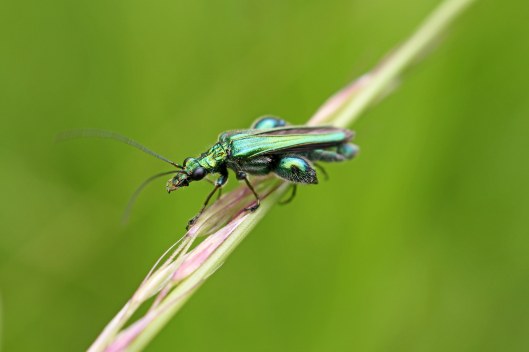
If you thought rugby players had well-developed thighs, take a look at this guy. He must work out at the gym every day of his life. Meet Oedemera nobilis, otherwise known as the Swollen-thighed beetle or, sometimes, the Thick-legged or Fat-legged flower beetle. Once seen, never forgotten … unless you see the female, whose shapely pins are nothing like the male’s.

160621 swollen-thighed beetle (2)

They’re a wonderfully vibrant green, often with a tinge of blue or gold in their metallic sheen, and they’re particularly abundant at this time of year. Though they feed on the nectar and pollen of a wide range of flower species, I’ve often found them immersing themselves in dandelion flowers, to emerge sprinkled in yellow pollen.

Like Loading...
← Older posts
Newer posts →

About me

sconzani

sconzani

I'm a writer and photographer; researcher and blogger; birder and nature lover; countryside rambler and city strider; volunteer and biodiversity recorder.

View Full Profile →

Follow earthstar on WordPress.com

Enter your email address to follow this blog and receive notifications of new posts by email.

Recent blog posts

  • The return of the Willow warblers April 23, 2026
  • Bug: Harpocera thoracica April 22, 2026
  • A female Tawny April 21, 2026
  • NFY: Orange-tip April 20, 2026
  • All the yellows April 19, 2026

From the archives

COPYRIGHT

Unless otherwise acknowledged, the text and photographs on this blog are my own and are subject to international copyright. Nothing may be downloaded or copied without my permission.

Fellow Earth Stars!

  • Unknown's avatar
  • Unknown's avatar
  • Unknown's avatar
  • Unknown's avatar
  • Unknown's avatar
  • Unknown's avatar
  • Unknown's avatar
  • Unknown's avatar
  • Unknown's avatar
  • Unknown's avatar
  • Unknown's avatar
  • Unknown's avatar
  • Unknown's avatar
  • Unknown's avatar
  • Unknown's avatar
  • Unknown's avatar
  • Unknown's avatar
  • Unknown's avatar
  • Unknown's avatar
  • Unknown's avatar
  • Unknown's avatar
  • Unknown's avatar
  • Unknown's avatar
  • Unknown's avatar
  • Unknown's avatar
  • Unknown's avatar
  • Unknown's avatar
  • Unknown's avatar
  • Unknown's avatar
  • Unknown's avatar
  • Unknown's avatar
  • Unknown's avatar
  • Unknown's avatar
  • Unknown's avatar
  • Unknown's avatar
  • Unknown's avatar
  • Unknown's avatar
  • Unknown's avatar
  • Unknown's avatar
  • Unknown's avatar
  • Unknown's avatar
  • Unknown's avatar
  • Unknown's avatar
  • Unknown's avatar
  • Unknown's avatar
  • Unknown's avatar
  • Unknown's avatar
  • Unknown's avatar
  • Unknown's avatar
  • Unknown's avatar

Blog at WordPress.com.

Privacy & Cookies: This site uses cookies. By continuing to use this website, you agree to their use.
To find out more, including how to control cookies, see here: Cookie Policy
  • Subscribe Subscribed
    • earthstar
    • Join 642 other subscribers
    • Already have a WordPress.com account? Log in now.
    • earthstar
    • Subscribe Subscribed
    • Sign up
    • Log in
    • Report this content
    • View site in Reader
    • Manage subscriptions
    • Collapse this bar
 

Loading Comments...
 

You must be logged in to post a comment.

    %d