• ABOUT
  • BIRDING 2018
  • Birding 2019
  • BLOG POSTS
  • Butterflies 2018
  • Resources

earthstar

~ a celebration of nature

earthstar

Category Archives: insects

Rye Harbour Nature Reserve

14 Sunday Aug 2016

Posted by sconzani in birds, insects, nature, wildflowers

≈ 4 Comments

Tags

largest coastal shingle area in Europe, Rye Harbour Nature Reserve, shingle beach

On the first full day of my short break in East Sussex, my friend Jill and I enjoyed a long walk around the fabulous Rye Harbour Nature Reserve, which, along with Dungeness, encompasses the largest coastal shingle area in Europe. Former gravel pits now filled with fresh water together with salt-marshes and saline lagoons provide the perfect habitats for a huge number of birds, as well as both common and rare species of plants and insects. I was in biological heaven!

160814 Rye Harbour (18)

The species in my photos are just a very small selection of what you can see: Black-headed gulls (Chroicocephalus ridibundus) and an unidentified small brown wader; Geranium sp; Viper’s bugloss (Echium vulgare); Little egret (Egretta garzetta); Great mullein (Verbascum thapsus); Curlew (Numenius arquata); Pied wagtail (Motacilla alba); Large white butterfly (Pieris brassicae); Field Grasshopper (Chorthippus brunneus); a plant that looks like a dandelion but isn’t (!); Wild teasel (Dipsacus fullonum); Cormorants (Phalacrocorax carbo); Yellow horned poppy (Glaucium flavum); Coots (Fulica atra); Gatekeeper (Pyronia tithonus) and rather raggedy Red admiral (Vanessa atalanta) butterflies; Lapwings (Vanellus vanellus); and Marsh mallow (Althaea officinalis).

For a wander around the landscapes of Rye Harbour Nature Reserve, check out my Sconzani blog post here.

160814 Rye Harbour (1)
160814 Rye Harbour (2)
160814 Rye Harbour (3)
160814 Rye Harbour (4)
160814 Rye Harbour (5)
160814 Rye Harbour (6)
160814 Rye Harbour (7)
160814 Rye Harbour (8)
160814 Rye Harbour (9)
160814 Rye Harbour (10)
160814 Rye Harbour (11)
160814 Rye Harbour (12)
160814 Rye Harbour (13)
160814 Rye Harbour (14)
160814 Rye Harbour (15)
160814 Rye Harbour (16)
160814 Rye Harbour (17)
Like Loading...

‘Dedicated Naturalist’: ‘brief but fleeting pleasure’

11 Thursday Aug 2016

Posted by sconzani in 'Dedicated Naturalist' Project, insects, nature

≈ Leave a comment

Tags

Eristalis arbustorum, Eristalis pertinax, Eristalis tenax, hoverfly

A snippet from my volunteer work on the ‘Dedicated Naturalist’ Project, helping to decipher and digitise, record and publicise the life’s work of naturalist extraordinaire, Dr Mary Gillham. This is the type of delightful insight we volunteers often discover when mining Mary’s copious archives for biological records. Never a dull moment and frequent chuckling make a volunteer’s work fun!
 160811 Eristalis pertinax

Eristalis tenax drone flies   MATING, presumably, on 10 July 1981. The larger female sitting on flower head – buddleja, hogweed, thistle, &c. Male, or up to four males, smaller but marked exactly the same, narrow yellow bands on black, hovering 2-3” above for often considerable while before darting momentarily down, sweeping a tail across hers and swooping away again. No wonder he has to hover so persistently to get his aim just right for the ‘brief but fleeting pleasure’. Only 1 male is accepted, she flying off almost at once.

160811 Eristalis arbustorum

My images are the same genus but not the same species as Mary’s though their behaviour is similar. The top image is Eristalis pertinax, a very common hoverfly in much of Britain, and the lower image depicts a female (left) and male (right) Eristalis arbustorum, in a situation similar to that Mary has described, with the male awaiting his chance to pounce.

For the full story about the Mary Gillham Archive Project, check out our website, and follow our progress on Facebook and on Twitter.

Like Loading...

The ladybird lifecycle

09 Tuesday Aug 2016

Posted by sconzani in insects, nature

≈ 7 Comments

Tags

Halyzia 16-punctata, harlequin ladybird, Harmonia axyridis, ladybird, ladybird larva, ladybird lifecycle, ladybird pupa, Orange ladybird

Just like every other insect, a ladybird goes through a complete transformation during its short, one-year life but the various stages are something I’ve only become aware of this year so I thought I’d share them with you.

160809 ladybird (1) 22 spot
160809 ladybird (2)

Adult ladybirds spend the cold winter months in a dormant state, awakening in the springtime as the weather begins to warm up. After munching away on some aphids to get their juices flowing again, they look for a member of the opposite sex and mate. I don’t have any egg photos but they are, apparently, bright yellow and are laid on the underside of leaves. Once the mating and egg-laying are complete, the adult ladybirds die.

160809 ladybird (3)
160809 ladybird (4)
160809 ladybird (5) orange Halyzia 16-punctata

Depending on the temperature and weather conditions, the eggs hatch after 3 to 10 days and the little larvae immediately begin eating: scale insects and aphids are their favourites so you can see why gardeners love them. At this stage, they look nothing at all like ladybirds, though they do have unique patterns – left and centre above are Harlequins (Harmonia axyridis) and the one on the right is an Orange (Halyzia 16-punctata).

160809 ladybird (6)
160809 ladybird (7)

After 3 to 4 weeks of constant eating, the larvae pupate, shedding their larval skin and changing into this strange-looking blob you can find attached to the tops of leaves. The metamorphosis from larvae to adult ladybird only takes 7 to 10 days – a miracle really!

160809 ladybird (8)

When the adult ladybird first emerges from its pupa, it is very pale and takes a little while for its final colours to show, though you can usually see traces of its spots. And that’s it! The adult will trundle around the leaves, eating all those pesky aphids until the winter months come, and the whole process will begin all over again.

Like Loading...

Heavenly hoverflies

06 Saturday Aug 2016

Posted by sconzani in insects, nature

≈ 8 Comments

Tags

Cheilosia illustrata, hoverflies, hoverfly, Myathropa florea, Pellucid fly, Volucella inanis, Volucella pellucens, Volucella zonaria

It’s been ages since I shared any images of hoverflies, yet I photograph them almost every time I go wandering and the summer months are prime hover time, so let’s remedy my omission.

160806 Cheilosia illustrata

Cheilosia illustrata
I’ve nicknamed this not-so-little hoverfly, Mr Scruffy, as it’s a bumblebee mimic and therefore rather furry, and oft times a little unkempt looking. It inhabits hedgerows and the shrubby edges of woodlands, and can frequently be seen feeding on the flowers of umbellifers – I see it most often on hogweed or sun-basking on nearby leaves.

160806 Myathropa florea

Myathropa florea
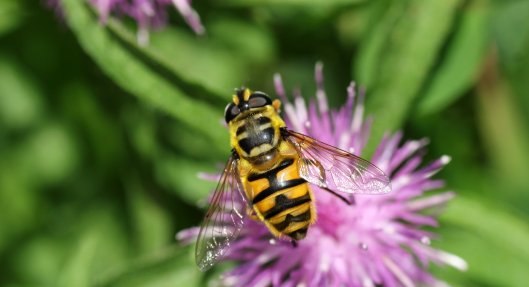
With its striking and often very vibrant pattern of yellow, orange and black markings, Myathropa florea is easily identifiable and, though it flies from May to October, it seems to be the hoverfly I’m seeing most often right now. Like Mr Scruffy, it enjoys feasting on the umbellifer flowers that grow along woodland edges. Can you see why it’s often called the Batman hoverfly?

160806 Volucella inanis (1)
160806 Volucella inanis (2)

Volucella inanis
Now we come to the big boys (and girls) of the hoverfly world. Volucella inanis and its very similar friend Volucella zonaria (below) are hornet mimics but don’t worry – with their vibrant colouring they may look like hornets, but they’re harmless. V. inanis was once localised around London but is gradually spreading throughout Britain.

160806 Volucella zonaria

Volucella zonaria
Volucella zonaria is a European hoverfly which, apparently, only got established in Britain in the 1940s. Since then it’s slowly been expanding its range, though I haven’t yet seen one in Wales. My photo was taken in Exeter in 2014, when I didn’t even know such things as hoverflies existed.

160806 Volucella pellucens

Volucella pellucens
Also known as the Pellucid Fly, Volucella pellucens is quite easy to recognise, as it has a distinctive broad white band across its body. It also favours umbellifer flowers and, though it can be seen right through till October, it’s almost past its peak season so get out and see if you can find one.

Like Loading...

The young ones

04 Thursday Aug 2016

Posted by sconzani in insects, nature

≈ 2 Comments

Tags

caterpillar, Drinker moth caterpillar, Large rose sawfly caterpillar, moth larvae, Old lady moth caterpillar, Pale tussock moth caterpillar, Ruby tiger moth caterpillar, Vapourer moth caterpillar

Caterpillar:
Noun. Pronunciation: /ˈkatəpɪlə/
1. The larva of a butterfly or moth, which has a segmented body resembling a worm with three pairs of true legs and several pairs of leg-like appendages.
1.1. (In general use) any insect larva resembling the larvae of caterpillars and moths, especially that of the sawfly. (Oxford Dictionary)

Here are some examples I’ve spotted of these insect larvae.

Cinnabar (1)
Cinnabar (2)

These black-and-yellow striped critters are Cinnabar moth caterpillars (Tyria jacobaeae), chewing away on their favourite food plant, ragwort.

Parsnip Depressaria pastinacella (1)
Parsnip Depressaria pastinacella (2)

The caterpillars of the Parsnip moth (Depressaria pastinacella) build themselves little silken webs within the structure of the umbellifer flowers (in particular Wild parsnip), on which they feed.

1 Drinker Philudoria potatoria
2 Old lady Mormo maura
3 Vapourer Orgyia antiqua
4 Sawfly rose larva CathaysCem
5 Ruby tiger methyr mawr
6 Pale Tussock Calliteara pudibunda

A snapshot of a few others I’ve sighted (from left to right): Drinker moth (Philudoria potatoria), Old lady moth (Momo maura), Vapourer moth (Orgyia antiqua), sawfly larva (possibly of the Large rose sawfly, Arge pagana), Ruby tiger moth (Phragmatobia fuliginosa), and, lastly, the wild extravagance of the Pale tussock moth caterpillar (Calliteara pudibunda).

Like Loading...

National Dragonfly Week: The Emperor

31 Sunday Jul 2016

Posted by sconzani in insects, nature

≈ 5 Comments

Tags

Anax imperator, dragonflies, dragonfly, dragonfly ovipositing, Emperor dragonfly, National Dragonfly Week 2016

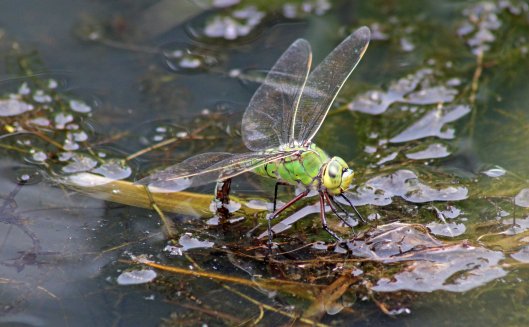
We’re finishing National Dragonfly Week with a grand flourish … let me introduce you to the royalty of the dragonfly world, the Emperor (Anax imperator) and his female, who, strangely enough, is not called the Empress but rather the female Emperor. I think we need to change that!

160731 Emperor male (1)

At around 78mm (just over 3 inches) long, these are Britain’s biggest dragonflies, twice as large as most damselflies, as you can see in my photo below right (sorry for the poor quality of this one but I wanted to show the size comparison). Though they are usually found around water – canals, lakes, ponds, ditches, slow-moving rivers, I have also seen the males hawking over the wildflower areas and around the trees and shrubs at my local cemetery, where the nearest water source is perhaps a kilometre away as the dragonfly flies.

160731 Emperor male (2)
160731 Emperor fem ovipositing (2)

The males are very territorial and seem to be constantly on the move, flying around the boundaries of their empires, chasing away other intruding males, hunting for food (insects, butterflies, tadpoles) and even eating as they fly. After mating – also on the wing – the female lays her eggs (known as ovipositing, see above right and below) in amongst vegetation in the water. The Emperors and their Empresses can be seen flying from June to August, in southern parts of Britain, though they seem gradually to be extending their empires northwards.

160731 Emperor fem ovipositing (3)

Like Loading...

National Dragonfly Week: Azure damselfly

30 Saturday Jul 2016

Posted by sconzani in insects, nature

≈ 2 Comments

Tags

Azure damselfly, Coenagrion puella, damselflies, damselfly, National Dragonfly Week 2016

As I mentioned in yesterday’s post on Common Blue damselflies, it’s often difficult to distinguish between them and the Azure damselflies so here now is the lovely little Azure (Coenagrion puella).

azure male (1)azure male (2)

The key identifying features for the Azure are: the presence of a Coenagrion spur (a short black line below the other markings) on the thorax, and thin antehumeral stripes (the blue stripes on the top of the body are narrower than the black stripes beneath them). The males also have a U-shaped mark at the top of their ‘tail’ but this is not so easy to see in the females (which are usually green or pale blue) as they often have darker markings on their ‘tail’. Once again, if this is confusing, check out the British Dragonfly Society webpage for more help.

azure fem (1)

Though the Azure isn’t keen on the colder parts of northern Scotland, both the Azure and the Common Blue can be seen throughout most of Britain, fluttering around small ponds, streams and lakes. I also see them amongst the long grass at my local cemetery where I presume their water source is the rain that accumulates in the urns that decorate many of the older graves, though I can’t be sure of that.

azure mating (1)

Like Loading...

National Dragonfly Week: Common Blue damselfly

29 Friday Jul 2016

Posted by sconzani in insects, nature

≈ 13 Comments

Tags

Common blue damselfly, damselflies, damselfly, Enallagma cyathigerum, National Dragonfly Week 2016

We’re over half way through National Dragonfly Week 2016 and now we get to some of the trickier critters to identify because there are several blue-coloured damselflies. In fact, in the course of preparing this and tomorrow’s blog posts, I’ve had to call in the experts to check a couple of my photos. When my books and keys don’t quite cover it, the ‘experts’ I use are all the wonderfully helpful folks on the UK Dragonflies & Damselflies group on Facebook – highly recommended!

160729 Common blue male (1)
160729 Common blue male (2)

As we don’t get Southern damselflies (also blue) in Cardiff, the two blues I sometimes have trouble with are the Common Blue and the Azure. The key features to look out for in the Common Blue damselfly (Enallagma cyathigerum) can be seen in the photos above: no Coenagrion spur (a short black line below the other markings) on the thorax, and broad antehumeral stripes (the blue stripes on the top of the body are wider than the black stripes beneath them). The males also have that thistle-shaped mark at the top of their ‘tail’ but this is not so easy to see in the females (which, as you can see below, are not blue) because of their blacker markings. If this all sounds like gobbledygook, you can get more ID help on the British Dragonfly Society webpage.

160729 common blue fem (1)
160729 common blue fem (2)
160729 common blue fem (3)
160729 common blue fem (4)
160729 common blue fem (5)
160729 common blue fem (6)

The Common Blues are the only damselflies I’ve managed to catch in their full mating ritual, showing the ‘mating wheel’. Sometimes, when you see these, they are the exact shape of a heart … awwwww!

160729 Common blue mating

Like Loading...

National Dragonfly Week: Blue-tailed Damselfly

28 Thursday Jul 2016

Posted by sconzani in insects, nature

≈ 2 Comments

Tags

Blue-tailed damselfly, damselflies, damselfly, exuvia, Ischnura elegans, National Dragonfly Week 2016

Let’s continue National Dragonfly Week today with a delightful damselfly, the little Blue-tailed (Ischnura elegans), another very common damselfly that can be seen flying throughout Britain from May through to September. Though there is also a Scarce blue-tailed damselfly, it is, well, scarce, so chances are if you see a dark-coloured damsel with that distinctive all-blue segment towards the end of its body, it will be the Blue-tailed damselfly. The females are a little more tricky, as their abdomens and tail spots can be different colours – pink, violet, pale green, pale brown – depending on their type and state of maturity.

160728 blue-tailed (1)

160728 blue-tailed (2)

I don’t have any female photos so thought I would show you, instead, earlier stages in a damselfly’s lifecycle. The eggs the females lay in their local pond, lake, or slow-moving stream or river hatch into nymphs that live in that water, preying on other larvae and small insects. After as little as six months or as long as two years, and having gone through a series of skin moults as their bodies grow in size, the nymphs leave the water and climb a plant stem, branch or tree trunk, where they undergo the ultimate change, emerging from their final skin to fly as an adult.

160728 damsel exuvia
160728 damsel new

As you can see above, they are often very pale when they emerge as it takes them a while to colour up. You can often find the discarded skin cases (known as exuvia) near watery places – I found a tree alongside my local lake that was covered in them.

Like Loading...

National Dragonfly Week: Banded Demoiselle

26 Tuesday Jul 2016

Posted by sconzani in insects, nature

≈ 10 Comments

Tags

Banded Demoiselle, Calopteryx splendens, damselflies, damselfy, National Dragonfly Week 2016

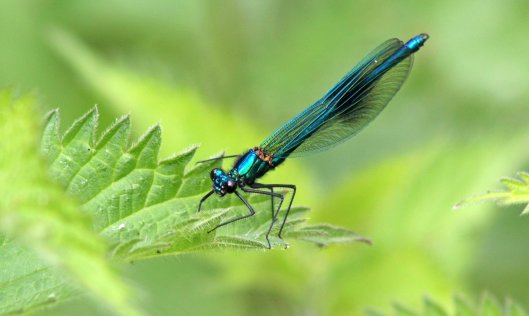
On the first day of National Dragonfly Week I showed you the Beautiful Demoiselle; today we have the other damselfly in the Demoiselle species, the only damselflies in Britain to have coloured wings. This is the Banded Demoiselle (Calopteryx splendens), and you can see immediately from the bands of colour on the males’ wings how it got its common name.

160726 Banded demoiselle male (1)

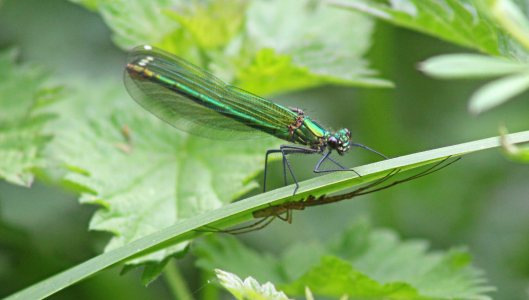
These damselflies are simply gorgeous, the male (above) a stunning metallic blue and the female (below) an equally spectacular metallic green. Common in Wales and all but the northernmost counties of England, they can be seen flying around lakes and ponds and along canals and slow-moving rivers and streams, from late April to early September. Banded Demoiselles are quite sensitive to pollution so their presence is a good sign that the local water source is clean.

160726 Banded demoiselle fem (3)

I wonder if this female knew about the spider, or the spider knew about the damselfly?

The male is territorial and also a bit of a show-off. He performs a delightful display of aeronautic dance moves in his attempts to impress the females – the damselfly version of Patrick Swayze in Dirty Dancing!

160726 Banded demoiselle fem (1)
160726 Banded demoiselle fem (2)
160726 Banded demoiselle male (2)
Like Loading...
← Older posts
Newer posts →

About me

sconzani

sconzani

I'm a writer and photographer; researcher and blogger; birder and nature lover; countryside rambler and city strider; volunteer and biodiversity recorder.

View Full Profile →

Follow earthstar on WordPress.com

Enter your email address to follow this blog and receive notifications of new posts by email.

Recent blog posts

  • The return of the Willow warblers April 23, 2026
  • Bug: Harpocera thoracica April 22, 2026
  • A female Tawny April 21, 2026
  • NFY: Orange-tip April 20, 2026
  • All the yellows April 19, 2026

From the archives

COPYRIGHT

Unless otherwise acknowledged, the text and photographs on this blog are my own and are subject to international copyright. Nothing may be downloaded or copied without my permission.

Fellow Earth Stars!

  • Unknown's avatar
  • Unknown's avatar
  • Unknown's avatar
  • Unknown's avatar
  • Unknown's avatar
  • Unknown's avatar
  • Unknown's avatar
  • Unknown's avatar
  • Unknown's avatar
  • Unknown's avatar
  • Unknown's avatar
  • Unknown's avatar
  • Unknown's avatar
  • Unknown's avatar
  • Unknown's avatar
  • Unknown's avatar
  • Unknown's avatar
  • Unknown's avatar
  • Unknown's avatar
  • Unknown's avatar
  • Unknown's avatar
  • Unknown's avatar
  • Unknown's avatar
  • Unknown's avatar
  • Unknown's avatar
  • Unknown's avatar
  • Unknown's avatar
  • Unknown's avatar
  • Unknown's avatar
  • Unknown's avatar
  • Unknown's avatar
  • Unknown's avatar
  • Unknown's avatar
  • Unknown's avatar
  • Unknown's avatar
  • Unknown's avatar
  • Unknown's avatar
  • Unknown's avatar
  • Unknown's avatar
  • Unknown's avatar
  • Unknown's avatar
  • Unknown's avatar
  • Unknown's avatar
  • Unknown's avatar
  • Unknown's avatar
  • Unknown's avatar
  • Unknown's avatar
  • Unknown's avatar
  • Unknown's avatar
  • Unknown's avatar

Blog at WordPress.com.

Privacy & Cookies: This site uses cookies. By continuing to use this website, you agree to their use.
To find out more, including how to control cookies, see here: Cookie Policy
  • Subscribe Subscribed
    • earthstar
    • Join 642 other subscribers
    • Already have a WordPress.com account? Log in now.
    • earthstar
    • Subscribe Subscribed
    • Sign up
    • Log in
    • Report this content
    • View site in Reader
    • Manage subscriptions
    • Collapse this bar
 

Loading Comments...
 

You must be logged in to post a comment.

    %d