• ABOUT
  • BIRDING 2018
  • Birding 2019
  • BLOG POSTS
  • Butterflies 2018
  • Resources

earthstar

~ a celebration of nature

earthstar

Category Archives: insects

Fly: Merzomyia westermanni

11 Thursday Sep 2025

Posted by sconzani in insects

≈ Leave a comment

Tags

British flies, British fruit flies, British Tephritidae, flies on Ragwort, fruit fly, Merzomyia westermanni, Tephritidae

This little beauty is one of the Tephritidae, the fruit flies, and its name is Merzomyia westermanni. As I’m sure you all know by now, flies can be tricky to identify but, fortunately, the patterns on the wings of this creature are unique so, as long as you get a clear photo of its wings, it can be recorded with confidence. Even better, in my brief experience of this species – I’ve only seen them twice, they are more settled, more confiding than many fly species so getting a photo is less difficult. Look for these fruit flies in grassland, particularly around the Ragwort flowers they favour.

Like Loading...

More moth appreciation

10 Wednesday Sep 2025

Posted by sconzani in insects

≈ Leave a comment

Tags

Bird-cherry ermine, British moths, moth, Nomophila noctuella, Orchard ermine, Pleuroptya ruralis, Pyrausta aurata, Yponomeuta evonymella, Yponomeuta padella

It’s moth appreciation time. Here are a few recent finds …

I thought it would be interesting to place these two ermine moths together so as to show their differences. On the left is an Orchard ermine (Yponomeuta padella), on the right a Bird-cherry ermine (Yponomeuta evonymella). To identify these and the several other species of ermine moths, you need to look carefully at the patterns of their spots and also at their food plants. The Bird-cherry has five rows of black dots on the forewing, so is quite distinctive. The Orchard ermine is very similar in appearance to a couple of other ermines, the Apple ermine and the Spindle ermine, so knowing their food plants is a great help (for the Orchard, they are Blackthorn, Hawthorn and Cherry, while the key to the other two is in their names, Apple and Spindle).

The Mint moth (Pyrausta aurata) can also be a bit tricksy to ID, as it’s very similar to the Common purple-and-gold (Pyrausta purpuralis), but the latter has distinctive light spots on its hind wings, which the Mint moth does not. Unsurprisingly, the Mint moth is often found on or near plants from the Mint (Mentha) family.

This, in my opinion, is the loveliest of today’s moths, the Mother of pearl (Pleuroptya ruralis), named for the pearlescent sheen of its wings. I must remember to look for its larvae, which feed in rolled-up leaves on Nettle plants (I can feel those stings already!).

For me, seeing a Rush veneer (Nomophila noctuella) – or, usually, several Rush veneers in one day – means warm winds are blowing from the south, bringing in migrating insects from Europe. And they are exactly the weather conditions we were experiencing over a couple of days very recently, when I saw more than six of these moths in just a few hours during a coastal walk.

Like Loading...

Leafmines: Bedellia somnulentella

08 Monday Sep 2025

Posted by sconzani in insects, leaves, plants

≈ Leave a comment

Tags

Bedellia somnulentella, Bedellia somnulentella larva, Bedellia somnulentella pupa, British leafminers, British moths, leaf-mining moth larvae, leaf-mining moths, leafmines on Field bindweed

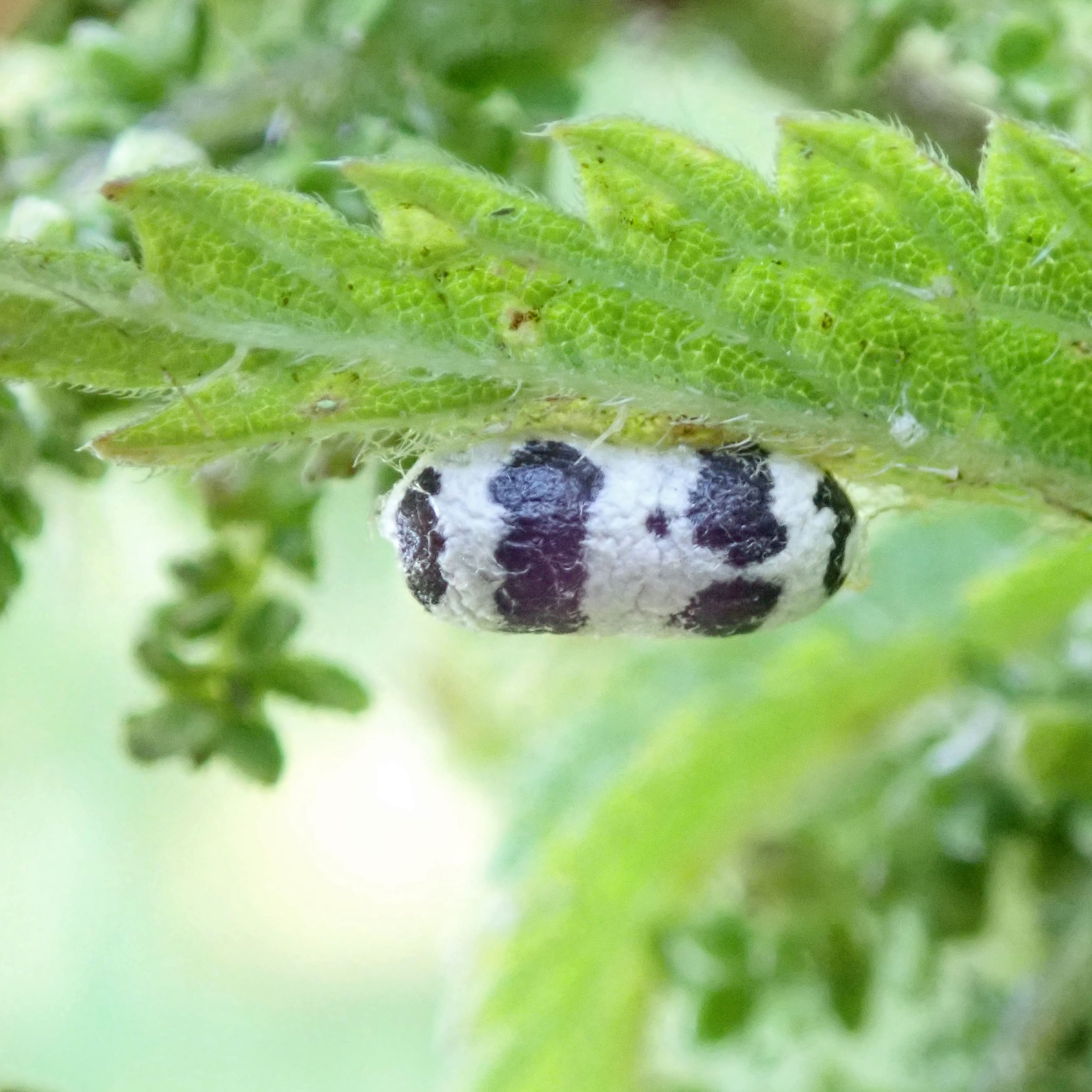
I’m particularly pleased to share this new leafminer as it’s not often that I find the signs of the mine, a larva within said mine, larvae resting outside their mines, and also a pupa, but here they are. These were found during two walks around the edge of a local recreation ground with, perhaps surprisingly, the pupa being seen on 9 August, a couple of weeks before I found the larvae (on 27 August) on plants that were a couple of hundred metres from the initial find site.

These mines are the work of the larvae of the moth Bedellia somnulentella, the adult of which is something of a ‘little brown job’, as you can see on the UK Moths website. The larval plants include both Field bindweed (as shown here) and Hedge bindweed, as well as Morning glory, and, though the mine begins as a gallery, this appears to be subsumed by the later blotch, as blotches were all I noticed.

These larvae have some interesting habits: they weave silken threads below their mines to create resting places outside their mines (an unusual habit). The threads would not be easy to spot, except for the fact that the larvae’s frass is also caught by them and so appears as scattered clumps and strings of pooh.

When they’ve finished feeding and their development is complete, the larvae exit their blotches and pupate suspended amongst their silken threads. They’re fascinating little creatures.


Like Loading...

Butterflies on Creeping thistle

07 Sunday Sep 2025

Posted by sconzani in insects

≈ Leave a comment

Tags

Butterflies on Creeping thistle, Cirsium arvense, Common blue, Common blue butterfly, Common blue on Creeping thistle, Creeping thistle, Small copper, Small copper on Creeping thistle

Creeping thistle (Cirsium arvense) is a much maligned plant. I understand that it can be prolific and somewhat invasive given the right growth conditions but, at this time of year, when many other wildflowers are going over and the last of the summer insects are struggling to find food, it is a gift from the gods.

This is especially true this year, following a long hot and very dry summer. Though we’ve had rain on and off this past week, the remaining wildflowers have been slow to bounce back to life – and many are past recovering.

Not so the Creeping thistle, which I have seen providing much-needed nectar to thirsty flies, beetles, and butterflies, like the Small coppers and Common blues shown here.

Like Loading...

Two lacewings

04 Thursday Sep 2025

Posted by sconzani in insects

≈ Leave a comment

Tags

British lacewings, Brown lacewings, Hemerobiidae, Hemerobius humulinus, Hemerobius micans, lacewings

This is one of those posts where I need to add a cautionary note at the beginning: the species of these lacewings have not yet been verified. In fact, I don’t think any of my lacewing records have ever been verified, which likely means that there is no lacewing expert able to volunteer their time for this task (I must add that I am full of praise for those experts that do volunteer their time as local or national recorders/verifiers) and also that it may not be possible to definitively identify these creatures without microscopic examination. Still, they are beautiful, and I felt them worth sharing.

So, after looking closely at the markings on their wings and checking they were in habitats where they might be expected to live, I think these are both Hemerobiidae (Brown lacewing) species, and I have tentatively labelled the lacewing pictured above as Hemerobius micans. The Naturespot entry for this species states that it ‘has wings which are quite yellow in colour and which have dark dashes on some longitudinal veins, not dots as in some similar species’ and is found ‘with deciduous trees, especially mature oaks’, which is consistent with my findings for this specimen.

I am even more wary of naming this second lacewing but I wonder if it might be Hemerobius humulinus. After once again consulting the Naturespot website, I found one particular image which shows the wing venation and this appears consistent with what I can see in my photograph. Both these species were found in deciduous woodland, which also fits the species description.

Nb. I did find a Lacewings and Allies Recording Scheme website but it has thus far been populated with very little information; there is a link to a winter 2024 newsletter but many of the pages are relatively empty.

Like Loading...

Closterotomus cousins

03 Wednesday Sep 2025

Posted by sconzani in insects

≈ Leave a comment

Tags

British bugs, Closterotomus fulvomaculatus, Closterotomus norwegicus, Closterotomus species, mirid bugs, Miridae, Potato capsid

This is a tale of two Closterotomuses – Closterotomi?

The first is Closterotomus norwegicus, also known as the Potato capsid, though I’m not sure why it has that common name. The British Bugs website says it ‘feeds on a wide range of plants, especially nettles, composites and clovers’, with no mention of potatoes. It’s a handsome little bug and quite common, though can be confused with other similar mirid bugs – the British Bugs page lists some of the distinguishing features to look out for.

This second Closterotomus species is C. fulvomaculatus – no common name that I’m aware of. It can be seen between June and August, so we’re right at the end of its date range now but there may still be time to spot it on scrub and in hedgerows where it feeds on nettles and meadowsweet. Apparently, it’s also quite partial to hops, but we don’t have those in my local area. It looks like just another brown bug until you look more closely and notice the lovely golden hairs that cover its upper body.

Like Loading...

A good year for Jersey tigers

30 Saturday Aug 2025

Posted by sconzani in insects

≈ Leave a comment

Tags

British moths, climate change affecting wildlife, Euplagia quadripunctaria, Jersey tiger, Jersey tiger moth, moth

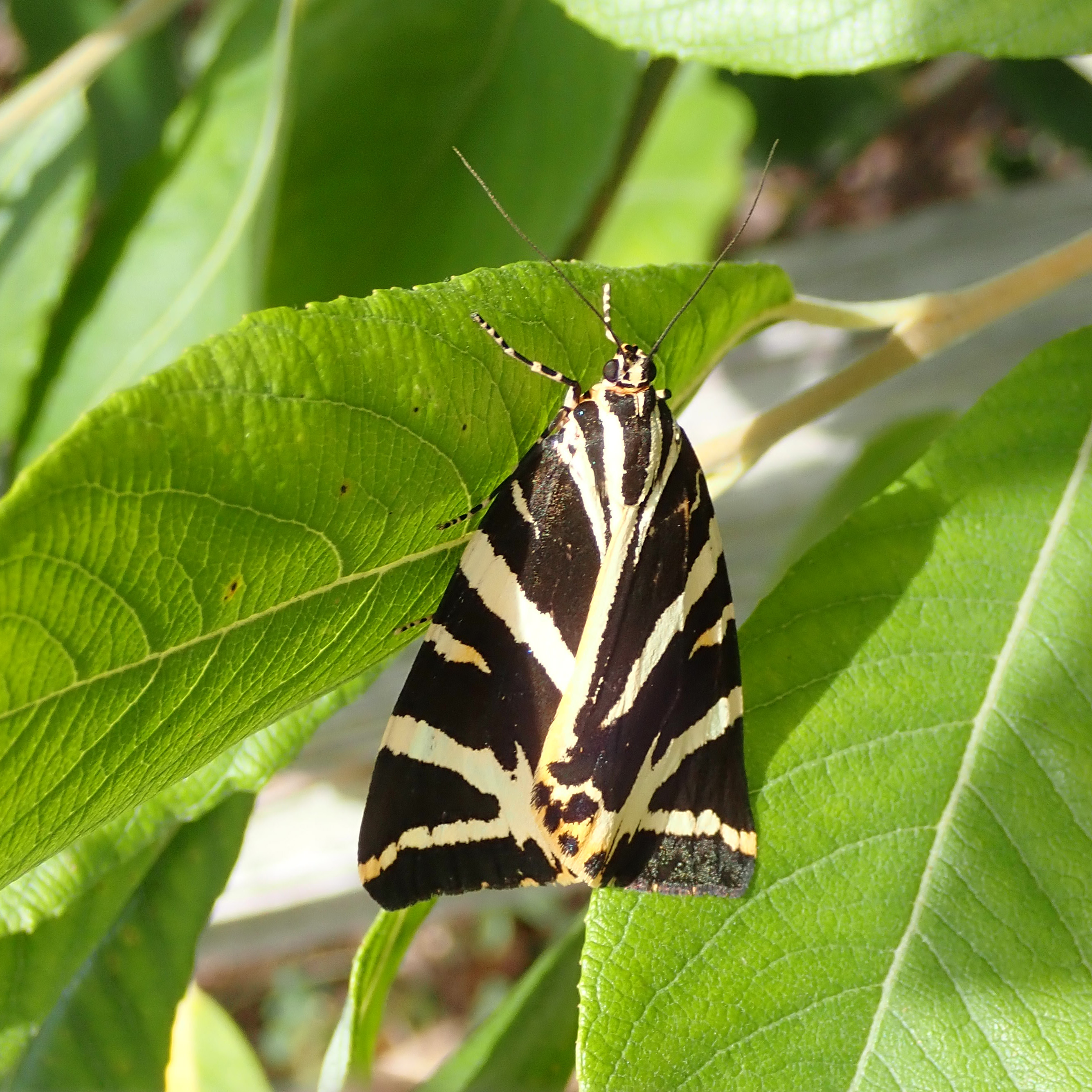
In the summers of 2018, 2019 and 2020 one of the local nature reserves near me held what seemed like a healthy population of Jersey tiger moths (Euplagia quadripunctaria), then they vanished. I don’t know why this was but several people have looked for them at the reserve in the intervening years and, though the occasional single moth has been sighted, the healthy population is no more. Away from that reserve, I would struggle to see any Jersey tigers, and saw none at all in 2021 and 2022.

So, this year, it has been an absolute delight for me to have enjoyed many, seemingly random sightings of these beautiful moths. By random, I mean that there haven’t been any large numbers concentrated in any specific location or area; instead, either I’ve spotted them lurking on trees and bushes, or my passing has disturbed them, there’s been a flash of their vibrant orange underwings as they’ve fluttered out and I’ve seen them once they’ve resettled.

And it seems my experience of seeing greater numbers of Jersey tigers this year has not been unique. This is a species that is included in Butterfly Conservation’s Big Butterfly Count, and, even before the count had ended, with 7 of the count’s 24 days remaining, that organisation had noted a ‘whopping 78%’ increase in reported Jersey tigers this year compared to last year. Butterfly Conservation’s blog post speculates that the dramatic increase was due to this summer’s record-breaking high temperatures.

As Dr Richard Fox, BC’s Head of Science is quoted as saying

The increase we’re seeing in Jersey Tiger moth sightings is a striking example of how climate change is reshaping the distribution of wildlife.
While it’s a delight to spot such a vibrant moth in gardens, parks and green spaces, it’s also a reminder of how rising temperatures are altering our natural environment.

Like Loading...

Emerald damsels

27 Wednesday Aug 2025

Posted by sconzani in insects

≈ Leave a comment

Tags

British damselflies, British dragonflies, damselfly, dragonfly, Emerald damsefly, Lestes sponsa, Odonata

This is the final blog in my short series about the dragonflies I saw during last week’s rail journey up the south Welsh valleys to Maesteg. Today’s subject is the Emerald damselfly (Lestes sponsa), a species I’ve seen only twice before, in August 2017 and in September 2021. I’ve looked for them a couple of times at the 2021 location, Parc Penallta, but the small ponds there quickly dry out in hot summers and dog walkers allow their charges to splash about in them, displacing more water and polluting the water with the dogs’ chemical flea treatments. These are probably some of the reasons why the population of this damselfly species has been in steady decline since the 1990s.

Emeralds are relatively large for damselflies and rest with their wings outspread, hence their European common name, Common spreadwing. Their bodies are metallic green, though the colours of some parts of their abdomens vary depending on whether they are male or female, immature or aging. Emeralds favour shallow standing waters, like bog pools and ponds, especially when these are surrounded by tall grasses, rushes and sedges.

Like Loading...

Keeled skimmers

26 Tuesday Aug 2025

Posted by sconzani in insects

≈ Leave a comment

Tags

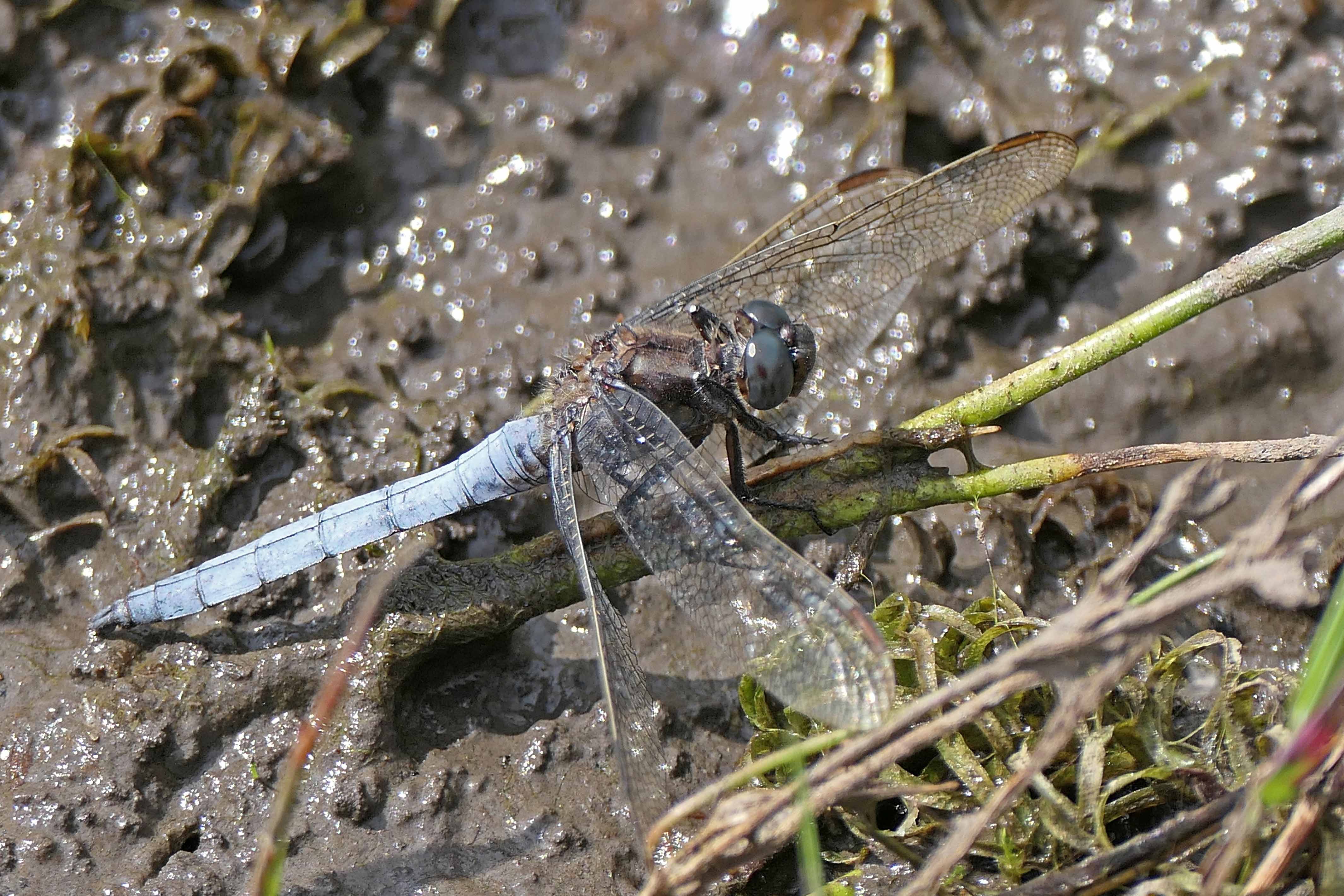
British dragonflies, dragonflies of heathlands, dragonflies of peat bogs, dragonfly, Keeled skimmer, male Keeled skimmers, Orthetrum coerulescens

Here’s another of the stunning dragons I saw at the ponds in Maesteg last week. And this is another species I’d only seen once before, back in 2017 on a birding day out to the Lliw Reservoirs north of Swansea.

These gorgeous dragonflies are Keeled skimmers (Orthetrum coerulescens), also known in Europe as Heathland skimmers, which gives a very clear indication of their preference for the acidic conditions of heathland waterways and the drains and ponds of peat bogs. The Maesteg ponds provide the perfect habitat for them, except perhaps for the locals who allow their dogs to swim there.

These beauties were quite easy to find when I wandered around the ponds as, according to my guide book, the males hold quite small territories, with a favourite perch from which they flit out to see off any intruders. So, once I found their perches, I was able to stand a little way off to watch their flights and grab photos once they settled again.

I only saw male Keeled skimmers during this visit to the ponds, so I’ve yet to see one of golden yellow females. These dragonflies are usually active from mid June to mid August so I may have missed seeing the females this year but I will certainly be visiting this location again next year.

Like Loading...

Leafmines: Stigmella lemniscella

25 Monday Aug 2025

Posted by sconzani in insects, trees

≈ Leave a comment

Tags

Beautiful elm dot, British leafminers, leaf-mining moth larvae, leaf-mining moths, leafmines, leafmines on Wych elm, Stigmella lemniscella

I discovered today’s new leafmines the same day as I found last week’s (Leafmines: Stigmella viscerella) and, considering how much time I spend leaf-fossicking and simply staring at trees, was also amazed I’d not noticed these very distinctive mines before.

The larvae of the moth Stigmella lemniscella munch away within the leaves of Elm trees (Ulmus species), in this case Wych elms (Ulmus glabra), and their galleries often follow the edge of the leaves, looking like a zigzag pattern. These moths are bivoltine so are active during July, and again in September – October. The adult moth is a pretty little thing – there’s a photo on the UK Moths website, which has the common name of Beautiful elm dot.

Like Loading...
← Older posts
Newer posts →

About me

sconzani

sconzani

I'm a writer and photographer; researcher and blogger; birder and nature lover; countryside rambler and city strider; volunteer and biodiversity recorder.

View Full Profile →

Follow earthstar on WordPress.com

Enter your email address to follow this blog and receive notifications of new posts by email.

Recent blog posts

  • O is for Odonata December 20, 2025
  • N is for nest December 19, 2025
  • M is for mite December 18, 2025
  • L is for lepidopteran lifers December 17, 2025
  • K is for Keeled skimmers December 16, 2025

From the archives

COPYRIGHT

Unless otherwise acknowledged, the text and photographs on this blog are my own and are subject to international copyright. Nothing may be downloaded or copied without my permission.

Fellow Earth Stars!

  • Unknown's avatar
  • Unknown's avatar
  • Unknown's avatar
  • Unknown's avatar
  • Unknown's avatar
  • Unknown's avatar
  • Unknown's avatar
  • Unknown's avatar
  • Unknown's avatar
  • Unknown's avatar
  • Unknown's avatar
  • Unknown's avatar
  • Unknown's avatar
  • Unknown's avatar
  • Unknown's avatar
  • Unknown's avatar
  • Unknown's avatar
  • Unknown's avatar
  • Unknown's avatar
  • Unknown's avatar
  • Unknown's avatar
  • Unknown's avatar
  • Unknown's avatar
  • Unknown's avatar
  • Unknown's avatar
  • Unknown's avatar
  • Unknown's avatar
  • Unknown's avatar
  • Unknown's avatar
  • Unknown's avatar
  • Unknown's avatar
  • Unknown's avatar
  • Unknown's avatar
  • Unknown's avatar
  • Unknown's avatar
  • Unknown's avatar
  • Unknown's avatar
  • Unknown's avatar
  • Unknown's avatar
  • Unknown's avatar
  • Unknown's avatar
  • Unknown's avatar
  • Unknown's avatar
  • Unknown's avatar
  • Unknown's avatar
  • Unknown's avatar
  • Unknown's avatar
  • Unknown's avatar
  • Unknown's avatar
  • Unknown's avatar

Blog at WordPress.com.

Privacy & Cookies: This site uses cookies. By continuing to use this website, you agree to their use.
To find out more, including how to control cookies, see here: Cookie Policy
  • Subscribe Subscribed
    • earthstar
    • Join 667 other subscribers
    • Already have a WordPress.com account? Log in now.
    • earthstar
    • Subscribe Subscribed
    • Sign up
    • Log in
    • Report this content
    • View site in Reader
    • Manage subscriptions
    • Collapse this bar
 

Loading Comments...
 

You must be logged in to post a comment.

    %d