• ABOUT
  • BIRDING 2018
  • Birding 2019
  • BLOG POSTS
  • Butterflies 2018
  • Resources

earthstar

~ a celebration of nature

earthstar

Category Archives: leaves

Leafmines: Phyllonorycter coryli

13 Monday Sep 2021

Posted by sconzani in insects, leaves, trees

≈ 4 Comments

Tags

leaf-mining moth, leafmines, leafmines on Hazel, moth larvae in leaf mines, moth leafmines, Phyllonorycter coryli

For those of you who are new to leafmines, here’s one that’s appearing on leaves right about now, is common in Britain and easy to identify.

210913 phyllonorycter coryli (1)

These blisters on Hazel leaves are made by the larvae of the perfectly named Nut leaf blister moth (Phyllonorycter coryli) – you can see what the adult moth looks like on the UK Moths website. In fact, if you’re sharp-eyed, you may have noticed these blisters in July, as this little moth has two broods each year. You can get more details and see more images on the excellent British Leafminers website.

210913 phyllonorycter coryli (2)
210913 phyllonorycter coryli (3)
Like Loading...

Leafmines: a first for Wales!

06 Monday Sep 2021

Posted by sconzani in insects, leaves, plants

≈ Leave a comment

Tags

British leafmines, Broad-leaved everlasting pea, leaf-mining fly larvae, leafmine, leafmine on everlasting pea, leafminer, Liriomyza pisivora

Back on 18 August, I noticed Rob Edmunds’ post on Twitter about his find of Liriomyza pisivora mines on the Everlasting pea in his garden, which led me to check, the next day, the plants growing at Cardiff’s Grangemoor Park. I found plenty of leafmines but my finds were inconclusive – there are several species that form similar mines so I needed to get better photos, if possible transparent images that showed the frass distribution in the mines.

210906 Liriomyza pisivora (1)

So, when I visited Grangemoor again on 28 August to look for the Wasp spiders that had been reported the previous day, I also took the opportunity to look again at the Everlasting pea plants and took several more photographs. From them, I could see that in some of the mines the frass had been deposited as thin lines alternating from one side of gallery to the other.

210906 Liriomyza pisivora (3)
210906 Liriomyza pisivora (2)

Those images were good enough for Barry Warrington, the national recorder of the Agromyzidae family of flies, to confirm that I had indeed found Liriomyza pisivora and, a splendid surprise, that this was the first ever record of these flies in Wales!

210906 Liriomyza pisivora (4)

The host plant in this instance, Broad-leaved everlasting-pea (Lathyrus latifolius), is a relatively recent arrival at Grangemoor, though it is now sprawling abundantly over bramble bushes and along scrubby hedgerows in several parts of the park. So far, I’ve only found Liriomyza pisivora mines in one relatively small area but, perhaps, in time, they will spread throughout the park.

Like Loading...

Leafmines: Profenusa pygmaea

30 Monday Aug 2021

Posted by sconzani in insects, leaves, trees

≈ 6 Comments

Tags

British leaf mines, British sawflies, leaf mines on Oak, leafminers, Oak leafmines, Profenusa pygmaea, sawfly leafmines

Believe it or not, #LeafmineMonday is a thing on Twitter, and last Monday I read with interest this tweet, with photos, posted by Rob Edmunds (@leafminerman, one of the people behind the excellent British Leafmines website):

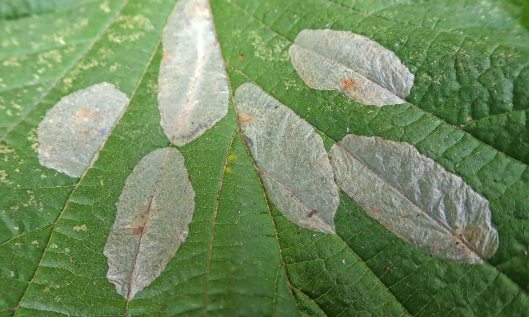
a sawfly mine which is fairly easy to find, made by Profenusa pygmaea. Look for brown blotches on Oak leaves but with a wriggling start as shown in the photo … Initial mines are whitish but then fade to brown.

210830 profenusa pygmaea leafmine (1)

Profenusa pygmaea is a species of sawfly – you can read more about it and see photos of the adult on the Sawflies of Britain and Ireland website. As I’m often to be found checking out Oak leaves and there were no records for this particular sawfly in my local area, of course I had to go looking, and I’ve now found these leafmines in two separate locations. I’m guessing it’s yet another under-recorded species so if you spot it in your area, do please record it.

210830 profenusa pygmaea leafmine (2)
210830 profenusa pygmaea leafmine (3)
Like Loading...

Oak: mothy goodness

27 Thursday May 2021

Posted by sconzani in insects, leaves, trees

≈ Leave a comment

Tags

Brindled green, British moths, Case-bearing moth, Coleophora flavipennella, Coleophora lutipennella, Dryobotodes eremite, moth larvae, moth larvae on Oak, moths on Oak, Oak leaves

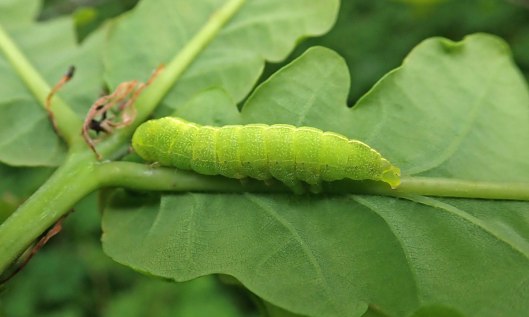
As you can see from the last two days’ blogs, there was much to be found on Oak leaves in my local woodlands on Sunday. These are two more finds, both relating to moths. This first was found on the same tree as the Purple hairstreak larva and, thanks to some help from Twitter moth-ers, I can tell you this is the larva of the Brindled green moth (Dryobotodes eremite) (you can see the adult moth on the UK Moths website here).

210527 brindled green larva

The wonderfully crafted cases in the photos below contain the larvae of either Coleophora lutipennella or Coleophora flavipennella – apparently, it’s not possible to determine the species without waiting for the adult moths to hatch and then dissecting their genitalia, which I’m not going to do. I’m happy just to admire their silk-weaving skills.

210527 Coleophora lutipennella or flavipennella (1)
210527 Coleophora lutipennella or flavipennella (2)
210527 Coleophora lutipennella or flavipennella (3)
Like Loading...

Oak: a new gall

25 Tuesday May 2021

Posted by sconzani in insects, leaves, spring, trees

≈ Leave a comment

Tags

Andricus curvator, British galls, galls on Oak leaves, galls on oak trees, Oak gall wasps, oak galls, oak tree

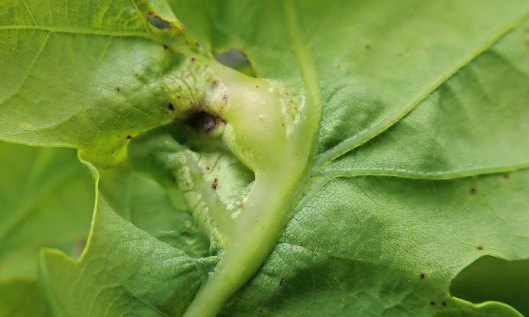
With heavy cloud and occasional rain, Sunday was not a day for finding butterflies in the woodland. So, I decided to look more closely at Oak leaves to see what I might find, and that strategy paid off in spades as the next few days’ blog posts will show. First up, I found a gall I hadn’t seen before, which turns out to be the sexual generation of the gall wasp Andricus curvator.

210525 Andricus curvator (1)

When the adult wasps emerge in the spring from the agamic (asexual) generation galls, which are formed on buds in the autumn and fall to the ground to over-winter, they lay their eggs mostly on Oak leaves but also, sometimes, on twigs or catkins, so these galls can take several forms. The ones I found (and they were numerous) were all on leaves, causing malformations and swellings, as you can see from the photos above and below.

210525 Andricus curvator (2)
210525 Andricus curvator (3)

I was tempted to split a gall open to see what was inside but it turns out I didn’t have to, as something had nibbled away at one gall, revealing a second round gall inside (see below). The larvae within this inner gall will emerge in the autumn to lay its eggs on Oak buds, and so the process will continue.

210525 Andricus curvator (4)

Like Loading...

Caterpillar in a tent

15 Saturday May 2021

Posted by sconzani in insects, leaves, trees

≈ Leave a comment

Tags

British moths, damage to Hazel leaves, Hazel, Hazel leaves, moth caterpillar, Operophtera brumata, Winter moth

While wandering through my favourite woodland earlier this week, I noticed small areas of damage on some Hazel leaves. It looked like a little critter had been munching on them and, checking further, I soon discovered a lot of leaves had suffered similar damage.

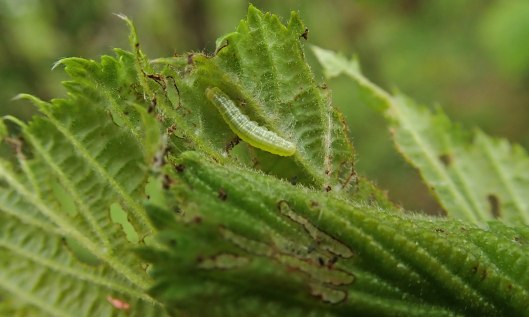
Closer inspection of one particular leaf soon revealed the culprit, a caterpillar, tucked away in a snug little tent it had created by binding two leaves together with silken thread. From there it could easily venture out to eat, yet retreat when threatened by predators or bad weather. Smart thinking!

210515 winter moth (2)

I think the caterpillar may be the larva of a Winter moth (Operophtera brumata) but I haven’t yet been able to confirm my identification (Update 16/5: ID now confirmed as Winter moth). Once I was alert to their presence, I noticed more leaf damage and several more ‘tents’, as well as a smaller caterpillar feeding out in the open.

210515 winter moth (3)
OLYMPUS DIGITAL CAMERA
Like Loading...

Leaf burst: Field maple

06 Tuesday Apr 2021

Posted by sconzani in leaves, spring, trees

≈ Leave a comment

Tags

British trees, bud burst, Field maple, Field maple bud burst, Field maple leaf burst, leaf burst

Field maple leaves are now bursting out wherever I walk, and they speak truth to the old saying that ‘good things come in small packages’. The tiny buds are exquisitely fashioned, covered in a soft furry outer skin that splits open to reveal the sculptural beauty of the prominent lime-green veins and much-folded pinkish-red blade.

210406 field maple leaf burst (1)
210406 field maple leaf burst (2)
210406 field maple leaf burst (3)
210406 field maple leaf burst (4)
210406 field maple leaf burst (5)
210406 field maple leaf burst (6)
Like Loading...

Bud burst

28 Sunday Mar 2021

Posted by sconzani in leaves, spring, trees

≈ Leave a comment

Tags

bud burst, buds, Hawthorn, Hawthorn leaves, leaf burst, the greening of spring, tree buds

Have you been watching the greening? The buds on the trees growing ever fatter? Swelling to the point where they burst with spring goodness?

210328 hawthorn budburst (1)
210328 hawthorn budburst (2)
210328 hawthorn budburst (3)
210328 hawthorn budburst (4)
210328 hawthorn budburst (5)
210328 hawthorn budburst (6)

This year I’ve been paying more attention to this incredible process. These are some images of Hawthorn from the last couple of weeks.

210328 hawthorn budburst (7)

Like Loading...

Ash key fungi

12 Tuesday Jan 2021

Posted by sconzani in fungi, leaves, trees, winter

≈ Leave a comment

Tags

Ash tree, British fungi, Diaporthe samaricola, fungi on Ash keys, Neosetophoma samarorum

These two fungi, found on Ash keys, were last week’s record of the week at my local biodiversity records centre, SEWBReC – not my record, that of another local recorder – but seeing this on Twitter last Friday reminded me to check the next Ash trees I saw. That opportunity came on Sunday’s walk and I found the fungi on just the second tree I passed by.

210112 ash key fungi (1)

The two fungi are Diaporthe samaricola (the small black dots on the seed part of the key, on the left below) and Neosetophoma samarorum (the much smaller, black speckles on the wing part of the key, on the right in my photo). Both fungi are under-recorded in my area, so I’ll now be checking all the Ash keys I find.

210112 ash key fungi (2)

Like Loading...

Incredible Ivy

10 Sunday Jan 2021

Posted by sconzani in flowers, insects, leaves, plants, winter

≈ Leave a comment

Tags

Hedera helix, ivy, ivy berries, ivy flowers

I’m not sure I can subscribe to the ancient concept that wearing a wreath of ivy leaves around my head would stop me getting drunk but the leaves are certainly amazing and incredibly diverse in shape, form and colour. Juvenile leaves have between 3 and 5 lobes, while mature leaves have no lobes and can be shaped both like ovals and hearts.

210110 ivy leaf (1)
210110 ivy leaf (2)
210110 ivy leaf (3)
210110 ivy leaf (4)
210110 ivy leaf (5)
210110 ivy leaf (6)

And then there are the flowers, in bloom from September through to November and a source of food for more than 50 insect species, and the subsequent berries, ripe from November to January – or, until the berry-loving winter thrushes, finches, woodpigeons and other hungry birds gobble them all up. What an incredible plant ivy is!

210110 ivy flowers and berries (1)
210110 ivy flowers and berries (2)
210110 ivy flowers and berries (3)
210110 ivy flowers and berries (4)
Like Loading...
← Older posts
Newer posts →

About me

sconzani

sconzani

I'm a writer and photographer; researcher and blogger; birder and nature lover; countryside rambler and city strider; volunteer and biodiversity recorder.

View Full Profile →

Follow earthstar on WordPress.com

Enter your email address to follow this blog and receive notifications of new posts by email.

Recent blog posts

  • Avocet February 21, 2026
  • First large spider February 20, 2026
  • Our celebrity Redshank February 19, 2026
  • My first moth of the year February 18, 2026
  • Three Common sandpipers February 17, 2026

From the archives

COPYRIGHT

Unless otherwise acknowledged, the text and photographs on this blog are my own and are subject to international copyright. Nothing may be downloaded or copied without my permission.

Fellow Earth Stars!

  • Unknown's avatar
  • Unknown's avatar
  • Unknown's avatar
  • Unknown's avatar
  • Unknown's avatar
  • Unknown's avatar
  • Unknown's avatar
  • Unknown's avatar
  • Unknown's avatar
  • Unknown's avatar
  • Unknown's avatar
  • Unknown's avatar
  • Unknown's avatar
  • Unknown's avatar
  • Unknown's avatar
  • Unknown's avatar
  • Unknown's avatar
  • Unknown's avatar
  • Unknown's avatar
  • Unknown's avatar
  • Unknown's avatar
  • Unknown's avatar
  • Unknown's avatar
  • Unknown's avatar
  • Unknown's avatar
  • Unknown's avatar
  • Unknown's avatar
  • Unknown's avatar
  • Unknown's avatar
  • Unknown's avatar
  • Unknown's avatar
  • Unknown's avatar
  • Unknown's avatar
  • Unknown's avatar
  • Unknown's avatar
  • Unknown's avatar
  • Unknown's avatar
  • Unknown's avatar
  • Unknown's avatar
  • Unknown's avatar
  • Unknown's avatar
  • Unknown's avatar
  • Unknown's avatar
  • Unknown's avatar
  • Unknown's avatar
  • Unknown's avatar
  • Unknown's avatar
  • Unknown's avatar
  • Unknown's avatar
  • Unknown's avatar

Blog at WordPress.com.

Privacy & Cookies: This site uses cookies. By continuing to use this website, you agree to their use.
To find out more, including how to control cookies, see here: Cookie Policy
  • Subscribe Subscribed
    • earthstar
    • Join 670 other subscribers
    • Already have a WordPress.com account? Log in now.
    • earthstar
    • Subscribe Subscribed
    • Sign up
    • Log in
    • Report this content
    • View site in Reader
    • Manage subscriptions
    • Collapse this bar
 

Loading Comments...
 

You must be logged in to post a comment.

    %d