• ABOUT
  • BIRDING 2018
  • Birding 2019
  • BLOG POSTS
  • Butterflies 2018
  • Resources

earthstar

~ a celebration of nature

earthstar

Category Archives: nature photography

Tit elation

12 Saturday Mar 2016

Posted by sconzani in birds, nature, nature photography

≈ 11 Comments

Tags

birding, birds, birdwatching, Blue tit, British birds, Cosmeston Lakes Country Park, Great tit

Yesterday saw my first visit to Cosmeston Lakes Country Park, just outside Penarth, here in south Wales. And what a fabulous place it is! With two former quarries now filled to form lakes, large meadows, seemingly endless tree-lined walks and an extensive woodland, it’s perfect for everything from family picnics and walking the dog, jogging and mountain-biking, to exercising the pony and birdwatching. I’ll certainly be heading back there again soon.

0 great tit

As I’m mad keen on birds I particularly enjoyed my wonderful long wander through Cogan Wood. The place was alive with all the little birds I love the most, and the most prolific of these were the Great tits and Blue tits. Though the weather was not particularly cold and there was plenty of natural food around for them, they acted like they were starving and, in the most wonderful way, I was almost mobbed by them as I walked along. I tell ya, those critters can smell seed even when it’s tucked away in a plastic box in a backpack! I rewarded them well for all the delightful photo opportunities they provided.

1 blue tit2 great tit3 blue tit4 great tit5 blue tit6 great tit7 blue tit

Like Loading...

Meet the Mallards

10 Thursday Mar 2016

Posted by sconzani in birds, nature, nature photography

≈ 5 Comments

Tags

birding, birds, birdwatching, British birds, duck, Mallard, weather folklore

160306 mallard 3

Though male and female Mallard (Anas platyrhynchos) are so different they were originally thought to be two different species, today they are what almost everyone imagines when they hear or read the word ‘duck’, and they are the bird people most love to feed with old scraps of bread. Please don’t! As Britain’s Canal and River Trust has often warned, with 6 million loaves being thrown into canals, lakes and waterways every year, bread is a serious problem. Not only is it bad for the ducks’ environment, it’s not very healthy for the ducks either. Click on this link to read about the more natural alternatives.

160306 mallard 1

British folklore has many charming references to mallards and weather forecasting, like this: ‘If ducks fly backwards and forwards, and continually plunge in water and wash themselves incessantly, wet weather will ensure.’ In Scotland, there’s a similar saying: ‘When ducks are driving through the burn [darting through the stream], / that night the weather takes a turn.’ And here’s one from Sussex: ‘If there’s ice at Martinmas will bear a duck / There’ll be nothing after but sludge and muck.’ Obviously, the nation’s weather forecasters should be watching the mallards, not their charts and satellite maps!

160306 mallard 2

Like Loading...

The horse in striped pyjamas

09 Wednesday Mar 2016

Posted by sconzani in animals, nature, nature photography

≈ 6 Comments

Tags

horse in striped pyjamas, Ngorongoro Crater, Serengeti National Park, Tanzania, zebra

Eight things you might not have known about zebras, until now:

zebras (1)

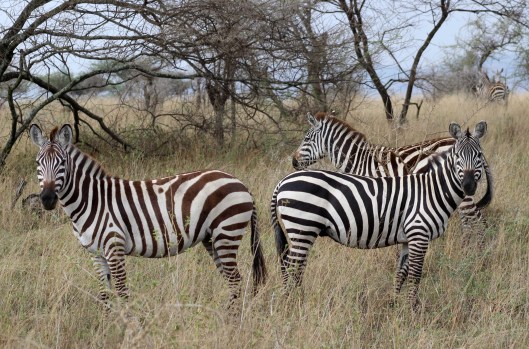
1 Zebras can move fast, up to 65mph in fact, which, when combined with superb stamina and some cunning zigzagging moves, means they can outrun most of the creatures that might want to eat them.
zebras (2)

2 Zebras are relatively long-lived animals, clocking up between 20 and 30 years in the wild, and up to 40 in zoos.

zebras (3)

3 Though never domesticated, zebras were once trained to pull chariots around the hippodromes of Ancient Rome.

zebras (4)

4 Zebras are clever communicators. As well as oral expression (barks, whinnies and sniffing sounds), they also use facial expressions and the position of their ears and tails to convey how they feel. Beware the zebra with wide-open eyes, bared teeth and ears pulled backwards – he’s mad!

zebras (5)

5 As the old Eddie Arnold song goes, a zebra looks like a horse in striped pyjamas. Turns out, zebras sleep like horses too, standing up and only when safe amongst the herd.
zebras (6)

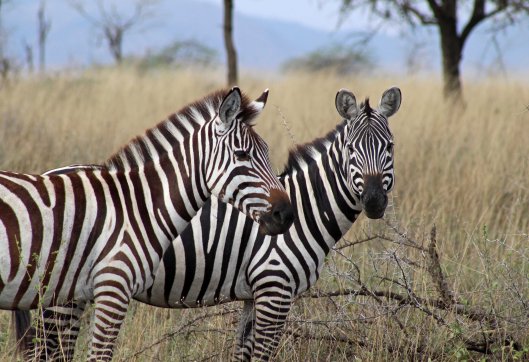
6 The herd means protection for a zebra, and the larger the herd the better, as then more ears and eyes are keeping watch. Other grazing animals like antelope and wildebeest are also welcome.

zebras (7)

7 Talking of herds – what about that incredible spectacle, the annual 1800-mile migration of zebras, antelopes and wildebeest between Kenya’s Maasai Mara and Tanzania’s mighty Serengeti Plains?

zebras (8)

8 And, finally, about those striped pyjamas – it seems zebras evolved stripes for a multitude of reasons:  en masse in a herd, their stripes visually merge so predators have a tough job focusing on individual animals; stripes also distort distance in low light (i.e. at dawn and dusk); they’re a unique visual fingerprint helping zebras recognise each other; they’re a form of temperature control as stripes are believed to disperse around 70% of the sun’s heat; and new research has shown that their monochrome pattern confuses the visual systems of flies, thus helping to keep those annoying critters at bay.

My photographs of zebras were taken on the Serengeti Plains and in the Ngorongoro Crater in Tanzania in 2014, at the end of a week-long trip with The Giving Lens, an organisation that combines photography workshops with mentoring, media and financial support for local NGOs.

Like Loading...

Great crested grebes: the nesting

07 Monday Mar 2016

Posted by sconzani in birds, nature, nature photography

≈ Leave a comment

Tags

birding, birdwatching, British birds, Great Crested Grebe, nesting

160307 great crested grebe nesting (1)

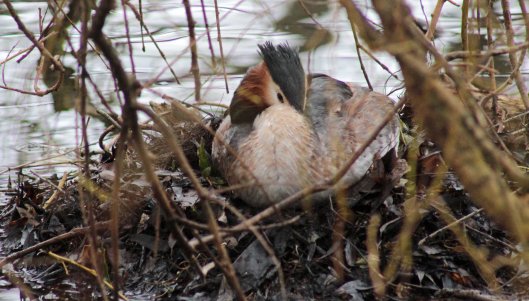
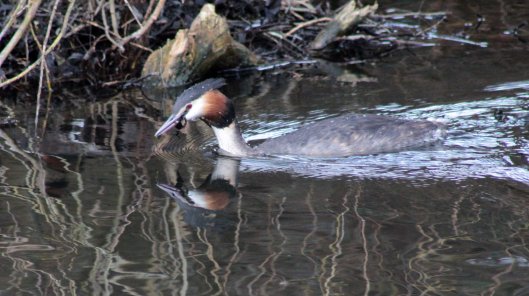
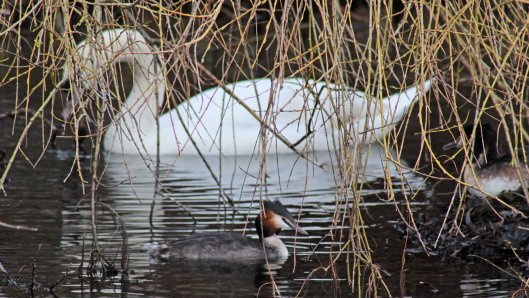
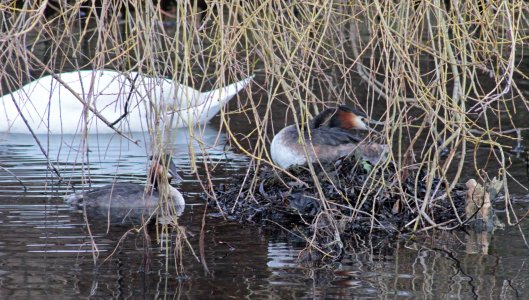
A week ago I mentioned that I had, quite by chance, found a pair of Great Crested Grebes nesting here in Cardiff. What a joy to see! I intend revisiting them once a week or so to see how they’re progressing.

160307 great crested grebe nesting (2)

If you think sitting on a nest all day is an easy job, think again! Firstly, it seems that, just like home decorating, the nest-building process is never finished. As I watch Mr Grebe brings home some bits of weed, shows the missus, then places them carefully around the edges of the nest.

160307 great crested grebe nesting (3)

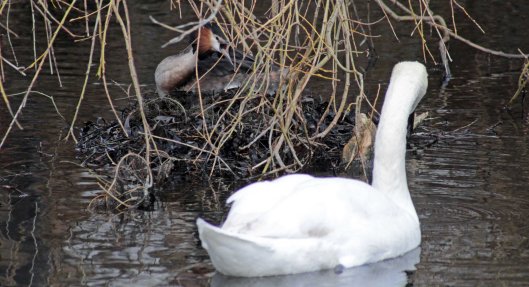
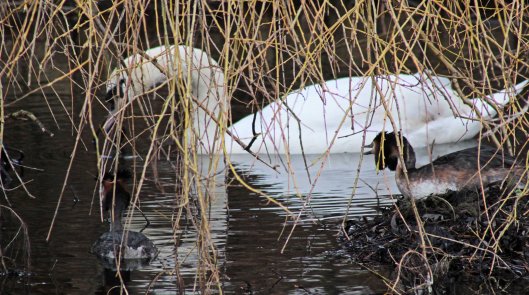
While he is off collecting more, the mate of the swan that is nesting just a few metres away comes gliding by, looking for food, perhaps with his eye on the fresh weed Mr Grebe keeps collecting. Mrs Grebe is having none of it! Feeling threatened and upset, she opens her mouth wide and starts protesting loudly at the swan.

160307 great crested grebe nesting (4)

Mr Grebe rushes home to see what’s upsetting wifey and also tells the swan in no uncertain terms to back off.

160307 great crested grebe nesting (5)

Though the swan is still quite close, the grebes calm down and hubby is about to head off for more weed.

160307 great crested grebe nesting (6)

But then another intruder gets too close: a coot comes paddling over, and Mrs Grebe gets upset all over again.

This all happened in the space of about 5 minutes. My photos are not the best but I don’t want to get too close and I don’t want to stay too long, though I don’t think the grebes even noticed my presence with all the other dramas happening.

Like Loading...

Fungi finger prints

06 Sunday Mar 2016

Posted by sconzani in fungi, nature, nature photography, trees

≈ Leave a comment

Tags

fungus, Rhytisma acerinum, sulphur dioxide air pollution, sycamore, Tar spot

Well, they look a bit like finger prints to me – or, perhaps, the wax seals people used to stamp on their communications and documents. But no! These are, in fact, the signs of Tar spot, a disease that most often affects sycamore trees but can also occur in other species of acer, and is caused by the fungus Rhytisma acerinum.

Rhytisma acerinum Sycamore Tarspot (1)

The spots start out yellow in the springtime, then eventually morph into the slightly raised bumpy black spots you can see in my photos. Although they look a little ugly, the spots don’t affect the health of the trees – they merely cause the leaves to drop a little earlier than normal in the autumn.

Rhytisma acerinum Sycamore Tarspot (2)
Rhytisma acerinum Sycamore Tarspot (3)

Though you might not like the look of them, there is one big benefit to seeing these spots on your sycamore tree: as the fungus is particularly sensitive to sulphur dioxide air pollution, its presence indicates your air is relatively clean and healthy.

Rhytisma acerinum Sycamore Tarspot (4)

Like Loading...

My favourite avians

05 Saturday Mar 2016

Posted by sconzani in birds, nature, nature photography

≈ 2 Comments

Tags

birding, birds, birdwatching, blackbird, Blue tit, British birds, bullfinch, dunnock, Forest Farm Nature Reserve, Great tit, robin, thrush

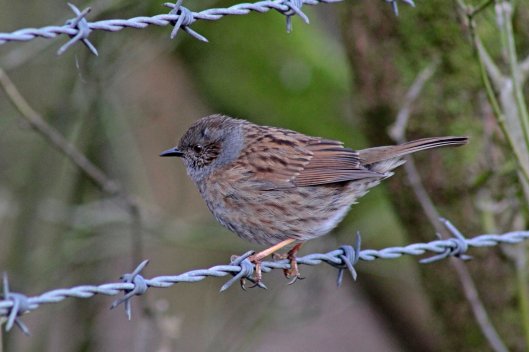
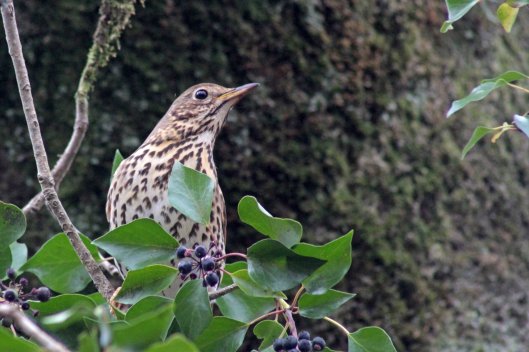
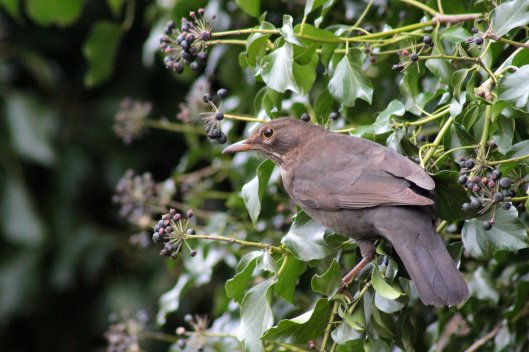
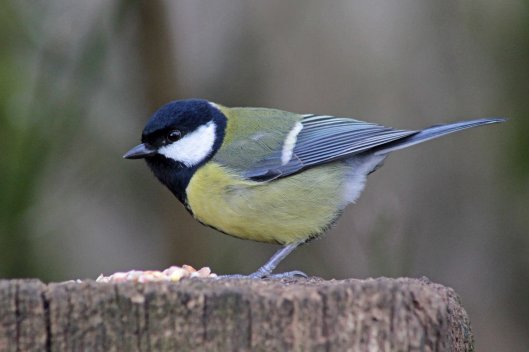
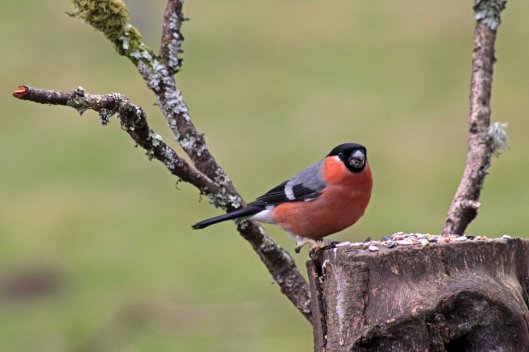
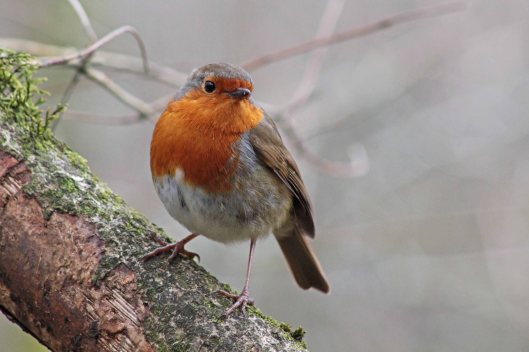
In spite of occasional hail showers and a biting cold wind, yesterday was another magical day at Forest Farm Nature Reserve. I was serenaded by robins, I laughed at the antics of the cute little blue tits, was entertained by the thrushes and blackbirds performing acrobatic stunts in search of the tastiest ivy berries, and enjoyed the most wonderful privilege of a great tit perching on my hand to eat the seeds I was offering. Here are a few of my photos.

160305 ff1 dunnock

A little timid, often overlooked, but very lovely dunnock

160305 ff2 thrush

Both the thrush (above) and blackbird (below) were feasting on ivy berries

160305 ff3 blackbird

160305 ff4 great tit

A great tit

160305 ff5 blue tit

Always so cute, a little blue tit

160305 ff6 bullfinch

A male bullfinch – such stunning colours

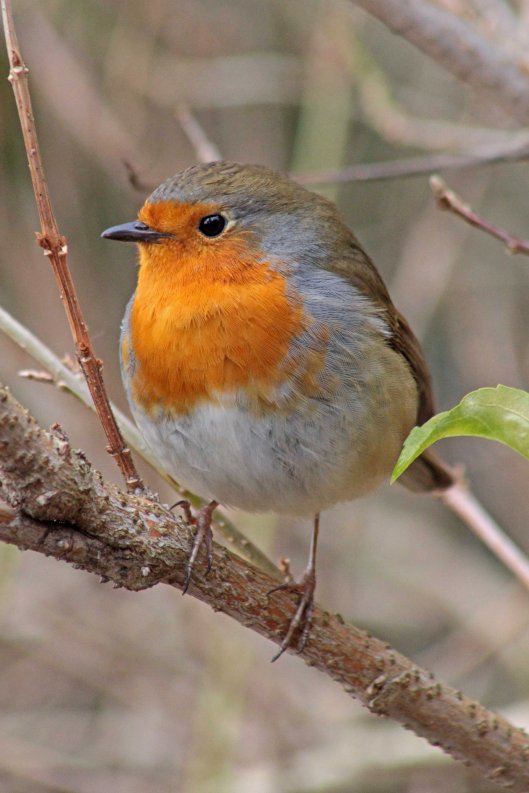
160305 ff7 robin

No visit to Forest Farm is complete without a robin or twenty!

Like Loading...

Conversation with robins: 4

04 Friday Mar 2016

Posted by sconzani in birds, nature, nature photography

≈ 8 Comments

Tags

birding, birds, birdwatching, British birds, conversations with robins, robin, singing robins

Forest Farm Nature Reserve, one fine February day …

160301 robin hood (1)

Me: ‘Hello, dear little robin. Got a song for me today?’
Robin: ‘Sure, lady. You know us robins love to sing. I’ve been learning a new one about an outlaw.’

160301 robin hood (2)

Me: ‘Really? Okay, let’s hear it.’
Robin: ‘Robin Hood, Robin Hood, riding through the glen.’

160301 robin hood (3)

Robin: ‘Robin Hood, Robin Hood, with his band of men.’

160301 robin hood (4)

Robin: ‘Feared by the bad, loved by the good.’

160301 robin hood (5)

Robin: ‘Robin Hood, Robin Hood, Robin Hood.’

160301 robin hood (6)

Robin: ‘Well, what d’ya think? I’d like to be an outlaw like Robin Hood. He’s my hero.’
Me: ‘You sang brilliantly. Well done! And, as a reward, here’s some birdseed you might like.’

Like Loading...

In honour of elephants

03 Thursday Mar 2016

Posted by sconzani in animals, nature, nature photography

≈ 2 Comments

Tags

#WorldWildlifeDay, elephants, Ngorongoro Crater, Serengeti National Park, Tanzania

For World Wildlife Day …

elephants 1

‘Nature’s great masterpiece, an elephant; the only harmless great thing.’ ~ John Donne

elephants 2

‘If an elephant has its foot on the tail of a mouse and you say that you are neutral, the mouse will not appreciate your neutrality.’ ~ Desmond Tutu

elephants 3

‘Of all African animals, the elephant is the most difficult for man to live with, yet its passing – if this must come – seems the most tragic of all. I can watch elephants (and elephants alone) for hours at a time, for sooner or later the elephant will do something very strange such as mow grass with its toenails or draw the tusks from the rotted carcass of another elephant and carry them off into the bush. There is mystery behind that masked gray visage, and ancient life force, delicate and mighty, awesome and enchanted, commanding the silence ordinarily reserved for mountain peaks, great fires, and the sea.’ ~ Peter Matthiessen, The Tree Where Man Was Born

elephants 4

‘I have a memory like an elephant. I remember every elephant I’ve ever met.’ ~ Herb Caen

elephants 5

‘I have a memory like an elephant. In fact, elephants often consult me.’ ~ Noel Coward

elephants 6

‘Elephants love reunions. They recognize one another after years and years of separation and greet each other with wild, boisterous joy. There’s bellowing and trumpeting, ear flapping and rubbing. Trunks entwine.’ ~ Jennifer Richard Jacobson, Small as an Elephant

elephants 7

‘They say that somewhere in Africa the elephants have a secret grave where they go to lie down, unburden their wrinkled gray bodies, and soar away, light spirits at the end.’ ~ Robert McCammon, Boy’s Life

elephants 8

‘The question is, are we happy to suppose that our grandchildren may never be able to see an elephant except in a picture book?’ ~ David Attenborough

elephants 9

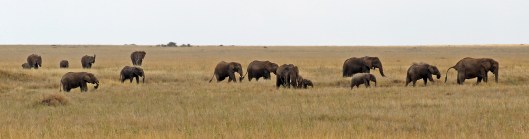
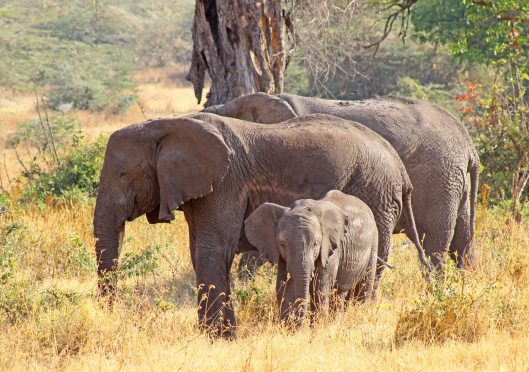
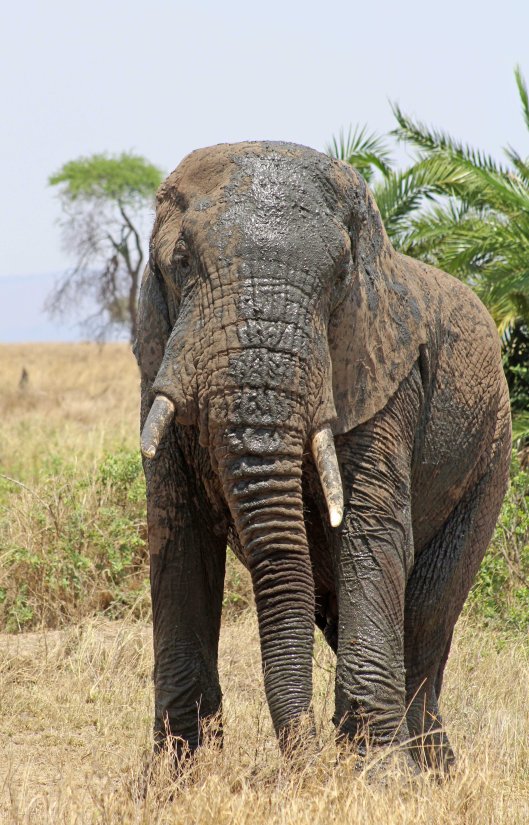
My photographs of elephants were taken on the Serengeti Plains and in the Ngorongoro Crater in Tanzania in 2014, at the end of a week-long trip with The Giving Lens, an organisation that combines photography workshops with mentoring, media and financial support for local NGOs.

Like Loading...

A most Changeable Lizard

01 Tuesday Mar 2016

Posted by sconzani in nature, nature photography, reptiles

≈ 6 Comments

Tags

Calotes versicolour, Cambodia, Changeable lizard, Eastern garden lizard, lizard, Oriental garden lizard

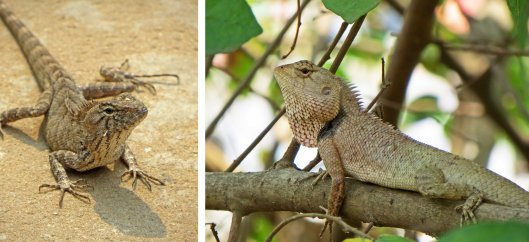
It’s St David’s Day here in Wales so I thought to feature something Welsh, but I’ve already covered the Daffy and the Taffy, and leeks aren’t exactly inspiring. Then I thought ‘Dragon’! Though I have photos of Welsh dragon sculptures and carvings, this is as close as I can get to the real thing, the lizards I encountered almost daily while living in Cambodia.

160301 oriental garden lizard (1)

Though these critters all look quite different, they are the same species, Calotes versicolour, also known as the Oriental garden lizard, the Eastern garden lizard and – no surprise – the Changeable lizard. As well as having naturally variable colouration, the males also take on red and black hues during the breeding season.

160301 oriental garden lizard (3)

Interesting facts? They have incredibly long stiff tails which, unlike other lizards, they do not drop. However, like other lizards, they do shed their skin, they do lay eggs – between five and fifteen, usually in a hole in the ground or a hollow in a tree, and, like chameleons, they can move each eye independently of the other. They mostly eat insects and small rodents but they don’t have teeth for chewing so gobble them down whole, after a little pre-dinner food-bashing. Sounds remarkably dragon-like to me, though I’m not sure of their attitude to gold!

160301 oriental garden lizard (4)160301 oriental garden lizard (2)

Like Loading...

Great Crested Grebe

28 Sunday Feb 2016

Posted by sconzani in birds, nature, nature photography, spring

≈ 5 Comments

Tags

birding, birds, birdwatching, British birds, Great Crested Grebe

160228 great crested grebe (1)

I’m always delighted to witness the mating display of the Great Crested Grebe (Podiceps cristatus). They make a rather noisy but thoroughly entertaining exhibition of head shaking and neck swaying and bill touching that is a joy to watch, especially with their vibrant neck plumage highlighting their every move. It comes as no surprise that those pretty plumes were once prized by early Victorian milliners to decorate their more extravagant creations. That usage, and the fact that the fine soft feathering on the bird’s body was also valued for costume adornment, meant the Great Crested Grebe was one of Britain’s rarest breeding species by the mid-1800s.

160228 great crested grebe (2)

Luckily, laws were enacted to protect Britain’s water birds but their recovery can also be attributed to mankind’s activities – and not in the way you might imagine. The massive increases in both road building and house building following the Second World War required enormous amounts of gravel, and the grebe was one of the birds that benefitted from the gravel pits once they had been abandoned and filled with water. It’s a fitting testament to how well nature can recover from man’s interference in the landscape.

160228 great crested grebe (3)

The highlight of today’s long walk was to witness a grebe sitting on a nest. It seems very early in the year and the nest was in rather an exposed position so I do hope the bird doesn’t get disturbed. It was wonderful and, indeed, a huge privilege to see the results of all that head shaking and neck swaying!

Like Loading...
← Older posts
Newer posts →

About me

sconzani

sconzani

I'm a writer and photographer; researcher and blogger; birder and nature lover; countryside rambler and city strider; volunteer and biodiversity recorder.

View Full Profile →

Follow earthstar on WordPress.com

Enter your email address to follow this blog and receive notifications of new posts by email.

Recent blog posts

  • Kestrel 2026 : 86 January 31, 2026
  • Birch polypore January 30, 2026
  • The Marl Med gull January 29, 2026
  • Recording Grey squirrels January 28, 2026
  • Jimmy Wren January 27, 2026

From the archives

COPYRIGHT

Unless otherwise acknowledged, the text and photographs on this blog are my own and are subject to international copyright. Nothing may be downloaded or copied without my permission.

Fellow Earth Stars!

  • Unknown's avatar
  • Unknown's avatar
  • Unknown's avatar
  • Unknown's avatar
  • Unknown's avatar
  • Unknown's avatar
  • Unknown's avatar
  • Unknown's avatar
  • Unknown's avatar
  • Unknown's avatar
  • Unknown's avatar
  • Unknown's avatar
  • Unknown's avatar
  • Unknown's avatar
  • Unknown's avatar
  • Unknown's avatar
  • Unknown's avatar
  • Unknown's avatar
  • Unknown's avatar
  • Unknown's avatar
  • Unknown's avatar
  • Unknown's avatar
  • Unknown's avatar
  • Unknown's avatar
  • Unknown's avatar
  • Unknown's avatar
  • Unknown's avatar
  • Unknown's avatar
  • Unknown's avatar
  • Unknown's avatar
  • Unknown's avatar
  • Unknown's avatar
  • Unknown's avatar
  • Unknown's avatar
  • Unknown's avatar
  • Unknown's avatar
  • Unknown's avatar
  • Unknown's avatar
  • Unknown's avatar
  • Unknown's avatar
  • Unknown's avatar
  • Unknown's avatar
  • Unknown's avatar
  • Unknown's avatar
  • Unknown's avatar
  • Unknown's avatar
  • Unknown's avatar
  • Unknown's avatar
  • Unknown's avatar
  • Unknown's avatar

Blog at WordPress.com.

Privacy & Cookies: This site uses cookies. By continuing to use this website, you agree to their use.
To find out more, including how to control cookies, see here: Cookie Policy
  • Subscribe Subscribed
    • earthstar
    • Join 670 other subscribers
    • Already have a WordPress.com account? Log in now.
    • earthstar
    • Subscribe Subscribed
    • Sign up
    • Log in
    • Report this content
    • View site in Reader
    • Manage subscriptions
    • Collapse this bar
 

Loading Comments...
 

You must be logged in to post a comment.

    %d