• ABOUT
  • BIRDING 2018
  • Birding 2019
  • BLOG POSTS
  • Butterflies 2018
  • Resources

earthstar

~ a celebration of nature

earthstar

Category Archives: nature

‘Dedicated Naturalist’: Mary Christmas from Macquarie, 2

25 Sunday Dec 2016

Posted by sconzani in 'Dedicated Naturalist' Project, birds, nature

≈ Leave a comment

Tags

Antarctic skua, Antarctica, Aub-Antarctic island, birdwatching, Christmas 1959, Dr Mary Gillham, Macquarie Island, Women in science

A snippet from my volunteer work on the ‘Dedicated Naturalist’ Project, helping to decipher and digitise, record and publicise the life’s work of naturalist extraordinaire, Dr Mary Gillham. In December 1959-January 1960 Mary made history as one of the first British women to conduct scientific research in the Antarctic region, as part of the ANARE expedition to restock the Australian Antarctic base on Macquarie Island.

Christmas 1959 was certainly a Christmas with a difference – wintry enough for the northern hemisphere, yet falling in midsummer. Our big meal was eaten buffet style; the mess hut would not rise to seating a population four times the size of the normal one. Antarctic skuas attended the second sitting (something which they scarcely waited for when the domestic fowl were being fed).

161225-skuas-on-macquarie-1
161225-skuas-on-macquarie-6

The skuas were the camp scavengers, fighting over the refuse bins and peering in hopefully through the window when the cook was at work. Occasionally one fell into the sink by mistake. It must be quite an experience suddenly to find a bird with a three foot wingspan flapping in your washing-up water!

161225-skuas-on-macquarie-5
161225-skuas-on-macquarie-4

After the Christmas toasts and speeches, Captain Hans Christian Petersen took the part of Santa Claus and came round with a sack of gifts. Our leader, Dick Thompson, had played a similar role at the Danish celebrations on board the previous evening. The captain warned us that we might well receive a pipe or tobacco pouch. The folks in Denmark could not possibly have foreseen that there would be ladies present on this auspicious occasion.

161225-skuas-on-macquarie-2
161225-skuas-on-macquarie-3

For the full story about the Mary Gillham Archive Project, check out our website, and follow our progress on Facebook and on Twitter.

Like Loading...

‘Dedicated Naturalist’: Mary Christmas from Macquarie, 1

24 Saturday Dec 2016

Posted by sconzani in birds, nature

≈ 3 Comments

Tags

Antarctic region, Christmas Day 1959, Dr Mary Gillham, Macquarie Island, Mary Gillham Archive Project, Wandering Albatross, women scientists in Antarctica

A snippet from my volunteer work on the ‘Dedicated Naturalist’ Project, helping to decipher and digitise, record and publicise the life’s work of naturalist extraordinaire, Dr Mary Gillham. In December 1959-January 1960 Mary made history as one of the first British women to conduct scientific research in the Antarctic region, as part of the ANARE expedition to restock the Australian Antarctic base on Macquarie Island.

161224-mary-gillham-albatross-drawing-2

Here we were in the “albatross latitudes”, where these greatest of all seabirds soar overhead like living sail planes. Albatrosses do not fly in the ordinary sense, but utilise air currents and turbulence. When the wind drops they are becalmed on the surface as surely as any sailing vessel.

161224-mary-gillham-albatross-photo-3
161224-mary-gillham-albatross-photo-2

It seemed incongruous that such noble birds should deign to eat the scraps from our table, in company with the scavenging host of smaller fry – the cape pigeons, giant petrels and Antarctic skuas. Although they did not scorn the scraps, they had, in fact, other motives for following us. They were cashing in on the fishy morsels such as squids which were churned up from below on the wake of our propellers.

161224-mary-gillham-albatross-drawing-1

The wandering albatross is a magnificent bird when viewed at close quarters and has no fear of man. I spent part of a memorable Christmas day within a yard or two of an old male bird with a wing span of eleven and a half feet. He had just started to nest on a level area of spongy bogland which provided an admirable landing field for his clumsy homecomings. He could only become airborne direct in a very high wind: usually he must walk several hundred yards to the sea.

161224-mary-gillham-albatross-photo-1

On Christmas morning his mate had not yet arrived from her long sojourn at sea and he was whiling away the time by preparing a home for her. He did this in the easiest possible way, scraping a circle of mosses and sedges towards himself as he sat. This would build up into a miniature volcano, sufficiently tall to raise the chick above the snow.

For the full story about the Mary Gillham Archive Project, check out our website, and follow our progress on Facebook and on Twitter.

Like Loading...

Fungi Friday: Of stagshorns and spindles

23 Friday Dec 2016

Posted by sconzani in fungi, nature

≈ 4 Comments

Tags

Calocera cornea, Calocera pallidospathulata, Clavaria fragilis, Clavaria fumosa, Pale Stagshorn, Small stagshorn, Smoky Spindles, White Spindles

Though the word stagshorn might conjure up images of majestic antlered beasts, I’ve got more small stuff for you today. In fact, the Small stagshorns (Calocera cornea) grow no more than 12mm tall so small is an over-statement.

161223-1-calocera-cornea-small-stagshorn
161223-2-calocera-cornea-small-stagshorn

The Stagshorns are jelly fungi so feel spongy when poked and that’s reflected in their scientific name: Calo comes from the ancient Greek καλός (kalos) which means beautiful, cēra is Latin for wax, and cornea is from the Latin cornu meaning horn-shaped, thus beautiful wax horns. The English name staghorn seems a little odd though as these fungi usually remain single stalked and unbranching.

161223-3-calocera-pallidospathulata-pale-stagshorn
161223-4-calocera-pallidospathulata-pale-stagshorn

There are two other species of Calocera to be found in Britain, though I have only photographed one so far, the Pale Stagshorn (Calocera pallidospathulata), shown above. All are small and grow on wood, and this is one of the characteristics that distinguishes them from the Spindles, as they grow in unimproved grassland (i.e. grassland which has not been improved with fertilisers or lime – I find Spindles often in my local cemetery which has been closed to burials for more than 30 years).

161223-5-clavaria-fragilis-white-spindles
161223-6-clavaria-fumosa-smokey-spindles

The White Spindles (Clavaria fragilis), above left, and Smoky Spindles (Clavaria fumosa), right, are two examples of these. Though sometimes forming clumps, Stagshorns tend to grow singly, whereas Spindles prefer to clump together, like little beds of eels or worms standing on end. Clavaria comes from the Latin word for club, which is why the Spindles as a group are often referred to as Club fungi.

Like Loading...

Bottoms up!

22 Thursday Dec 2016

Posted by sconzani in birds, nature

≈ 9 Comments

Tags

birding, birds bottoms, birdwatching, bottoms up, British birds, drinking idiom, festive cheer

With the festive season well underway and end-of-year / end-of-work / pre-holiday parties in full swing the phrase ‘Bottoms up!’ seems rather appropriate. But here it has nothing at all to do with drinking!

This slideshow requires JavaScript.

Like Loading...

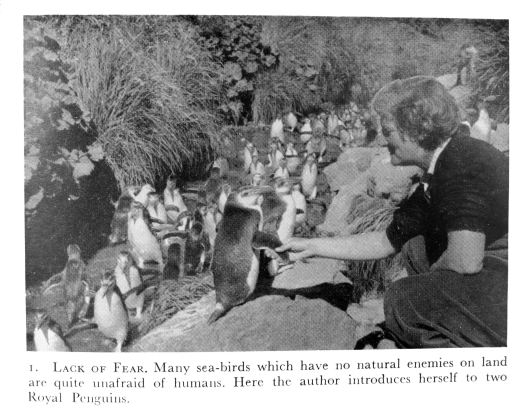
‘Dedicated Naturalist’: Mary and the penguins

21 Wednesday Dec 2016

Posted by sconzani in 'Dedicated Naturalist' Project, nature

≈ 1 Comment

Tags

Antarctic region, Dr Mary Gillham, Macquarie Island, penguins, Royal penguin, Women in Antarctica, Women in science

A snippet from my volunteer work on the ‘Dedicated Naturalist’ Project, helping to decipher and digitise, record and publicise the life’s work of naturalist extraordinaire.

In December 1959-January 1960 Mary made history as one of the first British women to conduct scientific research in the Antarctic region, as part of the ANARE expedition to restock the Australian Antarctic base on Macquarie Island and, when she returned to Britain following her Antipodean adventures, she was asked to give a presentation on BBC radio about her experience. The programme aired in May 1961 and this is a small snippet from the text of Mary’s talk.

161221-mary-gillham-and-penguin-1

The quaintly human form of the penguin has made it a universal favourite among bird lovers. On the whole we found them friendly little people, quite ready to offer their flipper for a cordial hand-shake, as long as we were not too hearty about it. Soon after I had sat down on one occasion, a penguin came and squatted between my extended legs. After a few enquiring pecks at my boots, he tucked his head into his body feathers and promptly fell asleep.

161221-mary-gillham-and-penguin-2

For the full story about the Mary Gillham Archive Project, check out our website, and follow our progress on Facebook and on Twitter.

Like Loading...

Fog

20 Tuesday Dec 2016

Posted by sconzani in nature, seasons, winter

≈ 4 Comments

Tags

fog, mist, Roath Lake, Roath Park, Roath Park Lake, winter weather

161220-fog-1

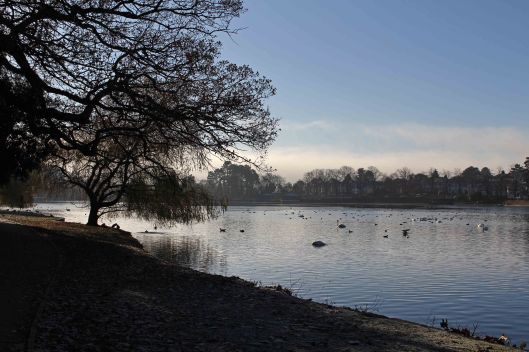
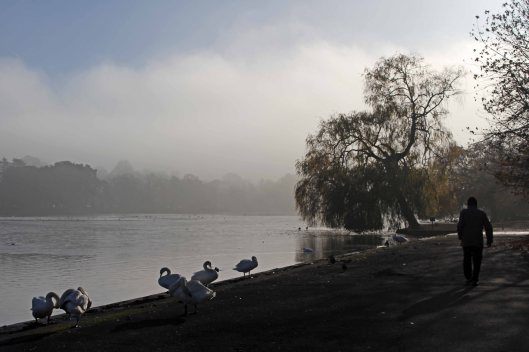
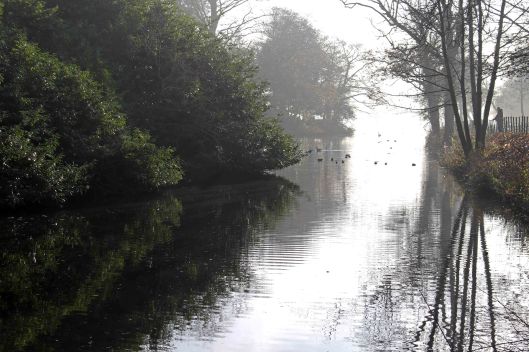
I can see it coming. Rolling silently over the house roofs and tree tops from the south, where the sea lies, where the ocean roars. Slowly, gradually, the light grows dim, eerie, the sun’s rays weaker, unable to penetrate the gloom. Trees vanish, leaving mere ghostly outlines.

161220-fog-2

Sounds become muffled but, at the same time, strangely amplified. Voices echo, seem nearby yet, in reality, are hundreds of metres distant. Footsteps tap, tap, tap. Spectral figures appear, pass quickly by, disappear once more. Birds fall silent as if afraid to pierce the silence with their squawks, tweets, chirps.

161220-fog-3

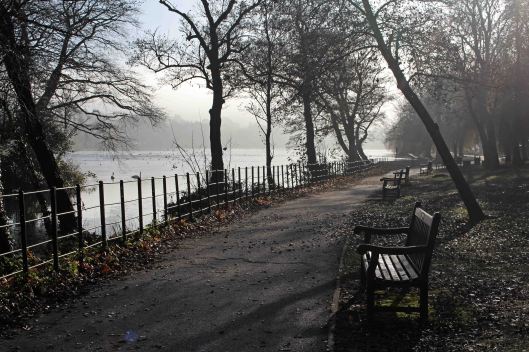
Fog is everywhere, blanketing the lake, flowing along the brook, shrouding buildings, hovering over bushes, making branches droop, making hair frizz. Creeping tendrils wind their way through tree branches, wrap themselves around park benches, slither between railings. Fog makes throats choke and chests heave, and seeps into old bones.

161220-fog-4

On Roath Lake, the light-less lighthouse needs a light today and a horn to warn.

161220-fog-5

Like Loading...

The right snuff

19 Monday Dec 2016

Posted by sconzani in fungi, nature

≈ 11 Comments

Tags

Beechmast Candlesnuff, bioluminescent fungi, Candlesnuff fungus, Xylaria carpophila, Xylaria hypoxylon

You might think that Candlesnuff Fungus (Xylaria hypoxylon) got its common name from its physical resemblance to a candle but no!

161219-xylaria-hypoxylon-candlesnuff-1

This tiny fungus is, in fact, bioluminescent – in a very very dark place it can be seen to emit light because, as Pat O’Reilly explains on his First Nature website (one of my go-to places for fungi identification), the phosphorus that accumulates within the mycelium reacts with oxygen and other chemicals in the fungus. Pat goes on to say that you really need night-vision goggles to see such weak luminescence or take a long-exposure image. Must try that some time!

161219-xylaria-hypoxylon-candlesnuff-5
161219-xylaria-hypoxylon-candlesnuff-3
161219-xylaria-hypoxylon-candlesnuff-2

161219-xylaria-hypoxylon-candlesnuff-6

Candlesnuff is an extremely common wood-rotting fungus that can be seen all year round in its various stages of growth. Though the fruiting bodies start out black at the base and white on top, they will eventually blacken all over and, from a single stem, they often develop multiple branches at the top.

161219-xylaria-carpophila-beechmast-candlesnuff-1
161219-xylaria-carpophila-beechmast-candlesnuff-2

Another member of the Xylaria genus is Xylaria carpophila, Beechmast Candlesnuff. It looks very similar to normal Candlesnuff but it is incredibly tiny and only grows on the rotting seeds of Beech trees (known as beechmast).

Like Loading...

Ebenezer Robin

18 Sunday Dec 2016

Posted by sconzani in birds, nature

≈ 8 Comments

Tags

Bah! Humbug!, birding, birdwatching, Christmas, Ebenezer Scrooge, robin

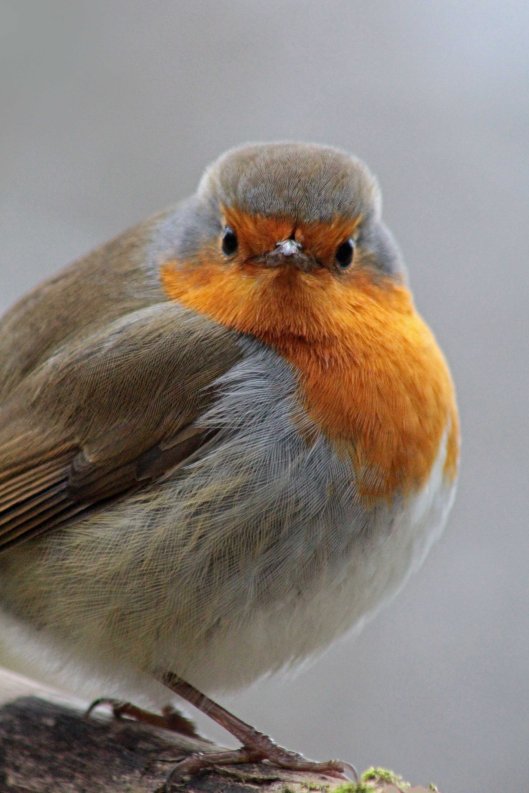
‘Christmas? Bah! Humbug!’

161218-robin

Like Loading...

Nature’s Christmas tree

17 Saturday Dec 2016

Posted by sconzani in flowers, nature, trees

≈ 9 Comments

Tags

berries, Callicarpa, Christmas baubles, Christmas tree, fruit, Holly, Mahonia

You’d think with the shortest day fast approaching that the landscape would be dull and grey and completely lacking in colour. But it’s not! If you look around, you’ll find the cotoneaster trees loaded with red berries, and holly trees, too, bursting with shiny red fruit. In my local park, the Mahonia bushes are flowering in brilliant yellow starbursts, and the Callicarpa shrubs are covered in stunning lilac berries that seem almost unreal and man-made, rather than something Ma Nature created. I thought I’d put some of Nature’s beautiful baubles together to make my very own ‘unreal’ Christmas tree!

161217-christmas-tree-1
161217-christmas-tree-2
161217-christmas-tree-3
161217-christmas-tree-1
161217-christmas-tree-4
161217-christmas-tree-5
161217-christmas-tree-3
161217-christmas-tree-6
161217-christmas-tree-7
161217-christmas-tree-8
Like Loading...

Fungi Friday: A load of tripe

16 Friday Dec 2016

Posted by sconzani in fungi, nature, trees

≈ 9 Comments

Tags

Auricularia auricula-judae, Auricularia mesenterica, Dutch Elm disease, Elm tree, Jelly Ear fungus, Tripe fungus

If you’re wondering how the Tripe fungus, Auricularia mesenterica, got its name, well, according to Pat O’Reilly’s most excellent First Nature website, ‘The specific epithet mesenterica is a Latinised adjective derived from the Ancient Greek word mesenterion meaning ‘middle intestine’.’ I checked – he’s not talking tripe! Auricularia comes from the Latin word for ear, a nod to its fleshy ear-like shape. (Fungi fans will notice that it resembles the Jelly Ear fungus, Auricularia auricula-judae, which is in the same genus.)

161215-tripe-fungus-3

This is not a particularly common fungus these days as it usually grows on dead elm trees but, with the devastating effects of Dutch Elm disease, which has killed over 60 million British elm trees, there are now not many elms left, even dead ones. I had first noticed this particularly fungus in one of my local woodlands several months ago when the hot dry summer had left it shrivelled up and unidentifiable but, as soon as the autumn rains came, it almost immediately fleshed out and began creating new growth. It’s very variable in colour, with bands of brown, grey, white or purple on top, and it is a rather odd combination of hairy above and jelly-like below.

161215-tripe-fungus-4
161215-tripe-fungus-5
161215-tripe-fungus-2
161215-tripe-fungus-1
161215-tripe-fungus-6
Like Loading...
← Older posts
Newer posts →

About me

sconzani

sconzani

I'm a writer and photographer; researcher and blogger; birder and nature lover; countryside rambler and city strider; volunteer and biodiversity recorder.

View Full Profile →

Follow earthstar on WordPress.com

Enter your email address to follow this blog and receive notifications of new posts by email.

Recent blog posts

  • Nesting material April 28, 2026
  • Lifer: Box bug April 27, 2026
  • Peak Wild garlic April 26, 2026
  • First damsels of 2026 April 25, 2026
  • NFY: Green-veined white April 24, 2026

From the archives

COPYRIGHT

Unless otherwise acknowledged, the text and photographs on this blog are my own and are subject to international copyright. Nothing may be downloaded or copied without my permission.

Fellow Earth Stars!

  • Unknown's avatar
  • Unknown's avatar
  • Unknown's avatar
  • Unknown's avatar
  • Unknown's avatar
  • Unknown's avatar
  • Unknown's avatar
  • Unknown's avatar
  • Unknown's avatar
  • Unknown's avatar
  • Unknown's avatar
  • Unknown's avatar
  • Unknown's avatar
  • Unknown's avatar
  • Unknown's avatar
  • Unknown's avatar
  • Unknown's avatar
  • Unknown's avatar
  • Unknown's avatar
  • Unknown's avatar
  • Unknown's avatar
  • Unknown's avatar
  • Unknown's avatar
  • Unknown's avatar
  • Unknown's avatar
  • Unknown's avatar
  • Unknown's avatar
  • Unknown's avatar
  • Unknown's avatar
  • Unknown's avatar
  • Unknown's avatar
  • Unknown's avatar
  • Unknown's avatar
  • Unknown's avatar
  • Unknown's avatar
  • Unknown's avatar
  • Unknown's avatar
  • Unknown's avatar
  • Unknown's avatar
  • Unknown's avatar
  • Unknown's avatar
  • Unknown's avatar
  • Unknown's avatar
  • Unknown's avatar
  • Unknown's avatar
  • Unknown's avatar
  • Unknown's avatar
  • Unknown's avatar
  • Unknown's avatar
  • Unknown's avatar

Blog at WordPress.com.

Privacy & Cookies: This site uses cookies. By continuing to use this website, you agree to their use.
To find out more, including how to control cookies, see here: Cookie Policy
  • Subscribe Subscribed
    • earthstar
    • Join 642 other subscribers
    • Already have a WordPress.com account? Log in now.
    • earthstar
    • Subscribe Subscribed
    • Sign up
    • Log in
    • Report this content
    • View site in Reader
    • Manage subscriptions
    • Collapse this bar
 

Loading Comments...
 

You must be logged in to post a comment.

    %d