‘Frost is the greatest artist in our clime –
he paints in nature and describes in rime.’
~ Thomas Hood (1799-1845, English editor, poet, publisher, and engraver)



15 Thursday Dec 2016
‘Frost is the greatest artist in our clime –
he paints in nature and describes in rime.’
~ Thomas Hood (1799-1845, English editor, poet, publisher, and engraver)
14 Wednesday Dec 2016
Posted in 'Dedicated Naturalist' Project, nature
Tags
Dr Mary Gillham, Hoiho, Mary Gillham Archive Project, New Zealand birds, New Zealand Forest & Bird, Yellow-eyed penguin
A snippet from my volunteer work on the ‘Dedicated Naturalist’ Project, helping to decipher and digitise, record and publicise the life’s work of naturalist extraordinaire, Dr Mary Gillham.
Today’s lunchtime reading was my newly arrived issue of the New Zealand Forest & Bird magazine. (I am a long-time supporter of this conservation charity; you can read more about them on their website.) Reading the depressing news that the Hoiho, the Yellow-eyed penguin, is on the verge of extinction reminded me that Mary had enjoyed many sightings of these noisy little birds (Hoiho means ‘noise shouter’ in Maori, a reference to the birds’ trumpet-like territorial call). Here’s an entry from one of Mary’s New Zealand diaries:
Monday 14 January 1957
A very strenuous but enjoyable day today starting with sunshine and finishing with rain. Ella and I set off after breakfast on the Peninsula bus to Portobello again, setting off from there on foot … to Little Papanui Bay …
Weary though I was and in spite of time and thirst, I had to delay lunch when I spotted a yearling yellow-eyed penguin silhouetted against the skyline on a steep grassy knoll. I stalked it successfully for a close up photo (in colour, hoping to show the large pink feet and bill) but the next one I stalked from the landward side scuttled back into the sea and was away at startling speed. … I returned to Ella to dry out and eat lunch and we sat and watched penguins (only a few) on beach and water. Was delighted to see a penguin walking up the beach unsuspecting (or not?) bowled over by a wave approaching from behind, turn a complete backward somersault and be swept several dozen yards up the beach before regaining its feet.
After lunch we explored up penguin gully where the birds were nesting in a steep-sided rift filled with a strip of evergreen native bush which made a dark splash down the adjacent slopes of English pasture grasses. I spotted something and slithered down thro’ a patch of the ferocious native nettle to find a large fluffy chick standing as high as the yearling (the yellow-eyed is one of the larger penguins) and much wider due to the copious grey fluff. The flippers and white breast were feathered. After photography, in spite of the gloom, I hauled myself up the other side, hailed Ella and we proceeded on up the gully to slither down at intervals to observe more where the patches of guano guided us.

Mary Gillham’s drawings of adult and young Hoiho
For the full story about the Mary Gillham Archive Project, check out our website, and follow our progress on Facebook and on Twitter.
13 Tuesday Dec 2016
Tags
I have no words of wisdom to impart today as I know very little about mosses, except that they can be extraordinarily beautiful when viewed up close, which is how I seem to be viewing a lot of the natural world in recent times. I hope you enjoy these images.
(p.s. I have an extremely knowledgable friend who really knows his bryophytes and he tells me these are: Grimmia pulvinata (with old capsules), Kindbergia praelonga, Ceratodon purpureus and Campylopus introflexus. Thanks a lot, George!)


12 Monday Dec 2016
Tags
birding, birds, birdwatching, Greylag goose, jackdaw, Mallard, Moorhen, Roath Park Lake, Tufted duck
Just to show that the birds of Roath Park Lake aren’t all vicious killers (see yesterday’s post for that horror story), here are some I photographed before the swans attacked.


There’s a little concrete ledge under the water at this end of the lake, which is just perfect for the water birds to sit on and preen but still have the chance for a quick watery getaway if needed. It’s also perfect for bird watchers to get a better look at the cute little Tufted ducks as you rarely see them out of the water. I think this little black-and-white male knows exactly how handsome he is!

Further around the lake I was entertained by three Jackdaws searching through the leaf litter for food. Just as I’ve seen blackbirds and thrushes do, they would grab the leaves and fling them to one side, then look back quickly for signs of any insect movement.

Still further along the path, I stopped and fed the seed from one of the two containers I was carrying firstly to one of the Barnacle geese, and then to the Greylag and Canada geese, Mallards and Feral pigeons that rapidly came to flock around me. This Moorhen came last but was still able to pick up a few seeds the bigger birds had missed. Their feathers have such beautifully rich colours.

And last but certainly not least was this very sleepy Greylag goose, standing apart from all the rest on the edge of the pavement at the end of the lake. As I watched it tucked one leg up under its plump body and, though it tried to keep an eye on me just in case I was a threat, its eyes gradually closed for a mid-afternoon snooze.
11 Sunday Dec 2016
I saw something last Friday afternoon that I hope never to see again – two male swans fighting, almost to the death.

I had just finished feeding seed to the water birds and pigeons when the battle commenced. I presume the second male had made a move towards the mate of the first, rather than it being a dispute over territory. This happened on Roath Park Lake in Cardiff, where the swans seem to move freely all around the lake and only get truly territorial in the mating season, which this was not.

These males were vicious, flapping their broad strong wings at each other, using their necks to wrestle and push, biting each other’s wing feathers. At first I was intrigued and took quite a lot of photos but, as the fight continued and neither swan was prepared to give way, I became concerned.

The female and this year’s two cygnets also grew more and more agitated. Both the female and one of the cygnets chased away other swans that came close, and the female tried to intervene but just got battered by the flapping wings of the males.
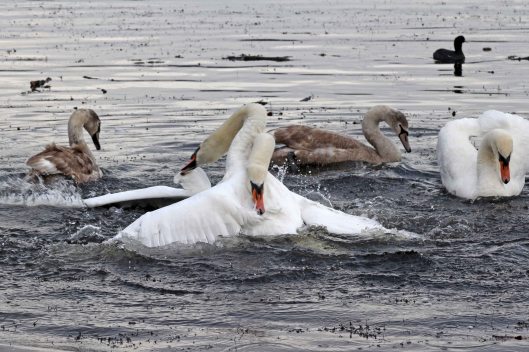
After twenty minutes or so, it was obvious both swans were getting weary but one, the interloper, was definitely weakening more. The dominant male tried to climb onto the back of the weaker bird, to push it under the water, and grabbed its neck, holding its head under the water to drown it.
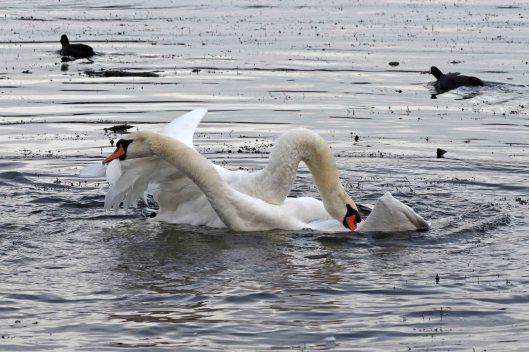
By this stage a small crowd of people had gathered and we were all rather shocked and becoming increasingly horrified by what was happening. Luckily, the swans were very close to the edge of the lake where there is a concrete pavement and one rather brave man managed to grab the neck of the dominant swan and held on until the other male could get some air and recover enough to swim away. If it hadn’t been for his actions, the weaker swan would definitely have drowned. I know this is a natural occurrence, this is how Nature operates, but it was still really shocking to see such violence play out in what is usually such a calm and peaceful setting.
10 Saturday Dec 2016
Following on from yesterday’s post where I (hopefully) sent you all on a quest to find the Holly parachute fungus, I thought I’d kill two biological records with one outing, and also get you to look for another species related specifically to holly.
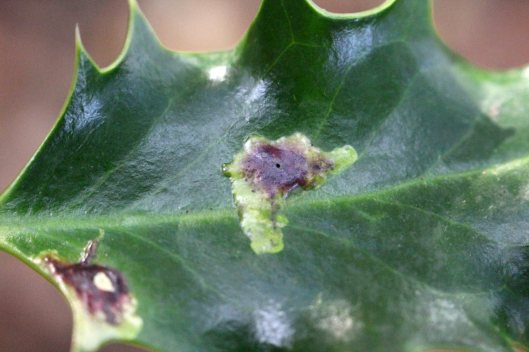
This is the Holly leaf-miner (Phytomyza ilicis), a small fly that lays its eggs inside the leaves of holly. ‘Inside’ may sound strange, but holly leaves are relatively thick and leathery so, once the eggs hatch, they make the perfect home for the fly’s larvae, which live out their lives feeding on the flesh of the leaves and making a little home for themselves in the process. Their feeding creates multi-coloured blotches on the leaves so, although you’ll probably never see the fly and probably not even the larvae (unless you slice open a leaf at the right time of year), you can always tell where they’ve been. Once they’ve eaten their fill, the larvae pupate inside their leafy homes, then open a small escape hole once their transformation is complete and fly away to start the process all over again.


Co-incidentally, the Holly leaf-miner is species of the month (really, two months – November and December) with SEWBReC, the South East Wales Biodiversity Records Centre. Like yesterday’s Holly parachute fungus, there are few biological records of the leaf-miner but it is almost certainly just under-recorded because, once you start looking for those tell-tale blotches, you quickly discover it’s almost everywhere. So, get looking and recording!
09 Friday Dec 2016
Tags
fungus challenge, Glamorgan Fungus Group, Holly leaves, Holly parachute, Holly tree, Marasmius hudsonii
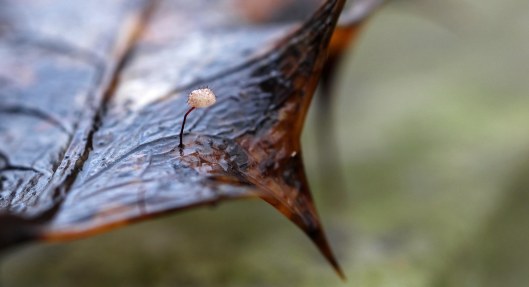
My friends and I from the Glamorgan Fungus Group have a team challenge going on and, if you live in Britain and enjoy fungi forays, this is something you might also like to have a go at. The Holly parachute fungus (Marasmius hudsonii) is usually described in fungi guides, if it’s included at all, as being a rare find but we wonder if it is, in fact, just rarely recorded because of its incredibly tiny size – its maximum cap size is 5mm and it’s frequently less than half that measurement.

As the name suggests, this small and very delicate mushroom is shaped a little like a parachute, though it has one interesting feature that makes identification easy – it’s covered in microscopic hairs that are a real challenge to see with the naked eye but are easier if you use a hand lens or a macro lens on a camera.
As its name also suggests, the Holly parachute grows exclusively on holly, specifically on dead and damp holly leaves like those you can find in the leaf litter beneath a holly tree. You might think that would make it easy to find but it’s not. Holly trees are usually evergreen so shed few leaves and they often grow amongst deciduous trees so, at this time of year, the ground is awash with all kinds of leaves that often smother the few holly leaves that have fallen.


However, members of our group have found Holly parachutes in more than 20 locations in our county since we began our challenge a month ago (I’ve found it twice) so we are leaning towards the idea that it is more common that the records might suggest. How about taking up the challenge and seeing if you can find it in your area?
08 Thursday Dec 2016
Tags
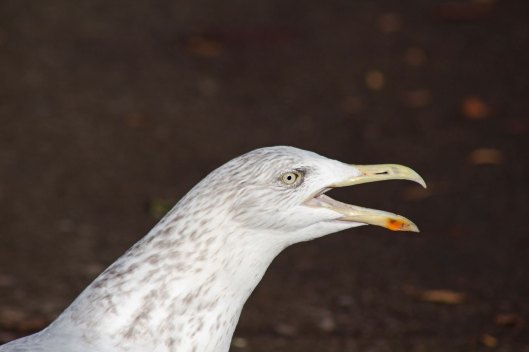
This land belongs to the gulls

And the gulls to their cry

And their cry to the wind

And the wind belongs to no-one, The wind belongs to no-one …
From ‘Gulls’ by David Gray (You can see the official music video on YouTube.)
07 Wednesday Dec 2016
Tags
Alouatta caraya, Argentina, Argentina Black Howler project, Black howler monkey, Globalteer, monkeys, South American monkey
Around this time, back in 2012, I had just enjoyed a flying visit to Argentina, to check out a project where the locals had been working tirelessly for over 20 years to rescue (from the pet trade) and rehabilitate the endangered Black Howler monkey (Alouatta caraya).
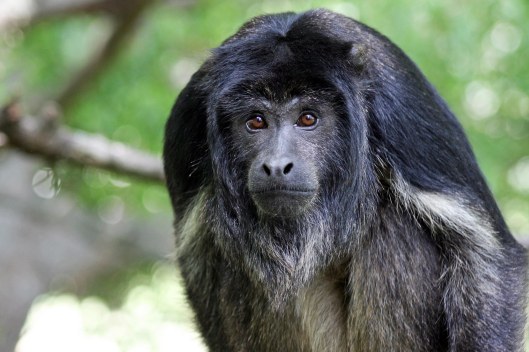
Although the project is a member of the Great Ape Project and is recognised for its excellent work by the Jane Goodall Institute, it receives no support from the Argentinian government, relying instead on volunteers from around the world to help with donations and manpower. The British charity I was then working for, Globalteer, was looking at partnering with this project, to send them more volunteers and funding, so I was making a preliminary site visit to check it out. (You can now volunteer with Globalteer at this project – check it out here!)

I couldn’t get very close to the monkeys, for our mutual protection – theirs from any bugs I might carry and mine from their bites! – but I could certainly hear them. The Howler monkey has the loudest call of any monkey – indeed, of any land animal – it can be heard up to 3 miles away. A small number of the Howlers were caged, while they went through the rehabilitation process, but they would later be released, to join one of the several troops that roam freely in the 360-hectare area of fields and forests owned by the project. Many of the free monkeys seemed curious about the gringa who had come to call and came down from their treetops to peer at me so I managed to get a few decent photos of these incredible creatures.


06 Tuesday Dec 2016
Posted in 'Dedicated Naturalist' Project, animals, nature
A snippet from my volunteer work on the ‘Dedicated Naturalist’ Project, helping to decipher and digitise, record and publicise the life’s work of naturalist extraordinaire, Dr Mary Gillham.
Scat, pooh, poop, droppings, guano, ordure, cow pies, cowplop, cow pat, meadow muffin, night soil, manure, excrement, faeces, muck, dung. Call it what you will, it’s part of life, and learning to recognise an animal’s excrement is a necessary skill for a good naturalist. Here are Mary’s words of wisdom on the dung of some of Britain’s mammals, with a couple of my photographs for good measure.

Fox
Up to 6” long; dropped at irregular intervals and sites. Always black elongated twisted with whip-like tail. Often has mucilaginous coating.
Stoat and polecat
Dark. 1½ – 2” long curved back on itself (boomerang shaped); bigger than weasels. Also an irregular black dollop on track of small mammal. Size of walnut.

Squirrel
More oval pellets than those of hares or rabbits.
Field vole
½” long, cylindrical. Greener than small rodents as eat vegetation. Also get bits of chopped grass in runs.
For the full story about the Mary Gillham Archive Project, check out our website, and follow our progress on Facebook and on Twitter.
 earthstar
You must be logged in to post a comment.