• ABOUT
  • BIRDING 2018
  • Birding 2019
  • BLOG POSTS
  • Butterflies 2018
  • Resources

earthstar

~ a celebration of nature

earthstar

Category Archives: nature

A rarely recorded moth

26 Monday Sep 2016

Posted by sconzani in insects, nature

≈ 4 Comments

Tags

Artemisia vulgaris, biodiversity in Wales, British moths, Coleophora artemisicolella, mugwort, Mugwort Case-bearer moth, UK moths, Welsh biodiversity

A few weeks ago, when I walked his butterfly transect with my colleague Dave Slade of SEWBReC, the South East Wales Biodiversity Records Centre, Dave stopped to inspect the seed heads of each mugwort (Artemisia vulgaris) plant we passed. Of course, I had to ask why and he explained that he was looking for signs of the rarely recorded Mugwort Case-bearer moth, Coleophora artemisicolella. As the UK Moths website explains, ‘The larva forms a case very closely resembling a seedhead, and moves from seed to seed leaving diagnostic small holes in the side of each one.’ Though it flies during the months of July and August, the moth itself is seldom seen (I certainly haven’t spotted it) and has previously been considered quite rare. It may be, however, that it is actually just rarely recorded as who but moth fanciers would know to look for it!

160926-coleophora-artemisicolella-2
160926-coleophora-artemisicolella-1
160926-coleophora-artemisicolella-3

I am not one to turn down a challenge and, after thoroughly checking every mugwort plant I found (not that many, to be honest) for the following three and a half weeks, I finally hit the jackpot at one of my local biodiversity hotspots, the Howardian Local Nature Reserve! These photos may not look exciting to you, but this is only the fifth recorded sighting of the Mugwort Case-bearer moth’s seed-head holes in the whole of Wales!
Like Loading...

Sulphur tuft

25 Sunday Sep 2016

Posted by sconzani in autumn, fungi, nature

≈ Leave a comment

Tags

fungus, Hypholoma fasciculare, Sulphur tuft

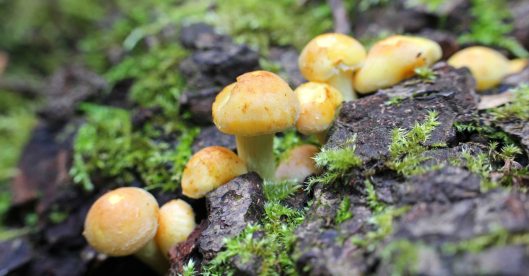
It’s fungi time! Well, strictly speaking, it’s fungi time all year round but autumn, with its rainy days and cooler night-time temperatures, always seems to be the time when fungi are most apparent, their colourful and plentiful fruiting bodies popping up wherever you look. One of the most colourful and plentiful, which can actually appear any time from April through to the time Jack Frost starts leaving his icy crust on the ground, is Sulphur tuft (Hypholoma fasciculare).

160925-sulphur-tuft-1

As you might guess from its name, its cap is usually quite a bright sulphur-yellow, though it sometimes has an orange tinge and a white band around the cap edge. It grows in large tufts or clumps, sometimes numbering several hundreds of individual mushrooms. Sulphur tuft is a wood-rotting fungus that happily devours both conifers and broadleaf hardwood trees, so can usually be seen in mixed woodland areas clustered on old stumps or bursting out of the cracks in the bark of fallen trees. As well as being very common in Britain and much of Europe, it’s also a frequent sight in North American woodlands. Sulphur tuft is poisonous so a feast for the eyes but not the belly.

160925-sulphur-tuft-2
160925-sulphur-tuft-3
160925-sulphur-tuft-4
160925-sulphur-tuft-5
160925-sulphur-tuft-6
160925-sulphur-tuft-7
160925-sulphur-tuft-8
Like Loading...

Earthstars!

24 Saturday Sep 2016

Posted by sconzani in fungi, nature

≈ 14 Comments

Tags

earthstar, Earthstar fungi, Geastrum

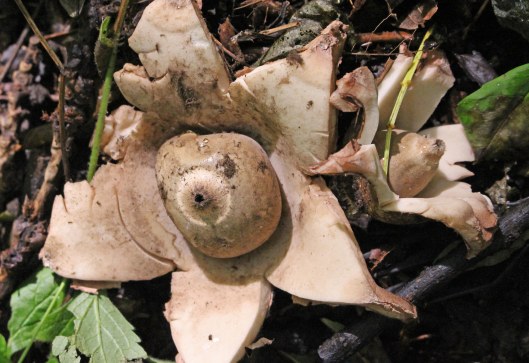
Yesterday I discovered I now have 100 followers on this blog – not a patch on those blogs that have thousands, even millions of followers, but I am utterly delighted just the same. Yesterday I also discovered these two gorgeous and very fresh Earthstar fungi (Geastrum sp.) while out wandering along an old railway cutting, now walking track, at a local nature reserve. I have blogged about Earthstars before and they are part of the reason behind the name of this blog, though my idea was also to make our Earth and all her wondrous creatures and creations the stars of my photographs and writing. I presume that you, my followers, are also charmed by the natural world around us, so I would like to dedicate this blog and these Earthstars to you. Thank you all most sincerely for your likes and your comments and for following along with me.

160924-earthstars-geastrum

Like Loading...

Don’t poke this weed!

23 Friday Sep 2016

Posted by sconzani in nature, plants

≈ 8 Comments

Tags

American nightshade, American pokeweed, berries, berry, Bute Park, Phytolacca americana, pokeweed

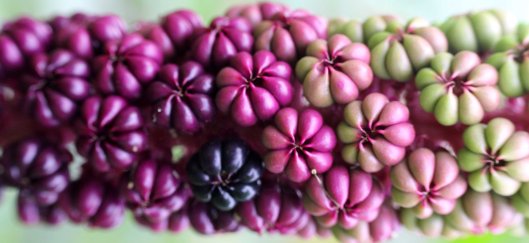
It’s toxic! If the sap touches your skin, it can burn. If you ingest the leaves, you might suffer a severe reaction. If you think these berries look delicious, think again – they will poison you. I think you get the picture – but what a beautiful picture it is, don’t you think? I am just entranced by the colours and shapes of the berries.

160923-american-pokeweed-1

This is Phytolacca americana, the American pokeweed or American nightshade or just plain pokeweed, and I found it growing alongside the hydrangeas and rhododendrons in Cardiff’s Bute Park. It’s a herbaceous perennial that grows to a height of about 8 feet (2 metres) and is native to the USA, where it’s apparently considered a weed by the agricultural community. However, several species of bird and some small beasties are unaffected by its toxicity so enjoy an autumn feast on the berries. And, according to Mrs M. Grieve’s 1931 A Modern Herbal, various parts of the plant can be used for a range of natural remedies, from drenching cattle to treating chronic rheumatism and haemorrhoids. I think I’ll stick to admiring the berries!

160923-american-pokeweed-2
160923-american-pokeweed-3
160923-american-pokeweed-4
160923-american-pokeweed-5
160923-american-pokeweed-6
Like Loading...

One of Nature’s whodunnits

22 Thursday Sep 2016

Posted by sconzani in insects, nature, plants

≈ 6 Comments

Tags

galls, oak galls, observing nature, wasp

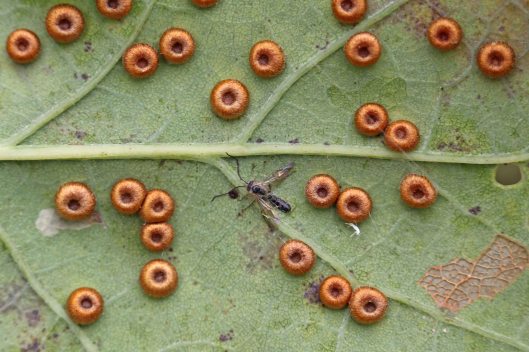
I sometimes get asked how I come up with enough ideas to post a blog every single day. This post goes some way to explaining how it works for me. I walk … a lot, and my camera is my constant companion, and I am by nature curious about … well, everything, really … and I’m also quite an observant person. So, for example, I went out for a wander around one of my local parks on Monday afternoon, thinking I would see if there were any fungi about, and also to get some photos of berries for a future blog. In the process of taking those photos, I noticed how many galls there were on this one particular oak tree so also took some photos of those … which then led me to check the neighbouring trees for galls. (If you’re not sure what galls are, there will now be a blog post on them as well!)

160922-whodunnit-1

When I got home and started going through my photos, this particular image really grabbed my attention because, for me, this is such a good example of one of Nature’s whodunnits. I look at this and my brain is immediately flooded with questions: how were these galls made? Why are they that shape? What is the creature that’s dead on the leaf? Is it a wasp? Did it make the galls? What killed it? It looks like it has white strands around it – a spider’s web or some kind of fungus? What created the bare patch where the leaf’s veins are showing? Was it the larvae of the wasp? What created the almost perfectly round hole in the leaf? Was that a leafcutter bee or something else? Was it the wasp? And what is the teeny weeny white thing? The shed skin of a larva perhaps?

160922-whodunnit-2
160922-whodunnit-3
160922-whodunnit

I don’t know the answers to any of these questions … yet. But, if I find out and if I can get more images related to the story, the result could be a blog or three from just this one photo. And so it goes on …

Like Loading...

El culpeo

21 Wednesday Sep 2016

Posted by sconzani in animals, nature

≈ 2 Comments

Tags

Andean fox, Andean wolf, Bolivia, Bolivian Altiplano, Culpeo, fox, Fuegian dog, Lycalopex culpaeus, Red Planet Expedition

For world wildlife Wednesday we head back to Bolivia for a closer look at this character, the Culpeo, Lycalopex culpaeus, also known as the Andean fox or wolf. True to the characterisation of foxes as wily, this one knew a tourist vehicle when it saw it and, though its normal diet would include rabbits, birds, rodents and whatever other small beasties it could hunt down, this fox obviously equated tourists with food. And it was not disappointed. On our Red Planet Expedition, in 4-wheel-drive vehicles deep in the remote regions of the Bolivian Altiplano, we carried food with us and our drivers prepared our lunches each day. El culpeo dined on chicken bones as we drove slowly off to our next destination.

160921-andean-fox

The Andean fox can be found in many South American countries, ranging from parts of Ecuador, Peru and Colombia in the north down to Patagonia and Tierra del Fuego in the south, though is mostly found on the western side of the mighty Andes mountain range. Just as today’s domesticated dogs all have a common ancestor in the wild wolf, there was once a breed of domesticated dog (the Fuegian dog) that was derived from this fox, but it became extinct some time in the late 19th or early 20th century.

160921-andean-fox-3
160921-andean-fox-1
160921-andean-fox-2
Like Loading...

Beetle mania!

20 Tuesday Sep 2016

Posted by sconzani in insects, nature

≈ 5 Comments

Tags

Bishop's mitre, British beetles, British bugs, Click beetle, Mint Leaf beetle, Potato capsid, Red lily beetle, Wasp beetle

Sorry, this has nothing to do with the Fab Four and, in fact, includes bugs as well as beetles but, as many of these cute little mini-beasties will soon disappear for the winter, I wanted to celebrate all those that have entertained me through the summer months but haven’t yet had their very own blog post (not because they’re boring, simply because I haven’t gathered enough good photos of them scurrying about their business in the flowers and bushes).

Little bugs and beetles, your time will come … but not till next year!
These have not all been identified to species but my list to date is: Bishop’s Mitre (Aelia acuminata); Click beetle (Elateridae family); Deraeocoris flavilinea; Heterotoma planicornis; Mint Leaf beetle (Chrysolina herbacea); Potato Capsid (Closterotomus norwegicus); Red lily beetle (Lilioceris lilii); four little unknowns; and, to finish, a Wasp Beetle (Clytus arietis).

160920-bishops-mitre
160920-click-beetle
160920-deraeocoris-flavilinea
160920-heterotoma-planicornis
160920-mint-leaf-beetle-chrysolina-herbacea
160920-potato-capsid-closterotomus-norwegicus
160920-red-lily-beetle-lilioceris-lilii
160920-unknown-1
160920-unknown-2
160920-unknown-3
160920-unknown-4
160920-wasp-beetle-clytus-arietis
Like Loading...

Spiders

19 Monday Sep 2016

Posted by sconzani in insects, nature

≈ 4 Comments

Tags

Araneus diadematus, Cross spider, Crowned orb weaver, Diadem spider, European garden spider, Garden spider, spiders

I don’t often share images of spiders because I don’t care for them much. I don’t mind large spiders because you can see them – most of the time you know exactly where they are. It’s the smaller spiders I don’t like, the ones that sneak around, hiding in dark corners or walking upside down on the bathroom ceiling, ready to abseil down when I’m having a shower. However, I know my feelings towards these mostly harmless little creatures are irrational so I’ve been making more of an effort lately to photograph them. And they can be really rather handsome.

160919-garden-spiders-1
160919-garden-spiders-3

Take this creature, for instance. This is the European garden spider, Araneus diadematus, also known as the Crowned orb weaver, the Diadem spider or the Cross spider. Although, as you can see from my photos, its colours are quite variable, the white markings on its abdomen form a distinctive cross pattern. And, although it’s called a garden spider, really much of Europe and North America is its garden. Also, from what I’ve seen of them, these spiders don’t try to hide – they sit quite blatantly in the centres of their webs, with that ‘I don’t know what you are. I don’t know what you want. But I will catch you. And I will suck the juices out of you’ kind of attitude!

160919 garden spiders (2)
160919 garden spiders (4)
Like Loading...

The wizard’s tree

18 Sunday Sep 2016

Posted by sconzani in autumn, nature, trees

≈ 3 Comments

Tags

berries, berry, Celtic beliefs, Greek mythology, Hebe, Mountain Ash, Norse mythology, Rowan, Rowan tree, Sorbus aucuparia

It’s berry time, and some of the loveliest berries to be seen at this time of year are those of the enigmatic Rowan tree (Sorbus aucuparia) or Mountain Ash, as it’s also commonly known.

160918-rowan-1

Why enigmatic? Well, the Rowan is surrounded by millenia of myths and legends. In Ancient Greek myth, Hebe, the beautiful young goddess who served ambrosia to the gods, lost her cup to demons and, when the gods sent an eagle to recover the cup, each one of the eagle’s feathers and drops of blood that fell to earth during the ensuing battle produced a Rowan tree. This also explains the Rowan’s red berries and its feather-shaped leaves.

The ancient Norse people believed the first woman was created from a Rowan tree, and a Rowan rescued the god Thor from drowning in a river in the Underworld. The Rowan also features in the ancient wisdom of the Celtic people. Fid na ndruad, its ancient Celtic name, means wizard’s tree; the Irish planted the Rowan near houses for protection against evil; the Scots believed that felling a Rowan would bring bad luck; and the Welsh planted Rowans in their graveyards to keep evil spirits at bay.

160918-rowan-2
160918-rowan-4
160918-rowan-3
Like Loading...

The Creature from the Black Stump

17 Saturday Sep 2016

Posted by sconzani in fungi, nature

≈ 5 Comments

Tags

fungus, Mycoacia uda, resupinate fungus, resupinate tooth fungus, tooth fungus

160917-mycoacia-uda

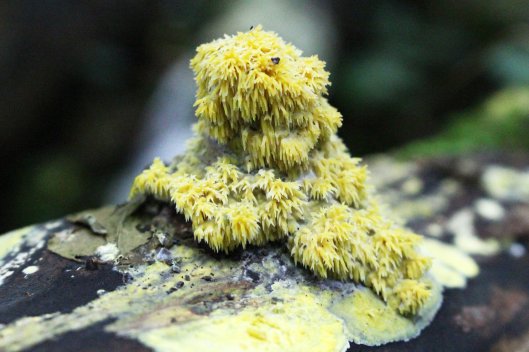
I’ve decided to name it Stumpy, this ‘creature’ that appears to be growing out of a fallen tree at one of my local nature reserves. Its scientific name is Mycoacia uda but that’s a bit of a mouthful.

Last Thursday was the first time I’d encountered one of these but, luckily, one of my Glamorgan Fungi group friends was able to identify it for me. It’s a resupinate tooth fungus and can be found growing on the fallen branches of deciduous trees in Britain, Europe and North America.

But, at night, when no one’s looking, it emerges from its fallen branch and roams the woodland eating stray dogs, howling at the moon, and searching for a mate … Just kidding!

Like Loading...
← Older posts
Newer posts →

About me

sconzani

sconzani

I'm a writer and photographer; researcher and blogger; birder and nature lover; countryside rambler and city strider; volunteer and biodiversity recorder.

View Full Profile →

Follow earthstar on WordPress.com

Enter your email address to follow this blog and receive notifications of new posts by email.

Recent blog posts

  • Nesting material April 28, 2026
  • Lifer: Box bug April 27, 2026
  • Peak Wild garlic April 26, 2026
  • First damsels of 2026 April 25, 2026
  • NFY: Green-veined white April 24, 2026

From the archives

COPYRIGHT

Unless otherwise acknowledged, the text and photographs on this blog are my own and are subject to international copyright. Nothing may be downloaded or copied without my permission.

Fellow Earth Stars!

  • Unknown's avatar
  • Unknown's avatar
  • Unknown's avatar
  • Unknown's avatar
  • Unknown's avatar
  • Unknown's avatar
  • Unknown's avatar
  • Unknown's avatar
  • Unknown's avatar
  • Unknown's avatar
  • Unknown's avatar
  • Unknown's avatar
  • Unknown's avatar
  • Unknown's avatar
  • Unknown's avatar
  • Unknown's avatar
  • Unknown's avatar
  • Unknown's avatar
  • Unknown's avatar
  • Unknown's avatar
  • Unknown's avatar
  • Unknown's avatar
  • Unknown's avatar
  • Unknown's avatar
  • Unknown's avatar
  • Unknown's avatar
  • Unknown's avatar
  • Unknown's avatar
  • Unknown's avatar
  • Unknown's avatar
  • Unknown's avatar
  • Unknown's avatar
  • Unknown's avatar
  • Unknown's avatar
  • Unknown's avatar
  • Unknown's avatar
  • Unknown's avatar
  • Unknown's avatar
  • Unknown's avatar
  • Unknown's avatar
  • Unknown's avatar
  • Unknown's avatar
  • Unknown's avatar
  • Unknown's avatar
  • Unknown's avatar
  • Unknown's avatar
  • Unknown's avatar
  • Unknown's avatar
  • Unknown's avatar
  • Unknown's avatar

Blog at WordPress.com.

Privacy & Cookies: This site uses cookies. By continuing to use this website, you agree to their use.
To find out more, including how to control cookies, see here: Cookie Policy
  • Subscribe Subscribed
    • earthstar
    • Join 642 other subscribers
    • Already have a WordPress.com account? Log in now.
    • earthstar
    • Subscribe Subscribed
    • Sign up
    • Log in
    • Report this content
    • View site in Reader
    • Manage subscriptions
    • Collapse this bar

Loading Comments...

You must be logged in to post a comment.

    %d