• ABOUT
  • BIRDING 2018
  • Birding 2019
  • BLOG POSTS
  • Butterflies 2018
  • Resources

earthstar

~ a celebration of nature

earthstar

Category Archives: nature

Bioblitzing at Porthkerry Country Park

06 Thursday Oct 2016

Posted by sconzani in nature, parks

≈ 8 Comments

Tags

bioblitz, biodiversity, biological recording, biological recording centre, biological records, Mary Gillham Archive Project, Porthkerry Country Park, SEWBReC

As I volunteer on the Mary Gillham Archive Project, which is hosted by SEWBReC (the South East Wales Biodiversity Records Centre), I got invited along to SEWBReC’s staff outing yesterday. And what do records centre staff do for a staff outing? Why we go looking for more biodiversity records, of course! I was in my element, and it was so nice being with like-minded people who also spend a lot of time standing and staring at bushes and trees, and can take an hour to progress a hundred metres. For once, I wasn’t the ‘strange’ one!
161006-porthkerry-bioblitz-5161006-porthkerry-bioblitz-3

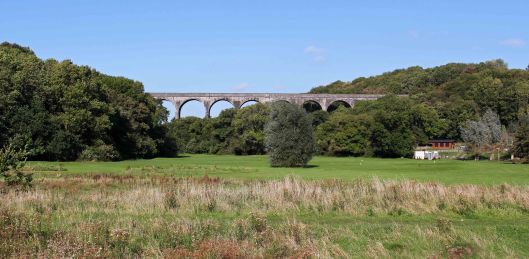
We spent the morning by the seaside at Porthkerry Country Park, on the south Wales coast near Barry, a first visit for me to this beautiful place, which ‘contains 220 acres of woodland and meadows in a sheltered valley that leads to a pebble beach and spectacular cliffs’. We barely scratched the surface, so I will certainly be heading back to explore further. Our list of species found currently stands at 93 but we have a few more to check so I feel sure we’ll push our total over the 100 mark before we’re finished. The sun shone on the recording team at Porthkerry!

161006-porthkerry-bioblitz-14
161006-porthkerry-bioblitz-7
161006-porthkerry-bioblitz-11
161006-porthkerry-bioblitz-8
161006-porthkerry-bioblitz-10
161006-porthkerry-bioblitz-4
161006-porthkerry-bioblitz-9
161006-porthkerry-bioblitz-12
161006-porthkerry-bioblitz-1
161006-porthkerry-bioblitz-13
161006-porthkerry-bioblitz-6
161006-porthkerry-bioblitz-2
Like Loading...

The Llama panorama

05 Wednesday Oct 2016

Posted by sconzani in animals, nature

≈ 2 Comments

Tags

llama, llama communication, llama in Bolivia, llama wool

Did you know:

The llama is sturdy and sure-footed, making it the ideal beast to carry heavy loads along the narrow mountain trails of South America.

The fine undercoat of wool on llamas is used to make clothing and handcrafts, and the more coarse outer wool is often made into rugs.

161005 llamas (3)

Llamas mate lying down – it’s called a kush position (sounds cushy to me!) – which is rather unusual for such a big animal and, also unusual for their size, their mating is no quick fling. Instead, they’re at it for between 20 and 45 minutes, plus the sexually aroused male makes a gargling sound – called an orgle – before and during the mating process.

Female llamas have very short tongues, preventing them from licking their newly born babies (called crias) so, instead of bonding with their offspring through the licking process, the mummy llamas nuzzle their babies and hum to them.

Llamas are family animals, sharing a strong familial bond and looking out for each other. When threatened, a llama will emit a warning bray to alert the rest of the herd, and llamas often hum to each other as a way of communicating. As well as these sounds, they also make groaning noises or produce a ‘mwa’ noise when they’re afraid or angry. Strange then that humans use ‘mwa’ as an expression for sending someone a kiss.

161005 llamas (2)
161005 llamas (4)
161005 llamas (5)
161005 llamas (6)
161005-llamas-1

a large herd of llamas on the hills behind La Paz, in Bolivia

Like Loading...

Watch your tongue!

04 Tuesday Oct 2016

Posted by sconzani in fungi, nature, trees

≈ 7 Comments

Tags

Alder, Alder tongue, Alnus glutinosa, fungal gall, fungus, galls on alder cones, Taphrina amentorum, Taphrini alni

If you’re out walking through parks and woodlands this month, keep an eye out for these strange-looking growths on the cones of Alder trees (Alnus glutinosa). They’re caused by the fungus Taphrina alni (also known as Taphrina amentorum), common name Alder tongue, a plant pathogen that uses chemicals to persuade the trees to produce these weird and wonderful tongue-shaped galls.

161004-alder-tongue-1
161004-alder-tongue-2
161004-alder-tongue-3

Though common in Western Europe, Alder tongue only appeared in Britain in the 1940s but has now become quite common throughout the isles as spores produced by the ‘tongues’ are easily carried on the wind to other trees. Sometimes the Alder cones have just one tongue, sometimes they have several, usually all emerging from the same spot on the cone and often curling into intriguing shapes (spot the dragons in the images below!). The tongues start off green in colour but then vary from yellow and orange to pink and red (which really would look very tongue-like) before becoming brown and black as they age. They can, in fact, be seen on Alder trees throughout the year, though, for some reason, I’m seeing more of them now, in the autumn months.

161004-alder-tongue-4
161004-alder-tongue-5
Like Loading...

‘Dedicated Naturalist’: What is a cow?

03 Monday Oct 2016

Posted by sconzani in 'Dedicated Naturalist' Project, animals, nature

≈ 3 Comments

Tags

cow, cow as a machine, dairy cow, Dr Mary Gillham, fun description of a cow, Mary Gillham Archive Project

A snippet from my volunteer work on the ‘Dedicated Naturalist’ Project, helping to decipher and digitise, record and publicise the life’s work of naturalist extraordinaire, Dr Mary Gillham. This piece is from Mary’s days as a Land Girl during the Second World War and is, it seems, ‘a dairying student’s concept of a cow’.

A cow is a completely automatic milk manufacturing machine. It is encased in untanned leather and mounted on four movable vertical supports, one on each corner.

161003-marys-cows-1

The front end contains the cutting and grinding machine, as well as headlights, air inlet and exhaust, and bumper and foghorn. At the rear is the dispensing apparatus and an automatic fly swatter.

The central portion houses a hydrochemical conversion plant. This consists of four fermentation and storage tanks connected in series by an intricate network of flexible plumbing. This section also contains the heating plant complete with automatic temperature controls, pumping station and main ventilating system. The waste processing and disposal apparatus is located at the rear of this central section.

161003-marys-cows-2
161003-marys-cows-3

In brief, the external visible features are: two lookers, two hookers, four stander-uppers, four hanger-downers and a swishy-wishy.

There is a similar machine known as a bull which should not be confused with a cow. It produces no milk but has other interesting features. 

161003-marys-cows-4
161003-marys-cows-5

For the full story about the Mary Gillham Archive Project, check out our website, and follow our progress on Facebook and on Twitter.

Like Loading...

Yesterday, today, tomorrow

02 Sunday Oct 2016

Posted by sconzani in autumn, nature, plants

≈ 2 Comments

Tags

flower seeds, proverbs about seeds, seed photographs, seed proverbs, seeds

161002-seeds-1

Seed well and harvest better. ~ Sicilian proverb

161002-seeds-2

They tried to bury us. They didn’t know we were seeds. ~ Mexican proverb

161002-seeds-3

With a little seed of imagination, you can grow a field of hope. ~ African proverb

161002-seeds-4

A harvest of peace grows from seeds of contentment. ~ Indian proverb

161002-seeds-5

All work is as seed sown; it grows and spreads, and sows itself anew. ~ Turkish proverb

161002-seeds-6

All the flowers of tomorrow are in the seeds of yesterday. ~ Italian proverb

Like Loading...

The coral that grows above the ground

01 Saturday Oct 2016

Posted by sconzani in autumn, fungi, nature

≈ 4 Comments

Tags

coral fungus, fungus, Ramaria stricta, Upright Coral Fungus

Once upon a time there was a coral that decided it didn’t like living under the ocean. It didn’t like living on hard unyeilding rocks; it didn’t like always having dirty sand being washed around its clean white branches by the harsh ocean waves; and it certainly didn’t like having all manner of little fishes ducking and diving around and nibbling at its extremities. So, it rebelled! It upped roots and moved to the land, to a place where it could be sheltered by beech trees and conifers, where it could spread its delicate root system through the welcoming piles of buried wood and leaf litter, where it could stretch its little branches straight up towards the sky.

161001-ramaria-stricta-1

Nah, not really! This is a coral fungus, probably Ramaria stricta, the Upright Coral fungus. It is quite common in Britain, and can also be found from late summer through the autumn months in much of Europe and in North America. It looks for all the world like the coral you find on reefs in tropical seas and oceans around the world, hence my fanciful flight of imagination earlier.

161001-ramaria-stricta-2
161001-ramaria-stricta-3
161001-ramaria-stricta-4

At the same location in October 2015

Like Loading...

Feasting on ivy flowers

30 Friday Sep 2016

Posted by sconzani in autumn, flowers, insects, nature

≈ Leave a comment

Tags

harlequin ladybird, ivy, ivy flowers, ladybird

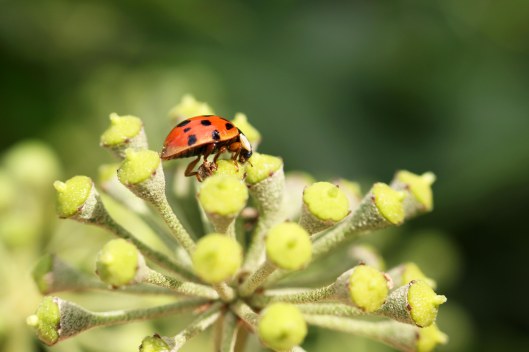
160930-ladybird-on-ivy

This little Harlequin ladybird was just one of the many insects – flies and hoverflies, honey bees, bumblebees and wasps, and a Red Admiral butterfly – that were enjoying the nectar and pollen to be found on these ivy flowers, an important source of food for so many insects in the autumn months.

Like Loading...

Bye bye butterflies

29 Thursday Sep 2016

Posted by sconzani in autumn, insects, nature

≈ 7 Comments

Tags

Brimstone butterfly, British butterflies, butterfly, Gatekeeper, Gonepteryx rhamni, Pyronia tithonus, Red Admiral, Vanessa atalanta

Though I love many things about the coming of autumn, it is also a time when many other things I love disappear for the year. The butterflies are one of those things. Gone now are the gorgeous Gatekeepers (Pyronia tithonus) that kept me company during my frequent wanders around my local cemetery.

160929-gatekeeper-1
160929-gatekeeper-2

Gone too is the pale, subtle beauty of the Brimstone (Gonepteryx rhamni). Though I searched for more, I saw only one this year, at the Parc Slip Nature Reserve.

160929-brimstone

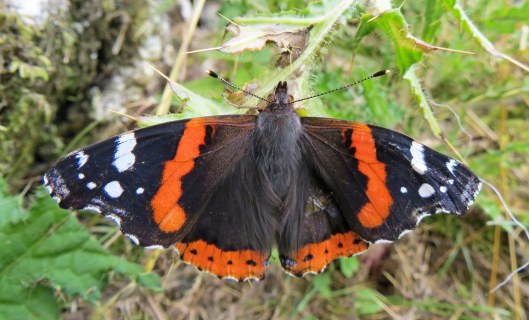
I have noticed, over the past couple of weeks, a little resurgence of Red Admirals (Vanessa atalanta), as they feast on the ivy flowers that are just beginning to bloom here in Cardiff and are providing a late season banquet for bees, hoverflies and butterflies. All too soon, these creatures will also fade away, hopefully to come again in the springtime when the temperatures begin to rise and the days to lengthen.

160929-red-admiral

Like Loading...

The Coconut grasshopper

28 Wednesday Sep 2016

Posted by sconzani in insects, nature

≈ 15 Comments

Tags

Cambodia, Cambodian insects, Coconut grasshopper, Pseudophyllanax imperialis

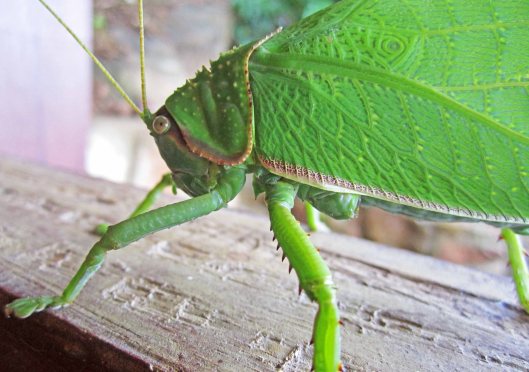
I’ve not been able to find out anything about the star of today’s world wildlife Wednesday post but I know one thing for sure – it’s a master of disguise!
160928-coconut-grasshopper-3

It’s a Coconut grasshopper (Pseudophyllanax imperialis) and I encountered it while on a brief holiday in the seaside town of Kep in Cambodia. Apparently, it’s one of the largest species of grasshopper in the world and can be found in other coconut-growing locations, like New Caledonia, in the Pacific.

160928-coconut-grasshopper-1
160928-coconut-grasshopper-2

I’m not sure in what ways it’s associated with coconut trees because its patterning and colouration make it look more like the leaf of an ordinary tree rather than the palm fronds of a coconut. Mind you, those jaws look like it could quite easily crack open a coconut. Though it looks rather fierce, these grasshoppers are harmless to humans, otherwise I wouldn’t have had it sitting on my hand!

160928-coconut-grasshopper-4

Like Loading...

First recorded sighting in Wales!

27 Tuesday Sep 2016

Posted by sconzani in insects, nature

≈ 9 Comments

Tags

Auchenorrhyncha, first biological record for Wales, leafhopper, Zyginella pulchra

I’m on a roll! Yesterday I told you about my fifth recorded sighting in Wales of a Mugwort Case-bearer moth; today I am thrilled to report a first recorded sighting for Wales!

160927-zyginella-pulchra-3

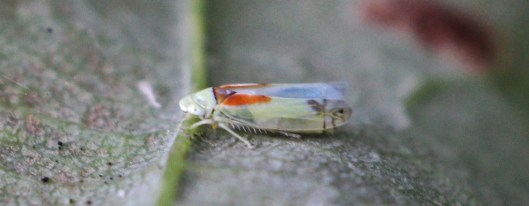
Now I must admit that I didn’t actually recognise this little creature when I first saw it at my local cemetery on 16 September and, as it was so tiny and my photos of it are not crisp, I almost didn’t record it. And, when I did, I wrongly recorded it as a nymph of the Rhododendron leafhopper (Graphocephala coccinea). 

160927-zyginella-pulchra-4
160927-zyginella-pulchra-1

Luckily, Alan Stewart, the national recorder for Auchenorrhyncha, realised my mistake and corrected my record. In his notification email, Alan wrote, ‘In fact, it’s more interesting because this is a species that arrived in Britain only recently and has gradually been spreading. Very interesting that it has arrived in Wales.’ That last sentence made me sit up and pay attention and, sure enough, when I checked with the team at SEWBReC, they confirmed that there were no recorded sightings so far in Wales. So, let me introduce you to Zyginella pulchra – it may be tiny but it is certainly not insignificant. When / if I can get better images, I will post them.

160927-zyginella-pulchra-2

Like Loading...
← Older posts
Newer posts →

About me

sconzani

sconzani

I'm a writer and photographer; researcher and blogger; birder and nature lover; countryside rambler and city strider; volunteer and biodiversity recorder.

View Full Profile →

Follow earthstar on WordPress.com

Enter your email address to follow this blog and receive notifications of new posts by email.

Recent blog posts

  • Nesting material April 28, 2026
  • Lifer: Box bug April 27, 2026
  • Peak Wild garlic April 26, 2026
  • First damsels of 2026 April 25, 2026
  • NFY: Green-veined white April 24, 2026

From the archives

COPYRIGHT

Unless otherwise acknowledged, the text and photographs on this blog are my own and are subject to international copyright. Nothing may be downloaded or copied without my permission.

Fellow Earth Stars!

  • Unknown's avatar
  • Unknown's avatar
  • Unknown's avatar
  • Unknown's avatar
  • Unknown's avatar
  • Unknown's avatar
  • Unknown's avatar
  • Unknown's avatar
  • Unknown's avatar
  • Unknown's avatar
  • Unknown's avatar
  • Unknown's avatar
  • Unknown's avatar
  • Unknown's avatar
  • Unknown's avatar
  • Unknown's avatar
  • Unknown's avatar
  • Unknown's avatar
  • Unknown's avatar
  • Unknown's avatar
  • Unknown's avatar
  • Unknown's avatar
  • Unknown's avatar
  • Unknown's avatar
  • Unknown's avatar
  • Unknown's avatar
  • Unknown's avatar
  • Unknown's avatar
  • Unknown's avatar
  • Unknown's avatar
  • Unknown's avatar
  • Unknown's avatar
  • Unknown's avatar
  • Unknown's avatar
  • Unknown's avatar
  • Unknown's avatar
  • Unknown's avatar
  • Unknown's avatar
  • Unknown's avatar
  • Unknown's avatar
  • Unknown's avatar
  • Unknown's avatar
  • Unknown's avatar
  • Unknown's avatar
  • Unknown's avatar
  • Unknown's avatar
  • Unknown's avatar
  • Unknown's avatar
  • Unknown's avatar
  • Unknown's avatar

Blog at WordPress.com.

Privacy & Cookies: This site uses cookies. By continuing to use this website, you agree to their use.
To find out more, including how to control cookies, see here: Cookie Policy
  • Subscribe Subscribed
    • earthstar
    • Join 642 other subscribers
    • Already have a WordPress.com account? Log in now.
    • earthstar
    • Subscribe Subscribed
    • Sign up
    • Log in
    • Report this content
    • View site in Reader
    • Manage subscriptions
    • Collapse this bar

Loading Comments...

You must be logged in to post a comment.

    %d