• ABOUT
  • BIRDING 2018
  • Birding 2019
  • BLOG POSTS
  • Butterflies 2018
  • Resources

earthstar

~ a celebration of nature

earthstar

Category Archives: nature

Moorhen multiplication

19 Thursday May 2016

Posted by sconzani in birds, nature, spring

≈ Leave a comment

Tags

birding, birdwatching, British birds, chicks, Forest Farm Nature Reserve, Gallinula chloropus, Moorhen

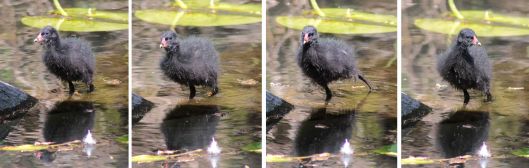
Are you ready for more cute bird babies? The Moorhen (Gallinula chloropus) chicks at Forest Farm Nature Reserve last Friday were the first I’d seen, so I just had to take lots of photos of them. They looked a lot like coot chicks to me, except perhaps with even bigger feet!

160521 moorhen chicks (2)

According to the RSPB website there are around 270,000 breeding pairs in Britain so the chances of seeing them are fairly good, especially in lowland areas. The adults build a nest on the ground, in amongst thick shrubs for protection, and lay between 5 and 8 eggs that take about three weeks to incubate, with both male and female taking turns on the nest.

160521 moorhen chicks (4)
160521 moorhen chicks (6)
160521 moorhen chicks (5)
160521 moorhen chicks (3)

The parents also share the feeding of their offspring, though the chicks are able to feed themselves after a few days, and are fully fledged 6 to 7 weeks after hatching. A few weeks after that, the chicks head off on their own and the parents will often raise a second brood. That sounds like an awful lot of moorhens in the making but, sadly, as with most birds, predators take their toll.
160521 moorhen chicks (1)

chick callisthenics?

If you want to know more about moorhens, I found a delightful article online here. Meantime, I hope my photos make you smile as much as I did while watching these little cuties.

Like Loading...

New Zealand’s parson bird

18 Wednesday May 2016

Posted by sconzani in birds, nature, nature photography

≈ 4 Comments

Tags

birding, birdwatching, New Zealand birds, parson bird, Prosthemadera novaeseelandiae, tui

For world wildlife Wednesday this week, I thought I’d go back to my roots and show you one of my favourite New Zealand birds.

160518 tui (1)

Called the parson bird by the early European immigrants to New Zealand, presumably because the white tufts of feathers at the front of its neck resemble a priest’s clerical collar, the Tui (Prosthemadera novaeseelandiae) is anything but pious. In fact, it has a habit of imbibing so much nectar from blossoming trees that it becomes quite intoxicated and sings uproariously. Its song is one of its most endearing qualities, highly variable, pleasingly melodic but also including a comprehensive vocabulary of clicks, creaks, cackles and groans.

160518 tui (2)
160518 tui (3)

Beautifully plumaged in shades ranging from iridescent greens and blues through dark browns to an inky black, the Tui has quite a distinctive flight pattern, with louder flapping than most other birds due to its relatively short wide wings. Chances are, then, that if you visit New Zealand, you’ll hear the tui before you see it.

160518 tui (4)
160518 tui (5)
Like Loading...

Fluttering their eyelashes

17 Tuesday May 2016

Posted by sconzani in fungi, nature

≈ 1 Comment

Tags

Cheilymenia, Eyelash fungi, Scutellinia

It’s easy to see how the Scutellinia fungi got their common name of Eyelash fungi – the long dark hairs that grow around their rims would be any girl’s dream – and some of their other vernacular names are delightful: Eyelash cup, Eyelash pixie cup and, my favourite, Molly eye-winker.

160517 Eyelash Scutellinia sp (1)

The fungi in my photos may be Scutellinia scutellata, the Common Eyelash fungi, but, as there are around 50 species of cup-shaped eyelash-fluttering fungi (Scutellinia and Cheilymenia) and they’re all rather tiny (usually no more than 3 to 5 mm across), you need a microscope to tell them apart.

160517 Eyelash Scutellinia sp (2)
160517 Eyelash Scutellinia sp (3)

Though very common in Britain, Europe and North America, and also found in much of South America, Australasia and Asia, the Eyelash fungi are easily overlooked because of their small size, and because they’re often obscured by their mossy surroundings. They have a preference for moist places where there’s plenty of rotten timber to eat, so next time you walk through a soggy woodland, kept a look out for these little dots of orangey-red. They’re around from late spring to late autumn.

160517 Eyelash Scutellinia sp (4)

Like Loading...

Springtime in the shrubbery

16 Monday May 2016

Posted by sconzani in insects, nature, spring

≈ 4 Comments

Tags

crane fly, Green dock beetle, harlequin ladybird, St Mark's flies

I took myself off on a long walk yesterday afternoon, no backpack full of camera gear, just my point ‘n’ shoot in my hand, intending to walk not look for critters. But, no sooner had I got to the start of the walk proper than the critters began presenting themselves, and I began to feel rather like a voyeur.

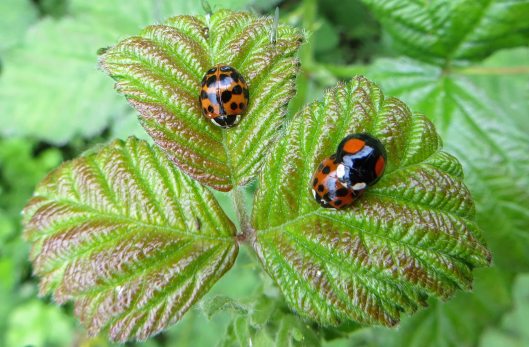
160516 Harlequin Ladybirds

First it was the Harlequin ladybirds, on the very top leaves of a bramble so hard to miss, and three of them. Was the second female waiting her turn, basking in the afterglow, or something of a voyeur herself?

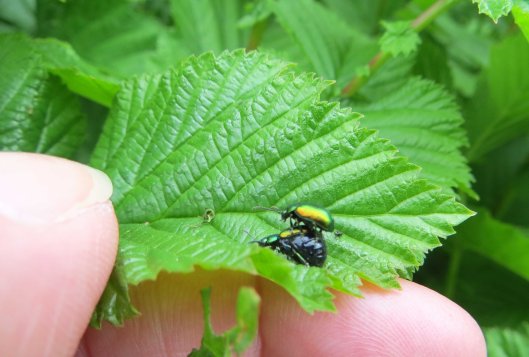
160516 Green Dock Beetle

A metallic flash on the neighbouring bush caught my eye and there were a couple of Green dock beetles, also getting into the swing of spring, though I think the male was a little confused as to how to go about things. He won’t accomplish much just riding on the female’s back.

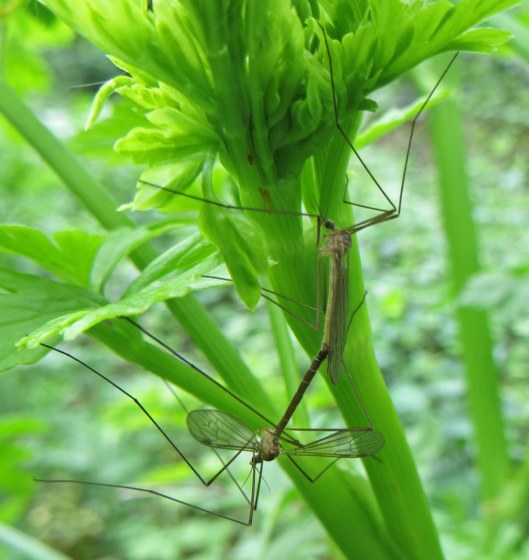
160516 crane flies

Further on, I bent down to re-tie my shoelace and what should I see but two Crane flies, making more Crane flies.

160516 Long-horned black legionnaire

And I almost stood on these final two, blatantly having it off in the middle of the footpath. I think they’re Long-horned black legionnaire beetles**, though I’m not entirely sure. They, like all the other minibeasts, were certainly feeling stimulated by the Sunday sunshine.

** Many thanks to Paul Challinor. These are actually St Mark’s flies (Bibio marci).

Like Loading...

‘Dedicated Naturalist’: The Rabbit

15 Sunday May 2016

Posted by sconzani in 'Dedicated Naturalist' Project, animals, nature

≈ Leave a comment

Tags

Dr Mary Gillham, Forest Farm Nature Reserve, rabbit

A snippet from my volunteer work on the ‘Dedicated Naturalist’ Project, helping to decipher and digitise, record and publicise the life’s work of naturalist extraordinaire, Dr Mary Gillham.

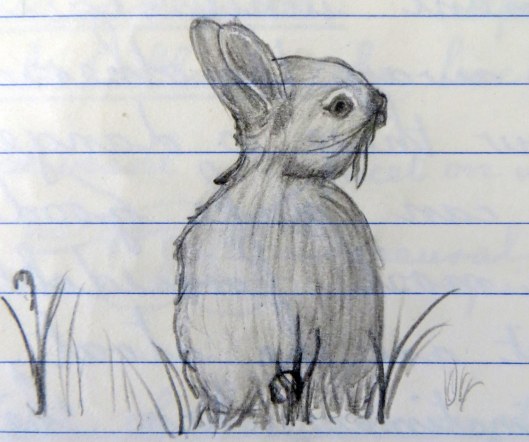
160515 rabbit (1)

From Mary’s 1935 Form IIa Biology exercise book:

The rabbit is covered with a soft greyish coloured fur. The teats or milk glands of the mother sometimes range over the whole of the ventral side of the body. Rabbits have flat feet with fur on the underneath. Their claws cannot be drawn in as can those of a cat, and so if it wasn’t for the fact that they usually run on grass they would make a noise when running. As it is easy prey for other animals it has large ears so that it can hear the slightest sound. The rabbit has a prominent white tail, so that when one runs away the others may see it and know there is danger at hand, then they can make good their escape. The three most formidable enemies of the rabbit are the stoat, weasel and fox. Sometimes when the rabbit sees any of these it is so overcome with fright that it seems paralysed and cannot move while its attacker comes up and kills it. The rabbit has three eyelids instead of the usual two, it also has sensitive whiskers like those of a cat growing from the sides of its face. The ventral side is a much lighter grey that the dorsal side. Rabbits are very common in England and in almost any field you go into you can see either the rabbits or their burrows.

160515 rabbit (2)
160515 rabbit (3)
160515 rabbit (4)
160515 rabbit (5)

My rabbits were photographed this week at Forest Farm Nature Reserve, where they are certainly very common!

160515 rabbit (6)

You can follow our progress with this project on Facebook and on Twitter. A website will follow soon.

Like Loading...

Pigeons: ‘rats with wings’?

14 Saturday May 2016

Posted by sconzani in birds, nature

≈ 4 Comments

Tags

birding, birdwatching, British birds, domestic pigeon, feral pigeon, pigeon, rats with wings

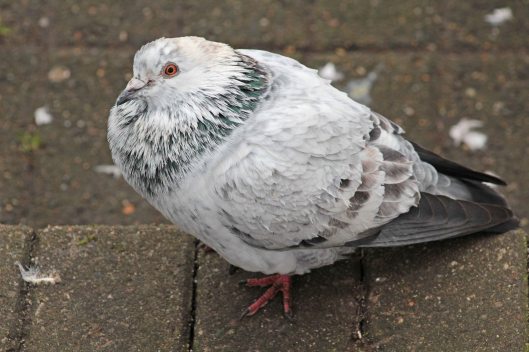
Humans have a love-hate relationship with the Feral pigeon (Columba livia domestica). On the one hand, we love to feed them – until recently, crowds would flock to London’s Trafalgar Square to be photographed feeding the birds (an activity now banned), and what child didn’t learn to love birds through feeding pigeons (or ducks). On the other hand, we hate the mess they make and spend millions defacing our buildings with anti-pigeon spikes and wires to stop pigeons roosting on their handy ledges.
160514 pigeons (3)

Yet, the pigeon has long been a friend of humankind. It was probably our first tame bird, having been domesticated as early as c. 4000 BC; it has seen war service and been awarded medals as a carrier of messages; it has been admired for its homing abilities; and it was once an important source of food.

160514 pigeons (2)

While many feral pigeons have the grey colouring of their Rock dove ancestors, others display a multitude of colour combinations, ranging from almost completely white through red and brown to almost completely black. The reds are my favourites, just because they’re so different, but I think all pigeons are pretty and I would never call them ‘rats with wings’, like Woody Allen did in his 1980 film Stardust Memories.

160514 pigeons (1)

Like Loading...

Wildflowers at the cemetery

13 Friday May 2016

Posted by sconzani in nature, spring, wildflowers

≈ 6 Comments

Tags

#FloralFriday, Cathays Cemetery, spring flowers

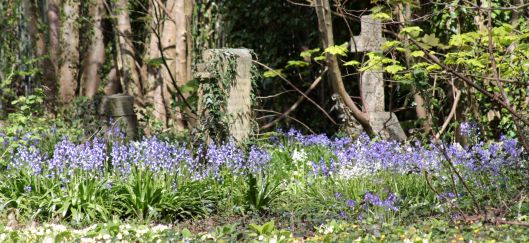
I am fortunate to have a magnificent location for wildflowers just a short walk from where I live. Cathays Cemetery’s 110-acre grounds have remained largely undisturbed since the cemetery closed to new burials about 35 years ago so it has the perfect habitat for wild plants to thrive… as long as the mowers and strimmers aren’t used too often.

160513 cemetery

There are native Bluebells (Hyacinthoides non-scripta) though many of the Spanish variety have also been planted here. The Bulbous buttercups (Ranunculus bulbosus) are always cheerful, as is the Cuckooflower or Lady’s smock (Cardamine pratensis). They may be common but I’m a big fan of the Daisy (Bellis perennis) and the Dandelion in its many forms (Taraxacum officinale agg.). Dog violets (Viola riviniana) and Germander speedwell (Veronica chamaedrys) give pretty bursts of blue and lilac, and Herb Robert (Geranium robertianum) add its special touch of pink. Though now past their best, Lesser celandine (Ficaria verna) and Primrose (Primula vulgaris) are both still flowering, while the Red clover (Trifolium pratense) is just beginning to bloom. Ribwort plantain (Plantago lanceolata) is abundant, as is Wild strawberry (Fragaria vesca). And the last flower I couldn’t identify, so if anyone can help with that, I’d be grateful.

160513 Bluebell Hyacinthoides non-scripta
160513 bulbous buttercup Ranunculus bulbosus
160513 Cardamine pratensis Cuckooflower or lady's smock
160513 daisy bellis perennis
160513 dandelion Taraxacum officinale agg
160513 Dog violet Viola riviniana
160513 germander speedwell Veronica chamaedrys
160513 lesser celandine Ficaria verna
160513 primrose primula vulgaris
160513 red clover Trifolium pratense
160513 ribwort plantain Plantago lanceolata
160513 Wild strawberry Fragaria vesca
160513 zz unknown
Like Loading...

Black oil beetles

12 Thursday May 2016

Posted by sconzani in insects, nature

≈ 6 Comments

Tags

beetles, black oil beetles, Brynna Woods, BugLife, Meloe proscarabaeus, oil species recovery programme

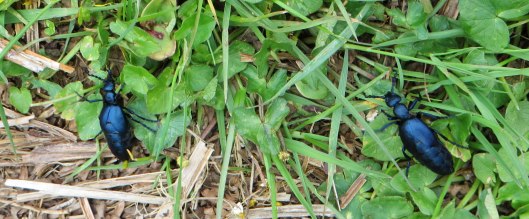
I went to Brynna Woods in search of bluebells and found beetles instead, the black oil beetle no less, Meloe proscarabaeus.

160512 Black oil beetle (3)

I was extremely lucky as oil beetles are an endangered species in Britain, with three native species already declared extinct and the remaining five under threat. The main reason for this is because their lifecycle depends on the solitary bee and changes in the way the environment is managed means bee numbers are also declining.

160512 Black oil beetle (1)

You see, oil beetles are most peculiar little critters. Their larvae strategically position themselves on flowers awaiting the arrival of solitary bees out collecting pollen and nectar. Then, using special hooks on their feet, they hitch a ride on the bees when they depart. Back in the bees’ nests, the larvae feed on the bees’ supplies of nectar and pollen, and also the bees’ eggs. The larvae continue to develop inside the bees’ nests until they emerge as adult beetles, ready to mate, lay their eggs, and begin the lifecycle all over again. No bees, no beetles!

160512 Black oil beetle (2)

With the support of Natural England, Buglife are working with the National Trust and the Oxford University Museum of Natural History on an oil beetle species recovery programme. You can read more here.

Like Loading...

Have you ridden a camel?

11 Wednesday May 2016

Posted by sconzani in animals, nature

≈ 5 Comments

Tags

camel, camel safari, camels and tourism, Camels in Morocco, camels in Tanzania, camels in Turkey

camels 1

From left, camels in Tanzania, in Turkey and in Morocco

I have, and I can tell you it is the most uncomfortable animal ever invented! Even with padded seating, the camel’s back bones soon make your body sore in unmentionable places and, without any kind of stirrups, your feet very quickly go numb from hanging down the camel’s sides.

camels 5 morocco

My camel safari was part of an overnight trip into the desert in Morocco. It was a novel experience, and being in the desert was magical, but I have no desire for a repeat performance.

camels 4 morocco

Camels were not an animal I expected to see in Tanzania but they were introduced from neighbouring Kenya in the 1990s and quickly became an important stock animal in the arid northern parts of the country. Not only are they used for transport, they are also an important source of milk, helping to combat malnutrition in some Maasai tribal areas. They are also used in the tourism industry for camel safaris, though I did read that, while you will undoubtedly see many of the special birds that live in the area, ‘if you are lucky, you can also see some game running away’! Perhaps not the ideal vehicle for a wildlife safari then.

camels 2 Tanzania

I saw camels awaiting willing tourists in Turkey some years ago as well, but camels are not native to Turkey and these were not for safaris. It seems the canny Turks discovered tourists like to be photographed sitting on or simply standing next to camels, and thus was a new tourism business created.

camels 3 Turkey

Like Loading...

Leaves on a rainy day

10 Tuesday May 2016

Posted by sconzani in leaves, nature, nature photography

≈ 12 Comments

Tags

leaf, leaf colour, leaf textures, rainy day

Scattered showers peppered the afternoon but I needed some fresh air and exercise so on went the rain jacket and off I went for a stroll around my local park. Here’s what I saw….  Isn’t Mother Nature amazing?

IMG_0568
IMG_0570
IMG_0575
IMG_0627
IMG_0630
IMG_0582
IMG_0636
IMG_0653
IMG_0660
IMG_0740
IMG_0803
IMG_0793
IMG_0794
IMG_0805
IMG_0810
IMG_0812
IMG_0823
IMG_0825


Like Loading...
← Older posts
Newer posts →

About me

sconzani

sconzani

I'm a writer and photographer; researcher and blogger; birder and nature lover; countryside rambler and city strider; volunteer and biodiversity recorder.

View Full Profile →

Follow earthstar on WordPress.com

Enter your email address to follow this blog and receive notifications of new posts by email.

Recent blog posts

  • Blood bees April 29, 2026
  • Nesting material April 28, 2026
  • Lifer: Box bug April 27, 2026
  • Peak Wild garlic April 26, 2026
  • First damsels of 2026 April 25, 2026

From the archives

COPYRIGHT

Unless otherwise acknowledged, the text and photographs on this blog are my own and are subject to international copyright. Nothing may be downloaded or copied without my permission.

Fellow Earth Stars!

  • Unknown's avatar
  • Unknown's avatar
  • Unknown's avatar
  • Unknown's avatar
  • Unknown's avatar
  • Unknown's avatar
  • Unknown's avatar
  • Unknown's avatar
  • Unknown's avatar
  • Unknown's avatar
  • Unknown's avatar
  • Unknown's avatar
  • Unknown's avatar
  • Unknown's avatar
  • Unknown's avatar
  • Unknown's avatar
  • Unknown's avatar
  • Unknown's avatar
  • Unknown's avatar
  • Unknown's avatar
  • Unknown's avatar
  • Unknown's avatar
  • Unknown's avatar
  • Unknown's avatar
  • Unknown's avatar
  • Unknown's avatar
  • Unknown's avatar
  • Unknown's avatar
  • Unknown's avatar
  • Unknown's avatar
  • Unknown's avatar
  • Unknown's avatar
  • Unknown's avatar
  • Unknown's avatar
  • Unknown's avatar
  • Unknown's avatar
  • Unknown's avatar
  • Unknown's avatar
  • Unknown's avatar
  • Unknown's avatar
  • Unknown's avatar
  • Unknown's avatar
  • Unknown's avatar
  • Unknown's avatar
  • Unknown's avatar
  • Unknown's avatar
  • Unknown's avatar
  • Unknown's avatar
  • Unknown's avatar
  • Unknown's avatar

Blog at WordPress.com.

Privacy & Cookies: This site uses cookies. By continuing to use this website, you agree to their use.
To find out more, including how to control cookies, see here: Cookie Policy
  • Subscribe Subscribed
    • earthstar
    • Join 642 other subscribers
    • Already have a WordPress.com account? Log in now.
    • earthstar
    • Subscribe Subscribed
    • Sign up
    • Log in
    • Report this content
    • View site in Reader
    • Manage subscriptions
    • Collapse this bar

Loading Comments...

You must be logged in to post a comment.

    %d