• ABOUT
  • BIRDING 2018
  • Birding 2019
  • BLOG POSTS
  • Butterflies 2018
  • Resources

earthstar

~ a celebration of nature

earthstar

Category Archives: plants

More woodland rusts

15 Friday Apr 2022

Posted by sconzani in fungi, plants

≈ Leave a comment

Tags

Dog's mercury, Melampsora populnea, primrose, Puccinia primulae, rust fungi, rust on Dog's mercury, rust on Primrose

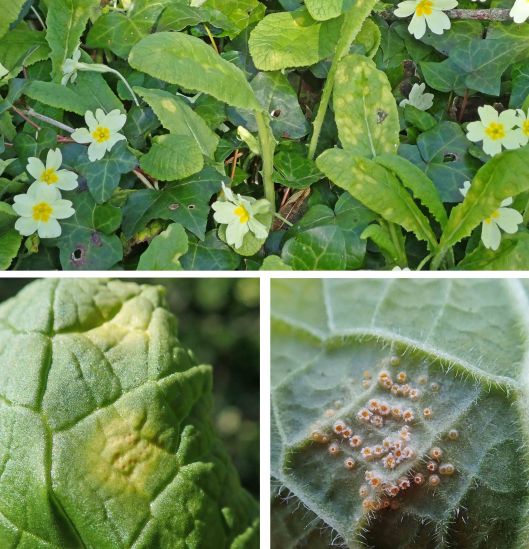
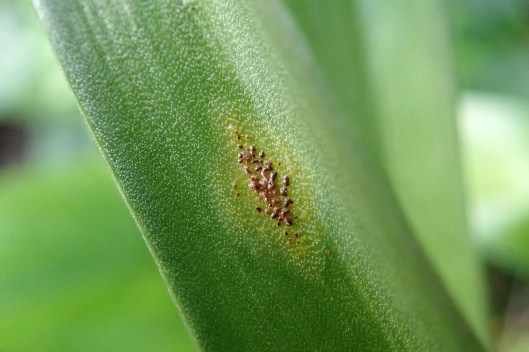
I was admiring the glorious display of Primrose in a local wood when I noticed that many of the plants’ leaves had yellowish spots on their upper leaves. Rust, I thought, and, sure enough, on turning the leaves over, I could see the tiny cup-shaped aecia on the undersides, which confirmed this as Primrose rust (Puccinia primulae).

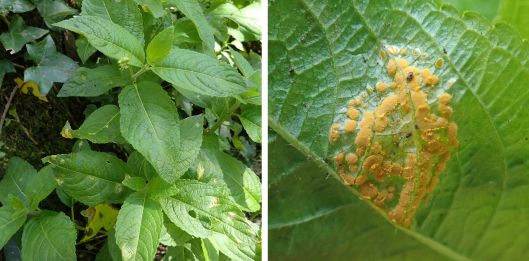
I found this second rust during today’s woodland meander. It’s Melampsora populnea on Dog’s mercury (Mercurialis perennis). Once again, there are yellowish marks on the upper leaves and, this time, rather than cups, there are minuscule splodges of yellow underneath. Neither of these rusts seems to do much harm to the plants.

Like Loading...

Woodland rusts

08 Friday Apr 2022

Posted by sconzani in fungi, plants

≈ Leave a comment

Tags

Celandine clustercup fungus, Melampsora epitea, rust fungi, rust on Lesser celandine, rust on Soindle, rusts on plant leaves, Uromyces dactylidis

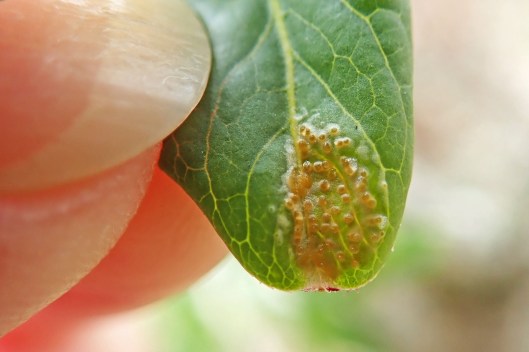
During my wander through a local woodland earlier this week, while admiring the golden carpets of Lesser celandine, I noticed small spots on some of the leaves. Closer examination and some photos showed that this was the rust Uromyces dactylidis, also known as Celandine clustercup fungus for the clusters of tiny orange cup-shaped aecia on the undersides of the leaves.

220408 Uromyces dactylidis (1)
220408 Uromyces dactylidis (2)

Once I had my ‘rust eye’ in, I then noticed more on other plants. Many, like Bluebell rust (Uromyces muscari) I have covered here before but this one, Melampsora epitea on Spindle (Euonymus europaeus), was a new one for me.

220408 Melampsora epitea (1)

Like Loading...

Common liverwort

05 Tuesday Apr 2022

Posted by sconzani in bryophytes, plants

≈ Leave a comment

Tags

Common liverwort, Marchantia polymorpha, plants in pavement cracks, tiny plants

I really should look down more often. I mean to say: how could I never have noticed before the miniature forest landscape that is Common liverwort (Marchantia polymorpha)?

220405 common liverwort (1)

According to the Naturespot website, the ‘umbrella-like reproductive structures [are] known as gametophores. Those of female plants consist of a stalk with star-like rays at the top. These contain the organs which produce the ova. Male gametophores are topped by a flattened disc and produce the sperm.’

220405 common liverwort (2)

Like Loading...

Rusty bluebells

25 Friday Feb 2022

Posted by sconzani in fungi, plants

≈ Leave a comment

Tags

Bluebell, Bluebell rust, British rusts, rust on Bluebells, rust on plants, Uromyces muscari

It will be some weeks yet before we see the first Bluebell flowers but I found my first examples of Bluebell rust (Uromyces muscari) during today’s walk. One to look out for….

220225 bluebell rust

Like Loading...

Name that rosette, 1

13 Sunday Feb 2022

Posted by sconzani in plants

≈ Leave a comment

Tags

British wildflowers, identifying early plant growth, plant identification, plant rosettes

This is a personal learning journey that I thought I would share, and some of you can probably help along the way. Call me mad if you want, but I’m trying to work out what plants will become from looking at their early growth. This may be a very short journey as I may get so frustrated that I quickly give up, particularly as I’m already uncertain about one of today’s examples, but here goes…. Working from left to right, I think these are Creeping thistle (Cirsium arvensis) and Daisy (Bellis perennis), then Teasel (Dipsacus fullonum) and today’s head-scratcher. It may be Prickly sow-thistle (Sonchus asper). It may be I’m biting off far more than I can chew trying to identify this plant at this early stage. Any ideas anyone?

220213 creeping thistle
220213 daisy
220213 teasel
220213 unknown
Like Loading...

Leafmines: Fenella nigrita

07 Monday Feb 2022

Posted by sconzani in insects, plants

≈ Leave a comment

Tags

British leafmines, Creeping cinquefoil, Fenella nigrita, Fenella nigrita larval mines, leafmines on cinquefoil, sawfly larvae, sawfly leafmines

When reviewing my leafmine records yesterday and comparing them to those I’ve blogged, I realised there are several I’ve yet to cover here. Most are spring- and summer-time finds so I’ll post about them at the appropriate time but this is one I found in December – I didn’t cover it then as I was in the middle of my A-to-Z end-of-year countdown.

220207 Fenella nigrita (1)

These are the leafmines of the sawfly Fenella nigrita. Its larval mines can be found on Agrimony and on the various cinquefoils – I found these on Creeping cinquefoil (Potentilla reptans). Though the British Leafminers website reports that the mines are normally seen in summer and autumn, I found these on 3 December and the mines are occupied (I’ve added a pointer to one of the larvae in the photo below right). Presumably the mild weather meant a longer breeding season for these sawflies, as with many other creatures.

220207 Fenella nigrita (2)
220207 Fenella nigrita (3)
Like Loading...

Inside a Teasel seed head

31 Monday Jan 2022

Posted by sconzani in insects, plants

≈ Leave a comment

Tags

Endothenia gentianaeana larvae, Endothenia marginana larvae, Endothenia moth species, insects in Teasel seed heads, moth larvae in Teasel seed heads, Teasel, Teasel seed heads

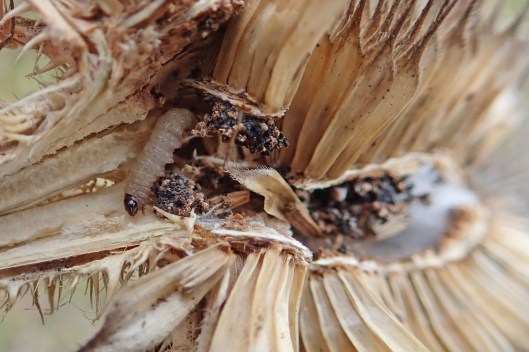
I’ve never looked inside a Teasel seed head before but I’m glad I braved the spines for a peek because each of the three I pulled open were occupied and, judging by the amount of frass, they’d been occupied for some time.

220131 Endothenia sp (1)

I think these are the larvae of one of the Endothenia species of moth, either E. marginana or E. gentianaeana, the former presumably being the more likely as there are more records of that species in south Wales. However, to be sure which is which you need to check each larva’s rear end to see if it has an anal comb. Not knowing this, I didn’t.

220131 Endothenia sp (2)

If you want to learn more about that anal comb, there’s a very detailed description, and clear photos, of the larvae of these two Endothenia species on the UK Moths website (E. marginana here and E. gentianaeana here). And, just to reassure you, I was able to close the seed heads (and wound stems of long grass around them, which should hopefully keep them closed so the larvae can complete their lifecycles) (I read later of someone who uses small rubber bands for the same purpose).

Like Loading...

Green fingers

27 Thursday Jan 2022

Posted by sconzani in plants

≈ 4 Comments

Tags

bulb shoots, new shoots, plant shoots, Wild garlic shoots

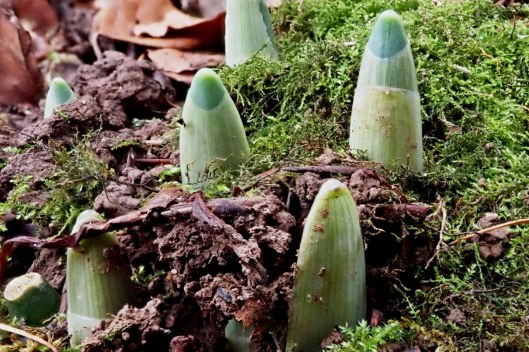
Coming soon to a green space near you …
Wherever I walk, I’m now seeing bulbs sending forth their green shoots, to be followed in a month or two by glorious Spring flowers. These are Wild garlic but I’m seeing a lot of Bluebell and Daffodil shoots (and there are planted Daffs already flowering in a local road verge). I’m probably being madly fanciful but I think these particular shoots look like green fingers, nails at their tips. Is this where the term originally came from, I wonder?

220127 green fingers

Like Loading...

Round in square

16 Sunday Jan 2022

Posted by sconzani in plants, wildflowers

≈ Leave a comment

Tags

British wildflowers, round seedheads, seedheads, wildflower seedheads

Round seedheads in square frames …

220116 seedhead (1)
220116 seedhead (2)
220116 seedhead (3)
220116 seedhead (4)
220116 seedhead (5)
220116 seedhead (6)
220116 seedhead (7)
220116 seedhead (8)
220116 seedhead (9)
Like Loading...

Leafmines: on Himalayan honeysuckle

10 Monday Jan 2022

Posted by sconzani in insects, plants

≈ Leave a comment

Tags

Chromatomyia lonicerae, Himalayan honeysuckle, leaf-mining fly larvae, leaf-mining moth larvae, leafmines on Evergreen oak, leafmines on Himalayan honeysuckle, Leycesteria formosa, Phyllonorycter emberizaepenella

Two for the price of one this week. The plant is Himalayan honeysuckle (Leycesteria formosa), not a British native as you can guess from its name, but a plant that’s now naturalised quite extensively in the wild, at least in my local area. The leafmines were found on 18 December, quite late in the year but a sign of how mild our weather has been so far this winter.

220110 Leycesteria formosa (1)
220110 Leycesteria formosa (2)

These first mines were made by the larvae of the tiny fly Chromatomyia lonicerae. I like the description of this mine on the Nature Spot website: ‘The leafmine starts with an irregular star-like blotch with a later linear section’. You can see that in my photo on the left below, and, in the photo on the right, you can see a pupa, which remains in the mine until it emerges as an adult fly.

220110 Chromatomyia lonicerae (1)
220110 Chromatomyia lonicerae (2)

This second mine is the creation of the larva of the moth Phyllonorycter emberizaepenella, a beautiful little brown-and-white creature that you can see on the UK Moths website. The larva spins itself a blotch mine, which pulls the underside of the leaf together, as you can see in the photos below: top of the leaf on the left, bottom on the right.

220110 Phyllonorycter emberizaepenella (1)
220110 Phyllonorycter emberizaepenella (2)
Like Loading...
← Older posts
Newer posts →

About me

sconzani

sconzani

I'm a writer and photographer; researcher and blogger; birder and nature lover; countryside rambler and city strider; volunteer and biodiversity recorder.

View Full Profile →

Follow earthstar on WordPress.com

Enter your email address to follow this blog and receive notifications of new posts by email.

Recent blog posts

  • Busy Blue tits March 17, 2026
  • Cuttlebones March 16, 2026
  • No woodland here March 15, 2026
  • Family comes first March 14, 2026
  • Local Little egrets March 13, 2026

From the archives

COPYRIGHT

Unless otherwise acknowledged, the text and photographs on this blog are my own and are subject to international copyright. Nothing may be downloaded or copied without my permission.

Fellow Earth Stars!

  • Unknown's avatar
  • Unknown's avatar
  • Unknown's avatar
  • Unknown's avatar
  • Unknown's avatar
  • Unknown's avatar
  • Unknown's avatar
  • Unknown's avatar
  • Unknown's avatar
  • Unknown's avatar
  • Unknown's avatar
  • Unknown's avatar
  • Unknown's avatar
  • Unknown's avatar
  • Unknown's avatar
  • Unknown's avatar
  • Unknown's avatar
  • Unknown's avatar
  • Unknown's avatar
  • Unknown's avatar
  • Unknown's avatar
  • Unknown's avatar
  • Unknown's avatar
  • Unknown's avatar
  • Unknown's avatar
  • Unknown's avatar
  • Unknown's avatar
  • Unknown's avatar
  • Unknown's avatar
  • Unknown's avatar
  • Unknown's avatar
  • Unknown's avatar
  • Unknown's avatar
  • Unknown's avatar
  • Unknown's avatar
  • Unknown's avatar
  • Unknown's avatar
  • Unknown's avatar
  • Unknown's avatar
  • Unknown's avatar
  • Unknown's avatar
  • Unknown's avatar
  • Unknown's avatar
  • Unknown's avatar
  • Unknown's avatar
  • Unknown's avatar
  • Unknown's avatar
  • Unknown's avatar
  • Unknown's avatar
  • Unknown's avatar

Blog at WordPress.com.

Privacy & Cookies: This site uses cookies. By continuing to use this website, you agree to their use.
To find out more, including how to control cookies, see here: Cookie Policy
  • Subscribe Subscribed
    • earthstar
    • Join 668 other subscribers
    • Already have a WordPress.com account? Log in now.
    • earthstar
    • Subscribe Subscribed
    • Sign up
    • Log in
    • Report this content
    • View site in Reader
    • Manage subscriptions
    • Collapse this bar
 

Loading Comments...
 

You must be logged in to post a comment.

    %d