Round seedheads in square frames …



16 Sunday Jan 2022
Posted in plants, wildflowers
Round seedheads in square frames …
10 Monday Jan 2022
Tags
Chromatomyia lonicerae, Himalayan honeysuckle, leaf-mining fly larvae, leaf-mining moth larvae, leafmines on Evergreen oak, leafmines on Himalayan honeysuckle, Leycesteria formosa, Phyllonorycter emberizaepenella
Two for the price of one this week. The plant is Himalayan honeysuckle (Leycesteria formosa), not a British native as you can guess from its name, but a plant that’s now naturalised quite extensively in the wild, at least in my local area. The leafmines were found on 18 December, quite late in the year but a sign of how mild our weather has been so far this winter.


These first mines were made by the larvae of the tiny fly Chromatomyia lonicerae. I like the description of this mine on the Nature Spot website: ‘The leafmine starts with an irregular star-like blotch with a later linear section’. You can see that in my photo on the left below, and, in the photo on the right, you can see a pupa, which remains in the mine until it emerges as an adult fly.


This second mine is the creation of the larva of the moth Phyllonorycter emberizaepenella, a beautiful little brown-and-white creature that you can see on the UK Moths website. The larva spins itself a blotch mine, which pulls the underside of the leaf together, as you can see in the photos below: top of the leaf on the left, bottom on the right.


06 Thursday Jan 2022
Posted in plants
It’s grey today, with heavy rain, so I felt the need for a splash of colour to brighten the day. The vivid pinks of Spindle, the deep reds of Yew, wild rose hips, and Holly certainly buoyed my spirits – I hope you also find them cheering, whatever your weather.


03 Monday Jan 2022
Tags
British leafmines, Hart's tongue, leaf-mining moths, leafmines on Hart's-tongue, moth larvae on Hart's-tongue, Psychoides filicivora
Once again, I was alerted to this little leafminer by a tweet from Rob Edmunds (@leafminerman), one of the brains behind the British Leafminers website, and I’ve now found it at three local sites where Hart’s-tongue fern (Phyllitis scolopendrium) is plentiful, though it can also be found on a couple of other fern species.

These are the larvae of Psychoides filicivora, a tiny brown moth (you can see the adult on the UK Moths website here), whose larvae munch on the fern fronds and hide away under little ‘nests’ of sporangia on the undersides of the fronds.


There is another very similar moth species that also lives on fern fronds, Psychoides verhuella – so far, I’ve only found P. filicivora – but the British Leafminers website has very good information on both, as well as an excellent side-by-side comparison image of their larvae.
20 Monday Dec 2021
Posted in flowers, plants, wildflowers
Perhaps O should really be for obsession, as it seems I have a bit of an obsession for orchids: they have featured in no fewer than nine blog posts this year. Early-purple orchids were the first to flower back in May, followed soon afterwards by the Common spotted-orchids, which also featured in a second post in late June about the variation in their colours and markings. Also in June, the Bee orchids showed their jolly faces, and I tried to get to grip with identifying Southern marsh-orchids. In July, more orchid species that like damp places were in the spotlight, first the Heath spotted-orchids of Aberbargoed, followed soon after by Rhoose Quarry’s magnificent Marsh helleborines. The late-summer-blooming Broad-leaved helleborines featured on the first day of August, and the first days of autumn were brightened by the sight of spiralling Autumn lady’s-tresses. What a feast for the senses these flowers are!


19 Sunday Dec 2021
This is a plug for the much-maligned Nettle, a plant most of us humans quickly learn to recognise in order to avoid its stings, though most wildlife seems well able to avoid them. I’ve read that Nettles support 40 species of insect but I wonder if that number is on the conservative side. Here are a few insects I spotted on them earlier this year: 7-spot ladybird larva, the 1st instar of a Common green shieldbug, Grypocoris stysi, Nettle weevil, the larva of the hoverfly Scaeva pyrastri, and a Speckled bush-cricket nymph.


05 Sunday Dec 2021
Posted in flowers, plants, wildflowers, winter
It may be the first week of winter but there are still plenty of wildflowers in bloom. I hope you enjoy seeing these as much as I enjoyed finding them.
02 Thursday Dec 2021
Posted in plants
From its nectar-and-pollen-providing flowers to its luscious juicy berries for birds, Ivy is a wonder plant, and I read somewhere recently that it also hosts over 100 species of insect larvae. Amazing!


22 Monday Nov 2021
Tags
British leafminers, Bucculatrix thoracella, leaf-mining moth, leaf-mining moth larvae, leafmines on lime
I found these mines on Lime leaves a few weeks ago but they will still be visible on the yellowing leaves, just not occupied any more. The tiny white tick shape is distinctive, making it easy to identify these as the mines of the little brown and yellow moth Bucculatrix thoracella.


After the ‘tick’ has been formed, the moth larvae graze beneath the leaves, creating small bare areas known as feeding windows. When they moult, the larvae retreat to cocoons – one of the leafmining experts calls them ‘cocoonets’ (shown below), but their final cocoons can be found either in the leaf litter below the tree or on the Lime’s trunk. I’ve yet to find one of those.


21 Sunday Nov 2021
Posted in flowers, plants, wildflowers
During Friday’s search for more leafmines, I ventured along roads I hadn’t walked before, and I’m so glad I did as I found a new plant – well, an abundance of new plants really, growing all along the roadside verge in front of Cardiff’s main Royal Mail delivery centre. This is Gallant-soldier (Galinsoga parviflora).
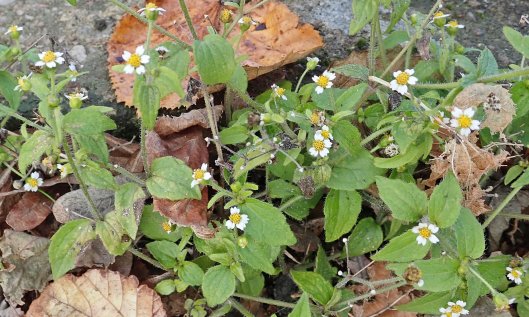
I’ve read several variations of its history in Britain: here’s what is written in Flora Britannica:
Gallant-soldier … was brought to Kew Gardens from Peru in 1793, bearing a name that commemorated the Spanish botanist Don Mariano Martinez de Galinsoga. The plant itself was rather less imperious, being a thin, lax and greenish-flowered daisy with weedy habits. In the early 1860s it escaped from Kew and became widely established in gutters, gardens and waste places around Richmond … Galinsoga was corrupted to ‘Gallant soldier’.
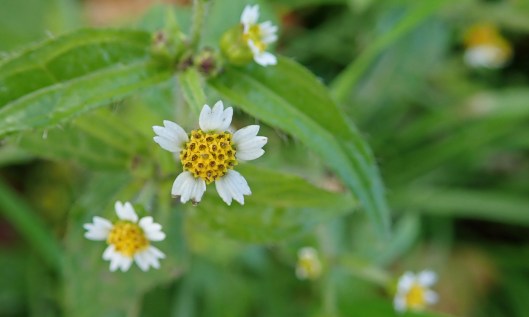
Since their escape from Kew, these soldiers have marched far and wide, though they haven’t yet reached all parts of the British Isles, and there are not a lot of Welsh records. You can see a map of their whereabouts on the NBN Atlas website.
 earthstar
You must be logged in to post a comment.