If you thought I’d exaggerated about how wet last month was, it’s official – Derek, the Welsh BBC weatherman, yesterday tweeted that ‘October was wetter than average in Wales with 208mm of rain’. Temperatures and sunshine were also below normal, and, having just returned from a long local walk, I can tell you it’s very squelchy out there. Still, the wet has its compensations as today’s seedheads testify.
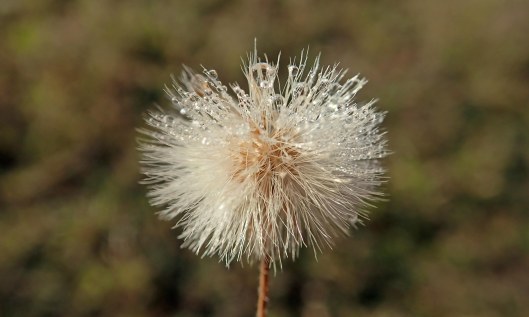
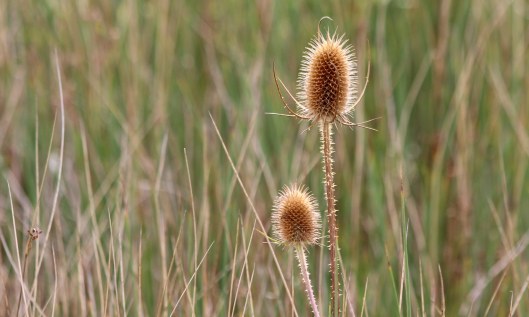
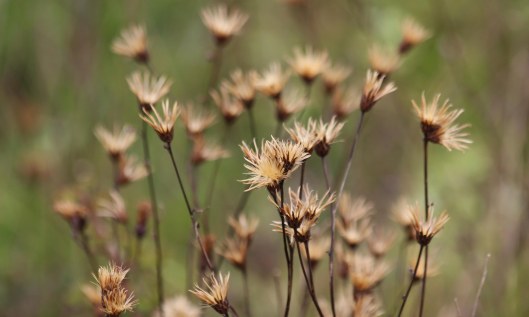
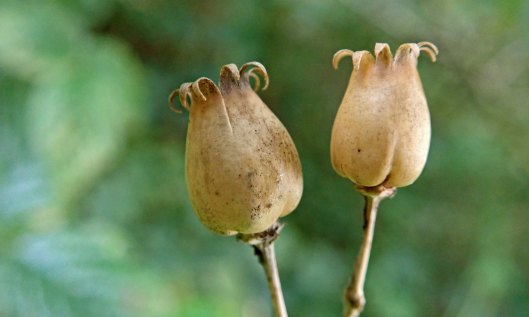
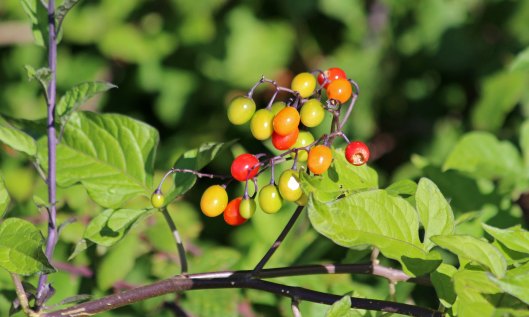
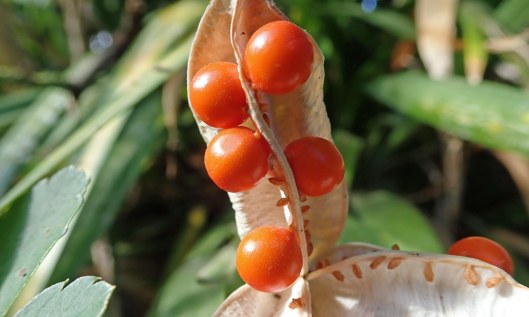
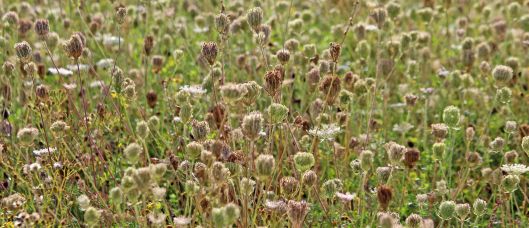
I just can’t resist the structural elements of seedheads, whether they be associated with wildflowers or grasses. And so here are some more recent photos …
Spectacular. Flamboyant. Ostentatious. Garish. There are so many adjectives you could use to describe the fruit of the Spindle tree (Euonymus europaeus). If I had a garden, this is one tree I would definitely plant in it, for the fruit alone.
‘There is not a fragment in all nature, for every relative fragment of one thing is a full harmonious unit in itself.’
~ John Muir, The Wilderness World of John Muir, ed. Edwin Way Teale, 1954
‘The vegetable life does not content itself with casting from the flower or the tree a single seed, but it fills the air and earth with a prodigality of seeds, that, if thousands perish, thousands may plant themselves, that hundreds may come up, that tens may live to maturity; that, at least one may replace the parent.’
~ Ralph Waldo Emerson, Chapter 6: Nature, Essays, Second Series, 1844.
One of the highlights for me at this time of year is finding Ivy bees feasting, as you might expect, on the newly opened flowers of Ivy. I blog about these little beauties every year so I won’t go in to their details again, just share my latest photos.
In recent weeks, when the weather has been fine and the air relatively still, I’ve been spending time searching the Devil’s-bit scabious for bees. Not just any bees, but four scarce and endangered bees. This is part of Buglife’s ‘Searching for Scabious’ project, which
aims to improve our understanding of the distribution and conservation status of some of Wales’ rarest and most threatened solitary bees – the Large Scabious Mining Bee (Andrena hattorfiana) and its associated cuckoo, the Armed nomad bee (Nomada armata), and Small Scabious Mining Bee (Andrena marginata) and its cuckoo, the Silver-sided nomad bee (Nomada argentata).
I wasn’t familiar with these bees and am not very good at bee identification in general but Liam Olds, Buglife’s local conservation officer, has put together an excellent explainer video, which can be accessed on YouTube, so I thought I’d join the search.
Unfortunately, I haven’t managed to find any of the scarce bees at the two local sites where Devil’s-bit scabious grows in abundance (and neither has Liam, which was reassuring for me re my search skills but bad news for the bees). The bees I did find most commonly were the appropriately named Common carder (Bombus pascuorum) (below, left) and the Buff-tailed bumblebee (Bombus terrestris) (below, right).
Liam very kindly helped to identify the other small bees I found. These lovely little furrow bees are either the White-zoned furrow bee (Lasioglossum leucozonium) or the Bull-headed furrow bee (Lasioglossum zonulum) – the two species are too similar to tell them apart without closer examination.
I also found several of these more distinctive individuals, the Wood-carving leafcutter bee (Megachile ligniseca). You can find out more about them, and watch a little video of their nest-building skills, on the BWARS website. Meantime, I’m heading back to the scabious for another look.
Bumblebees and Teasels – I’m not sure why but they seem to be a match made in heaven.
In fact, bumblebees are the insects I see most often nectaring on Teasels, though the Burnet moths also find Teasel to their taste, as did this Meadow brown butterfly yesterday.
Earlier this year, when we were in full lockdown and our Council, in their stupidity, closed the spacious local country park even to local pedestrians, I was one of many who looked for alternative places, other than too-narrow pavements, to walk, and in the process discovered a disused lane that leads to farm fields, which, this year, have not been leased for crop growing. These fields are where, in recent months, I’ve seen many nice birds, and plants like the Musk thistle I blogged about in July and the Lesser burdock from August’s Burdock Beasties. These are a few more finds from those fields.
Redshank (Persicaria maculosa)
Of course, you can find Redshank in many diverse locations – it thrives along the lane behind my flat – but it seems to be doing particularly well in this arable landscape. You may notice that Redshank bears a strong resemblance to the Amphibious bistort I blogged about on Thursday – they are both from the genus Persicaria, and, if you want to know more about this fascinating plant, I recommend you read the entry on the Plant Lore website, which will explain why one East Anglian name for the plant is ‘devil’s arse-wipe’!
Greater plantain (Plantago major)
Its name may be Greater plantain but I think this is the Greatest plantain I’ve ever seen – it was huge. The Plantlife website has some fascinating information about this plant:
A common name is Rat’s tails which perfectly describes the plant’s flowering spike. Another vernacular name is Angels’ harps because when you pull the leaves apart you get the fibres showing between. This is also the likely explanation for the names Banjos and Beatles’ guitars.
Plantain has healing powers since the leaves contain tannins and astringent chemicals, which can make them useful styptics if crushed and applied to small cuts.
Common field-speedwell (Veronica persica)
I have trouble identifying the various members of the Speedwell family but I’m fairly confident about this one – it was low and sprawling and hairy, and its solitary flowers were on stems growing from the bases of the upper leaves. A check of its seed capsules would’ve clinched it but I forgot to look at those. As its name implies, Common field-speedwell is commonly found in fields – in fact, my footpath today took me along the edge of a field where the farmer is growing maize and the soil between the maize plants was completely covered by this lovely plant with its delicate blue flowers.













 earthstar
You must be logged in to post a comment.