• ABOUT
  • BIRDING 2018
  • Birding 2019
  • BLOG POSTS
  • Butterflies 2018
  • Resources

earthstar

~ a celebration of nature

earthstar

Category Archives: plants

Horsetail: pretty, nasty

18 Monday Apr 2016

Posted by sconzani in nature, plants, spring

≈ 8 Comments

Tags

Equisetum arvense, Horsetail, invasive plant

Who would think such a pretty little plant could be considered a nasty invasive monster?

Horsetail Equisetum arvense (4)

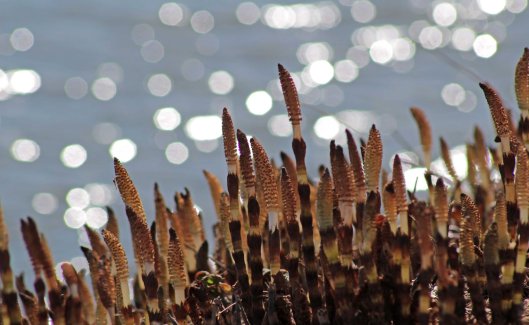
Meet Equisetum arvense, more commonly known as Horsetail or sometimes Mare’s tail. My images show the plant in the springtime, when its sturdy shoots first push their way up through even the most compact ground (I’ve seen them force through a pile of tarmac left by workmen at the side of the road). These shoots grow between 20-50cm (10-20in) tall and that cone-like part at the top opens up to release spores, in a way similar to some fungi. In the summertime, the shoots develop into a miniature version of a fir tree plantation, their dense foliage growing to around 60cm (2ft) tall and crowding out other nearby plants.

Horsetail Equisetum arvense

The Horsetail’s roots are also strong, which is partly why it’s considered so invasive. The roots grow quickly and can dive down as deep as 2m (7ft) into the ground, so are difficult to remove, and they also spread sidewise. If this is growing in your neighbour’s garden, chances are it will soon appear in yours as well. I found whole banks of Horsetail growing along the water’s edge in Cardiff Bay, where it looked very pretty with the water sparkling in the background.

Horsetail Equisetum arvense (5)

Like Loading...

See it, smell it, record it!

12 Tuesday Apr 2016

Posted by sconzani in nature, plants

≈ 8 Comments

Tags

Allium ursinum, biological recording, Ramsons, SEWBReC, Wild garlic

Perhaps, my title for this post should read smell it, see it, record it, as you usually smell Wild garlic (Allium ursinum) before you see it – that’s how pungent its aroma can be! This cousin to the chive, which grows in many parts of Europe and Asia, is also known as Ramsons, and can be found in parks and woodlands throughout Wales – or can it?

160412 wild garlic (1)

The database for the South East Wales Biodiversity Records Centre (SEWBReC) was only showing 1400 records at the start of this month but they’re certain there must be many many more areas where this prolific plant is growing. So, SEWBReC have nominated Wild garlic as their plant of the month and they’re asking as many people as possible to record their sightings.

160412 wild garlic (2)
160412 wild garlic (3)

So, come on Citizen Scientists of Wales. This is a very easily recognisable plant – no detailed analysis needed, no microscope required – just a good nose (more info here, if you’re not entirely sure). And entering your findings into the SEWBReC database is also easy peasy (instructions here). I expect there’ll be so many records by the end of April that the Welsh national emblem will change from leek to Wild garlic!

160412 wild garlic (4)

Like Loading...

The far too Common gorse

02 Wednesday Mar 2016

Posted by sconzani in nature, plants

≈ 7 Comments

Tags

Common gorse, gorse, invasive weed, spring flowers

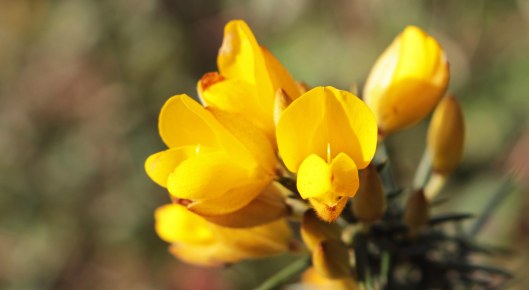
Mention gorse to a farmer in New Zealand and he’ll curse and swear and grab the nearest strong weed-killer. It’s considered the country’s worst agricultural weed, and millions of dollars have been spent trying to eradicate it. Obviously, then, it is not a New Zealand native but was introduced in the very early days of colonial settlement for use as hedges and windbreaks. Little did those early settlers realise how invasive the plant would become in New Zealand’s temperate climate or how much angst they would cause their descendants.

160302 gorse (1)

So, you will, I hope, forgive me for not waxing lyrical about the joys of gorse in my newly adopted country of Wales. Yes, I recognise it has a very pretty flower, and I also acknowledge that it is a useful source of pollen when very few other plants are flowering. Apparently, the scent of its flowers reminds people of the smell of coconut – I admit I haven’t given them the sniff test. And I have read that gorse provides shelter and a good nesting habitat for a range of birds, including the stonechat, yellowhammer and linnet. But, in this instance, I just can’t set my heritage aside – to my eye, it’s a weed, and always will be!

160302 gorse (3)
160302 gorse (2)
160302 gorse (4)
Like Loading...

The lovely Lesser Celandine

24 Wednesday Feb 2016

Posted by sconzani in nature, nature photography, plants, wildflowers

≈ 4 Comments

Tags

Lesser Celandine, Ranunculus ficaria, William Wordsworth

160224 lesser celandine (3)

Everyone associates poet extraordinaire William Wordsworth with daffodils – ‘I wandered lonely as a cloud …’ – but Wordsworth’s favourite flower was, in fact, the Lesser Celandine (Ranunculus ficaria), as witnessed by the bloom carved on his memorial plaque at the Church of St Oswald in Grasmere. As I wandered through woodlands and along river banks today, feeling not the slightest bit lonely, I saw a lot of this pretty flower. Along with the primroses and daffodils, it’s another of the yellow wildflowers that is both charming and uplifting at this time of year.

160224 lesser celandine (1)

I’m not sure what ailments Wordsworth suffered from but perhaps he favoured the Lesser Celandine because it has long been considered a treatment for haemorrhoids, hence its old English name of Pilewort. According to the Ancient Greek physician Galen, sniffing a mixture of the juice of the roots with honey was also good for clearing the head of ‘foul and filthy humours’, though I wouldn’t recommend sniffing anything that also cured piles!

160224 lesser celandine (2)

Like Loading...

The original source of iodine

02 Tuesday Feb 2016

Posted by sconzani in nature, nature photography, plants, seaweed

≈ Leave a comment

Tags

bladder wrack, kelp, seashore plant, seaside

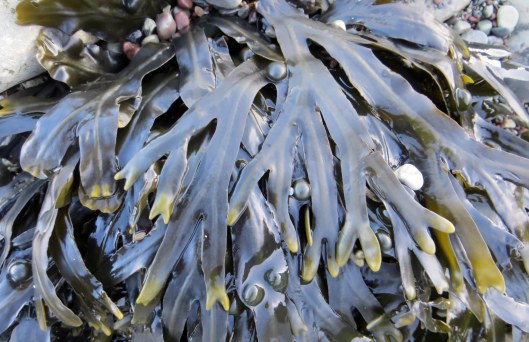
For the first time this year I’ve been to the seaside – not a long sandy beach, but the boulder-strewn former harbour entrance at the bottom of the crumbling cliffs of Penarth Head where many rocks on the lower half of the shore have bladder wrack growing on them. Fucus vesiculosus is probably the most common seaweed to be found on British shores, and grows on the coasts of most of the oceans and seas in the northern hemisphere.

160202 bladderwrack (1)

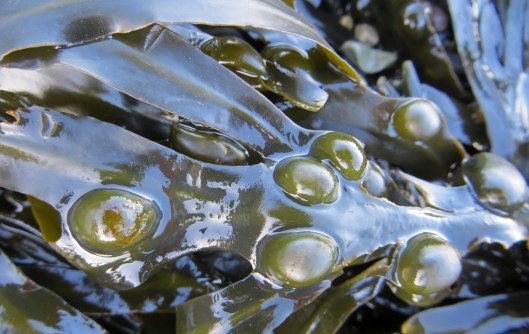
As its common name implies, this member of the kelp family uses air bladders for buoyancy, to help float its fronds upwards towards the light. When growing in an area with more violent wave action, it grows less bladders as the wave movement helps elevate its fronds instead. It is intolerant of drying out, so its fronds flop together in a moist heap which helps keep water loss to a minimum between tides.

160202 bladderwrack (2)

Though herbalists have used bladder wrack for centuries to stimulate thyroid function, and for the treatment of rheumatism and some skin diseases, it was only in 1819 that J. F. Coindet validated its efficacy scientifically, when he discovered that bladder wrack contained iodine. Extracts were subsequently used in medicines to treat goitre and other thyroid diseases.

Like Loading...

Old Man’s Beard

08 Friday Jan 2016

Posted by sconzani in nature, nature photography, plants

≈ Leave a comment

Tags

clematis vitalba, Old Man's Beard, seeds, Traveller's joy, winter garden

If I were still living in New Zealand, I would be horrified to see this plant, Clematis vitalba. It’s a British native that was introduced as a garden plant but it very quickly escaped into forest areas where, in the temperate climate, its vigorous growth quickly smothers native plants. Unsurprisingly, it has been outlawed and is listed on the National Pest Plant Accord.

160108 clematis vitalba old mans beard (1)

Here in Britain, though, I can enjoy the silky plumed seed heads that make such a pretty show at this time of year. It’s easy to see how they led to its common name of Old Man’s Beard, but this clematis has many other vernacular names, including traveller’s joy, virgin’s bower, ladies’ bower, love vine, and traveller’s ivy. In the south-east of England it is also known as Boy’s Bacca and Shepherd’s Delight because poorer country folk once used the dry stems as a tobacco substitute.

160108 clematis vitalba old mans beard (2)

In France, its common name is herbe aux gueux, the beggar’s herb because, in times past, beggars would make use of its toxic sap to purposefully irritate their skin in order to provoke sympathetic donations from passers by. All parts of this clematis are poisonous so look but don’t touch!

Like Loading...
Newer posts →

About me

sconzani

sconzani

I'm a writer and photographer; researcher and blogger; birder and nature lover; countryside rambler and city strider; volunteer and biodiversity recorder.

View Full Profile →

Follow earthstar on WordPress.com

Enter your email address to follow this blog and receive notifications of new posts by email.

Recent blog posts

  • A huddle of 7-spots March 18, 2026
  • Busy Blue tits March 17, 2026
  • Cuttlebones March 16, 2026
  • No woodland here March 15, 2026
  • Family comes first March 14, 2026

From the archives

COPYRIGHT

Unless otherwise acknowledged, the text and photographs on this blog are my own and are subject to international copyright. Nothing may be downloaded or copied without my permission.

Fellow Earth Stars!

  • Unknown's avatar
  • Unknown's avatar
  • Unknown's avatar
  • Unknown's avatar
  • Unknown's avatar
  • Unknown's avatar
  • Unknown's avatar
  • Unknown's avatar
  • Unknown's avatar
  • Unknown's avatar
  • Unknown's avatar
  • Unknown's avatar
  • Unknown's avatar
  • Unknown's avatar
  • Unknown's avatar
  • Unknown's avatar
  • Unknown's avatar
  • Unknown's avatar
  • Unknown's avatar
  • Unknown's avatar
  • Unknown's avatar
  • Unknown's avatar
  • Unknown's avatar
  • Unknown's avatar
  • Unknown's avatar
  • Unknown's avatar
  • Unknown's avatar
  • Unknown's avatar
  • Unknown's avatar
  • Unknown's avatar
  • Unknown's avatar
  • Unknown's avatar
  • Unknown's avatar
  • Unknown's avatar
  • Unknown's avatar
  • Unknown's avatar
  • Unknown's avatar
  • Unknown's avatar
  • Unknown's avatar
  • Unknown's avatar
  • Unknown's avatar
  • Unknown's avatar
  • Unknown's avatar
  • Unknown's avatar
  • Unknown's avatar
  • Unknown's avatar
  • Unknown's avatar
  • Unknown's avatar
  • Unknown's avatar
  • Unknown's avatar

Blog at WordPress.com.

Privacy & Cookies: This site uses cookies. By continuing to use this website, you agree to their use.
To find out more, including how to control cookies, see here: Cookie Policy
  • Subscribe Subscribed
    • earthstar
    • Join 668 other subscribers
    • Already have a WordPress.com account? Log in now.
    • earthstar
    • Subscribe Subscribed
    • Sign up
    • Log in
    • Report this content
    • View site in Reader
    • Manage subscriptions
    • Collapse this bar
 

Loading Comments...
 

You must be logged in to post a comment.

    %d