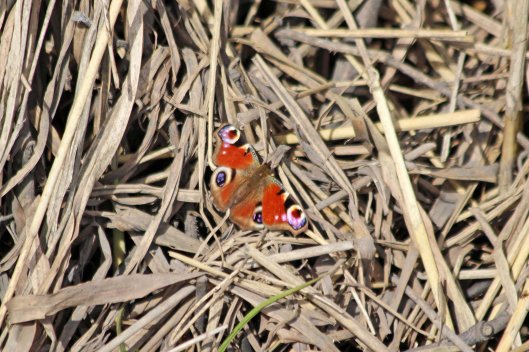
Finally a butterfly that settled long enough for a photo. This Peacock was my fifth butterfly, third species for 2022.

17 Thursday Mar 2022
Finally a butterfly that settled long enough for a photo. This Peacock was my fifth butterfly, third species for 2022.
16 Wednesday Mar 2022
Tags
British bugs, Common Green Shieldbug, Coreus marginatus, Dock bug, Dolycoris baccarum, Hairy shieldbug, Palomena prasina
The shallow bowl shape of the leaves of Winter heliotrope were perfect for the bugs enjoying Monday’s warm spring sunshine. In one small sheltered area I found several Common green shieldbugs (Palomena prasina) . . .

two Hairy shieldbugs (Dolycoris baccarum) . . .

and two Dock bugs (Coreus marginatus).

15 Tuesday Mar 2022
Tags
birding, birdwatching, British birds, Cardiff Bay birding, Hydrocoloeus minutus, Little gull, spring passage
Local birders have been treated to another striking gull visitor to Cardiff Bay in recent days, this time an adult Little gull (Hydrocoloeus minutus). They can often be seen locally at this time of year as they move from their over-wintering locations to their breeding grounds but they can be difficult to spot, especially if they are flying in the centre of the Bay.

These are the smallest gulls in the whole wide world – compare the size of the Little gull perched on the buoys with the Black-headed gull standing next to it. Their size is one distinguishing feature, but the best way to pick out the adults is from their wing colours, light grey with a white edging on top, very dark grey with that white edging underneath. The wing shape – often described as paddle-shaped – is also distinctive.

13 Sunday Mar 2022
Posted in nature, spring, wildflowers
Tags
British wildflowers, Common whitlowgrass, Erophila verna, signs of spring, sping wildflowers, Spring colour
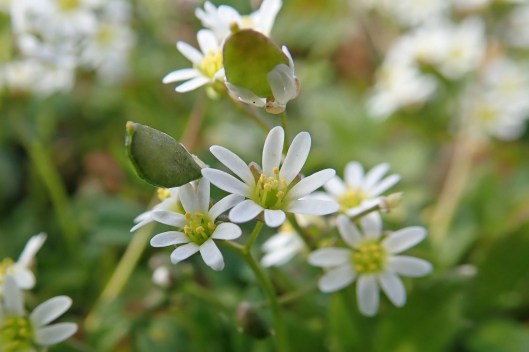
‘Modestly cheerful’ – this is how Richard Mabey describes Common whitlowgrass (Erophila verna) in Flora Britannica. He continues: ‘The small white flowers are amongst the first to appear in March, and are followed by seed-pods a little like miniaturised versions of honesty’s.’

He also explains that the name is due to the plant’s use by medieval herbalists to treat whitlows, not a medical condition I was familiar with but which the Oxford Dictionary defines as ‘an abscess in the soft tissue near a fingernail or toenail’. I don’t recommend a Google image search as the condition looks quite gruesome, but these wildflowers, often present in large massed displays, are a delight.
12 Saturday Mar 2022
I was just about to head home from Cosmeston when I got word there was a Wheatear in the southern end of the west paddock – I was at the northern end. Back I stomped and splashed – it’s exceedingly muddy there after all the recent rain – and enjoyed close views of this very handsome bird, as well as a lovely catch up with a female birding friend. I’ve since seen reports of Wheatears in other locations today – Spring migration has begun!

11 Friday Mar 2022
I first saw this, my first frog spawn of the year a couple of days ago but it got bumped from yesterday’s post by the excitement of seeing the Bonaparte’s gull. This spawn is a bit later than last year’s first sighting and I’ve only spotted the one lot, despite peering into many pools and puddles. I hope that doesn’t bode ill for the local frog population.

07 Monday Mar 2022
During Saturday’s walk I was delighted to spot my first Red-tailed (Bombus lapidarius) and Tree bumblebees (Bombus hypnorum) of the year. The only food source in a 20-square-metre area (except for a few daisies on a patch of grass) was a flowering Mahonia bush, which had attracted not only those two bumblebees but also a Buff-tailed bumblebee (Bombus terrestris), as well as several species of fly, bee and hoverfly. It just showed how important flowers are for these early emerging insects.

06 Sunday Mar 2022
Tags
Goat willow, goslings, Grey willow, male willow catkins, Pussy willow, Salix caprea, Salix cinerea, willow catkins
One of the sure signs of Spring for me is the appearance of the ‘goslings’, and by that I don’t mean birds, but rather the gorgeous male catkins of the Goat willow (Salix caprea) and Grey willow (Salix cinerea). You probably know them as pussy willow but, according to my Flora Britannica, ‘they used to be called “goslings” … because their texture and colour were like newly hatched geese’.


02 Wednesday Mar 2022
After a mild winter, the local birds are already feeling the need to breed, and yesterday’s walk took me past a Mute swan and a Coot both sitting on nests, as well as this pair of Great crested grebes.

During the time it took me to walk first along one side of the waterway, then back along the other side, the grebes mated twice, so I’m sure they’ll soon be sitting on nests as well.

27 Sunday Feb 2022
Posted in flowers, spring, wildflowers, winter
The title of today’s post may be later winter wildflowers but, in fact, my video includes some glorious hints of the spring colour we can all expect to see very soon. I hope you enjoy looking at them as much as I enjoyed finding them.
 earthstar
You must be logged in to post a comment.