Signs of Spring, 3
25 Saturday Mar 2017
Posted in insects, ladybird, nature, spring, wildflowers
25 Saturday Mar 2017
Posted in insects, ladybird, nature, spring, wildflowers
18 Saturday Mar 2017
12 Sunday Mar 2017
Posted in nature, spring, wildflowers
Tags
Cranesbill, Death comes quickly, Geranium Robertianum, Herb Robert, herbal medicine, Knecht Ruprecht, Red Robin, Robin Goodfellow, Storksbill
One of the highlights of yesterday’s walk was seeing this little geranium in flower. Though thought to have an offensive odour – some say it smells of burning tyres, others that it emits has an unpleasant mousey smell, hence one of its common names, ‘stinking Bob’ – I admit I haven’t noticed its stink and instead find myself attracted to its delicate ferny foliage, its reddish stalks, and its pretty pink flowers.

This is Geranium robertianum, most commonly known in Britain as Herb Robert but with a plethora of other common names which, in part, reflect the folklore around it: Storksbill, Crow’s foot, Death comes quickly and Red Robin are just a few of its 100-odd regional variants. The origins of the name ‘Robert’ are disputed – some attribute it to the abbot and herbalist Robert of Molesme, others to Saint Robert or Rupert of Salzburg, and there appear also to be associations with the German hobgoblin Knecht Ruprecht and the English equivalent Robin Goodfellow (Puck in Shakespeare’s A Midsummer Night’s Dream). (You can read more in this excellent blog on the Metropolitan Museum of Art’s website.)
Herb Robert has long been valued by herbalists, for its healing properties – everything from wounds and toothache to its supposed ability to increase oxygen at a cellular level in the human body, thus assisting in the body’s fight against cancer. Personally, rather than ingest it, I think I’ll just continue to enjoy the dainty dabs of colour this pretty little plant adds to the countryside of my walks.

p.s. Some of these photos were taken last summer.

11 Saturday Mar 2017
Tags
biodiversity, Cardiff parks, Grangemoor Park, old rubbish tip, Penarth Moors, River Ely, signs of spring
I had my first wander around Grangemoor Park yesterday and I’ll definitely be going back, though perhaps when it’s a little drier underfoot. With an extensive area of grass and scrub that rises up to two central mounds (from which you get quite good 360-degree views over Cardiff), this land wasn’t always a park. You have only to look at old maps to see that, once upon a time, the River Ely meandered through Penarth Moors here but, once the river was realigned, the hollows thus created were used as one of Cardiff’s rubbish tips. When the tip was full, Cardiff Council had a load of underground drains built, as well as ventilation pipes to allow the methane to escape, covered the lot with tons of clay – hence the very soggy ground, edged it all around with a solid stone wall, and changed its designation to a park in 2000.
That may sound like a sad history but, according to locals, the park now hosts quite a broad range of flora and fauna, and I certainly saw many of the stirrings of Spring. There were bumblebees and flies, a butterfly and a ladybird, masses of primroses almost hidden under bushes, golden coltsfoot and dandelions in bloom all around and horsetail pushing through everywhere, as well as incredibly vibrant lichens and a healthy growth of Oak curtain crust fungi. I will be going back!
06 Monday Mar 2017
Posted in flowers, nature, spring, wildflowers
Tags
British native flora, British wildflowers, genetic variation in primrose, pink-purple primrose, primrose, Primula vulgaris
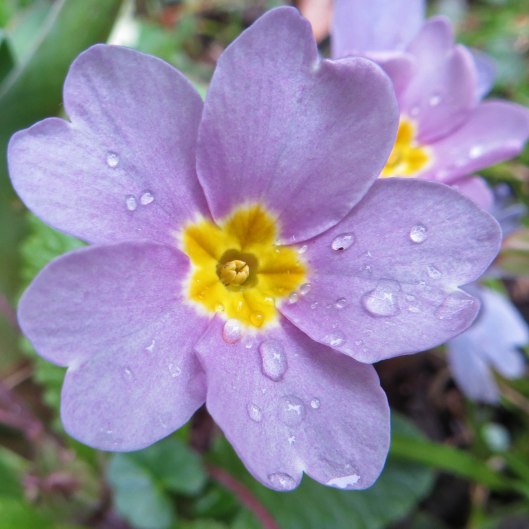
One of the earliest signs of Spring here in Britain is the flowering of the native primrose (Primula vulgaris). Its flowers range in colour from milk white through clotted cream to buttery yellow but there is also a sweet-potato-pink variation. In a delectable continuation of my comestible metaphors, in his Flora Britannica author Richard Mabey labels this form rhubarb-and-custard.

I found these flowers growing locally in the now-public grounds of an old house, built between 1790 and 1810. Though some areas of the grounds have obviously been cultivated, there are also wilder areas where native flowers grow, and these lilac-flowered primroses are sprinkled in amongst the more common yellow forms, suggesting they are not garden escapees. In Flora Britannica, Mabey goes on to say that the rhubarb-and-custard variety ‘is most frequent in churchyards and on banks close to villages, so there is some doubt about its origins. But it also occurs in much wilder sites, especially in west Wales, and is so constant in its colouration that it is almost certainly a genetically different form.’ Delicious!

05 Sunday Mar 2017
Tags
colour in nature, effects of colour, Goethe, Johann Wolfgang von Goethe, Theory of Colours, yellow
‘We find from experience that yellow excites a warm and agreeable impression…. The eye is gladdened, the heart expanded and cheered, a glow seems at once to breathe toward us.’ ~ Johann Wolfgang von Goethe, from his Theory of Colours, published in 1810.
24 Friday Feb 2017
Posted in flowers, nature, seasons, spring, wildflowers

Determination. Persistence. Resistance. Constancy.
Humans have cleared the land of ‘weeds’; laid a gravel path edged with a concrete strip; planted a bed of ornamental shrubs (many of which have died); and mulched that garden bed with metal chips yet, in spite of all that destruction of its habitat, this little Colt’s-foot (Tussilago farfara) has managed to push through and begin to flower.
Admiration!
18 Saturday Feb 2017
Posted in flowers, nature, seasons, spring, wildflowers
I went for a lovely long walk around parts of Cardiff Bay yesterday and it was sunny and warm, so warm that I had to strip off my scarf and the thin jumper I was wearing over my t-shirt and under my fleece. Spring was definitely in the air and, on my return walk home, I discovered I wasn’t the only one to be feeling the temperature change. These crocuses were putting on a glorious display in the churchyard of St Augustine’s and in the small grassy area just down the hill from the church. Beautiful!
23 Monday Jan 2017
Tags
crocus, Galanthus nivalis, Lesser Celandine, primrose, Primula vulgaris, snowdrop, spring flowers in January
It’s not even the end of January and the spring flowers are starting to open. I saw these Snowdrops (Galanthus nivalis), Crocuses (Crocus sp.), Lesser celandines (Ficaria verna) and Primroses (Primula vulgaris) yesterday during a walk through my local park and cemetery. They’re wonderful to see but I have a feeling winter hasn’t quite finished with us yet.
18 Wednesday Jan 2017
You must be logged in to post a comment.