
‘I’m so glad I live in a world where there are Octobers.’
~ L.M. Montgomery



10 Sunday Oct 2021
‘I’m so glad I live in a world where there are Octobers.’
~ L.M. Montgomery
08 Friday Oct 2021
‘And this our life, exempt from public haunt,
Finds tongues in trees, books in the running brooks,
Sermons in stones, and good in everything.’
~ William Shakespeare, As You Like It, Act II, scene I, lines 15-17
When the Duke in As You Like It referred to finding tongues in trees, I think Shakespeare was probably thinking more of the whispers of rustling leaves that finding Alder tongue fungi on the cones of Alder trees, but I like the quote and the way Shakespeare highlights how eloquently Nature speaks to so many of us. And it fits well with all the Alder tongues (Taphrina alni) I’ve been finding lately.


03 Sunday Oct 2021
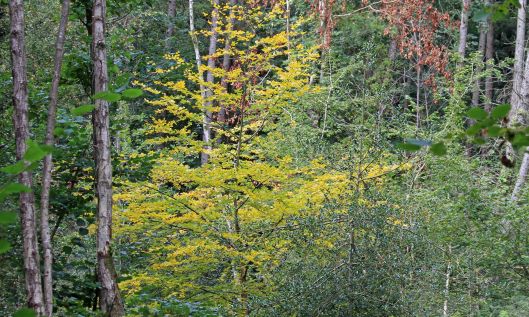
‘How beautiful the leaves grow old. How full of light and color are their last days.’ ~ John Burroughs


20 Monday Sep 2021
Tags
Acrocercops brongniardella, British leafminers, Holm oak, leaf-mining moth, leafmines, leafmines on Oak
Another Monday, another leaf-mining moth. This one goes by the tongue-twisting name of Acrocercops brongniardella and can be found on the leaves of Oak trees, mostly in southern parts of England, Wales and Ireland. The adult moth is a very smart-looking creature (see the photos on the UK Moths website).
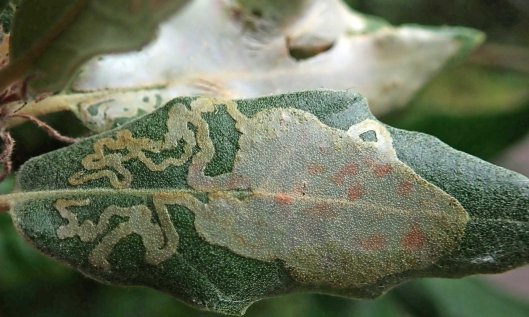
Fortunately, the larval leafmines are fairly easy to identify as they begin with a distinctive twist before broadening to a large blotch or blister.
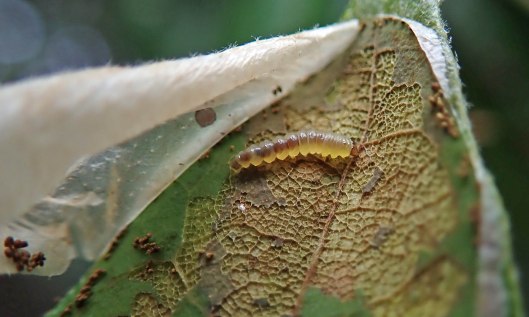
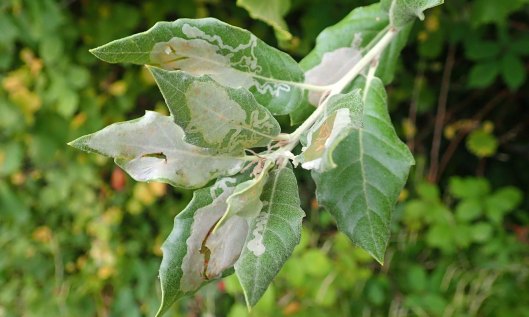
I found my very first Acrocercops brongniardella mines in a small area of woodland on 6 September and have since found more on a tree in a local park, both times on the evergreen Holm oak (Quercus ilex) and the latter rather abundant on leaves at the tips of lower branches. The mines can supposedly be found on all oak species, though I’ve failed to find them in the other local woodlands where I’ve recently been walking and there are not a lot of records for this species of Wales. I’ll be keeping an eye out for more.
18 Saturday Sep 2021
Tags
British sawflies, holes in Alder leaves, Platycampus luridiventris, sawfly larvae, sawfly larvae on Alder
I don’t know about you but when I see a leaf with holes in it, I feel a compulsion to turn over that leaf to try to determine what caused those holes. And that’s how I discovered today’s rather bizarre-looking creature.

And once I realised that the holes it made were smaller than many of the other holes in the surrounding leaves, I looked for other leaves with similar sized holes. And so I found several more.

And then I looked at other Alder trees in the same park, and I found even more.

It took a bit of googling when I got home but I eventually found a name for my mystery creatures, and that identification has now been confirmed by a national expert. These are the larvae of a sawfly called Platycampus luridiventris, a rather non-descript fly when you consider the larva it develops from. You can see that adult fly and read the scientific information about this species on The Sawflies (Symphyta) of Britain and Ireland website.

13 Monday Sep 2021
Tags
leaf-mining moth, leafmines, leafmines on Hazel, moth larvae in leaf mines, moth leafmines, Phyllonorycter coryli
For those of you who are new to leafmines, here’s one that’s appearing on leaves right about now, is common in Britain and easy to identify.
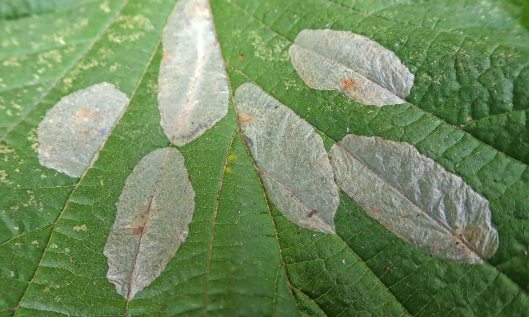
These blisters on Hazel leaves are made by the larvae of the perfectly named Nut leaf blister moth (Phyllonorycter coryli) – you can see what the adult moth looks like on the UK Moths website. In fact, if you’re sharp-eyed, you may have noticed these blisters in July, as this little moth has two broods each year. You can get more details and see more images on the excellent British Leafminers website.


12 Sunday Sep 2021
Tags
#WildflowerHour, autumn berries, autumn colour, autumn fruit, berries, drupes, fruits, hips, rose hips
This was @wildflower_hour’s tweet announcing this week’s #WildflowerHour challenge:
Samaras, siliques, nuts, drupes, berries, hips and capsules, how many different types of wild fruit can you find? That’s the challenge this week for #WildflowerHour. Share your pics this Sunday 8-9pm using the hashtag #fruits.
I’m saving my samaras, siliques, nuts and capsules for another day but here are my drupes, berries and hips: an assortment of Black bryony, Bramble, Buckthorn, Crab apple, Dewberry, Red-osier dogwood (with vivid red stems and white fruit) and Common dogwood, Guelder rose, Hawthorn, the hips of Japanese rose (these grow wild at the local country park) and Dog-rose, Sloe, Whitebeam, Woody nightshade and Yew.
01 Wednesday Sep 2021
Tags
autumn berries, bird migration, birding, Blackcap, Blackcap eating Elderberries, British birds, Elderberry, Sambucus nigra
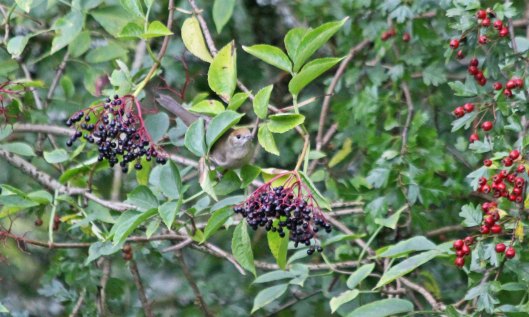
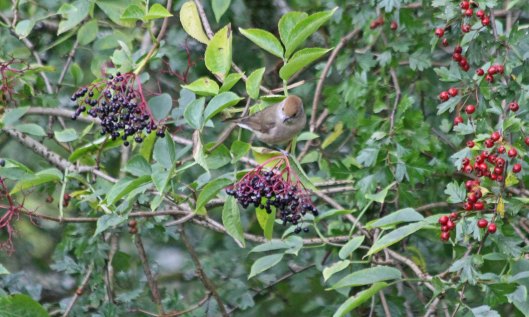
It’s not only humans that like to go foraging for ripe berries in the autumn. Though the raw berries of the Elderberry tree (Sambucus nigra) are mildly poisonous to mammals, they do not seem to affect fruit-eating birds, and Blackcaps, in particular, love to feast on them. This beautiful female had interrupted her migration journey south to top up her tank with their succulent goodness.

30 Monday Aug 2021
Tags
British leaf mines, British sawflies, leaf mines on Oak, leafminers, Oak leafmines, Profenusa pygmaea, sawfly leafmines
Believe it or not, #LeafmineMonday is a thing on Twitter, and last Monday I read with interest this tweet, with photos, posted by Rob Edmunds (@leafminerman, one of the people behind the excellent British Leafmines website):
a sawfly mine which is fairly easy to find, made by Profenusa pygmaea. Look for brown blotches on Oak leaves but with a wriggling start as shown in the photo … Initial mines are whitish but then fade to brown.

Profenusa pygmaea is a species of sawfly – you can read more about it and see photos of the adult on the Sawflies of Britain and Ireland website. As I’m often to be found checking out Oak leaves and there were no records for this particular sawfly in my local area, of course I had to go looking, and I’ve now found these leafmines in two separate locations. I’m guessing it’s yet another under-recorded species so if you spot it in your area, do please record it.


13 Tuesday Jul 2021
Tags
British leafhoppers, Cicadellidae, Eupterycyba jucunda, Italian Alder, leafhopper, leafhoppers on Alder
I just happened to be examining the leaves of a local Italian alder tree on Saturday (looking for signs of the Crypturaphis grassii aphids I found on this tree last December) when I spotted first one, then another, then several more leafhoppers, all with quite distinctive markings so, of course, I took photos. When I later checked the British Bugs website, I was able to identify them as Eupterycyba jucunda, a new species for me.


The website notes that this species is ‘found predominantly on alder in England and Wales, as far north as Lancashire’, and that the adults can be seen between July and October. Looking at the photos on the website, I think the small black-and-white objects I also saw (photos below) are actually the empty exuvia of Eupterycyba jucunda nymphs. Fascinating!


 earthstar
You must be logged in to post a comment.