• ABOUT
  • BIRDING 2018
  • Birding 2019
  • BLOG POSTS
  • Butterflies 2018
  • Resources

earthstar

~ a celebration of nature

earthstar

Category Archives: wildflowers

218/366 Vervain

05 Wednesday Aug 2020

Posted by sconzani in nature, plants, wildflowers

≈ Leave a comment

Tags

British wildflowers, Grangemoor Park, The Chief Herb, The Herb, Verbena officinalis, Vervain, wildflower

I’ve been trying, very slowly, to learn the names of more wildflowers so, when I couldn’t put a name to this plant at Grangemoor Park a couple of days ago, I made sure to take lots of photos of it. And today I found out this straggly, nondescript wildflower is not just any old plant, this is ‘The Herb’!

200805 vervain (1)

Vervain (Verbena officinalis) was so valued by herbalists in Anglo Saxon times that it was considered ‘The Chief Herb’, and was ‘a venerated plant, valued not just as a panacea (it was trumpeted as a cure for the plague in the Middle Ages) but as a magical charm, which could both protect against witches and demons and conjure up devilry of its own’ (Flora Britannica). 

200805 vervain (3)
200805 vervain (2)
Like Loading...

216/366 Red bartsia

03 Monday Aug 2020

Posted by sconzani in nature, plants, wildflowers

≈ 2 Comments

Tags

British wildflowers, Cosmeston Lakes Country Park, Odontites vernus, Red bartsia, wildflowers

Red bartsia (Odontites vernus) is an unobtrusive wildflower that I have tended to overlook until now but it’s very common in Cosmeston Lakes Country Park, one of my local haunts, so I thought I should take a closer look at it.

200803 red bartsia (1)

The Wildlife Trust website says Red bartsia can be found growing on low-fertility soils – places like waste ground, brownfield sites, along the edges of roads and railway tracks, and it survives in these more barren places because it’s semi-parasitic on the plants around it, tapping in to their root systems to gather extra nutrients.

200803 red bartsia (2)
200803 red bartsia (3)

Its scientific name is interesting: Odontites comes from Ancient Greek ὀδούς meaning tooth and apparently refers to the fact that Pliny the Elder used this plant to treat toothache; vernus refers to springtime, presumably when this plant comes to life for the year. It flowers for several months over the summer, providing a good nectar source for many species of bee and wasp.

200803 red bartsia (4)

Like Loading...

208/366 A pod of peas

26 Sunday Jul 2020

Posted by sconzani in nature, wildflowers

≈ 1 Comment

Tags

British wildflowers, Broad-leaved everlasting pea, Common bird's foot trefoil, Goat's-rue, Grass vetchling, Leguminosae, Meadow vetchling, Melilotus species, Pea family

The Pea family (properly known as the Leguminosae) is a large one, and its members are easily recognised by their flower shape. I see them a lot during my meanders – Red and White clovers, the Bird’s-foot trefoil and Melilotus species, Tufted and Bush vetch are all common hereabouts.

200726 1 birds-foot trefoil
200726 1 melilotus sp
200726 2 tufted vetch
200726 2 bush vetch

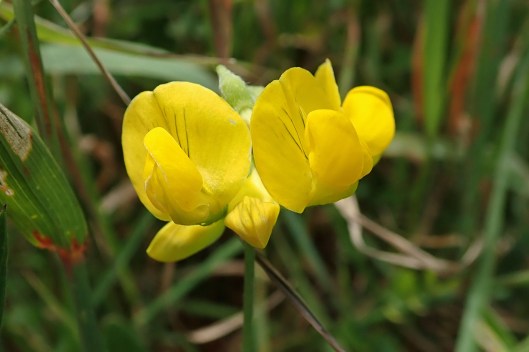
Those that follow are the peas I see less often, starting with Meadow vetchling (Lathyrus pratensis), which is not an uncommon plant in my area – it’s just that I’ve seen it more often since lockdown started, as my walks have taken me along the less-used footpaths across local farm fields and meadows.
200726 3 meadow vetchling

Grass vetchling (Lathyrus nissolia) is less common – or, perhaps, less easily found, as it’s a delicate plant, easily lost amongst the long grass in which it grows, unless you manage to spot its one or two bright pink flowers on fine, tall stems.

200726 4 grass vetchling (2)
200726 4 grass vetchling (1)

Broad-leaved everlasting pea (Lathyrus latifolius): I’ve found this lovely, sprawling pea in two local parks, both former rubbish dumps. It seems an aggressive climber and rambler, adorning bramble and low scrub with its attractive blooms. It is a favourite plant of the Long-tailed blue butterfly so I know where to look if this pretty migrant butterfly ever decides to fly as far as south Wales.

200726 5 broad-leaved everlasting pea

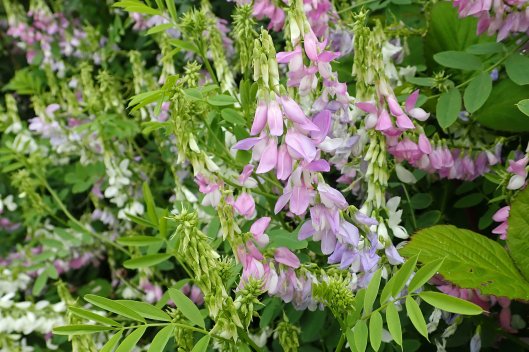
Goat’s rue (Galega officinalis) is new to me, and I’ve only seen it in one location, near a large local hospital, perhaps blown in by the constant comings and goings of traffic. My Flora Britannica says it ‘was introduced … in the sixteenth century as a vegetable and medicinal herb, and later grown for ornament’. It certainly has very beautiful flowers.

200726 6 goats-rue

Like Loading...

207/366 At home in the bindweed

25 Saturday Jul 2020

Posted by sconzani in flowers, molluscs, nature, wildflowers

≈ Leave a comment

Tags

Bindweed flower, slugs, slugs in bindweed flowers

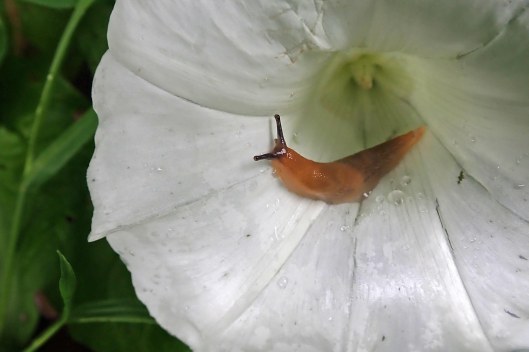
I had to chuckle during this morning’s brief stomp between bouts of heavy rain. The local slugs, which I thought would be at home in such conditions, sliding on the grass, slithering over leaves, were more literally ‘at home’, sheltering in the deep flower cups of bindweed.

200725 slugs in bindweed (1)200725 slugs in bindweed (2)200725 slugs in bindweed (3)

Like Loading...

204/366 Musk thistle

22 Wednesday Jul 2020

Posted by sconzani in nature, plants, wildflowers

≈ 4 Comments

Tags

British wildflowers, Carduus nutans, Musk thistle, Nodding thistle, thistle

This gorgeous thistle was a new plant for me when I discovered it in a local farm field a couple of days ago. It’s a Musk thistle (Carduus nutans), also known as Nodding thistle, and it’s precisely the nodding habit of its growth that alerted me to something new.

200722 musk thistle (1)

Its flowers, though a glorious and vibrant pinky purple, droop downwards, nodding on long spineless stems and, in fact, compared to the upright habit of other thistles I see, this one’s growth habit overall is very droopy. It’s a bit of a sloucher, though, as its name suggests, those flowers have a musky smell that bees find particularly attractive, and several butterflies seemed to like it too.

200722 musk thistle (2)

The Plantlife website provides some interesting facts about the Musk thistle: apparently ‘its fleshy stem is edible and said to be delicious after peeling and boiling’ and ‘medicinally, the leaves have been used as a tonic to stimulate liver function, whereas the flowers have been used to reduce fevers and purify the blood.’

200722 musk thistle (3)

Like Loading...

201/366 Small and white

19 Sunday Jul 2020

Posted by sconzani in nature, wildflowers

≈ 2 Comments

Tags

British wildflowers, Common centaury, Common mouse-ear, Eyebright, Fairy flax, Hedge bedstraw, white-flowered wildflowers

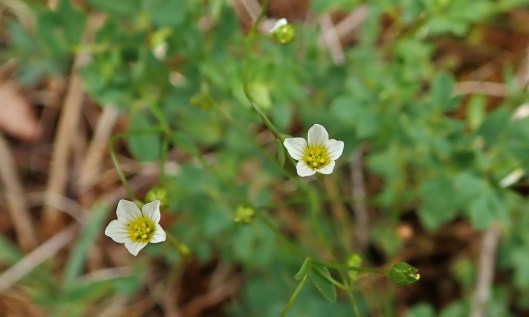
Many of the local wildflowers currently in bloom have small, white flowers. These are some of them …

200719 fairy flax

Fairy flax (Linum catharticum): this is the smallest, a tiny delicate plant that appears to shake and quiver even in the lightest breeze. It is also known as Purging flax as, in past times, herbalists prescribed it as a laxative.

200719 hedge bedstraw (1)
200719 hedge bedstraw (2)

Hedge bedstraw (Galium mollugo): not the bedstraw that was used to sweeten the smell of straw mattresses (which is the yellow-flowered Lady’s bedstraw), but its close cousin, which can be found scrambling along hedgerows, particularly on calcareous soils.

200719 common eyebright (1)
200719 common eyebright (2)

Eyebright (Euphrasia sp.): I didn’t know until I checked this plant on the Plantlife website that the various species of Eyebright are semi-parasitic, stealing the nutrients of other plants, like grasses.

200719 common mouse ear

Common mouse-ear (Cerastium fontanum): A type of chickweed, which many gardeners will know as a persistent ‘weed’, this little plant gets its mouse-ear name from its hairy leaves that grow in pairs on either side of the plant’s stem.

200719 common centaury (1)

Common centaury (Centaurium erythraea) is usually pink flowered (see the variations below) but many of the plants I see locally, like those above, have white flowers. The Plantlife website gives the fascinating information that centaury is ‘named after the centaur Chiron, who, according to legend, discovered its healing power and used it to cure himself from the effects of a poisoned arrow.’

200719 common centaury (2)
200719 common centaury (3)
Like Loading...

198/366 Sneezewort

16 Thursday Jul 2020

Posted by sconzani in flowers, nature, wildflowers

≈ Leave a comment

Tags

Achillea ptarmica, British wildflowers, Sneezeweed, Sneezewort, wildflower

Sneezewort (Achillea ptarmica) is not a wildflower I see very often so I was delighted to find a few plants of it blooming in a local meadow during yesterday’s wander.

200716 sneezewort (1)

The First Nature website explains its scientific name: Achillea ‘stems from the belief that Achilles used flowers of this genus to cure his soldiers’ wounds; ptarmica … comes from the Greek and means to cause a sneeze’. And, as well as Sneezewort, it has a host of other wonderful common names, including Sneezeweed, Bastard pellitory, Fair-maid-of-France, and Goose tongue.

OLYMPUS DIGITAL CAMERA
Like Loading...

194/366 Watching, waiting

12 Sunday Jul 2020

Posted by sconzani in flowers, nature, wildflowers

≈ 1 Comment

Tags

British orchids, Broad-leaved helleborine, Grangemoor Park, native orchids

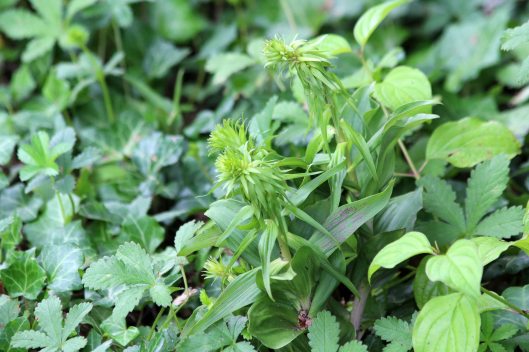
During my lockdown meanders around Cardiff’s Grangemoor Park, I’ve been keeping an eye on these Broad-leaved helleborines, watching and waiting for them to bloom. Though I’d only found them in one location in previous years, this year I’ve spotted them in three different places around the park.

200712 broad-leaved helleborine 17 june (2)

Here they are on 17 June, looking healthy, with lots of lush foliage.

200712 broad-leaved helleborine 17 june (1)

Just over a week later, on 25 June, flower spikes have developed well on a couple of plants, so I’m hopeful of a good display.

200712 broad-leaved helleborine 25 june (1)
200712 broad-leaved helleborine 25 june (2)

I don’t manage to get back this way until 11 July, but I’m full of expectation of a mass of blooms. Unfortunately, though we’ve had plenty of rain, a couple of plants look brown and slightly withered (as they’re adjacent to a well-used footpath, I wonder if passing dogs might have urinated on them). A couple of other plants look as if they’ve been trampled.

200712 broad-leaved helleborine 11 july (1)
OLYMPUS DIGITAL CAMERA

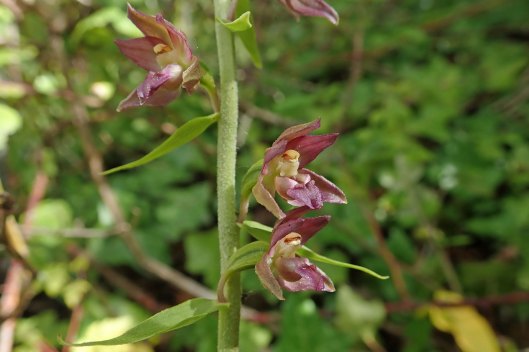
Luckily, I have found two plants with spikes intact and a couple of flowers open on each. Such pretty little things.

OLYMPUS DIGITAL CAMERA

Like Loading...

190/366 For the love of thistles

08 Wednesday Jul 2020

Posted by sconzani in insects, nature, plants, wildflowers

≈ 3 Comments

Tags

British insects, Cirsium arvense, Creeping thistle, insects on thistles, thistle

Many people would consider the thistle – any thistle, all thistles – to be a weed but one look at these photos will show just what a diverse range of insects find the humble thistle an essential source of food. From flies and hoverflies, bees and wasps, to beetles and butterflies, the Creeping thistle (Cirsium arvense) is a favourite of them all. And when the flowers are finished, it will be the turn of the birds to find nourishment in the thistle seeds. What an amazing wildflower this is!

This slideshow requires JavaScript.

Like Loading...

187/366 Pinkish

05 Sunday Jul 2020

Posted by sconzani in flowers, wildflowers

≈ 5 Comments

Tags

British wildflowers, pink wildflowers, shades of pink

I was planning a more informed, more specific post about wildflowers for today but I’ve been having trouble with my internet connection for a couple of days – technology is great, until it isn’t! – so here are some general wildflower images instead. Enjoy all these glorious shades of pink!

200705 betony
200705 bramble
200705 buddleja
200705 common spotted orchid
200705 cut-leaved cranesbill
200705 geranium a
200705 geranium b
200705 hedge woundwort
200705 knapweed
200705 mallow
200705 pyramidal orchid
200705 red clover
200705 self heal
200705 southern marsh orchid
200705 stinking iris
200705 thistle 2
200705 thistle
200705 rose
Like Loading...
← Older posts
Newer posts →

About me

sconzani

sconzani

I'm a writer and photographer; researcher and blogger; birder and nature lover; countryside rambler and city strider; volunteer and biodiversity recorder.

View Full Profile →

Follow earthstar on WordPress.com

Enter your email address to follow this blog and receive notifications of new posts by email.

Recent blog posts

  • Springtime invasives March 22, 2026
  • Singing Dunnocks March 21, 2026
  • New cat: Large yellow underwing March 20, 2026
  • Curious Coal tit March 19, 2026
  • A huddle of 7-spots March 18, 2026

From the archives

COPYRIGHT

Unless otherwise acknowledged, the text and photographs on this blog are my own and are subject to international copyright. Nothing may be downloaded or copied without my permission.

Fellow Earth Stars!

  • Unknown's avatar
  • Unknown's avatar
  • Unknown's avatar
  • Unknown's avatar
  • Unknown's avatar
  • Unknown's avatar
  • Unknown's avatar
  • Unknown's avatar
  • Unknown's avatar
  • Unknown's avatar
  • Unknown's avatar
  • Unknown's avatar
  • Unknown's avatar
  • Unknown's avatar
  • Unknown's avatar
  • Unknown's avatar
  • Unknown's avatar
  • Unknown's avatar
  • Unknown's avatar
  • Unknown's avatar
  • Unknown's avatar
  • Unknown's avatar
  • Unknown's avatar
  • Unknown's avatar
  • Unknown's avatar
  • Unknown's avatar
  • Unknown's avatar
  • Unknown's avatar
  • Unknown's avatar
  • Unknown's avatar
  • Unknown's avatar
  • Unknown's avatar
  • Unknown's avatar
  • Unknown's avatar
  • Unknown's avatar
  • Unknown's avatar
  • Unknown's avatar
  • Unknown's avatar
  • Unknown's avatar
  • Unknown's avatar
  • Unknown's avatar
  • Unknown's avatar
  • Unknown's avatar
  • Unknown's avatar
  • Unknown's avatar
  • Unknown's avatar
  • Unknown's avatar
  • Unknown's avatar
  • Unknown's avatar
  • Unknown's avatar

Blog at WordPress.com.

Privacy & Cookies: This site uses cookies. By continuing to use this website, you agree to their use.
To find out more, including how to control cookies, see here: Cookie Policy
  • Subscribe Subscribed
    • earthstar
    • Join 668 other subscribers
    • Already have a WordPress.com account? Log in now.
    • earthstar
    • Subscribe Subscribed
    • Sign up
    • Log in
    • Report this content
    • View site in Reader
    • Manage subscriptions
    • Collapse this bar
 

Loading Comments...
 

You must be logged in to post a comment.

    %d