• ABOUT
  • BIRDING 2018
  • Birding 2019
  • BLOG POSTS
  • Butterflies 2018
  • Resources

earthstar

~ a celebration of nature

earthstar

Category Archives: wildflowers

198/366 Sneezewort

16 Thursday Jul 2020

Posted by sconzani in flowers, nature, wildflowers

≈ Leave a comment

Tags

Achillea ptarmica, British wildflowers, Sneezeweed, Sneezewort, wildflower

Sneezewort (Achillea ptarmica) is not a wildflower I see very often so I was delighted to find a few plants of it blooming in a local meadow during yesterday’s wander.

200716 sneezewort (1)

The First Nature website explains its scientific name: Achillea ‘stems from the belief that Achilles used flowers of this genus to cure his soldiers’ wounds; ptarmica … comes from the Greek and means to cause a sneeze’. And, as well as Sneezewort, it has a host of other wonderful common names, including Sneezeweed, Bastard pellitory, Fair-maid-of-France, and Goose tongue.

OLYMPUS DIGITAL CAMERA
Like Loading...

194/366 Watching, waiting

12 Sunday Jul 2020

Posted by sconzani in flowers, nature, wildflowers

≈ 1 Comment

Tags

British orchids, Broad-leaved helleborine, Grangemoor Park, native orchids

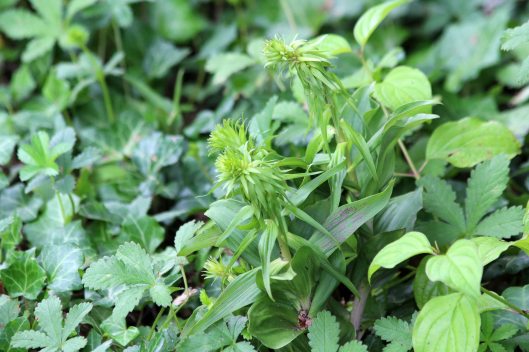
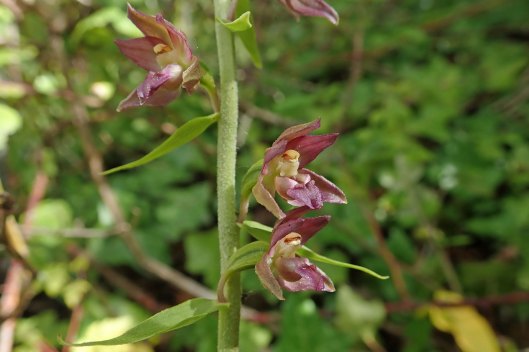
During my lockdown meanders around Cardiff’s Grangemoor Park, I’ve been keeping an eye on these Broad-leaved helleborines, watching and waiting for them to bloom. Though I’d only found them in one location in previous years, this year I’ve spotted them in three different places around the park.

200712 broad-leaved helleborine 17 june (2)

Here they are on 17 June, looking healthy, with lots of lush foliage.

200712 broad-leaved helleborine 17 june (1)

Just over a week later, on 25 June, flower spikes have developed well on a couple of plants, so I’m hopeful of a good display.

200712 broad-leaved helleborine 25 june (1)
200712 broad-leaved helleborine 25 june (2)

I don’t manage to get back this way until 11 July, but I’m full of expectation of a mass of blooms. Unfortunately, though we’ve had plenty of rain, a couple of plants look brown and slightly withered (as they’re adjacent to a well-used footpath, I wonder if passing dogs might have urinated on them). A couple of other plants look as if they’ve been trampled.

200712 broad-leaved helleborine 11 july (1)
OLYMPUS DIGITAL CAMERA

Luckily, I have found two plants with spikes intact and a couple of flowers open on each. Such pretty little things.

OLYMPUS DIGITAL CAMERA

Like Loading...

190/366 For the love of thistles

08 Wednesday Jul 2020

Posted by sconzani in insects, nature, plants, wildflowers

≈ 3 Comments

Tags

British insects, Cirsium arvense, Creeping thistle, insects on thistles, thistle

Many people would consider the thistle – any thistle, all thistles – to be a weed but one look at these photos will show just what a diverse range of insects find the humble thistle an essential source of food. From flies and hoverflies, bees and wasps, to beetles and butterflies, the Creeping thistle (Cirsium arvense) is a favourite of them all. And when the flowers are finished, it will be the turn of the birds to find nourishment in the thistle seeds. What an amazing wildflower this is!

This slideshow requires JavaScript.

Like Loading...

187/366 Pinkish

05 Sunday Jul 2020

Posted by sconzani in flowers, wildflowers

≈ 5 Comments

Tags

British wildflowers, pink wildflowers, shades of pink

I was planning a more informed, more specific post about wildflowers for today but I’ve been having trouble with my internet connection for a couple of days – technology is great, until it isn’t! – so here are some general wildflower images instead. Enjoy all these glorious shades of pink!

200705 betony
200705 bramble
200705 buddleja
200705 common spotted orchid
200705 cut-leaved cranesbill
200705 geranium a
200705 geranium b
200705 hedge woundwort
200705 knapweed
200705 mallow
200705 pyramidal orchid
200705 red clover
200705 self heal
200705 southern marsh orchid
200705 stinking iris
200705 thistle 2
200705 thistle
200705 rose
Like Loading...

182/366 Flowering rush

30 Tuesday Jun 2020

Posted by sconzani in flowers, nature, wildflowers

≈ 2 Comments

Tags

British wildflowers, Butomus umbellatus, Cardiff Bay wetlands, Flowering rush

200630 flowering rush

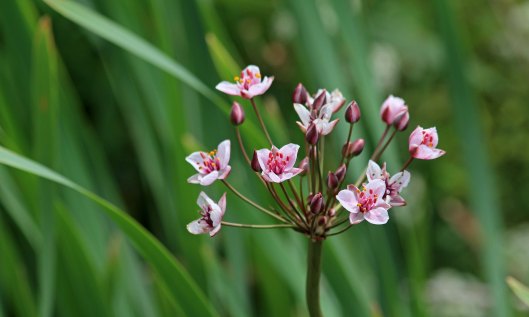
When I see the grasses and sedges and rushes that grow in and around rivers and ponds, canals, ditches and wetlands, I don’t expect to see such gorgeous flowers as these. This is the umbel-shaped flower of Flowering rush (Butomus umbellatus), hence the umbellatus epithet. According to the eFloras website, Butomus is from the Greek bous, meaning cow, and femno, meaning to cut, which refers to the belief that the sharp leaves would cut the mouths of cattle. Fortunately, no cattle are at risk from this particular Flowering rush plant, which is growing at Cardiff Bay wetlands reserve.

Like Loading...

181/366 Spot the beetle

29 Monday Jun 2020

Posted by sconzani in insects, nature, wildflowers

≈ 6 Comments

Tags

beetle, British beetles, Rutpela maculata, Spotted longhorn beetle, umbellifer flowers, umbellifers

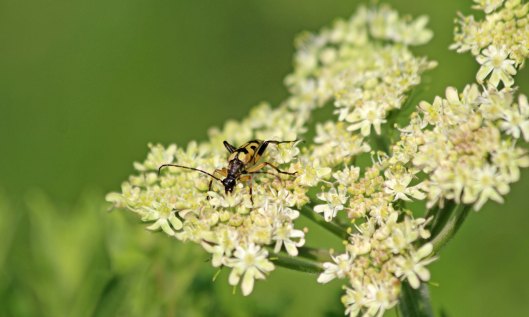
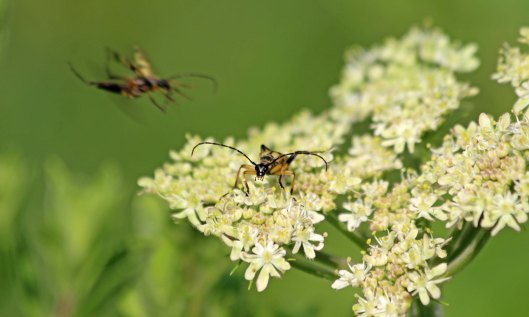
This Spotted longhorn (Rutpela maculata) was happily minding its own business, feeding on the umbellifer flowers growing along the edge of a woodland ride, as is its wont, when …

200629 spotted longhorn (1)

Incoming!

200629 spotted longhorn (2)

And so the necessity of life as a beetle takes over, the need to reproduce, to continue the species. Lunch might have to wait.

200629 spotted longhorn (3)

Like Loading...

173/366 Beautiful Betony

21 Sunday Jun 2020

Posted by sconzani in nature, wildflowers

≈ Leave a comment

Tags

Betonica officinalis, Betony, British wildflowers, Stachys officinalis, wildflowers, wildflowers in road verges

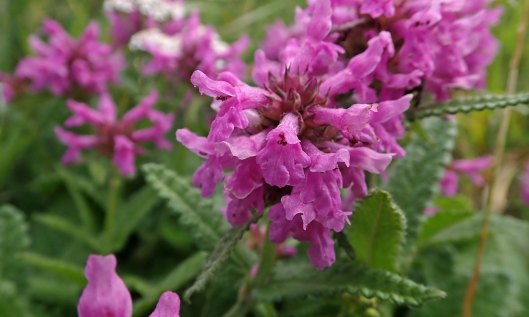
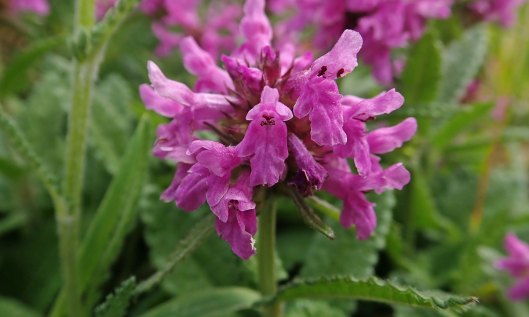
This was a pretty find in an unmown roadside verge earlier this week. It looks more pink than my wildflower guide and most online images show, but I’m fairly sure this is Betony, which now goes by the scientific name of Betonica officinalis, but was previously Stachys officinalis.

200621 betony (2)

Its common names include Common hedgenettle, and Bishopwort or Bishop’s wort, and my Flora Britannica labels it ‘one of the great “all-heals” of medieval herbalists’. The various old herbals claim it was effective for everything from treating arthritis and gout, to preserving the liver and curing drunkenness. Roman physician Antonius Musa reckoned it counteracted sorcery, and Christians planted Betony in churchyards as a ghost-busting tool.

200621 betony (1)

I’ve read that various subspecies are available that produce different flower colours so perhaps this is one of those and the plants have developed from seed dropped via bird droppings, though the verge contains a wealth of other wildflowers – Yarrow, as you can see in one of my photos; Oxeye daisies; Knapweed; Bird’s-foot trefoil; and even three Pyramidal orchids. Before the high-rise apartment blocks and office blocks were built, this riverside location must have contained a wealth of wonderful plants and, perhaps now that the verge is not being mowed, the plants are making a comeback.

200621 betony (3)

200621 pyramidal orchid

Like Loading...

171/366 Buttercups

19 Friday Jun 2020

Posted by sconzani in nature, wildflowers

≈ 8 Comments

Tags

British wildflowers, Bulbous buttercup, buttercups, Creeping buttercup, identifying buttercups, Meadow buttercup

I’ve been trying to learn about buttercups, specifically how to identify the three species that are most common in my area and, three cheers, I think I’ve finally got it! Each species has several distinguishing characteristics – these are simply the features I find most helpful.

200619 meadow buttercup (1)

200619 meadow buttercup (2)
200619 meadow buttercup (3)

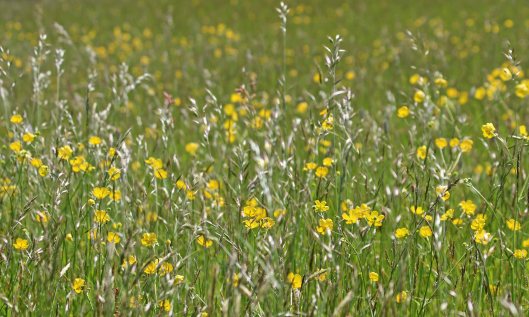
Meadow buttercup (Ranunculus acris): This is probably the easiest to put a name to, partly because it’s the tallest and also because its leaves are very distinctive – they are quite finely cut, and remind me of geraniums. This is the buttercup I see most often, especially in local wildflower meadows.

200619 creeping buttercup (2)
200619 creeping buttercup (3)

200619 creeping buttercup (1)

Creeping buttercup (Ranunculus repens): I see Creeping buttercup frequently too, and find its leaves the best way to identify it – they are broader, with three lobes and with pale marks on each lobe.

200619 bulbous buttercup (1)

200619 bulbous buttercup (2)
200619 bulbous buttercup (3)

Bulbous buttercup (Ranunculus bulbosus): Bulbous is the buttercup I see least often. The distinguishing feature I find easiest to remember is the way the sepals underneath the flower bend back against the stem, rather than cupping the flower. I had to turn over a lot of flowers before I found this one!

Like Loading...

166/366 Wild and yellow

14 Sunday Jun 2020

Posted by sconzani in nature, wildflowers

≈ 2 Comments

Tags

Agrimony, British wildflowers, Creeping cinquefoil, Dyer’s greenweed, Evening-primrose, Prickly sow-thistle, Silverweed, Smooth sow-thistle, yellow flowers

It’s grey here in south Wales today, which is not a bad thing as we desperately need the accompanying rain, and it also makes me appreciate even more the days when vibrant, sunshiny, cheery yellow is the dominant colour of my day. Here’s some of the yellow that’s been brightening my walks in recent days.

200614 1 dyers greenweed

Dyer’s greenweed (Genista tinctoria), found at several local sites, and the food plant for the larvae of a couple of rare moths, though I’ve yet to find any.
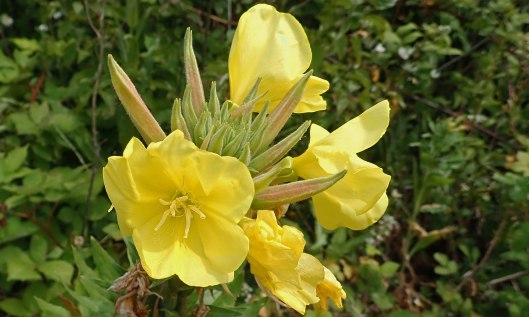
200614 2 evening primrose

Evening-primrose (Oenothera agg). There are several different species, which can be difficult to differentiate, and they also hybridise with each other, hence the ‘agg’.

200614 3 silverweed

Silverweed (Potentilla anserina). The Plantlife website has some fascinating information about this pretty plant – did you know, for example, that Roman soldiers used to pad their shoes with Silverweed to ease their feet on long marches?

200614 4a prickly sow-thistle
200614 4 prickly sow-thistle

Prickly sow-thistle (Sonchus asper). Most thistles have flowers in shades of pink-lilac-purple but not this one. I’ve included two photos, one to show the structural beauty of the flower, one to show the prickly leaves.
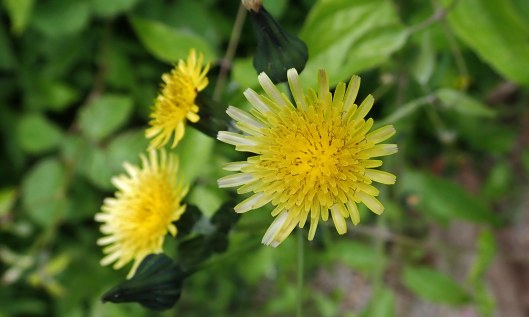
200614 5 smooth sow-thistle

Smooth sow-thistle (Sonchus oleraceus). Another sow-thistle, but without those pesky prickles, and with flowers a more lemon-yellow.

200614 6 agrimony

Agrimony (Agrimonia eupatoria), a plant of hooking-bristle seed heads, as you may remember from my earlier post Hooked, September 2019.

200614 7 creeping cinquefoil

Creeping cinquefoil (Potentilla reptans), a plant that thrives on waste and bare ground.

Like Loading...

159/366 Daisy power

07 Sunday Jun 2020

Posted by sconzani in flowers, insects, nature, wildflowers

≈ Leave a comment

Tags

British wildflowers, daisies, insects on Oxeye daisies, Oxeye daisy, wildflowers

I walk past this magnificent display of Oxeye daisies quite often, and it always makes me smile.

200607 ox-eye daisies (1)

It runs alongside a local footpath, behind a wire fence that borders a school playground, and transforms an ugly bank of earth, which prevents footpath walkers from seeing the children at play, into a stunning floral flourish.

200607 ox-eye daisies (2)

You might be forgiven for thinking the flowers look a bit ‘empty’ – where are all the insects that love feasting on these wildflowers? Well, though sunny, this was quite a windy day, with huge clouds scudding rapidly across the sky, changing bright warmth to grey coolness in the blink of an eye. But, when I looked closely in the more sheltered spots, the insects were there, sometimes more than I expected on a single flower head, sharing the nutrient power of these glorious daisies.

200607 ox-eye daisies (3)

Like Loading...
← Older posts
Newer posts →

About me

sconzani

sconzani

I'm a writer and photographer; researcher and blogger; birder and nature lover; countryside rambler and city strider; volunteer and biodiversity recorder.

View Full Profile →

Follow earthstar on WordPress.com

Enter your email address to follow this blog and receive notifications of new posts by email.

Recent blog posts

  • Nesting material April 28, 2026
  • Lifer: Box bug April 27, 2026
  • Peak Wild garlic April 26, 2026
  • First damsels of 2026 April 25, 2026
  • NFY: Green-veined white April 24, 2026

From the archives

COPYRIGHT

Unless otherwise acknowledged, the text and photographs on this blog are my own and are subject to international copyright. Nothing may be downloaded or copied without my permission.

Fellow Earth Stars!

  • Unknown's avatar
  • Unknown's avatar
  • Unknown's avatar
  • Unknown's avatar
  • Unknown's avatar
  • Unknown's avatar
  • Unknown's avatar
  • Unknown's avatar
  • Unknown's avatar
  • Unknown's avatar
  • Unknown's avatar
  • Unknown's avatar
  • Unknown's avatar
  • Unknown's avatar
  • Unknown's avatar
  • Unknown's avatar
  • Unknown's avatar
  • Unknown's avatar
  • Unknown's avatar
  • Unknown's avatar
  • Unknown's avatar
  • Unknown's avatar
  • Unknown's avatar
  • Unknown's avatar
  • Unknown's avatar
  • Unknown's avatar
  • Unknown's avatar
  • Unknown's avatar
  • Unknown's avatar
  • Unknown's avatar
  • Unknown's avatar
  • Unknown's avatar
  • Unknown's avatar
  • Unknown's avatar
  • Unknown's avatar
  • Unknown's avatar
  • Unknown's avatar
  • Unknown's avatar
  • Unknown's avatar
  • Unknown's avatar
  • Unknown's avatar
  • Unknown's avatar
  • Unknown's avatar
  • Unknown's avatar
  • Unknown's avatar
  • Unknown's avatar
  • Unknown's avatar
  • Unknown's avatar
  • Unknown's avatar
  • Unknown's avatar

Blog at WordPress.com.

Privacy & Cookies: This site uses cookies. By continuing to use this website, you agree to their use.
To find out more, including how to control cookies, see here: Cookie Policy
  • Subscribe Subscribed
    • earthstar
    • Join 642 other subscribers
    • Already have a WordPress.com account? Log in now.
    • earthstar
    • Subscribe Subscribed
    • Sign up
    • Log in
    • Report this content
    • View site in Reader
    • Manage subscriptions
    • Collapse this bar

Loading Comments...

You must be logged in to post a comment.

    %d