• ABOUT
  • BIRDING 2018
  • Birding 2019
  • BLOG POSTS
  • Butterflies 2018
  • Resources

earthstar

~ a celebration of nature

earthstar

Category Archives: wildflowers

March on the Ely embankment

31 Saturday Mar 2018

Posted by sconzani in birds, nature, walks, wildflowers

≈ Leave a comment

Tags

#BeastfromtheEast, Cardiff Bay, Colt's-foot, Ely embankment, Great Crested Grebe, Linnet, Pied wagtail, Redshank, River Ely, Rock pipit, snow in Penarth Marina, Turnstone

A month of superlatives!

180331 1 Ely embankment

4 March  The coldest! My first visit of March was in the aftermath of ‘The Beast from the East’ and Storm Emma, a weather combination that brought Cardiff an unseasonal covering of snow, with deep drifts in places. As the east-facing embankment had been subject to the full assault of those storm systems, it was not surprising to see piles of the white stuff still blocking the road alongside Cardiff Bay, and there was a smattering on the embankment itself.

180331 2 snow
180331 3 pied wagtail contemplates snow

Though I wondered if the storm might have blown in some European strays or other unusual birds, I wasn’t really surprised to find that the very exposed embankment was almost bare of birds. A smattering of perhaps 10 Coots, a couple of Mallards and Mute swans, and two Pied wagtails were almost the only avian wildlife. Even the gulls were sparse.

9 March  The contrast between today’s weather and last weekend’s was almost unbelievable: it was 12°C, the sun was shining and it felt positively Spring like. Maybe that’s why the birds were out in force, with five Redshanks – the most I’ve ever seen on the embankment at once, 3 Turnstones – two venturing well up the stones away from the water’s edge, 2 Grey wagtails and 1 Pied.

180331 6 redshank
180331 7 redshank
180331 8 redshank
180331 9 redshank
180331 10 redshank
180331 11 turnstone

And just to prove that I don’t only look at the birds, I noticed the Red campion was already in flower and I was most surprised to see a large area of Colt’s-foot flowers. They must be tough to grow in such a stony bank.

180331 4 colt's-foot
180331 5 colt's-foot

14 March   A bumper day along the embankment, in light drizzle, which almost put me off going out for a walk. I’m so glad I got off my chuff! There were 3 Redshank, 7 Turnstone, 2 Grey wagtails, 3 Pied wagtails, 1 Rock pipit, 4 Linnets, 1 Carrion crow, 4 Feral pigeon and, in the water adjacent, 8 Coots, 5 Great crested grebes, 1 Cormorant, 2 Mallards, and 6 Mute swans. The greatest variety!

180331 12 Grey wagtail
180331 13 Carrion crow
180331 14 Feral pigeon
180331 15 Rock pipit
180331 16 Mute swan
180331 17 Linnet
180331 18 Coot
180331 19 Pied wagtail
180331 20 Great crested grebe

20 March  This was another day of cold winds, blowing directly across the bay and slamming into the embankment, so the few birds that were around were sheltering further up the river, and there weren’t many to be seen – a single Redshank looking very unhappy, perhaps still recovering from our second bout of snow this Spring, last weekend’s ‘Mini-beast from the East’, plus 3 Turnstones and 2 Grey wags.

180331 21 unhappy Redshank

24 March  I was really heading across the Barrage in search of a Wheatear (more on that here) but figured I’d detour along the embankment path on my way, and I’m so glad I did as there were 10 Turnstones – a large number! – and a solitary Redshank bimbling along the shoreline.

180331 22 turnstones

28 March  Fourteen (14!) Turnstones on the embankment during this day’s walk (the most I’ve ever seen on one visit), plus 2 Redshanks and a solitary Pied wagtail. What a way to end my monthly walks along this bay-side path!

180331 23 redshank

Like Loading...

Lovely Lungwort

30 Friday Mar 2018

Posted by sconzani in flowers, nature, plants, spring, wildflowers

≈ 7 Comments

Tags

British flora, British wildflowers, Jacob's coat, Lungwort, Mary spilt the milk, Pulmonaria officinalis, Soldiers and sailors, spring flowers

OLYMPUS DIGITAL CAMERA

I kid you not – Lungwort really is this wildflower’s common name (scientific name: Pulmonaria officinalis). And why? Well, it goes back to the times when people believed that the physical qualities of a plant – its shape, colour, features – reflected its uses (a theory also known as the doctrine of signatures). In this case, the freckled oval-shaped leaves were thought to resemble diseased lungs (and I thought I had a good imagination!) and so the plant was (and still is) used as a treatment for various respiratory ailments.

OLYMPUS DIGITAL CAMERA

Those blotchy leaves are also the reason for one of the plant’s many common names, ‘Mary-spilt-the-milk’. And the variety of pinks and blues in its flowers are behind its other vernacular names, ‘Jacob’s coat’ and ‘Soldiers and Sailors’ – all much more understandable.

OLYMPUS DIGITAL CAMERA
Like Loading...

March at Cosmeston

29 Thursday Mar 2018

Posted by sconzani in birds, flowers, nature, reptiles, spring, wildflowers

≈ 2 Comments

Tags

birding, birdwatching, British birds, Chiffchaff, Common frog, Cosmeston, Cosmeston Lakes Country Park, Gadwall, Great Crested Grebe, Hawfinch, Meadow pipit, primrose, Reed buntin, Sand martin, Scaup, treecreeper

11 March  This visit to Cosmeston started with me being yaffled at by a Green woodpecker – I always think they’re jeering at me, trying to lure me into stalking them for that ever-elusive close-up. I resisted and walked on, then paused to watch a Magpie trying to carry off a very large twig / small branch, proof that nest-building has begun.

180329 1 primroses

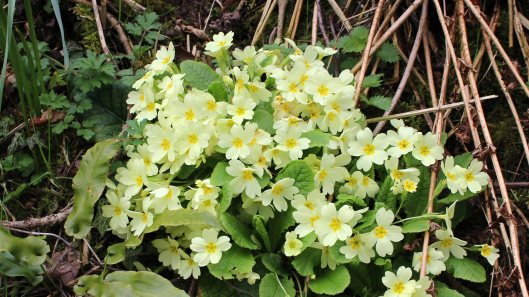
Masses of pale Primroses were flowering prettily along the western boundary path, and the lake was overflowing the boardwalk at the west end due to recent heavy rain.

180329 2 drake Scaup

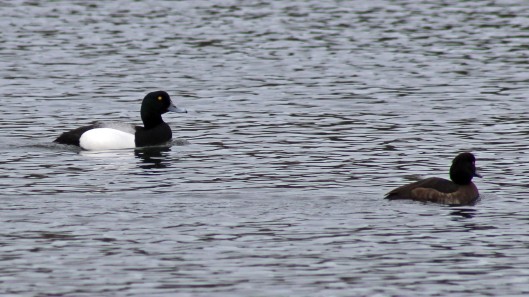
I paused near there, as I always do, to look at the gulls and finally, FINALLY, spotted the drake Scaup that’s been visiting the Cosmeston lakes on and off in recent weeks, this time in company with a female Tufted duck, which could be why some interesting hybrids are occasionally sighted locally.

180329 3 Treecreeper
180329 4 Gadwall & Tufted ducks

I walked up Mile Road and then off the main track to where the bird hide used to be (it was burnt down by vandals last year and has not been rebuilt), and spotted a Treecreeper hopping up a nearby tree, then turned to see a group of five Gadwall on the east lake, much closer in than usual.

180329 5 Great crested grebes

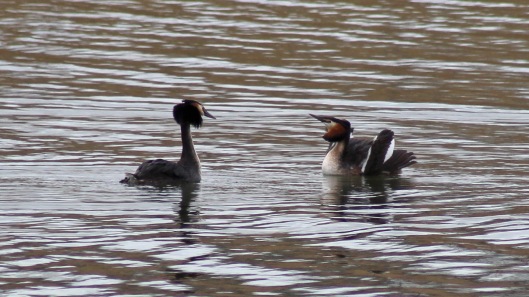
I watched them a while then was charmed to also watch a pair of Great crested grebes displaying – more on those here. I wandered on, up Mile Road to the top end where I head back in to suburbia, and was farewelled by a large flock of perhaps fifty Fieldfare and Redwing that flew up from the area of Old Cogan Farm and landed in the trees above me.

180329 6 Scaup
180329 7 Common frog

16 March  I only walked through Cosmeston as part of a longer walk from Sully to Penarth, so I didn’t linger long but I did manage to get closer views and better photos of the Scaup, as it was sitting right off the boardwalk and ‘swan feeding area’ near the cafe. And I also detoured past the dipping pond to check out the Common frog eruption – see more on the frogs here.

180329 8 Meadow pipits
180329 9 Meadow pipits

19 March  I stomped off to Cossie with snow still on the ground (but steadily melting) after the ‘Mini-beast from the east’, the second instalment of cold weather to blast us this month. The most notable wildlife effect was in the large numbers of Meadow pipits to be seen, sometimes in singles, at one point a flock of at least 20 grazing together.

180329 10 Chiffchaff

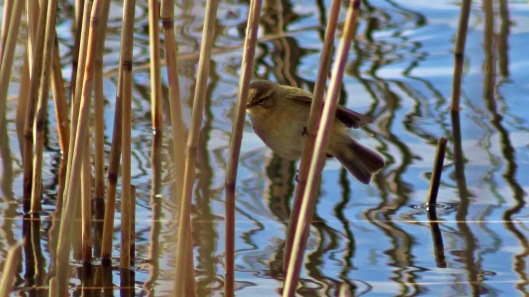
It was also a day of confusing birds: there was a female Blackbird with a pale bib, making me think she might be a Ring ouzel, and two Chiffchaffs pretending to be Reed warblers, presumably because there were more insects to be had close to the water – behaviour also seen at another site in south Wales that day.

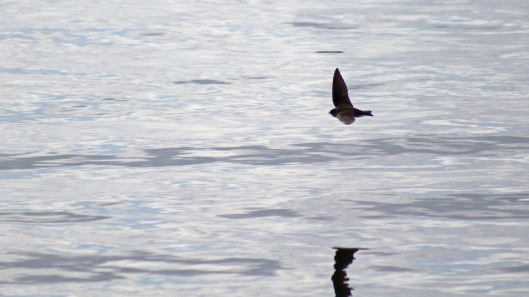
180329 11 Sand martin

And, another sign of spring, I saw my first Sand martins of the year, three of them, hawking back and forth on the east lake.

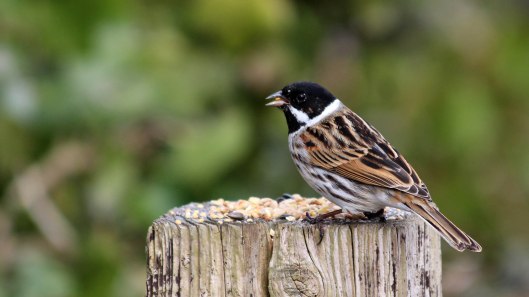
180329 12 Reed bunting

23 March  Once again, this was a walk through rather than around Cosmeston, as I was doing the same walk as a week ago, from Sully back home. As I had recently stocked up on bird seed, I was sprinkling small amounts here and there as I strolled, and was delighted to see three male Reed buntings come down for a snack in one spot – such handsome birds. The other highlight was the Chiffchaffs, at least six crisscrossing the lane between the two lakes, flycatching the multitude of little gnatty things flying about on this sunny day.

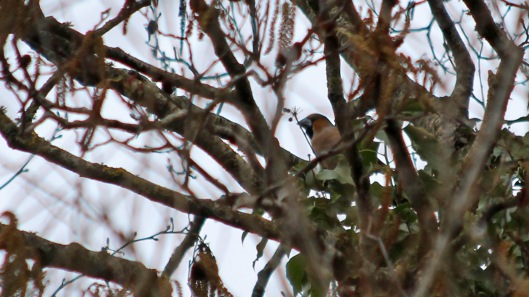
180329 13 hawfinch

29 March  Well, I wasn’t intending to make another visit to Cossie this month but then one of my birding friends spotted a Hawfinch there on the 27th and I couldn’t let that pass without at least having a look for it. (For non-birders, Hawfinches are usually difficult to find, though they have been having a good winter this year.) So, trying, somewhat unsuccessfully, to dodge heavy rain showers, I headed over to Cosmeston early this morning. I knew the approximate location to look but it certainly wasn’t easy spotting anything in the dense trees. Luckily, I had listened to the bird’s call on the RSPB website before I set off and that’s how I found it … by listening very very carefully and then following that sound. The bird was very high in a tree and almost obscured by intervening branches (my photo is a heavy crop) … but I was very chuffed to find it!

Like Loading...

This week in wildflowers

23 Friday Mar 2018

Posted by sconzani in flowers, nature, spring, wildflowers

≈ Leave a comment

Tags

#FloralFriday, British flora, British wildflowers, Colt's-foot, Daisy, dandelion, gorse, Groundsel, Lesser Celandine, Red dead-nettle, Speedwell, Three-cornered garlic, wildflowers

What a week it’s been weather wise! We’ve gone from a generous dumping of snow and temperatures hovering around -5°C last Sunday through occasional rain, sunny periods, UV factors up and down, zephyr winds and mustang gales. Is it spring or isn’t it? Well, I’m seeing increasingly more wildflowers so I guess it must be. Here’s a selection from this week’s wanders.

180323 colt's-foot

Colt’s-foot (Tussilago farfara)

180323 daisy

Daisy (Bellis perennis)

180323 dandelion sp

a type of Dandelion (Taraxacum sp.)

180323 gorse

a type of Gorse (Ulex sp.)

180323 groundsel

Groundsel (Senecio vulgaris)

180323 lesser celandine

Lesser celandine (Ficaria verna)

180323 red dead nettle

Red dead-nettle (Lamium purpureum)

180323 speedwell

a species of Speedwell (probably Germander) (Veronica sp.)

180323 three-cornered leek

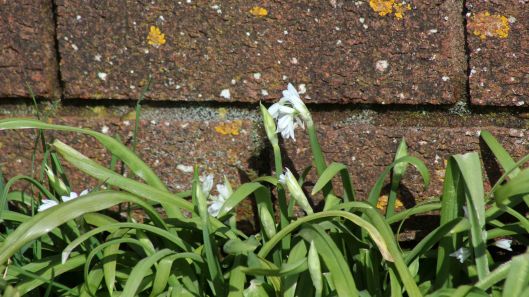
Three-cornered leek (Allium triquetrum)


Like Loading...

Birth notice

17 Saturday Mar 2018

Posted by sconzani in insects, nature, plants, wildflowers

≈ 6 Comments

Tags

Ficaria verna, flies, fly, leaf mines, leaf mining fly, leafminer, Lesser Celandine, Phytomyza ranunculi

I was handing out the cigars last Monday!
Now, you might well think me more than a little mad to be excited about the birth of a fly but this was the first time I had tried rearing one … and it was actually successful, which bodes well for the fact that I’m intending to take part in a fly-rearing investigation this summer (more on that closer to the time).

180317 Phytomyza ranunculi (2)
180317 Phytomyza ranunculi (3)

The fly is Phytomyza ranunculi, a creature whose larvae often make their home in the leaves of Lesser celandine (Ficaria verna). I blogged about this leafminer, its larvae and the pupa here, and it is that pupa which finally hatched earlier this week. I had been told it would take about 3 weeks to hatch but it was, in fact, longer than that – it was 6 February when I found the pupa and 12 March when it hatched, so 34 days in total.

180317 Phytomyza ranunculi (1)

Now, here I must admit to a rookie error. As it was well over the 3 weeks, I had almost given up on its hatching so, on Monday night, when I had a sudden notion to open the container, I didn’t look inside first. The fly popped straight out, perched on the edge for a very brief time – and I managed to get just one photo, and then it flew off. I’ve searched for it in my flat, and it did a quick fly by when I was washing the dishes yesterday, but I haven’t been able to find it, neither to take more photos nor to let it outside.

Like Loading...

Pavement plants

11 Sunday Mar 2018

Posted by sconzani in nature, plants, wildflowers

≈ Leave a comment

Tags

#PavementPlants, #WildflowerHour, British flora, Groundsel, Hairy bittercress, Lesser Celandine, plants in pavement, Shepherd's purse, wild plants, wildflowers

This week’s Wildflower Hour challenge was to check out your local pavement for #PavementPlants. As the challenge says: ‘It is amazing how many plants are able to eke out a living where they were never invited. Growing in seemingly inhospitable cracks and crevices, thriving where there is little soil, these tough little plants are often overlooked.’ So, it was eyes down this week as I wandered around Penarth and, though I decided to look just for plants that were flowering and ignore the ubiquitous grasses and mosses, I did manage to find a few little treasures in my local pavements, steps and paths.

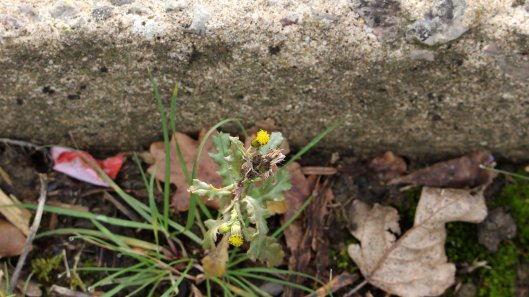
180311 pavement plant groundsel

Groundsel (Senecio vulgaris)
I’m sure most people recognise Groundsel when they see it, as it’s very common in areas of disturbed ground. I just learned today that Senecio comes from the Latin for ‘old man’, a reference to the bare ‘scalp’ that remains once the plant’s fluffy white seeds have blown away.

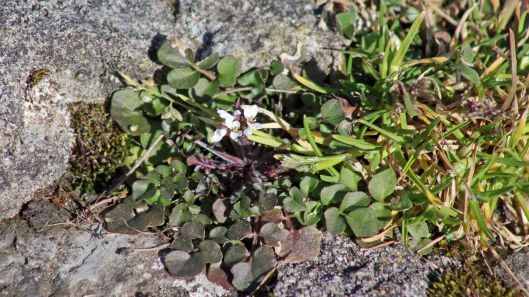
180311 pavement plant hairy bittercress (2)

Hairy bittercress (Cardamine hirsuta)
I was initially confused about which bittercress this was, Hairy or Wavy but my trusty wildflower guide tells me that Hairy has four stamens and Wavy usually has six, so that clinched it. Apparently, this plant is edible, though bitter – hence its name: I think I’ll pass.

180311 pavement plant lesser celandine

Lesser celandine (Ficaria verna)
Once known as Pilewort, as it was believed to be a remedy for haemorrhoids, Lesser celandine contains high levels of vitamin C and was also used to prevent scurvy.

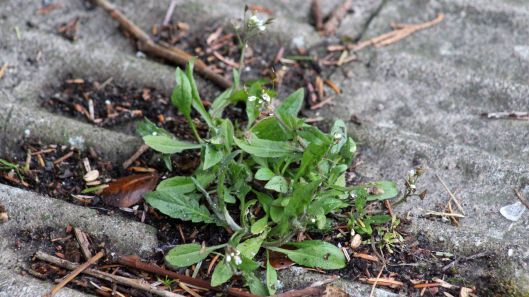
180311 pavement plant Shepherd's purse

Shepherd’s purse (Capsella bursa-pastoris)
This very common wild plant’s common name comes from the purse-like shape of its seed pods.

Like Loading...

2018’s first Colt’s-foot

09 Friday Mar 2018

Posted by sconzani in flowers, nature, spring, wildflowers

≈ 2 Comments

Tags

British wildflowers, Colt's-foot, Coltsfoot, signs of spring, spring flowers, Tussilago farfara

Monday’s walk took me around Grangemoor Park, looking to see what effects last week’s snow storm had had. Luckily, the park and its wildlife appear to have come through fairly well – no trees down, no signs of dead creatures (though they could have been hidden), and plenty of bird sounds all around. And then, the best thing, in a location where I had seen many last year, almost hidden under twigs, my very first Colt’s-foot flower of 2018. Spring really is on its way!

180309 Colt's-foot

Like Loading...

The bumbles are back!

24 Saturday Feb 2018

Posted by sconzani in flowers, insects, nature, spring, wildflowers

≈ Leave a comment

Tags

bumblebee, crocus, spring flowers, Spring has sprung

180224 bumblebee

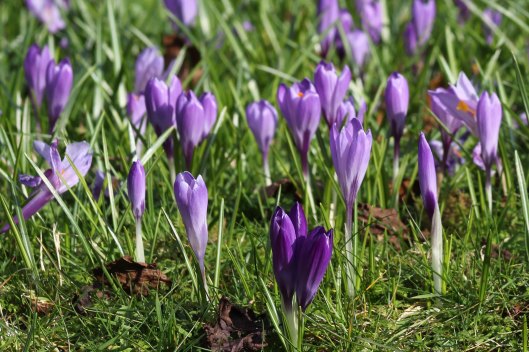
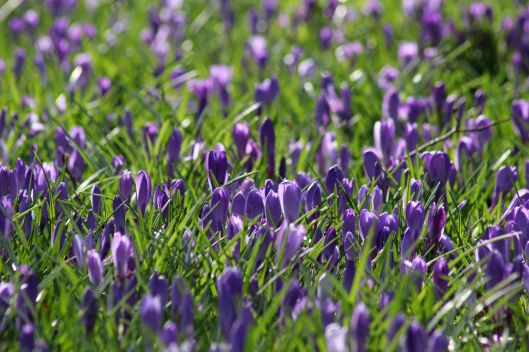
Following on from yesterday’s gorgeous crocuses for Floral Friday, here’s a little something I found bumbling about in those flowers …

180224 bumblebee (1)
180224 bumblebee (2)
180224 bumblebee (3)
180224 bumblebee (4)
180224 bumblebee (5)
180224 bumblebee (6)
Like Loading...

Fair-handed Spring

23 Friday Feb 2018

Posted by sconzani in flowers, nature, plants, spring, wildflowers

≈ Leave a comment

Tags

Cathays Cemetery, crocus, spring flowers

180223 crocuses (4)

Along these blushing borders bright with dew,
And in yon mingled wilderness of flowers,
Fair-handed Spring unbosoms every grace –
Throws out the snowdrop and the crocus first
~ James Thomson, ‘Spring’, The Seasons
180223 crocuses (2)180223 crocuses (3)180223 crocuses (5)180223 crocuses (1)

Like Loading...

Spring messenger

16 Friday Feb 2018

Posted by sconzani in flowers, nature, spring, wildflowers

≈ Leave a comment

Tags

#FloralFriday, British wildflowers, Ficaria verna, Lesser Celandine, Ranunculus ficaria, signs of spring

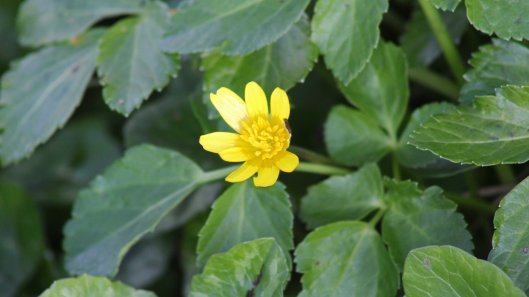
180216 Lesser celandine (1)

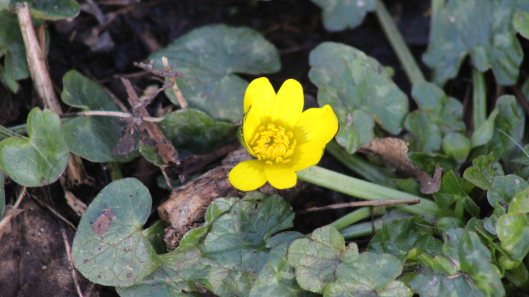
Not only was it the favourite flower of William Wordsworth (who wrote three poems about it) and considered to be a herbal remedy for haemorrhoids (due to the shape of its roots), but the pretty Lesser celandine (was Ranunculus ficaria, now Ficaria verna) is one of the first floral heralds of spring.

180216 Lesser celandine (2)
180216 Lesser celandine (3)

The flowers are supposed to appear around the same time that the Swallows arrive back in Britain (hence the name Celandine, which comes from the Greek chelidon, meaning Swallow) (flower and bird are out of sync this year, though) so we need to keep our eyes on the skies, as well as on the ground.

180216 Lesser celandine (4)

Like Loading...
← Older posts
Newer posts →

About me

sconzani

sconzani

I'm a writer and photographer; researcher and blogger; birder and nature lover; countryside rambler and city strider; volunteer and biodiversity recorder.

View Full Profile →

Follow earthstar on WordPress.com

Enter your email address to follow this blog and receive notifications of new posts by email.

Recent blog posts

  • Black-tailed godwits fighting March 25, 2026
  • Singing from every tree top March 24, 2026
  • Turtle bug March 23, 2026
  • Springtime invasives March 22, 2026
  • Singing Dunnocks March 21, 2026

From the archives

COPYRIGHT

Unless otherwise acknowledged, the text and photographs on this blog are my own and are subject to international copyright. Nothing may be downloaded or copied without my permission.

Fellow Earth Stars!

  • Unknown's avatar
  • Unknown's avatar
  • Unknown's avatar
  • Unknown's avatar
  • Unknown's avatar
  • Unknown's avatar
  • Unknown's avatar
  • Unknown's avatar
  • Unknown's avatar
  • Unknown's avatar
  • Unknown's avatar
  • Unknown's avatar
  • Unknown's avatar
  • Unknown's avatar
  • Unknown's avatar
  • Unknown's avatar
  • Unknown's avatar
  • Unknown's avatar
  • Unknown's avatar
  • Unknown's avatar
  • Unknown's avatar
  • Unknown's avatar
  • Unknown's avatar
  • Unknown's avatar
  • Unknown's avatar
  • Unknown's avatar
  • Unknown's avatar
  • Unknown's avatar
  • Unknown's avatar
  • Unknown's avatar
  • Unknown's avatar
  • Unknown's avatar
  • Unknown's avatar
  • Unknown's avatar
  • Unknown's avatar
  • Unknown's avatar
  • Unknown's avatar
  • Unknown's avatar
  • Unknown's avatar
  • Unknown's avatar
  • Unknown's avatar
  • Unknown's avatar
  • Unknown's avatar
  • Unknown's avatar
  • Unknown's avatar
  • Unknown's avatar
  • Unknown's avatar
  • Unknown's avatar
  • Unknown's avatar
  • Unknown's avatar

Blog at WordPress.com.

Privacy & Cookies: This site uses cookies. By continuing to use this website, you agree to their use.
To find out more, including how to control cookies, see here: Cookie Policy
  • Subscribe Subscribed
    • earthstar
    • Join 642 other subscribers
    • Already have a WordPress.com account? Log in now.
    • earthstar
    • Subscribe Subscribed
    • Sign up
    • Log in
    • Report this content
    • View site in Reader
    • Manage subscriptions
    • Collapse this bar
 

Loading Comments...
 

You must be logged in to post a comment.

    %d