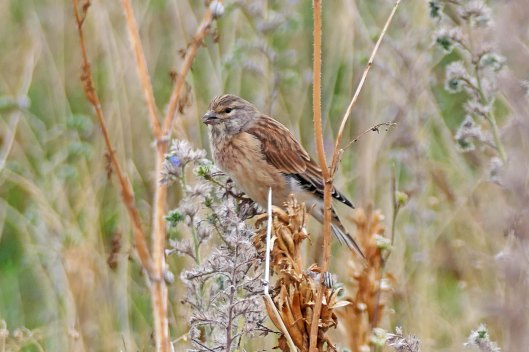
Three weeks ago, we enjoyed Linnets bathing. Today, we have one of a small flock stripping seeds from wildflowers, munching happily with its efficiently designed, seed-cracking beak.

26 Monday Sep 2022
Three weeks ago, we enjoyed Linnets bathing. Today, we have one of a small flock stripping seeds from wildflowers, munching happily with its efficiently designed, seed-cracking beak.
25 Sunday Sep 2022
Posted in autumn, flowers, walks, wildflowers
A railway line used to run along the south Wales coast from my town to the next large town but it fell victim, like so many other railway lines, to the Beeching cuts of the 1960s (the last passenger train ran on 4 May 1968). Part of that old line is now a well-used walking and cycle path, the rest runs through land that is both in private hands and owned by the Welsh government. When Covid first told hold and our county council stupidly closed the local country park (where people could exercise with space in safety), many locals began using the government land or either side of the old rail line. Though there are government plans afoot to turn this land into a cheap, nasty and overcrowded housing estate, in the interim local people continue to use the area for walking, both themselves and their dogs, which means it’s now also possible to access the old rail trail. Today’s little video shows the trail and the wildflowers that were still in bloom along it during a walk I took earlier this week.
24 Saturday Sep 2022
Posted in birds
Tags
bird conservation, birding, British birds, Into the Red, red-listed birds, supporting Britain's red-listed birds
I’m finally able to share some exciting news with you all. Back in June I was utterly astonished and hugely delighted to be invited by the British Trust for Ornithology (BTO) to contribute to their forthcoming publication Into the Red, ‘a collection of words and art inspired by Britain’s most vulnerable birds’. The book focuses on Britain’s red-listed birds, each one the subject of an original artwork and a piece of writing, prose or poetry, by 70 artists and 70 writers, some well-known, some not (like me). Profits from the sale of the book will be used to help these birds, to support the work being done to conserve and restore ailing bird populations.

The official publication date is 4 October but you can see examples of the book’s interior pages right now, and pre-order your copies, by clicking on this link to the BTO website. I know times are tough for many people at the moment but, if you can, I urge you to buy the book so that, together, we can try to bring these vulnerable birds back from the edge of extinction. My sincere thanks!
23 Friday Sep 2022
Posted in autumn, flowers, wildflowers
Happy equinox! Today is the first day of astronomical autumn in the northern hemisphere, and what better way to celebrate than with some autumnal blooms, in this case some Wild cyclamen (Cyclamen hederifolium) flowers I spotted growing in a nearby green space earlier this week.

22 Thursday Sep 2022
Posted in birds
As well as the Ringed plovers I blogged about yesterday, my walk along Sully beach produced over 30 Turnstones, my favourite beach birds, pottering along, poking under stones, pulling at piles of seaweed in their never-ending search for tasty invertebrates.

21 Wednesday Sep 2022
Posted in birds
Tags
beach birding, birding, birdwatching, British birds, Charadrius hiaticula, Ringed plover, Sully birds
Ringed plovers are not common on my local patch. In fact, the only place I see them is amongst the rocks on Sully beach, and that’s exactly where these 15 were perched, snoozing, preening, balancing on one spindly looking leg, when I walked along the beach last week.

Though their scientific name, Charadrius hiaticula, is a bit of a tongue-twister, they have, according to my Fauna Britannica, some wonderful vernacular names: bull’s-eye (Ireland); dulwilly and grundling (Lancashire); ringlestone (Yorkshire); sand tripper (County Down); shell-turner (Sussex); and wideawake (Somerset), to list just a few.

20 Tuesday Sep 2022
Tags
Barred Sycamore pigmy moth larval mines, British leafmines, leafmines on Sycamore, leafmining moth larvae, Stigmella speciosa, Sycamore leafminer
While searching out Sycamore tarspot fungi on local Sycamore trees, I’ve also been keeping a look out for leafmines, specifically for the mines of the Barred Sycamore Pigmy moth, Stigmella speciosa. (You can see the very attractive adult moth on the UK Moths website by clicking here.)

Although I’ve found the tarspot fungi, in varying quantities, on almost every Sycamore tree I’ve seen, the leafmines, though supposedly common, are not so easily spotted. Despite checking over a hundred Sycamore trees now, I’ve only found Stigmella speciosa mines in one location, where there were just three mines within the limits of my visibility. Perhaps more will turn up as I continue my search for Sycamore tarspot.

19 Monday Sep 2022
Posted in birds
Today was a very good day to sit quietly in a peaceful spot. And I was blessed with the company of this little Robin that came and spent some time with me. As we silently communed, overhead the air was alive with hundreds, perhaps thousands of Swallows and the occasional House martin, all feeding up before their miraculous migration.

18 Sunday Sep 2022
Posted in autumn, wildflowers
At this time of year, when there are few wildflowers in bloom, the presence of Rough sow-thistle, with its glowing yellow flowers and fluffy white seedheads, is a lifesaver for thirsty bees and butterflies, and a boon for finches wanting to nibble at its seeds. And, for me, it provides yet another example of the sculptural beauty of the seedheads of plants.

17 Saturday Sep 2022
Posted in birds
Usually Collared doves are easily spooked so, when I rounded the bend in a local footpath that winds between houses and saw these two on the ground in front of me, I expected them to fly off immediately. But no! Someone had sprinkled seed alongside the path and they wanted it. There was no way they were leaving until they’d consumed every tasty niblet. So, I waited, and used the opportunity to get several close photos of these grey beauties.

 earthstar
You must be logged in to post a comment.