
The days of the Wheatears

Tags

, , , , ,

I’ve been trying to work out what the optimum conditions are for bird migration, and it seems to be a combination of a clear night followed by a sunny day, with just the right amount of wind – at least, that seems to be what Wheatears like as, both on Wednesday and today, they have been moving through in reasonable numbers, with some stopping off locally en route to their southern over-wintering grounds. These are a few I’ve been privileged to spot in recent days …
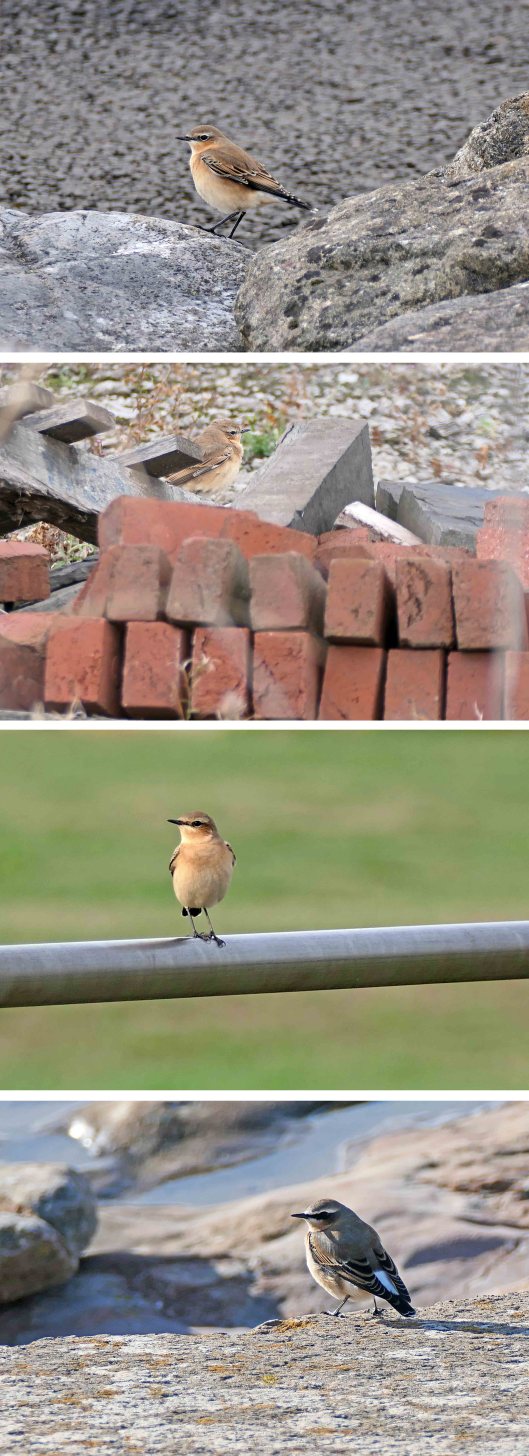
220916 wheatear

A surprise Holly blue

Tags

, , ,

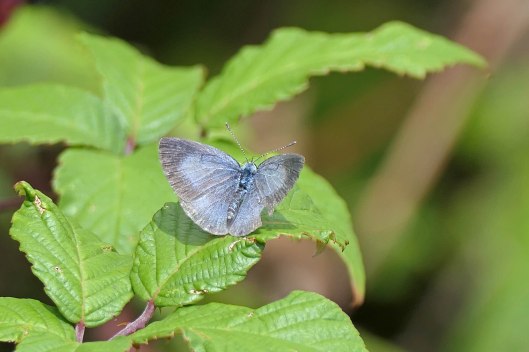
Well, this was a surprise sighting during today’s walk! Holly blue butterflies have two broods each year (very occasionally three in the right conditions) but even with a second brood, the adults have usually disappeared by the beginning of September. This female did look quite faded and a bit bird-pecked but she was still flying strongly. Butterflies continuously amaze me!

220915 holly blue

A Buzzard worming

Tags

, , , , ,

220914 buzzardWhen I first saw a Buzzard on the ground like this but couldn’t see any sign of it having caught any prey, I wondered if it might be ill. My fellow birders quickly put me right – the Buzzard was probably worming. I never thought a bird of prey would eat something so tiny as an earthworm but needs must when prey is hard to find, or catch. And, indeed, I could see that the end of this bird’s beak was a bit grubby with soil. It was fascinating to watch, especially as the Magpies sneakily tried to pinch what the Buzzard was finding.

Pearly underwing

Tags

, , ,

I start to put on my jacket before heading out on my daily walk when something flutters on the sleeve. It’s a moth, this moth, and I have no idea how it got there. Did it land on me during yesterday’s walk and spend the night on the jacket that I’d just flung over the back of a chair? Or did it creep in through the gap in a barely open window during the night?

220913 pearly underwing

A moth expert on Twitter tells me it’s a Pearly underwing (Peridroma saucia), a moth that doesn’t breed in Britain but migrates here from Europe, most often during September and October. No wonder it’s looking a little faded after such a long flight. I keep it inside during the day and release it after dark, hoping that will help it avoid any hungry birds.

A Kingfisher treat

Tags

, , , ,

As well as the phenomenal Black terns I shared on Saturday, my visit to Parc Tredelerch produced another avian treat, this Kingfisher, at first perching on the edge of the boardwalk, then, later, appearing right in front of us as we searched the skies for the terns. Most of my recent views of Kingfishers have been of a fleeting flash of teal streaking rapidly past, so it was especially nice to have this one sit a short while quite close by.

220912 kingfisher

Seedheads: Ragwort

Tags

, , , , ,

Over the summer, one of the local fields I regularly walk around was a sea of yellow, chock full of tall flowering Ragwort plants.

220911 ragwort

Now that it’s autumn, the landscape has changed to a rich brown, dotted with tiny spots of white, the fluffy Ragwort seeds. It would be easy to overlook this brown field but, when you look closely, the seedheads are quite lovely.

220911 ragwort seedheads

Phenomenal fliers

Tags

, , , ,

Phenomenal fliers effortlessly performing awesome aerobatics…. It’s easy to get carried away and, at the same time, difficult to describe adequately in words the flying skills of members of the Tern family. It also proved extremely difficult, even with my new camera, to get good photographs as they swooped and swerved, dipped and dived, feeding on tiny insects both on and above the water.

These are juvenile Black terns (Childonias niger), rare visitors to south Wales, so it’s been a treat for many birders this week to have seen first one, then yesterday a second bird, feeding over the lake in Cardiff’s Parc Tredelerch. I spent several magical hours with a friend at the lake yesterday, watching and marvelling at these thrilling fliers.

Sycamore tarspot

Tags

, , , ,

As the South East Wales Biodiversity Records Centre has only 400 records of the very easily identifiable Sycamore tarspot (Rhytisma acerinum) in its database, SEWBReC staff have chosen this fungus to be the September species of the month to inspire as many people as possible to find and record this fungus. Using the Welsh records database Aderyn, it’s possible to see where people have recorded Sycamore tarspot and, more importantly for this exercise, where they haven’t. I know this fungus is very common in my local area, yet there are few records.

So, I’m making it my mission during my walks this month to find and record Sycamore tarspot in as many 1-km squares as possible. I got off to a good start on Wednesday, with records logged in four new squares. It will be interesting to see how many more I can get, and to see how many records other people manage to find over the next few weeks. I’m picking the map will change dramatically by 30 September.

220909 sycamore tarspot

Whinchats in a row

Tags

, , , , ,

Thanks to my fellow local birders who found first one (first sighting to Graham), then two (Mat spotted the second), and then a third (Ian got all three, and was trying very hard to turn a Reed bunting into a fourth), I managed to get all my Whinchats in a row during Sunday morning’s walk.

220907 whinchat (1)

These weren’t my first Whinchats of the autumn – they were the sixth, seventh and eighth, but this might well be the first time I’ve seen three together. And every single one is a little gem!

220907 whinchat (2)