Bud burst
28 Sunday Mar 2021
28 Sunday Mar 2021
27 Saturday Mar 2021
Posted in amphibian
Tags
Back in January I blogged about the gruesome sight that awaited me on exiting my flat one day: a frozen Toad (A gruesome sight, January 2021). Fortunately, my most recent sighting of a Toad was much more pleasant, for me and the Toad. I started to roll over a rotting log, thinking I might find some beetles, when I spotted a pair of warty legs poking out. I managed to get a few photos before the little creature realised I had removed its covering and began to move. I quickly, and carefully, put the log back – the beetles would have to wait for another day, though it occurs to me that the Toad might well have eaten them.

26 Friday Mar 2021
Tags
British fungi, British insects, Daldinia concentrica, King Alfred's Cakes, springtail, woodlouse
King Alfred’s been back in the kitchen but a Great British Bake Off winner he is not. His cakes, otherwise known as Daldinia concentrica, even when you can peek inside their blackened exteriors, never look palatable. With these I found in the woods this week though, Alfred has certainly produced some creative shapes.
And, even if inedible, they are sturdy enough to provide a home to tiny creatures, in this case a woodlouse and a springtail.
25 Thursday Mar 2021
Posted in birds
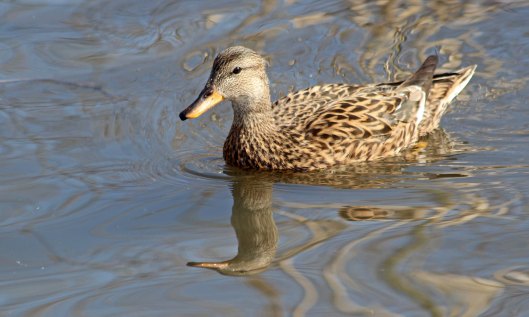
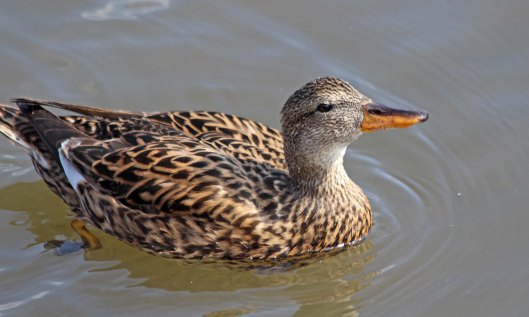
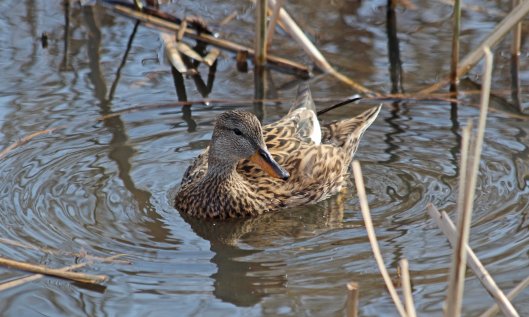
As well as the Wheatear I wrote about yesterday, Monday’s walk around Cardiff Bay also turned up another treat, this time at the wetlands reserve.

Gadwall can be quite shy birds, and I’ve certainly never seen one as close as this beautiful female, who was mixing quite happily with the Mallards by the boardwalk. Apparently, she had even been coming to feed on the bread some people had thrown in the water.

Several other people were on the boardwalk, waiting in anticipation of seeing one of the Water rails that have been quite showy in recent days, but ignoring this stunning duck right under their noses.

Not me – I took a ton of photos of her, many of which turned out a bit blurry because she was almost too close for my long lens. And that’s not something that happens very often in the world of bird photography!

24 Wednesday Mar 2021
Tags
bird migration, birding, birdwatching, British birds, Cardiff Bay birding, spring migration, Wheatear
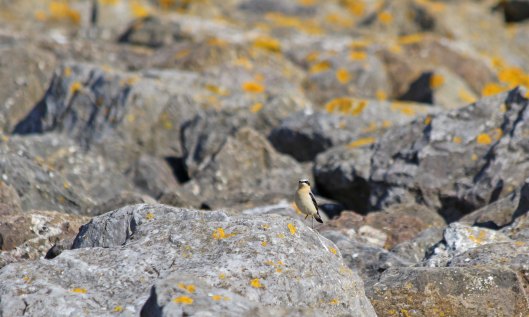
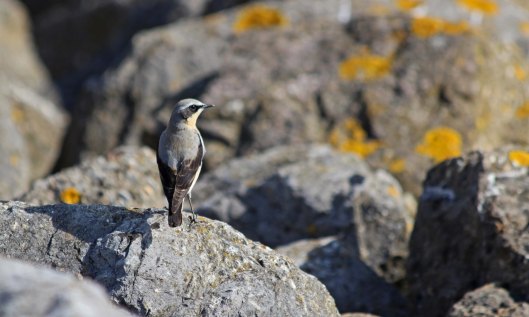
Monday was warm and sunny, at last – sunny days have been few and far between so far this month – so I decided to walk a circuit of Cardiff Bay, hoping this might be the day I would see my first Wheatear of the year.

I was already on the Barrage, bins out and scanning, when I got a message from a fellow birder that a Wheatear had just been reported. As I checked further along the Barrage, I could see someone, off their bike, camera with long lens in hand – that had to be where it was.

It only took a few minutes to reach Tate, one of our star local birders, whose keen eyes had found this stunning male Wheatear. We’re lucky that these birds sometimes stop off for an insect break on the Barrage rocks before continuing their migration flight to their breeding grounds further north. Such a treat to see!

23 Tuesday Mar 2021
Posted in birds
The British Trust for Ornithology describes it as a ‘nasal “dzwee”’; my description would be something like: stuttered twittering interspersed with long nasal wheezing. It’s an odd sound to make to attract a member of the opposite sex but it seems to work perfectly for the male Greenfinch. So, if you’re out walking and happen to hear a loud nasal wheezing from above, do look up. The Greenfinch is such a fabulous-looking bird and it has suffered a dramatic national decline in population since about 2005, so don’t miss any opportunity to see one.

22 Monday Mar 2021
At this time of year the ornamental cherry tree outside my flat is awash with blossom, of a warm white shade flushed with the merest tinge of pink.

It looks glorious, especially on sunny days, and, at a time when there are few flowers in bloom, it’s a magnet for newly emerging, hungry insects of the flying kind.

Yesterday, as well as a few Honey bees, I spotted half a dozen, all Buff-tailed, bumblebees doddering from one flower to the next, before lurching haphazardly to the next branch, dislodging the delicate petals as they passed.

21 Sunday Mar 2021
Posted in flowers, spring, wildflowers
Tags
British wildflowers, Common dog-violet, dog violets, Early dog-violet, Spring colour, Sweet violet, Viola odorata, Viola odorata var. dumetorum, Viola reichenbachiana, Viola riviniana, violets, white Sweet violet
The wildflower hour challenge this week was to ‘find a violet in bloom and work out which one it is’. Now, you might think that’s an easy task but, once you learn – as I did – that there are five subspecies of Sweet violet alone, you could easily decide – as I almost did – that this was a challenge too far. But I persevered, and found three different species (and two subspecies of one).
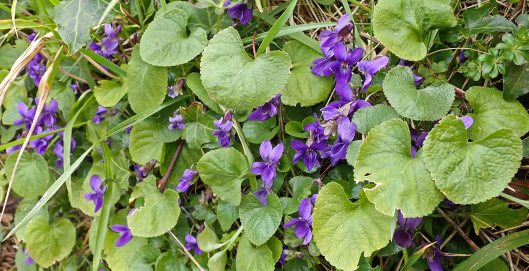
Let’s start with Sweet violet, and the two subspecies I Iocated, the standard purple violet with the glorious scent, Viola odorata var. odorata, and one of the two white subspecies, Viola odorata var. dumetorum. As well as its glorious smell, the Sweet violet can most easily be identified by the rounded sepals that lay flat against the flower (if the sepals were angled back towards the stem, you’d have a Hairy violet – I didn’t find any of those this week). And I’ve not yet seen the second variation of the white violet, Viola odorata var. imberbis (which doesn’t have a ‘beard’, the hairs inside the flower).

I managed to find both the dog-violets (the word ‘dog’ in this case indicating there is no scent; nothing to do with the domestic pet!). These are Common dog-violet (Viola riviniana) (photos on the left below) and Early dog-violet (Viola reichenbachiana) (photos on the right). These two can be difficult to tell apart sometimes but, though both dog-violets have pointy sepals, the Common dog’s sepals are usually bigger, with tops (the sepal appendages) that are more square, and often notched or scalloped. Also, the spurs at the back of the flowers are mostly stouter and notched at the end on the Common dog, and the veins inside its flowers are longer and multi-branching.
You can find Wildflower hour on Twitter by clicking this link, and their website is here. They’re probably on Facebook too but I no longer use FB. If you’re on Twitter, there are many excellent botanists’ accounts to follow but one I definitely recommend is Moira O’Donnell (@nervousbotanist), who often shares easy-to-follow species crib sheets, one of which I have drawn on for this post.

20 Saturday Mar 2021
Posted in birds
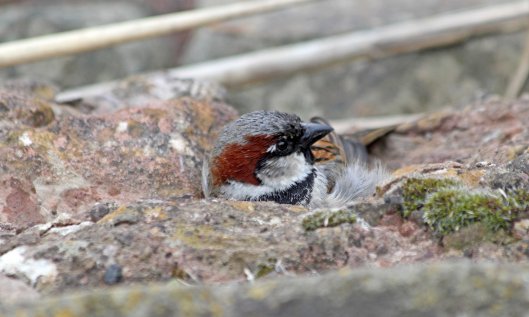
For today’s celebration of the humble little House sparrow, I’m sharing a wonderful snippet of information tweeted this morning by the Welsh Ornithological Society:
‘We’re proud to say that Wales holds the longevity record for #HouseSparrow at 12 years and 12 days with a bird which was ringed in #Torfaen in 1966 and which was found dead in . . . Torfaen in 1978. A well-travelled individual!’


19 Friday Mar 2021
Posted in insects
First, I read that there are around 4000 species of beetle in Britain. But I remained optimistic and figured I might be able to narrow it down by location – it was bumbling along on the ground, so perhaps it was a ground beetle (the Carabidae). Next, I read that there are 374 species of ground beetle. But I continued to be optimistic and thought I might be able to narrow it down by shape or colour. Then, I looked through the gallery of photos on the Coleoptera website and also on the Nature Spot website, and realised that these creatures are a whole lot more difficult to identify than I first thought. So, here’s a beetle, a rather gorgeous beetle with a metallic green sheen, but a beetle none-the-less.

You must be logged in to post a comment.