Red spots

Tags

, , , ,

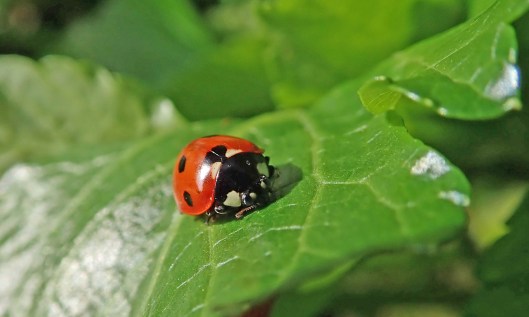
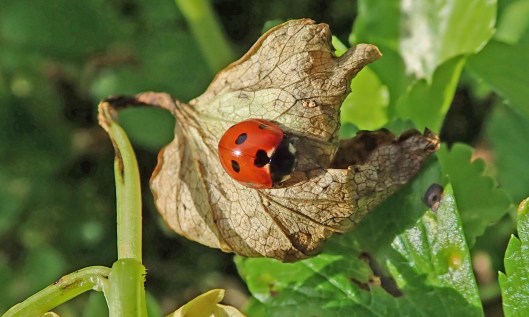
A tiny spot of red caught my eye, and then, close by, another – my first ladybirds of the year, both Seven-spot ladybirds (Coccinella septempunctata).

210318 ladybird (1)

If you’re lucky, you may have had these little beauties hibernating in your garden shed but, in this case, these two are countryside dwellers so have probably spent the winter inside a plant stem, or perhaps tucked securely within the dense branches of ivy, or maybe in a deep crack in tree bark. A few sunny days and warmer overnight temperatures will have triggered their emergence from hibernation, and produced another spring treat for me to enjoy!

210318 ladybird (2)

A five-Brimstone day!

Tags

, , , ,

Though yesterday’s weren’t my first butterfly sightings of the year (I’ve seen two different species fly rapidly past in recent weeks but haven’t managed photos), they were simply splendid. A walk around Cardiff’s Grangemoor Park produced five (!) Brimstones and, though most were patrolling their chosen territories at speed, I waited patiently for one to stop for a rest and managed to get close enough to get some good images. I can’t tell you how truly wonderful it feels to be sharing my air space with butterflies again. They are such magical creatures!

210317 brimstone

Mother to be

Tags

, , , , , , ,

I was enchanted, during this morning’s local meander, to spot a pair of Long-tailed tits nest building – it seemed so appropriate for Mother’s Day, though in this case it may be a few weeks before the female bird becomes a mum.

210314 long-tailed tit

The nest was almost totally hidden inside a tangle of bramble branches and, once the bramble leaves grow, will be completely obscured.

210314 long-tailed tit nest (1)

And the nest itself was only about one third built, so I’ve included, below right, a photo of a Long-tailed tit nest that I was shown a couple of years ago, after its occupants had fledged and the bush containing the nest had been chopped down. Of course, I’ll be heading back to this location to follow progress from a suitable distance.

Phellinus pomaceus

Tags

, , , , ,

Though I haven’t been able to verify its identification, I’m fairly sure today’s fungus is Phellinus pomaceus.

210312 Phellinus pomaceus (1)

It’s a hard, woody bracket fungus that grows on Prunus tree species – in this case, it’s growing on Blackthorn (Prunus spinosa).

The NBN (National Biodiversity Network Trust) Atlas entry for this species (which also includes a map showing where in Britain the fungus has been recorded) says ‘It is not aggressively pathogenic but can cause considerable decay in trees suffering from other stress factors’, so you wouldn’t want to find it in a commercial fruit orchard. In my case, the fungi were only showing on two adjacent trees in a large copse of Blackthorn, and the trees looked quite elderly, so I don’t think it’s causing a problem.

Landscape

Tags

, , , , ,

I don’t often take landscape photos these days but the combination of sunny spring weather, fabulous trees, and what looked to my inexpert eye as good land management, plus the colours and leading lines, prompted me to start clicking during a recent walk.

210311 landscapes (1)

This piece of countryside, about an hour’s walk from home, is a combination of farm and woodland. Perhaps a hedgerow would be better than a fence alongside this field (happily, there are a lot of hedgerows in this area) but at least there’s a wide area of ‘set aside’ where, hopefully, wildflowers will be allowed to grow. And there are some magnificent towering old trees in the surrounding landscape, to which my photos really do not do justice.

210311 landscapes (2)

A rare sighting

Tags

, , , , , ,

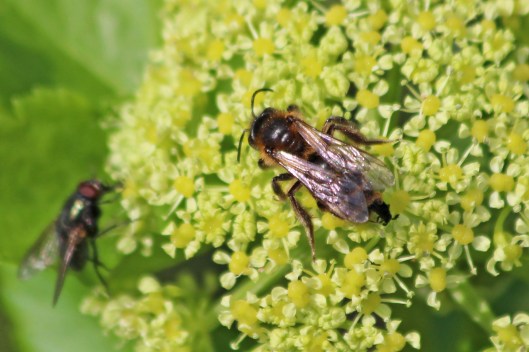
These photos had the entomologists on Twitter getting excited when I first posted them Monday evening. Though I didn’t realise it at the time, what I was seeing was a parasite emerging from the back of the bee’s body. The parasite is a Stylops, a species that has a rather gruesome but incredibly fascinating lifestyle.
210310 bee parasite (1)

The female Stylops lives permanently in the body of its host, often, as here, one of the Andrena species of bee. Her head and thorax poke out of the bee’s abdomen so she can release male-attracting pheromones and mate. I managed to photograph these and blogged about them in April 2020 (Wild word: stylopised). When the resulting larvae emerge, they pop out onto flowers the bee is feeding on, so they can then hitch a ride with another bee, burrow into it, and start the process all over again.

210310 bee parasite (2)

Some of the Stylops larvae are male, with wings. They do not have mouth parts for feeding as their only purpose is to find a female and mate. It is one of those emerging winged males that can be seen in my photos and, apparently, this process is rarely seen. Unfortunately, someone came walking along the path where I was watching this bee and I had to move to one side to allow them to pass at a safe distance. When I looked back, the bee had disappeared.

If you want to read more about the Stylops, there’s an interesting article on the Royal Entomological Society website – the male Stylops has the distinction of appearing as the emblem on the society’s official seal and logo.

When Coots attack

Tags

, , , , , ,

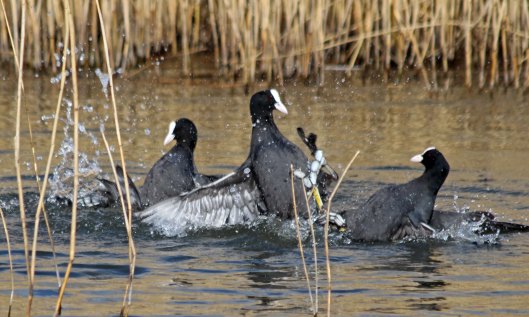
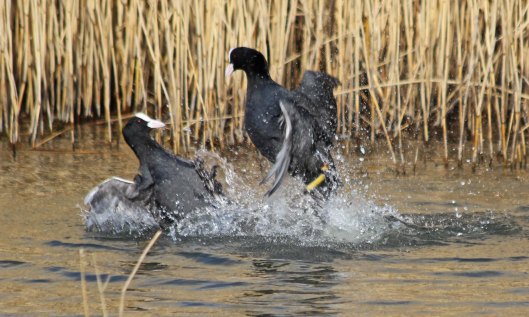
Coots don’t do mediation. If a pair likes the look of or has already staked a claim to a particular nesting place, then they’ll fight to retain / defend that position.

210309 fighting coots (1)

Today I watched these two pairs battling over the pond in Cardiff Bay Wetland Reserve.

210309 fighting coots (2)

It’s actually quite a large pond, which should be big enough for both pairs, but these Coots obviously thought otherwise.

210309 fighting coots (3)

And they certainly don’t pull any punches!

210309 fighting coots (4)