360/365 Christmas birding

Tags

, , , , , , , , , , , ,

Normal weather service (i.e. wind and rain) has resumed here today but yesterday, Christmas Day, was glorious – blue skies, cold but no wind, so I took myself on a 6-hour 8½-mile walk right around Cardiff Bay. I saw 44 species of bird (and dished out some Christmas seed to a few), and had some nice chats to random strangers. The birding highlights included …

Grey wagtails and my favourite little Turnstones on the Ely embankment

191226 3 linnets

Seven Linnets in a tree

A Moorhen and a Little grebe at Cardiff Bay Wetlands Reserve

191226 6 great spotted woodpecker

The day’s surprise, a Great spotted woodpecker in trees, also at the wetlands reserve

Two Cetti’s warblers seen (and more heard), plus a lovely male Stonechat
191226 9 common gull

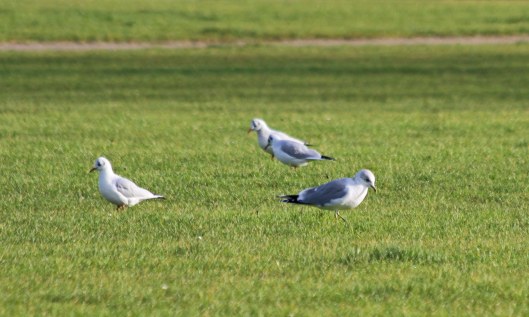
A Common gull puddling for worms with the Black-headed gulls in Hamadryad Park

359/366 A Christmas special

Tags

, , , , ,

It’s a little known fact that feral pigeons bathe just once a year. On Christmas Day, they gather together at well-known bathing spots for a giant mid-winter splash. One of the most popular locations in Wales is Cardiff Bay and I was lucky enough to witness today’s big event.

The birds take it in turns to bathe from the rocks, then line up on adjacent railings to dry off and preen.

191225 pigeons (3)

For some birds the cleansing process is so dramatic that they even change colour from grey to white!

191225 pigeons (4)

357/365 Immature BHG

Tags

, , , ,

I have nothing exciting to share today despite a long walk around Cardiff Bay, as there was a strong, bitterly cold wind blowing and most of the birds were hunkering down. Luckily, this immature Black-headed gull kindly posed for me and, as I feel I often take these lovely gulls for granted, I decided to make it my choice for today’s post.

191223 black-headed gull


356/365 Winter solstice wildflowers

Tags

, , , , ,

It may be the shortest day of the year but I’ve found more blooming wildflowers this week than in the previous weeks of wildflowerhour’s winter 10 challenge. Here we have: a Buttercup species; Daisy; one of the many Dandelion species; Hemlock water dropwort; still quite a bit of Herb Robert about; Ivy-leaved toadflax is flourishing in the wet weather; a Knapweed; a lovely surprise, a couple of plants of Musk mallow; Oxeye daisy; plenty of Petty spurge; surprisingly, a few Primroses already in flower (though most partly eaten); Common ragwort; Red clover; quite a lot of Red valerian; what I assume is Sea radish; plenty of Shepherd’s purses; one of the Sowthistles; Violets – sweet, I think; a Thistle species; White clover; an umbellifer which I think is Wild carrot; quite a lot of Winter heliotrope in flower now; Yarrow; and, a bright burst of Yellow corydalis.

354/365 Bring on the breeding season!

Tags

, , , ,

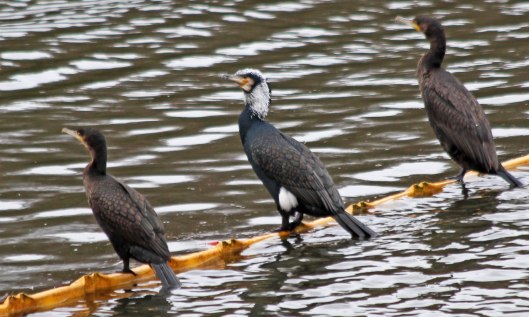
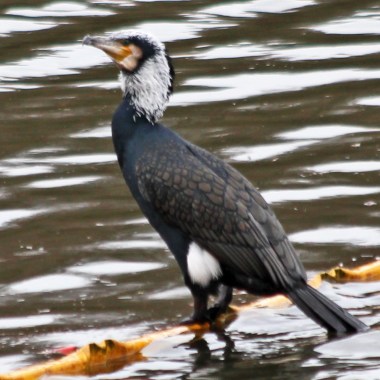
It’s not yet mid winter, not even the shortest day, and we’ve many long cold nights to endure before the first snowdrops of Spring start flowering, but this Cormorant doesn’t seem to know that.

191220 cormorant (1)

Though their breeding season can vary from year to year, it usually runs from March through to September, but this Cormorant doesn’t seem to know that either.

191220 cormorant (2)

191220 cormorant (3)


Here it is, with its impressive shaggy white mane and fluffs of white feathers on its flanks, in full breeding plumage, sitting on the River Ely in south Wales, in mid December, ready for the breeding season to begin, waiting, waiting….

353/365 Oak curtain crust

Tags

, , , ,

‘Nearly always associated with dead oak trees, this easily-overlooked crust fungus varies considerably in its appearance, sometimes mainly resupinate beneath fallen logs but usually in bracket form when on dead stumps,’ writes Pat O’Reilly on his First Nature website. The specimens of Oak curtain crust fungi I found yesterday, in Cardiff’s Grangemoor Park, were definitely growing on oak but, in this case, they were on thick, solid oak logs that have been used to construct benches and signposts.

191219 Oak Curtain Crust (2)

I always enjoy reading the etymology entries on O’Reilly’s website. Oak curtain crust’s binomial name is Hymenochaete rubiginosa, which is explained as follows:

Hymenochaete, the genus name, comes from hymen – a prefix referring to the fertile membrane (the crust surface), and -chaete perhaps from the Greek noun chaite meaning long hair and perhaps referring to the fine hairs (settae) on the upper surfaces of fungi in this generic group.
The specific epithet rubiginosa means rusty and refers to the reddish-brown colour of the hymenial (fertile) surface of this crust fungus.

191219 Oak Curtain Crust (1)

352/365 Black redstart

Tags

, , , , , ,

What a smashing day I’ve had! I went for a long walk around the outside of Grangemoor Park – it was too squidgy underfoot to walk up the hill (and found some nice blooms for this week’s wildflowerhour), then walked home via the Ely embankment and Penarth Marina.
191218 blackcaps

Amongst the houses at the marina, I spotted a couple of Blackcaps, birds that usually migrate during our winter months (though I did see a male Blackcap in the same area last winter – perhaps the same bird, and one of its offspring – these were both males).

191218 black redstart (1)

While watching the Blackcaps, I noticed another small bird dotting about on the rooftops behind and was immediately on the alert, because I’ve been keeping an eye out for one of these since the winter began.

191218 black redstart (2)

I was trying to angle for a better look when it flew above me and on to the roof of a much taller building opposite. The light today was shocking and the bird now distant, three storeys up. I thought I knew what it was but, even using my binoculars, I couldn’t be sure. So, I took lots of photos and hurried home. Once I had the photos on my laptop and was able to crop and lighten them, I was certain – a Black redstart, a bird we don’t often see in my area, though one has visited the marina in winter before. Yay!!!

351/365 Sully beach beauties

Tags

, , , , , ,

It’s been a few weeks since I bussed to Sully and walked back to Penarth so, when I realised today’s high tide was mid morning, I headed off. And I was lucky.

191217 sully birds (1)

When I first arrived at the beach there was a large flock of 21 Ringed plovers flying back and forth over the water, and further west a large flock of Oystercatchers hovered right on the water line.

191217 sully birds (2)

Nearer at hand was a mixed flock of around 35 Turnstones, 13 Ringed plovers and 3 Dunlins, though I couldn’t actually see all the birds at once – they were scuttling back and forth to avoid the rising tide, and frequently disappeared behind small rocks and larger boulders.

191217 sully birds (3)

Dogs and their owners kept flushing the birds, which meant I didn’t manage any good photos, though their frequent flying did allow me to count them more easily.

191217 sully birds (4)