New Year Plant Hunt

Tags

, , , , ,

From 29 December to 1 January don’t be surprised if you see people taking photos of blooming wildflowers, puzzling over pictures in ID books, scratching their heads over the differences between one plant species and another. We are the New Year Plant Hunters, doing our best to find and identify as many wildflowers in bloom as possible throughout Britain to help the BSBI (Botanical Society of Britain and Ireland) keep track of what’s happening in the botanical world around us. And you can join in. Go for a walk, list what you find and submit your list on the BSBI website. So, for day 6 of my #7DaysofWildChristmas, I took myself on a walk around Penarth and was delighted to find these 27 species in bloom.

Under the log

Tags

, , , , , , , , , , ,

The weather was back to grey and drizzly again today so I donned my wet weather gear and headed to Cogan Wood to spend part of day 5 of my #7DaysofWildChristmas challenge turning over a few rotten logs and branches. And what did I find lurking there?

Woodlice; snails both long and rotund; earthworms; luscious balls of orange slime; tiny globular balls that looked like the eggs of something or other; pale little lumps of White or Crystal brain fungi; slugs brown and black; a stripey legged Harvestman; miniscule white mushrooms adorned with drops of water; a young centipede or millipede – I can never be quite sure which is which; dark little cup fungi, black with olive rims (Catinella olivacea) – very pleased with that find; and various other things, the photographs of which were either out of focus or too grainy due to the poor light conditions in the woodland. There’s nothing quite like getting wild and muddy – it was fun!

181229 under the log (11)

Along the Ely

Tags

, , , , , , , ,

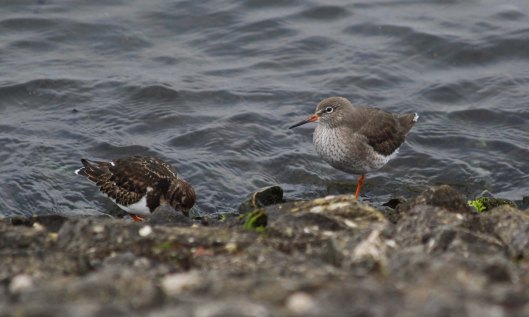
Today, on day 4 of the #7DaysofWildChristmas challenge, my search for the wild took me down to the river – the River Ely, that is – where the river flows in to Cardiff Bay and where the embankment is now edged with tall apartment blocks and where one half of the river is a marina, home to millions of pounds of water craft. It’s a path I walk often but today I was particularly delighted to see my favourite dumpy little waterbirds, the Turnstones, had returned – eleven of them – and they’d brought a friend along, a handsome Redshank that was trying uneasily to snooze while the Turnstones prospected for food to and fro.

181228 turnstones (1)
181228 turnstones (2)181228 turnstone and redshank (1)

Wild Christmas, day 3

Tags

, , , , , , , , , , ,

I’m currently taking part in the local Wildlife Trusts’ #7DaysofWildChristmas challenge. This ‘is a week-long challenge to do one wild thing a day from the 25th to the 31st of December’. For me a challenge like this is easy peasy ’cause I try to live my whole life as one long wild challenge but I like to support these initiatives to help to inspire other people to put more Nature and wildness in their lives. Believe me, in a world as crazy as ours currently is, you will feel better for it.

For today’s challenge I spent about four hours at Cardiff’s Cathays Cemetery, hunting for fungi to photograph (not forage) in both the old and new sections of the cemetery. I figured that, after all the rain we’ve had recently, I should be able to find one or two nice things. I wasn’t disappointed.

On the bramble

Tags

, , , , , , , ,

I took myself on a meander along the south Wales coastal path from Penarth to Lavernock and back again today. The weather was still quite gloomy, as it’s been for several days now, but at least there was no rain. I often have this trail to myself but not today – every man, woman, child and their dog had obviously decided this was a good way to walk off their festive feasting. As I had made it today’s mission to look for the little, I got a lot of strange looks, and I heard one or two ‘What was that lady doing?’ comments after people had passed. To their credit a couple of folk were brave enough to ask me directly but their eyes glazed over when I began to extol the beauty of the many leafhoppers I was seeing.

181226 on the bramble (1)

I saw lots of lovely things but thought, for the purposes of this blog, I’d focus on the Bramble (Rubus fruticosus agg.), which grows in abundance along the coastal path and, with this year’s mild weather, is still very green, and even flowering in places.

181226 on the bramble (2)

I haven’t yet had a chance to identify my finds but I think I have photos of three different species of leafhoppers (though it’s possible number 3 is just a yellower version of number 1). I was amazed to see so many of these little critters still flying and hopping around the bushes, though the winter has been very mild here so far and I think some species over-winter as adults.

181226 on the bramble (3)181226 on the bramble (4)181226 on the bramble (5)

I also spotted a couple of other tiny mini-beasties lurking amongst the leaves. I’m not sure what these are.

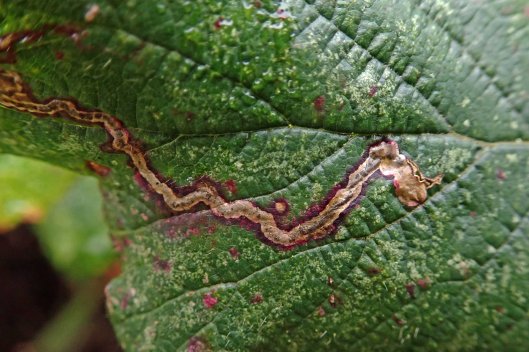
Lots of the leaves had leaf mines, though their makers have now left the leaves. I think most of the mines I saw would have been made by the larvae of Stigmella aurella, a moth.

181226 on the bramble (8)

And my last find was on an old, decaying Bramble branch, where these beautiful little bonnet fungi were growing. Though you can’t see the details in this photo, the caps were striated and the stems grooved so I think these might be Grooved bonnets (Mycena polygramma).

181226 on the bramble (9)

Winter 21!

Tags

, , , , , ,

Well, I have to say I’m really rather pleased, and surprised, with this week’s blooming wildflower finds. I certainly didn’t expect to find Dove’s-foot crane’s-bill (Geranium molle) still flowering at Christmastime, and the Mallow and Red dead nettle were also nice surprises. So, this week I don’t just have Winter 10 for Wildflowerhour, I have Winter 21.


Black-necked grebe

Tags

, , , , , , , ,

There are five species of grebe you can reasonably expect to see in Britain: the Great crested and the Little grebes are relatively common here in south Wales, while the Slavonian, the Red-necked and the Black-necked are rarer visitors. Yet, I’ve been lucky enough to see all five this year and all within 30 miles of home – in fact, except for the Slavonian at Kenfig National Nature Reserve, the other four were within walking distance of home, and one of these lovely rarities is currently visiting Cardiff Bay.

181222 CardiffBay (1)

This handsome little water bird is a Black-necked grebe (Podiceps nigricollis). Its generic name Podiceps is a combination of two Latin words, podicis, meaning vent or anus, and pes, meaning foot. This has nothing to do with the bird’s bottom – cute though that certainly is – but is, rather, a reference to the fact that its legs are attached to its body at the extreme back end. The epithet nigricollis is Latin for black-necked (niger means black and collis means neck).

181222 CardiffBay (2)

This is a bird that switches from freshwater to saline habitats throughout the year, favouring freshwater lakes throughout Europe in which to breed, then moving to saline waterways to undergo its moult, before migrating to winter in the coastal estuaries of the south-western Palearctic and eastern parts of Africa. According to the RSPB website, an average of 130 birds opt to spend their winter in Britain.

181222 CardiffBay (3)

This is the second Black-necked grebe to spend some time in Cardiff Bay in 2018: another – or perhaps the same – bird was here for a couple of weeks in September. Although I did see that grebe, I didn’t get very good views of it, whereas this latest visitor has been treating birders to relatively close views from the Cardiff Bay Barrage in recent days, usually in the company of Tufted ducks and Coots.

181222 CardiffBay (4)

It’s a small bird – only about 12 inches long and, from the way it appears to bob about on top of the water, it must be as light as a feather. In its searches for the aquatic insects, small fish and crustaceans that make up its diet, it dives frequently, staying underway for several minutes at a time and sometimes reappearing a considerable distance from where it originally disappeared.

181222 CardiffBay (5)

Some of the local birding community, me included, are hoping this little grebe will stay around until at least the dawn of 2019, as it would certainly be a treat to have this on our bird lists on the first day of the new year.

Fungi Friday: Turkey tails

Tags

, , , , , ,

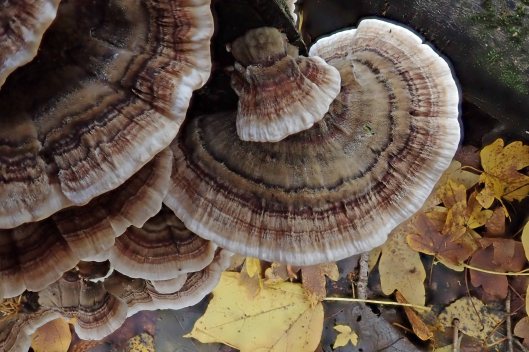
I’ve been collecting these images of Turkey tail fungi (Trametes versicolor) for the past couple of months, thinking they would be appropriate for the last Fungi Friday before Christmas seeing as how a lot of people eat turkey for their Christmas dinner.
So, merry feasting … but not on these!

181221 turkey tails (1)