Second time lucky

Tags

, , , , , , , , ,

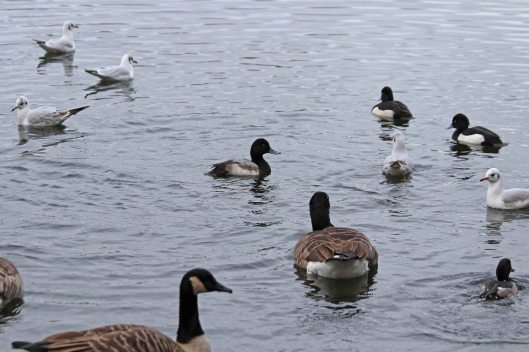
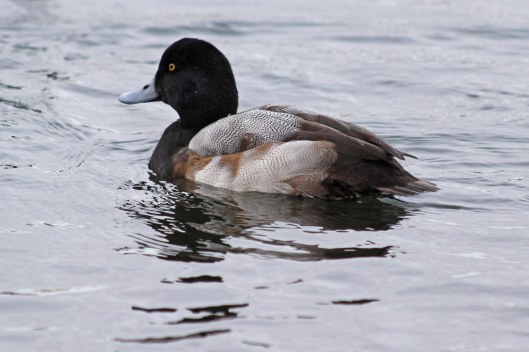
On Sunday I went to Cosmeston Lakes Country Park to look for the Scaup that has, since 13 December, been enjoying the delights of the lakes and the company of the huge number of Tufted ducks currently resident there. I had a wonderful mooch about but couldn’t find the Scaup (though I did spot a Hawfinch, a rare visitor, and was very pleased with that).

181219 scaup (1)

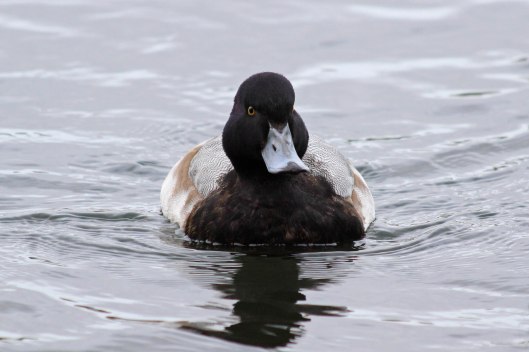
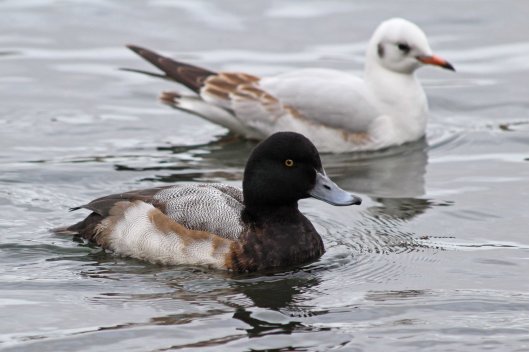
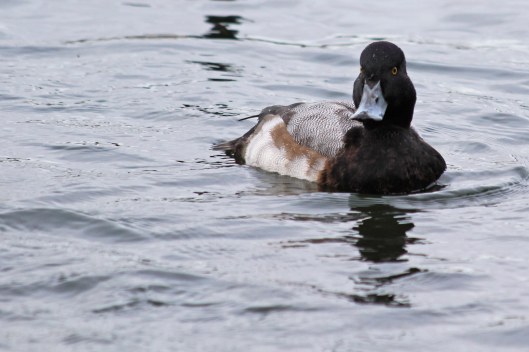
So, I went back again on Monday, partly to look again for that Hawfinch but also for the Scaup. And I was lucky with both birds, with another very fleeting, distant view of the finch but superb close views of the Scaup, which came to feed on the seed I always carry with me in the winter.

181219 scaup (3)181219 scaup (5)

This is a drake Scaup – actually a Greater scaup (Aythya marila), which is usually just known as Scaup, as the Lesser scaup is so rarely seen, and a first-winter bird, as it doesn’t yet have its adult plumage – the brown colouring you can see on this bird will disappear as it develops into an adult.

181219 scaup (6)181219 scaup (7)

In south Wales, the Scaup is an uncommon winter visitor and passage migrant, which, according to the latest Glamorgan Bird Report, enjoyed a ‘welcome increase of records and numbers’ in the 2017 first winter period (i.e. between January and mid April). Let’s hope the increasing number of sightings of this handsome little duck continues.

181219 scaup (8)181219 scaup (9)

Two Harvestmen

Tags

, , , ,

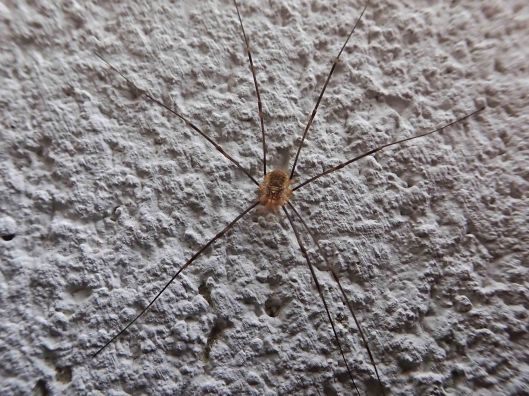
I found these two mini-beasties lurking on the outside of my building the other day. They may look like spiders but they’re not really – they’re Harvestmen (Opiliones species). Unlike true spiders, Harvestmen can’t spin webs and their bodies have only one segment, not two. They’re completely harmless – no venom – and, I think, rather prehistoric looking.

181217 harvestmen (1)

And I just discovered this very interesting but slightly creepy snippet of information about them on the UK Safari website:

When attacked, harvestmen are able to shed a leg as a defensive trick. Even after the leg becomes detached from the body it continues to jump and flick about. This distracts the predator while the harvestman makes its escape. They are able to shed up to four legs in this way, but they need to retain at least one of the sensory legs to survive.

181217 harvestmen (2)

Winter 10, week 4

Tags

, , , , , , ,

It’s certainly getting a little more difficult now to find any wildflowers in bloom but, tucked away from the prevailing westerlies and battering rain in small sheltered niches, a few wee beauties still persist.

And, of course, the winter-flowering species, like the Winter heliotrope pictured above, are just beginning their flowering period. I managed to find several large swathes of this invasive plant in and around Penarth this week. My other finds are shown below.

The gammy-legged Rock pipit

Tags

, , , , ,

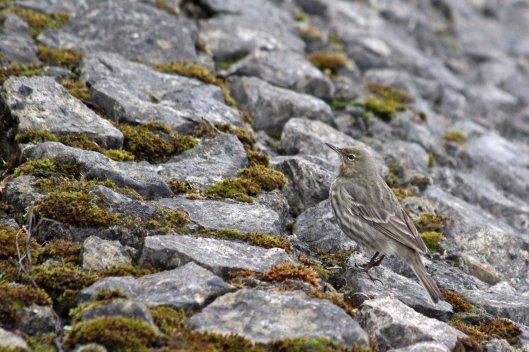
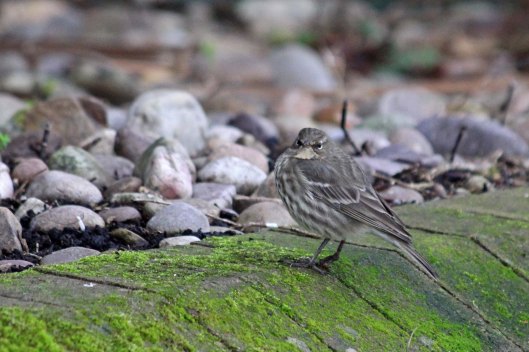
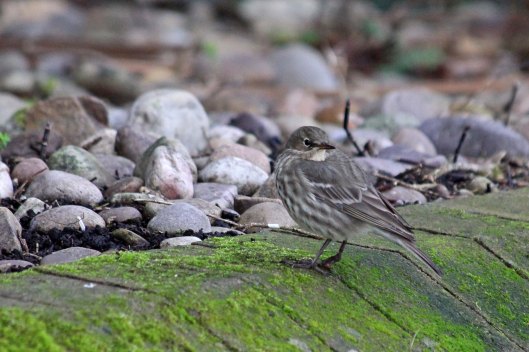
Last Monday, during my stroll along the Ely embankment path, I enjoyed a close encounter with this Rock pipit. It had ventured across the pavement at the top of the stony embankment and was poking about in a pebble-filled ground-floor garden in front of one of the tall apartment blocks that border the path. I guess, to a Rock pipit, one group of stones is as good as another to explore for insects.

181215 rock pipit (3)

The Rock pipit saw me approaching and quickly hopped back across to the safety of the embankment, where it would be easier to fly away. So, I moved to stand next to a lamp post, kept completely still and waited.

181215 rock pipit (2)181215 rock pipit (1)

As I’d hoped, the pipit decided I presented no immediate threat and, though it continued to keep a wary eye on me, it soon hopped back across to the garden again. So I was able to spend a delightful 10 minutes getting some photos and watching it foraging. It always amazes me how much food small birds like this seem able to find – tiny titbits to be sure but, presumably, enough to keep them alive.
181215 rock pipit (4)181215 rock pipit (5)

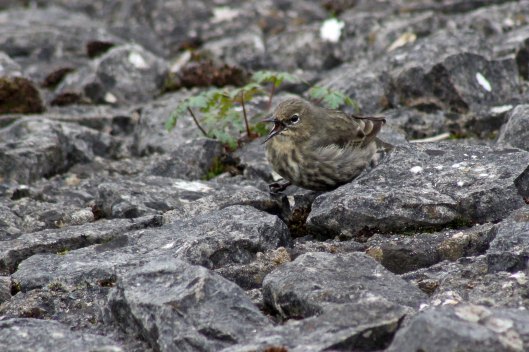
It was only when I got home and checked my photos that I noticed the bird’s gammy right leg, with its twisted misshapen claw. This had not seemed to be causing the bird any difficulty while I was watching it. And then something stirred in my memory – I was certain I’d seen this bird before. And, sure enough, when I checked through my Rock pipit album, I had photos of this same bird in this general area taken on 27 January and 11 March 2017, and 11 and 31 January, and 14 March 2018. I’m not sure how long Rock pipits usually live but this little bird has obviously been coping remarkably well with its disability.
181215 rock pipit (6)

Same bird, 11 March 2017

Fungi Friday: variety

Tags

, , , , , , , ,

I took myself off for a fungi foray around the woodland at Cardiff’s Heath Park today as it’s usually a good place to find a wide variety of fungi. And, rather than post colour photos of my finds, I thought I’d convert them all to black and white as that shows, I think, the fungal world’s amazing diversity of shapes and textures.

My little Welsh Robin

Tags

, , , , , ,

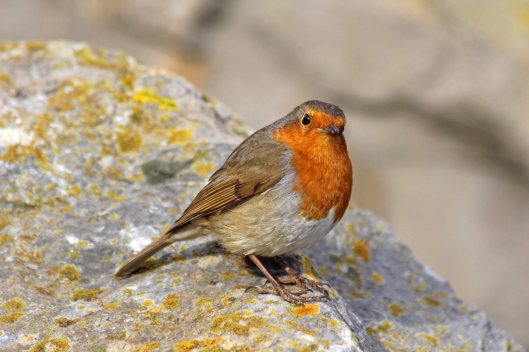
181213 robin (1)

‘Art thou the bird whom Man loves best,
The pious bird with the scarlet breast,
Our little English Robin …’
~  from William Wordsworth, ‘The Redbreast Chasing the Butterfly’, 1806

Blogger’s note: This particular little cutie, with whom I shared some quality moments – me chatting and it peeping – at Penarth Heads beach on Monday, is actually a Welsh (not English) Robin. And its breast is really more orange than red but I’ve just this week found out why it was formerly known as Redbreast and described as having a red or scarlet rather than orange breast – it’s because orange as a colour (which originated from the fruit of the same name) was unknown in Britain prior to the mid 16th century.

The zigzag winter 10

Tags

, , , , , , ,

I’ve blogged previously about the wildflower and invertebrate delights of the local zigzag path that leads from Penarth down the cliffs to Penarth Marina. It’s a path I walk at least once a week so, during Friday’s wander, I decided to see what wildflowers were still in bloom there for this week’s Wildflowerhour and its Winter 10 challenge. And here they are …

The marina sparrows

Tags

, , , , , , ,

At one end of my regular walk along the embankment of the Ely River where it flows in to Cardiff Bay, near the entrance to Penarth Marina, is a huge stand of what I presume is a type of pampas grass. I always look at it, partly because it reminds me of my New Zealand home (where we would call this by the Maori name Toetoe) and partly because it is often covered in House sparrows.

181208 marina sparrows (1)

The birds seem to adore this grass. The sturdy stems provide convenient perches on which to sit and cheep their continuous sparrow conversations, and they pluck away at the fluffy plumes, presumably extracting edible seeds to munch on. And, when threatened by the local ginger-and-white cat, which is frequently to be seen staring hungrily in their direction, the sparrows can easily flit into the dense vegetation of the grass clump to escape the cat’s clutches.