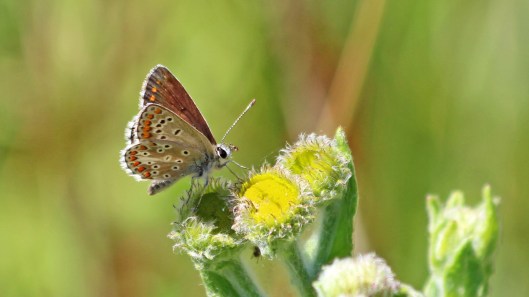
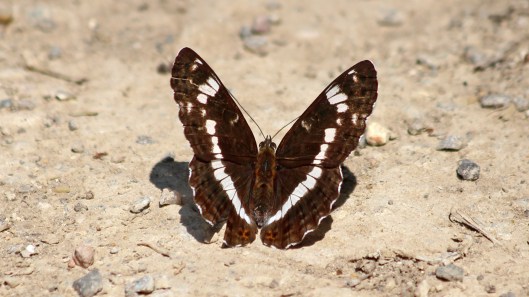
Birding at RSPB Dungeness

Tags

, , , , , , , , ,

I had never been to RSPB Dungeness until my visit with my friend Jill two weeks ago but, if you can get past the fact that there’s a nuclear power station buzzing away just down the road, then you should be able to appreciate what a wonderful place it is. (British people seem to take nuclear power stations for granted but, as a nuclear-free New Zealander, I still find them quite scary places and really rather menacing!)

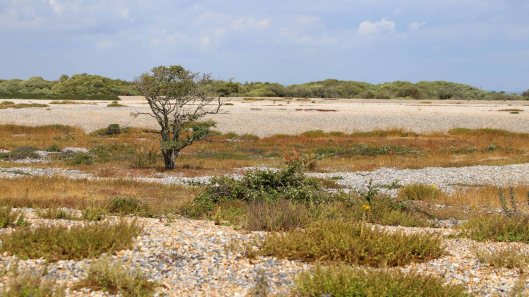
180731 Dungeness nuclear power station180731 RSPB Dungeness

This is a unique landscape of low rolling shingle banks, interspersed with patchy areas of low scrub and large shallow pools – it’s water bird heaven!

180731 Common terns (3)

Our first highlight was seeing the Common terns that breed at Dungeness. Terns are such agile flyers and to see their young fledglings was a real treat.
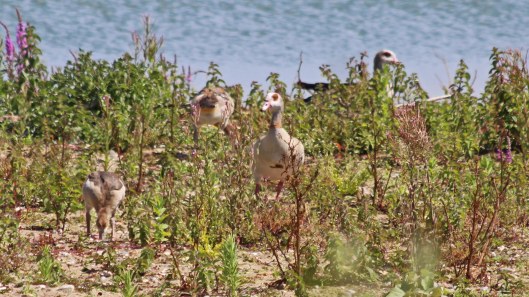
180731 Egyptian geese

Eqyptian geese have also bred here, and we saw a pair with two well-grown goslings.

180731 snipe

I had my best-ever views of a Snipe that decided to come out and poke around the muddy edges of one of the pools. These are normally such secretive birds so it was a real pleasure to watch this bird foraging.
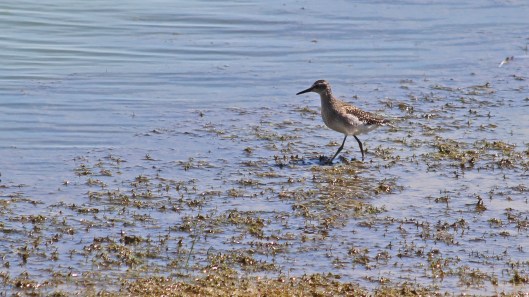
180731 wood sandpiper

And the Snipe was joined by not one but two Wood sandpipers.

180731 water birds galore

Each of the six hides on the two-mile-long main trail offers different views, different birds, and, after motoring down to a cafe near the lighthouse (and that power station), we also stopped off on our return to check out the two shorter trails and hides on the opposite side of the road. Here we had good, though distant views of a Greenshank and a Bar-tailed godwit. Cracking!

As well as the birds, the wildflowers added lots of pretty colour to our wander, and we were entertained as we walked by large numbers of beautiful butterflies and debonaire dragonflies, though it wasn’t quite so pleasant watching an Emperor dragon biting the wings off a Gatekeeper.
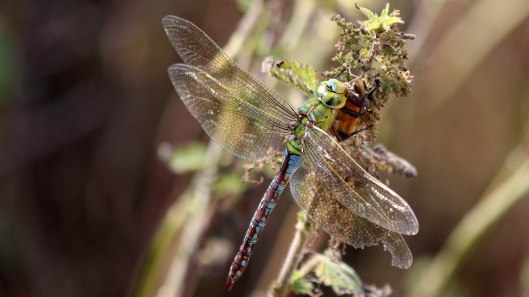
180731 b emperor

Here’s my bird list for the day (not including a lot of smaller birds that were flitting about the bushes while I was marvelling at the butterflies): Teal, Lesser black-backed gull, Tufted duck, Mallard, Herring gull, Common tern (with young), Cormorant, Sandwich tern, Common sandpiper, Wood sandpiper (2), Snipe, Egyptian goose (and goslings), Ringed plover, Pochard, Little grebe, Great crested grebe, Lapwing,Coot, Dunlin, Goldeneye, Reed warbler, Redshank, Woodpigeon, Oystercatcher, Grey heron, Great white egret (2), Greylag goose, Mute swan, Black-headed gull, Shelduck, Shoveler, Carrion crow, Swallow, House martin, Greenshank, Bar-tailed godwit, Pied wagtail, Gadwall and Magpie.
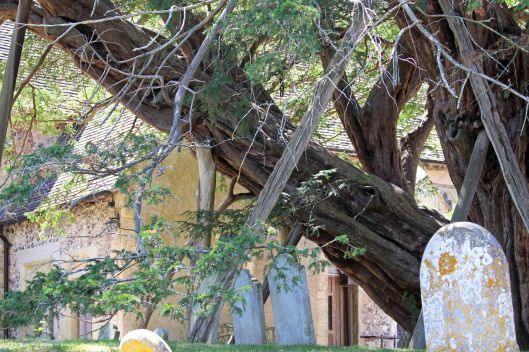
An ancient Yew

Tags

, , , ,

The Church of St Mary and St Peter in Wilmington, and the adjacent priory to which it was once attached, date from about 1100AD. You might think that’s pretty old – and it is – but the Yew tree in the church grounds is even older – it is truly ancient.

180730 1600-yr-old yew (2)

Scientific testing has dated the Yew to around 1600 years old, meaning it must have been planted around 400AD. Its girth measures approximately 23 feet (7m), though the trunk has now split in two, and both its trunks and huge branches are supported by a variety of posts and chains. As I only had my zoom lens, I wasn’t able to get a good photo of the entire tree but I hope to revisit next time I’m in East Sussex. It was a truly humbling experience to see such an incredible tree.
180730 1600-yr-old yew (1)

Big butterfly count

Tags

, , , , , ,

Just before we move away from this week of butterfly blogs, I do want to put in a plug for Butterfly Conservation’s Big Butterfly Count that is happening right now. It runs from 20 July to 12 August, so there’s still plenty of time to join in, and it’s super easy. Even if you’re not too crash hot on identifying butterflies, I’m sure you can count from one to, say, twenty, and there’s a handy pictorial chart you can easily download to help you work out which flutterby is which. And, for the smartphoners, which is probably most of you, there’s even a handy app you can download to help identify and record your sightings – though I do think you should at least try to work them out for yourselves.

And if you won’t take my word for the fact that it’s a truly wonderful feeling to sit quietly somewhere and watch and count butterflies, then maybe you’ll listen to / watch Sir David Attenborough.


Singing the Chalk hill blues

Tags

, , , , , ,

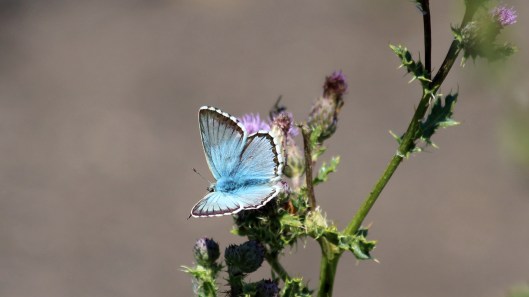
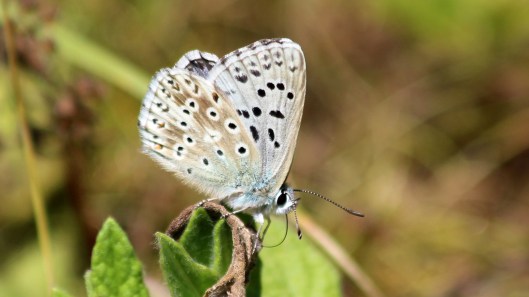
This is the last of the seven new butterflies I saw during my seven days in Sussex and the second from my walk around Seaford Head (see yesterday’s blog for the first). This stunner used to be known as the Chalkhill blue and is now the Chalk hill blue – I haven’t been able to find out why the change was made but the name does indicate their preferred location, the grasslands found on the chalk hills and downs of southern England. (Its scientific name, Polyommatus coridon, hasn’t changed.)

180728 Chalk Hill blue (1)

Luckily, the two butterflies I saw were both males – I say luckily because the female looks an awful lot like a Brown argus / Common blue female, and we all know how tricky those are to distinguish.

180728 Chalk Hill blue (2)

Apparently, these stunning males are often seen in large numbers, many hundreds together, flying low over vegetation in search of females. What a glorious sight that would be!

180728 Chalk hill blue (3)

Small and blue

Tags

, , , , , ,

Nine days ago, when I was staying with my friend Jill in East Sussex, we decided to re-enact a walk we had done on 12 May 2017, a wildlife walk led by Michael Blencowe of the Sussex Wildlife Trust, an expert lepidopterist and co-author of The Butterflies of Sussex.

180727 May 2017

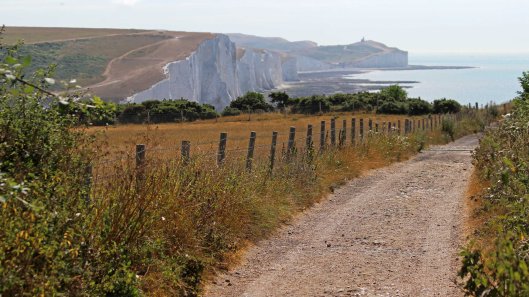
May 2017, looking from Hope Bottom on Seaford Head towards the Seven Sisters

On that previous occasion the day was cool, windy and sometimes wet so we didn’t see any butterflies. This time Britain was in the grip of a scorching heatwave so it was almost too hot and dry for butterflies….

180727 July 2018

I didn’t quite match the framing but this is the same view in July 2017

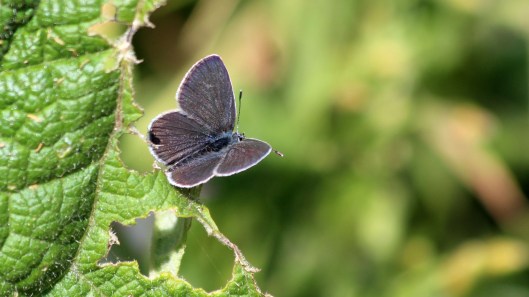
Almost, but not quite. As luck would have it, I managed to spot two more new butterflies this day, and I almost missed the first as it was so tiny. This is the very appropriately named Small blue (Cupido minimus), Britain’s smallest butterfly and one that is becoming increasingly scarce.

180727 Small blue (2)

These lovelies are often found in small colonies, in areas of scrub and grassland near where their food plant grows. I don’t recall seeing any Kidney vetch (Anthyllis vulneraria) during our walk through the Seaford Head Local Nature Reserve but, luckily for the Small blue and for me, it must have been there.

180727 Small blue (1)

Flying on the wings of confusion

Tags

, , , , , , ,

In yesterday’s blog I mentioned my confusion in identifying the Brown argus butterfly. Here’s why, plus some tips on how to defuse that confusion.

One of these butterflies is a Brown argus (Aricia agestis), the other five are female Common blues (Polyommatus icarus). Can you spot the odd one out?

If you have keen eyes, you will have noticed a difference in the patterns of spots of the butterfly in the last photo, which is the Brown argus. The Common blues all have an extra spot on their forewings (below right) and, on their hind wings, the two spots on the leading edge are more spaced out than those of the Brown argus – its two spots have been described as being close to a ‘figure of eight’ shape (below left).

180726 underwing patterns

Now, let’s look at the open wing patterns, which I find even trickier. Two of these butterflies are Brown argus, four are Common blue females. Which are which?

Firstly, as you can no doubt see, the amount of blue on Common blue females is very variable and that alone cannot help you identify them, as the Brown argus can also have a slight blue sheen to its wings sometimes. What I have found is that there is much less, sometimes no white colouration below the orange markings on the lower wings of the Brown argus (below left) and, though the Common blue can show a slight dark spot in the middle of its forewings (below right), that spot is much less obvious than the Brown argus’s spot.

180726 open wing patterns

So, did you work out which was which in the open wing photos? The middle butterfly in each row (photos two and five) are the Brown argus butterflies. Top marks if you spotted them!

Brown argus

Tags

, , , , , , ,

When I spotted this little Brown argus butterfly (Aricia agestis) in the RSPB reserve at Dungeness in Kent, I thought it was a first for me, but I was wrong.

180724 Brown argus Dungeness

It turns out I had actually seen one two days earlier during a walk along ancient footpaths in the Cuckmere Valley in East Sussex, but I hadn’t realised until I’d had a really good look at my photos.

180724 Brown argus CuckmereValley

And then, when I got home and rechecked the photos on my computer of another very similar butterfly, it turned out that I had actually seen my very first Brown argus at Cosmeston, my local country park, back in August 2017.

180724 Brown argus Cosmeston

Why was I so confused? Check back in tomorrow and I’ll show you.

White admirals

Tags

, , , ,

These lovely creatures, White admirals (Limenitis camilla), were the fourth new species of butterfly I saw while on holiday in East Sussex last week, and the third new species we found at Abbot’s Wood, a lovely Forestry Commission woodland near Polegate that we chose for a walk primarily because the towering trees would provide shelter from the burning sun. Little did we realise what wonders lay within!

180724 white admiral (1)

I knew this was a new-to-me species when I saw it gliding low along the woodland path in front of me, as I’d not seen a butterfly flying like that before. This first White admiral was rather tatty looking, with much of its lower wings missing. Was it a poor flyer or had it been tangling with other butterflies in the hunt for a mate?

180724 white admiral (2)

Almost immediately we saw a second White admiral and, though this one had a small nick out of one wing, it was in much better overall condition and seemed quite happy to sit and pose for photos. These glorious butterflies live mostly in southern Britain, in mature woodland where there is an abundance of their caterpillar food plant, the Honeysuckle (Lonicera periclymenum).

A tale of two Hairstreaks

Tags

, , , , , , ,

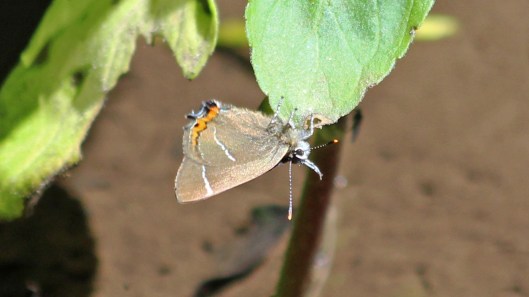
First off, let me just say I have not started blogging about hairstyling: the Hairstreaks are a group of butterflies, so named because of the thin streak of white across their underwings, that usually live their whole lives in the upper canopies of various trees. This year, due to the extremely hot dry weather, their tree-top food sources have dried up, forcing them to come down to ground level for sustenance.

180723 white-letter hairstreak

I spotted this lovely little butterfly purely by chance. I was wandering along the Glamorgan Canal in Forest Farm Nature Reserve, north of Cardiff, taking photos of the Demoiselle damselflies, when something small and brown fluttered down to water level, settled briefly on a leaf, then was chased off by one of the Demoiselles (hence the poor images). The White-letter hairstreak (Satyrium w-album) can usually be found in the tops of Elm trees and suffered a severe decline in numbers due to Dutch Elm disease killing off so many Elm trees in the 1970s but it seems slowly to be recovering. Its name comes from the shape of the letter W on its lower underwing.

180723 purple hairstreak

I can’t take the credit for spotting this Purple hairstreak (Favonius quercus) – my friend Jill noticed it sitting on the woodland trail as we explored Abbot’s Wood in East Sussex last week. (This was my third new butterfly of the week!) Purple hairstreaks usually live in the tops of Oak trees, mostly in southern areas of Britain. Unfortunately, I only managed a couple of quick photos and didn’t get to see its purple-coloured upper wings.

Silver-washed fritillaries

Tags

, , , , ,

What an absolute delight it was to see these beauties during my recent visit to Sussex, my second new butterfly sighting for the week!

180722 Silver-washed fritillary (3)

My friend Jill can testify to the fact that I was grinning from ear to ear as we followed the Abbot’s Amble trail through Abbot’s Wood, a Forestry Commission site near Polegate, and were entertained at every sunlit spot by Silver-washed fritillaries (Argynnis paphia) flitting about the bracken, bramble, thistles and burdock.

180722 Silver-washed fritillary (5)

With a wingspan between 7 and 8 cms, they’re large butterflies, and so very vibrant.

180722 Silver-washed fritillary (4)

These are woodland butterflies, feeding on the flowers that grow along the edges of paths and trails in wooded areas. Apparently, they also lay their eggs on tree trunks, rather than on their caterpillar’s food plant. Once hatched, the caterpillars hibernate through the winter, awakening and descending to the forest floor come the springtime to feed on the leaves of violets.

180722 Silver-washed fritillary (1)

The bumblebee has its eye on that flower but the fritillary isn’t moving!

180722 Silver-washed fritillary (2)