What do ladybirds eat?

Tags

, , , , , ,

I googled ‘What do ladybirds eat?’ today because I was trying to work out why there are so many ladybirds – about a 50 / 50 split between 7-spots and Harlequins – on the Wild parsnip plants at Cosmeston Lakes Country Park. It turns out ladybirds are particularly keen on aphids and, as you can see in some of my photos, there are rather a lot of aphids on these plants. Good news for the ladybirds!

A family of Linnets

Tags

, , , , , , ,

I went for a wander along the Ely embankment yesterday and was delighted to discover a family of five Linnets, two adults and three exceedingly cute juveniles, all feeding on Herb Robert seeds. They started off with Mum and Dad feeding the youngsters but the kids soon got impatient and wanted more food more quickly.

180809 linnet (1)

Mum or Dad has just plucked one of the Herb Robert seed pods while …

180809 linnet (2)

… youngster is watching to see how this food-gathering process works.

180809 linnet (3)

“Now if I can just reach …”

180809 linnet (4)

“Gotcha!”

180809 linnet (5)

“Now I’ve got the idea, I can help myself.”

180809 linnet (6)

Youngster looking rather pleased with itself.

180809 linnet (7)

Two more lovelies

Tags

, , , , , , ,

As I mentioned in yesterday’s post, last Sunday’s birding didn’t only produce some nice bird sightings, it also featured an abundance of beautiful butterflies, including two newbies for me.

I’ve been keeping an eye out for Clouded yellows (Colias croceus) for a couple of months now, as these immigrants can fly in from the southern parts of Europe and even north Africa as early as June. The occasional sighting has been reported in my area, with one being seen at Lavernock as recently as last Friday, but I hadn’t managed to spot one myself … until last Sunday.

180808 clouded yellows (3)

Ace birder Gareth spotted the first as we walked along the coastal path at Rumney Great Wharf, on the eastern side of Cardiff, and then a second was spotted soon afterwards. And then, as we retraced our steps back to the starting point of our walk, I spied two more, obviously a male and female engaged in their pre-mating aerial display. Luckily, their focus on mating meant I was able to get some open-wing photos, which, though not particularly sharp, are quite difficult with this butterfly, as it usually zooms along at quite a rate of knots.

180808 wall (1)

The second butterfly, which was again spotted by Gareth, was a first-ever sighting for me. This is a Wall (Lasiommata megera, until recently called a Wall brown), so named because of its liking for sunning itself on rocks, banks and, you guessed it, walls (though this one was not living up to its name!).

This particular Wall had been in the wars and was missing half of one wing and a third of the other, but was still flying well enough. I’m not sure I would have spotted it myself as, in flight, it looked very much like a small Meadow brown or a Gatekeeper, so I’m particularly grateful for Gareth’s sharp eyes.

I’ve had a fabulous summer of butterfly sightings, with my species total now on 34, but will these two be the final two species I see for 2018? Only time will tell.

Birding along Rumney Great Wharf

Tags

, , , ,

It was hot! In fact, it was not just hot, it was scorching but, along with 15 other brave souls, I joined the Glamorgan Bird Club’s outing last Sunday to walk part of the coastal path along Rumney Great Wharf. We started at Parc Trederlerch, where fishermen were trundling their mountains of gear to favourite sites for a day’s fishing, and Swans, Coots, Tufted ducks and Moorhens flocked to be fed by strolling families.
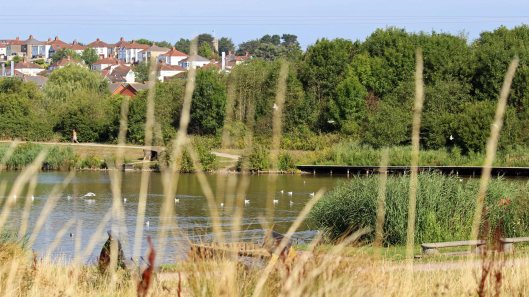
180807a Parc Tredelerch

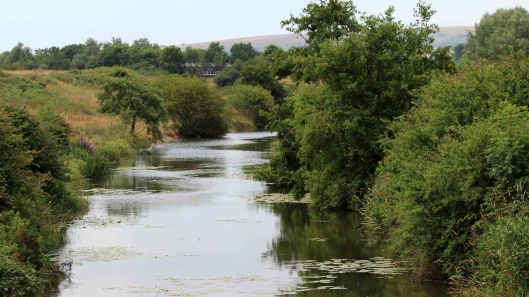
From there we walked down towards the sea alongside Cors Crychydd Reen. Despite being choked with weed, the reen was home to Little grebes, Coots and Moorhens, all with young, as well as countless, though elusive Reed warblers.

180807b Cors Crychydd Reen

A Buzzard was hunting from a post overlooking the adjacent landfill site, where gulls, Swifts and assorted hirundines were diving and swooping for food.

180807c buzzard

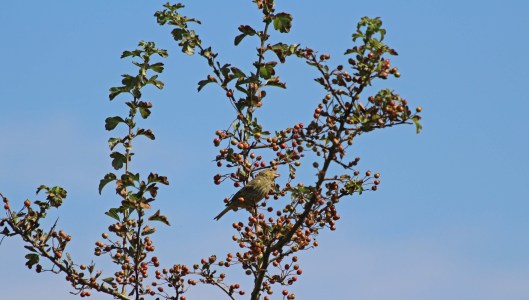
Tucking in to the blackberries as we walked, we were charmed by the sounds of Willow warblers and House sparrows, Goldfinches and Greenfinches, like this one perched high in a tree.
180807d greenfinch.jpg

When we reached the sea wall, we turned left towards Newport. Here’s the view in both directions, firstly looking west over Cardiff Bay towards Penarth Head and then west across the very dry foreshore. The heat shimmer didn’t make bird-spotting easy.

180807e view west twds Penarth180807f view east

Linnets entertained us as they bounced around the bushes and reeds.

180807g linnet

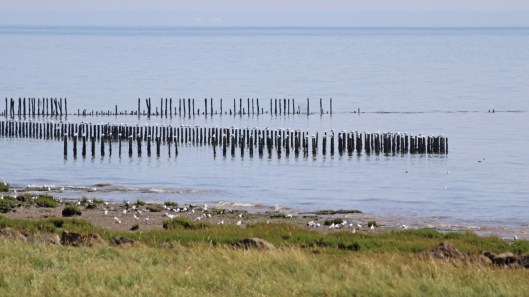
We didn’t see a huge number of waders – maybe it was too hot even for them. A large mixed flock of Redshanks and Dunlins flew east, we had good ’scope views of Ringed plovers and Dunlins at the water’s edge, and gulls abounded. There was one Common gull amongst this lot perched on the posts and a Little egret further along doing the same.
180807h gulls

There were also a ton of dragonflies and hoverflies, bees and butterflies – I’ll post more on two of those lovelies in tomorrow’s blog.

And for those who like the nitty-gritty details – I saw 42 bird species: Black-headed Gull, Carrion Crow, Buzzard, Chiffchaff, Common Gull, Redshank, Swift, Common Whitethroat, Coot, Dunlin, Goldfinch, Great Black-backed Gull, Green Woodpecker, Greenfinch, Grey Heron, Herring Gull, House Martin, House Sparrow, Jackdaw, Kestrel, Lesser Black-backed Gull, Linnet, Little Egret, Little Grebe, Magpie, Mallard, Moorhen, Mute Swan, Lapwing, Oystercatcher, Reed Bunting, Reed Warbler, Ringed Plover, Feral Pigeon, Rock Pipit, Shelduck, Starling, Swallow, Tufted Duck, Willow Warbler, Woodpigeon, and Wren. Also seen by trip participants were Blackbird, Blackcap, Blue tit, Canada goose, Collared dove, Cormorant, Curlew, Great crested grebe, Pied wagtail, Skylark, Robin, Stonechat and Whimbrel, bringing the total club list to a very respectable 55 species.

The Painted Ladies

Tags

, , , ,

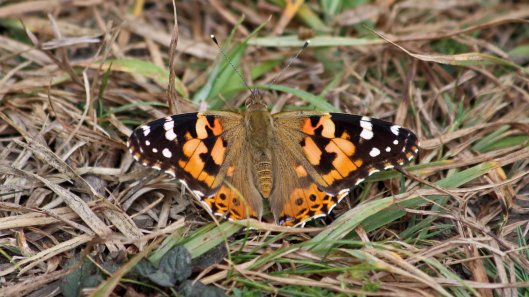
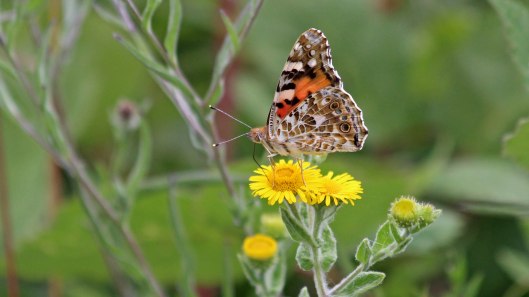
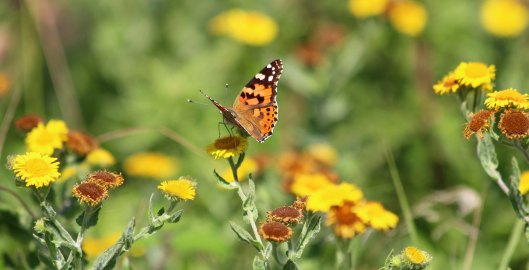
A google search on “Painted Ladies” will take you to San Francisco, as this is the name used by Americans to describe the local Victorian and Edwardian buildings, particularly houses, that have been repainted in multiple colours to highlight the details of their architectural style.

180806 painted lady (2)

Britain’s Painted ladies have also been painted in multiple colours but not by human hands – these are the masterpieces of Mother Nature.

180806 painted lady (3)

And they are not static – they fly, and not just around our local meadows and gardens – these beauties fly all the way from North Africa and the Middle East to dazzle us with their kaleidoscope of colour.

180806 painted lady (4)

Some years – 2009 was one – these butterflies arrive in huge numbers – and I do mean huge. That summer, tens of millions of Painted ladies arrived in Britain and the skies were filled with fluttering colour. I hope I live to see such a sight.

180806 painted lady (1)

It’s a biggie

Tags

, , , , ,

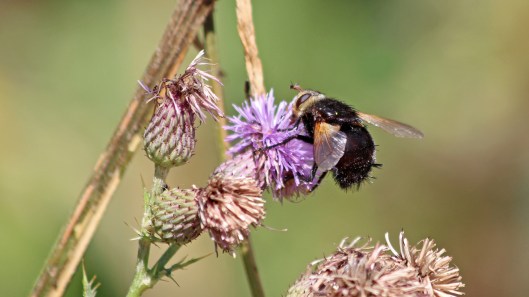
At first glance I thought this big brute was a hoverfly, ’cause I know there are some very large hoverflies, but one look at those eyes told me otherwise. Meet Tachina grossa, the largest Tachnid fly in Britain and Europe.

180805 Tachina grossa (4)

As you can see, it feeds on pollen and nectar and, though it’s harmless to us humans, it’s no friend of moths. The female Tachina grossa lays her eggs on living larvae, in particular the large hairy caterpillars of the Oak eggar moth and the Fox moth. The fly larvae eat the caterpillars from the inside, eventually but not immediately killing them.

So, it may look kind of cute in the photograph below but I’m just glad I’m not a large hairy caterpillar.

180805 Tachina grossa (2)

Three in one day

Tags

, , , , ,

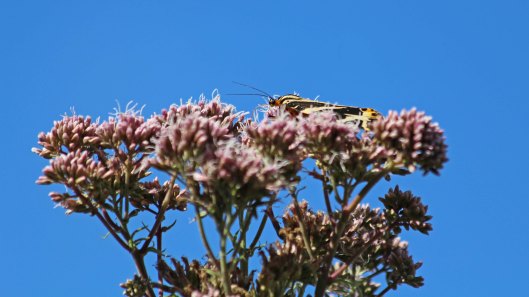
Many of you probably knew that last Sunday 29 July was International Tiger Day but I’ll bet you didn’t know that Tuesday the 31st was Jersey Tiger Day!

180804 Jersey tiger (1)

Well, of course you didn’t because I just made that up. And why?

180804 Jersey tiger (2)

Because that was the day I saw my first Jersey Tiger moths for the year.

180804 Jersey tiger (3)

And I didn’t just see one – I saw three of these most gorgeous of moths.

180804 Jersey tiger (4)

Want to know why I was so delighted to see them? Read on …

The flower of the moment is …

Tags

, , , , , , ,

The flower of the moment is Fleabane (Pulicaria dysenterica) or, at least it is at Lavernock Nature Reserve.

180803 fleabane

I’ve read that Fleabane usually grows in ditches and damp meadows so, despite the recent drought conditions, I guess there must be water somewhere below the wildflower meadows at Lavernock, as they are currently awash with these bright golden flowers. And, at a time when most other wildflowers have dried up and died off, the Fleabane is providing a much-needed source of pollen and nectar for butterflies and other assorted mini-beasties.

Gordon the Gull

Tags

, , , , , ,

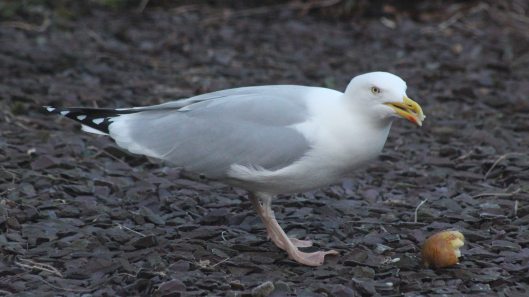
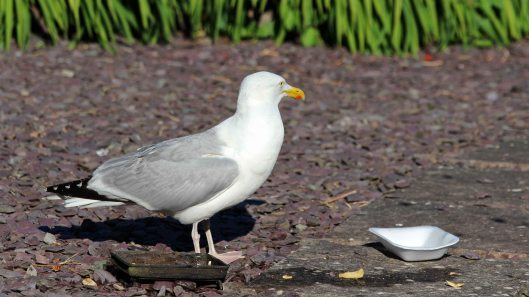
Gordon is a bit of a character.

180802 Gordon the gull (4)

He taps on the floor-to-ceiling windows in my friend Jill’s bedroom some mornings, early, to check whether she might have any food for him.

180802 Gordon the gull (1)

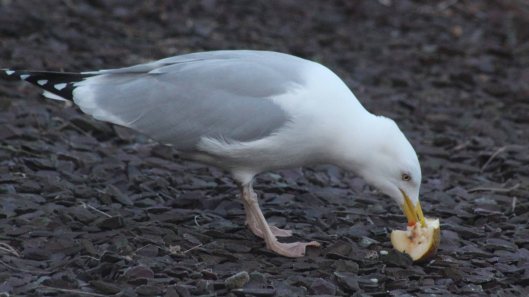
Jill doesn’t actually feed him anything but, as a Herring gull, he’s a master scavenger and a skilled opportunist, so will pounce on anything tasty looking that she puts out for the smaller birds.
180802 Gordon the gull (3)

Gordon also vigorously defends Jill’s backyard from potential gull interlopers, mostly by screeching loudly from the roof when they come near.

180802 Gordon the gull (7)

Gordon may sound like a nuisance but he’s also a bit of a charmer.

180802 Gordon the gull (6)

I mean he is rather handsome, don’t you think?

180802 Gordon the gull (2)

I succumbed immediately to his charms so, when we bought ourselves fish and chips after a particularly long day out and about, I insisted we got a portion of chips for Gordon.

180802 Gordon the gull (10)

And, the next morning, when I put them out for him, Gordon was in seagull heaven. He wolfed those chips down like only a ravenous, greedy gull can.

180802 Gordon the gull (9)

I think Jill’s very glad I don’t visit too often as Gordon might easily come to expect such preferential treatment.

180802 Gordon the gull (8)

Banded demoiselles

Tags

, , , ,

One of the many highlights of my recent walk around Arlington Reservoir in East Sussex with my friend Jill was being able to get quite close to several pairs of Banded demoiselle damselflies (while simultaneously heeding Jill’s warning that if I fell in the stream – actually the Cuckmere River – she wasn’t going to rescue me – ha!).

180801 Arlington stream

And actually this was off the main Arlington trail, as there was an old church that looked interesting not far away and we’d headed off down a public footpath towards it.

180801 Banded demoiselle (1)

Although I’ve seen a number of Beautiful demoiselles at my local nature reserves in Wales, I haven’t seen any Banded … and they are such gorgeous creatures, especially the bright blue males when they’re flying. Makes me believe in fairies!

180801 Banded demoiselle (2)

If you’re ever in the area, Arlington is a lovely place for a walk, with colourful and insect-rich wildflower meadows and plenty of birdlife, just the right amount of exercise in its circular walk and a cafe with icecreams at the end.