Eleven go birding in a minibus

Tags

, , , , , ,

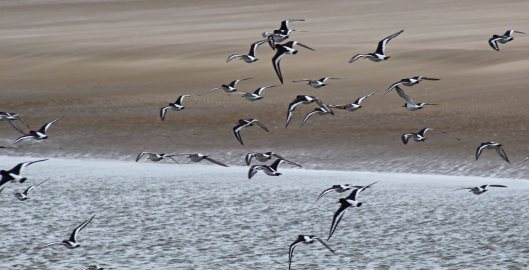
180512 Seawatching at Musselburgh

From 4 to 9 May, I joined a group of my fellow Glamorgan birders on a 6-day, multi-location, dawn-to-dusk, exhilarating (if a little exhausting), absolutely incredible birding blast to Northumberland and beyond.
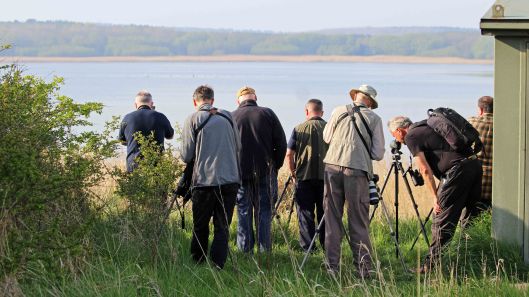
180512 At East Chevington Nature Reserve

As a group we saw 149 different species of bird, I added 52 birds to my year list, of which 18 were first-in-my-lifetime sightings, and I increased my knowledge of birds well beyond my initial expectations. And I saw a wide range of magnificent sites and stunning scenery in England and Scotland that I hadn’t seen before. Huge thanks to my birding buddies Ade, Alan, Andrew, Ceri, John, Rob, Stuart, Tim, Trevor, and Trish. You’re the best!!!
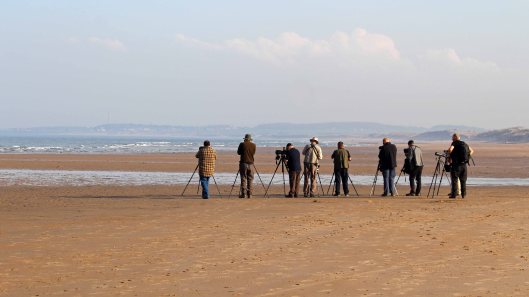
180512 Seawatching at Druridge Bay

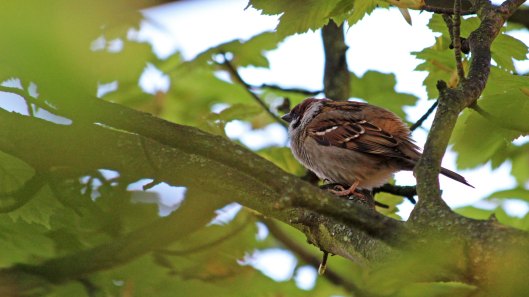
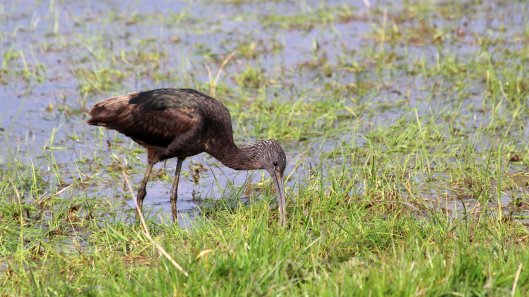
The photos below show just a few of the birds we saw – there will be blogs on individual species as soon as I get through processing my 1100+ photos. In the meantime, here’s a link to my updated birding list. I’ve now got 176 of the 200 species I’m aiming to see this year (though a couple of these are dubious ticks and I should probably aim for 204 to compensate). With most of the more common birds now ticked off and this trip done and dusted, the task of finding the final 24 (or 28) species becomes a whole lot harder.
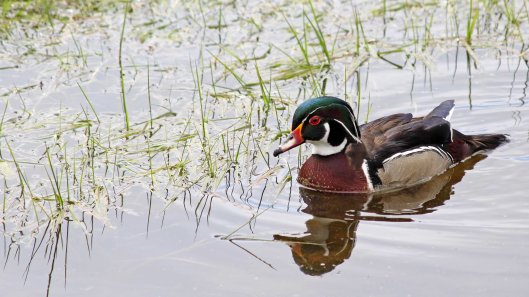
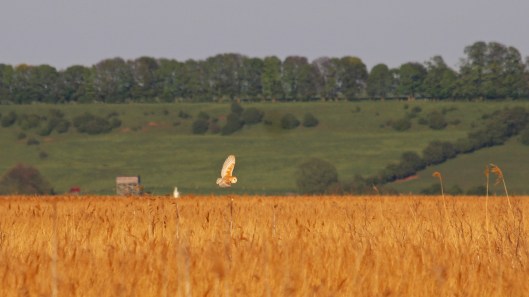
133 wood duck139 barn owl147 tree sparrow164 glossy ibis


Some crane’s bills

Tags

, , , , , , , , , ,

The word geranium comes from the Greek geranos, meaning crane, so named because of the likeness of the plant’s seed case to the bill of the bird. Thus, in the plant world, the crane’s-bills are the wild geraniums.

180511 round-leaved crane's-bill

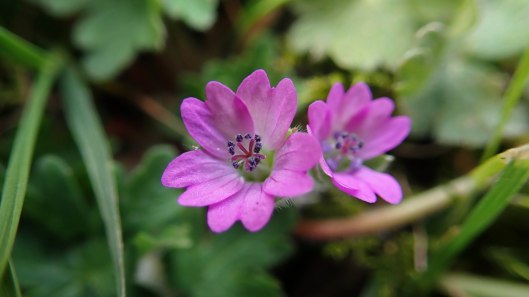
’Tis the time the geraniums begin to bloom and I’m trying to learn which is which, so I thought I’d share a few I’ve found during recent perambulations. The first is the Round-leaved crane’s-bill (Geranium rotundifolium).

180511 herb robert

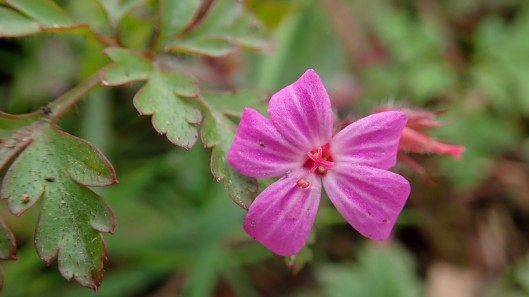
This next is the one most people can name. It seems to grow almost anywhere and makes even a rubbish heap look beautiful: Herb Robert (Geranium robertianum).

180511 shining crane's-bill

At a quick glance, this Shining crane’s-bill (Geranium lucidum) looks a lot like Herb Robert … and then you notice how different the leaves are.

Cool craneflies

Tags

, , , , ,

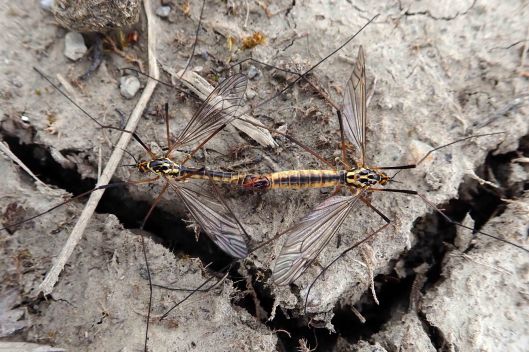
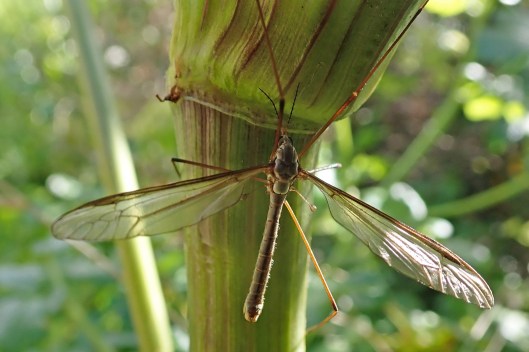
When I was a kid I always knew these insects as Daddy long legs and thought they were a bit creepy the way they fluttered wildly around. Now I know them as Craneflies and think they’re really cool. Incredibly, there are around 300 species of Cranefly in Britain – yet another insect species to try to learn – sometimes my brain hurts! Luckily, there is a Cranefly Recording Scheme (CRS) and they’re on Twitter so I’ve been able to get expert and very friendly help with my IDs for these recent sightings, and a little bit of information about each as well.

180510 Nephrotoma appendiculata

For this one, CRS said: ‘That will be Nephrotoma appendiculata at this time of the year. A side on photo would definitely confirm it but given it is still April I’m happy with this species, one of rough grassland, verges etc.’ And very soon there will be many more of them!

180510 Tipula oleracea

And this one is ‘Tipula oleracea, the other common Tipula (Tipula) species. [I had wrongly thought it might be Tipula paludosa.] Typically a May species in dampish grassland. Larvae feed on grass roots.’

So, if you’re fascinated by Craneflies, why not give the Cranefly Recording Scheme a follow on Twitter?

Wild word: binomial

Tags

, , , ,

Binomial: noun; a two-part name, especially the Latin name of a species of living organism (consisting of the genus followed by the specific epithet) (Oxford Dictionary). I have just finished reading John Wright’s book about binomials, The Naming of the Shrew: A Curious History of Latin Names (Bloomsbury, 2014), and it’s surprisingly entertaining. I’m not going to start doing book reviews on here but I thought I’d just share a tiny sample of the weird and wonderful binomials John writes about and, if that tempts you to read the book, then all well and good.

180509 Naming of the ShrewSenecio squalidus (Oxford ragwort) translates as ‘dirty old man’ and Primula vulgaris (Primrose) is ‘first common girl’. There are names derived from fiction: Yoda purpurata, a genus of deep-sea acorn worms, is so named because the large lips on the sides of its head are reminiscent of Yoda’s ears; and, under the influence of the Harry Potter books, a dragon-like dinosaur is named Dracorex hogwartsia, dragon king of Hogwarts. There’s a midge named after a rock band: Dicrotendipes thanatogratus translates to Grateful Dead; and a land snail named after Australian zookeeper and conservationist Steven Irwin: Crikey steveirwini. There are carabid beetles named Agra vate and Agra vation (say them out loud), and there’s a horsefly with ‘a perfectly round and golden rear end’ called Scaptia beyonceae. Enough … check out the book for more.

Gone birding: Starling

Tags

, , , , , ,

In Welsh, the word for Starling (Sturnus vulgaris) is drudwy, and a drudwy featured in one of the many ancient tales that now form The Mabinogion. The princess Branwen, who was ill-treated by her Irish husband, trained a starling to speak so the bird could carry messages to her brother Bendigeidfran, the king of Britain. Such clever birds!

180508 starling

Gone birding: Blackcap

Tags

, , , , , ,

Before I moved to Britain, I associated the word Blackcap with cricket: it’s the name of the New Zealand national men’s cricket team. Now, the word means bird, Sylvia atricapilla to be precise, the male with his black cap, the female with her brown one, and I look forward to their return migration each Spring.

The RSPB website notes that the Blackcap’s ‘delightful fluting song has earned it the name “northern nightingale”.’ If you haven’t heard the song, here’s a little video I shot recently of the male bird in action. British birds’ve got talent!

Gone birding: Blue tit

Tags

, , ,

180506 Blue tit

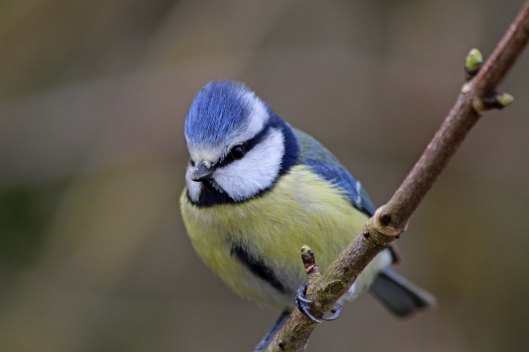
Oh, how I long to quit the throng
Of human forms and faces:
The vain delights, the empty shows,
The toil and care bewild’rin’,
To feel once more the sweet repose
Calm Nature gives her children.
At times the thrush shall sing, and hush
The twitt’ring yellow-hammer;
The blackbird fluster from the bush
With panic-stricken clamour;
The finch in thistles hide from sight,
And snap the seeds and toss ’em;
The blue-tit hop, with pert delight,
About the crab-tree blossom;

~   extract from the poem ‘Letter From The Town Mouse To The Country Mouse’, Horace Smith (1779-1849), English poet and novelist

Gone birding: Mistle thrush

Tags

, , , ,

I was alerted to the presence of two Mistle thrushes in Cosmeston’s Cogan Wood by the unmistakable screech of their football-rattle alarm call. It seems they had been enjoying a spot of seed foraging at an old tree the locals call the Dragon tree when they were interrupted by Magpies with the same idea in mind. Luckily for me, once the Magpies had departed, one of the Mistles sat quietly preening on a low branch.

180505 Mistle thrush

More blooming wildflowers

Tags

, , , , , , , ,

The Spring sunshine has been a little sparse in recent weeks but the wildflowers are slowly continuing to appear. Here are some recent finds …

180504 1 bluebells

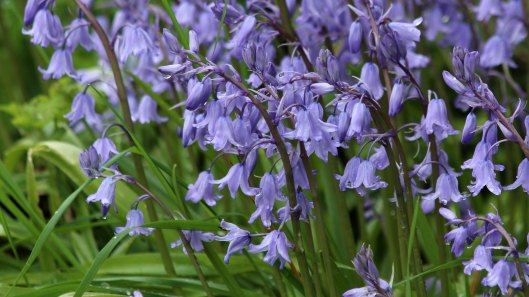
I couldn’t resist including more Bluebells (Hyacinthoides sp.) as they really encapsulate Spring for so many people.

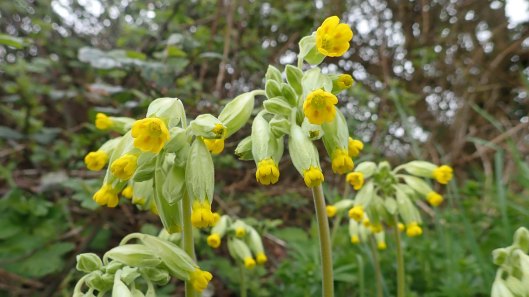
180504 2 cowslip

First come the primroses, then these beauties take over: Cowslips (Primula veris).

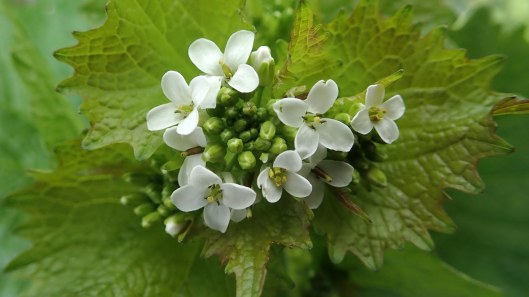
180504 3 Garlic mustard

You may know it as ‘Jack-by-the-hedge’, so-named for its love of a shady spot by a hedge, this is Garlic mustard (Alliaria petiolata).

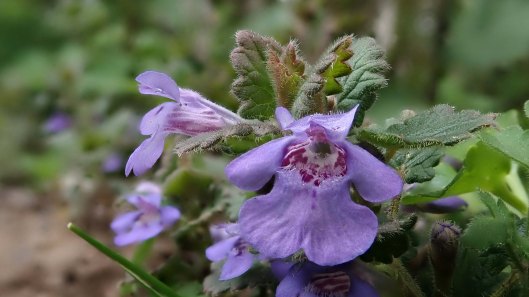
180504 4 ground ivy

Don’t forget to look down low for this burst of purple goodness. It’s Ground ivy (Glechoma hederacea). 

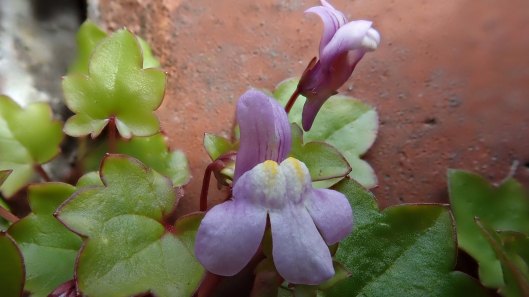
180504 6 ivy-leaved toadflax

Blooming now on a wall near you, Ivy-leaved toadflax (Cymbalaria muralis). 

180504 9 Sow thistle

Part of the large and mightily confusing dandelion family, this is one of the Sow thistles (Sonchus sp.).

180504 10 wild garlic

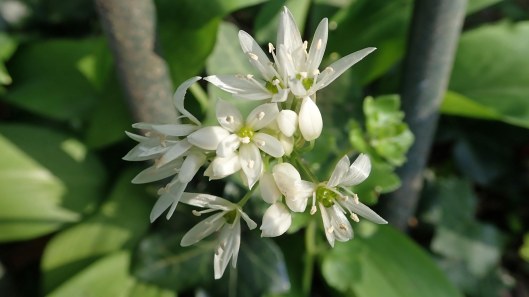
If you go down to the woods today, make sure you take a peg for your nose … unless, like me, you love the smell of Wild garlic (Allium ursinum).

Gone birding

Tags

Thanks for dropping in to my little corner of the internet. I’m off on a birding trip for the next few days, hoping to see lots of beautiful birds to add to my #200BirdYear list, exploring parts of England I’ve not visited before and sharing good times with some fellow birding friends. My daily posts will continue – appropriately enough with a birding theme this week – so check below for the latest, and I’ll respond to any comments as soon as I get back.

105003 Gone birding