A bird’s eye view

Tags

, , , , , , ,

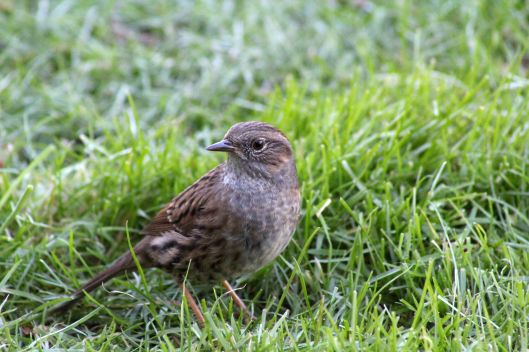
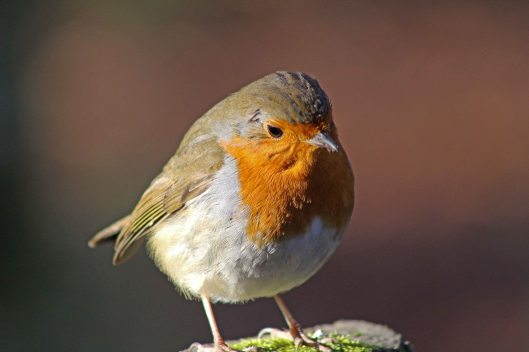
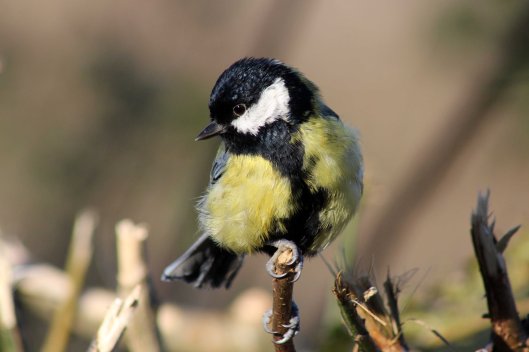
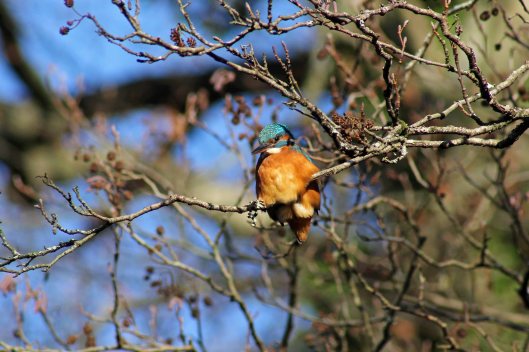
When I was searching out photos for my post on animals’ eyes back in November,  I became fascinated with the variety of eye shapes and colours. Then I began to look more closely at birds’ eyes. Did you know …

Birds have the largest eyes relative to their size in the animal kingdom.

Excellent vision is essential to birds so that they can avoid collisions and capture their prey.

Birds don’t have as many eye muscles as humans so they can’t roll their eyes around as much as we can. That, plus the fact that the eyes of many birds are set at the sides of their heads, means they have to turn their heads to one side or the other, or bob their heads up and down, to see close things better.

Birds have an extra set of photo receptors within their eyes, called double cones, which, scientists speculate, probably means they have much better colour vision that most animals.

Birds have three eyelids: the third eyelid is a nictitating membrane that moves horizontally across the eye both to lubricate it and to protect it from injury.

A murder of crows

Tags

, , , , , , , ,

I wonder if school children still get taught the weird and wonderful collective nouns for the various groupings of birds, animals and fishes. No one really knows the origins of some of these nouns but it’s easy to speculate about how a murder of crows came about. Humans have always been wary and suspicious of scavenging black birds like ravens and crows, thinking them harbingers of death and associating them with battlefields and cemeteries. Even the Ancient Greeks painted black birds in their pottery scenes, an inclusion that indicated someone was going to die, or had already died.

There are old folk tales and superstitions saying that crows will appear in large numbers in places where people or animals are expected soon to die. And just as there are rhymes associated with magpies, there is also one covering the number of crows seen together at one time: ‘One’s unlucky / Two’s lucky / Three is health / Four is wealth / Five is sickness / And six is death’.

171214 crow (1)

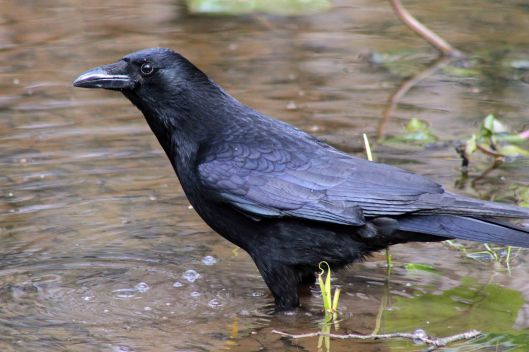
I’ve also read that crows make good weather forecasters. In Fauna Britannica, Buczacki writes that ‘In Wales, an indication of strong winds is given by ravens and crows flapping their wings and flying at a great height, while sunshine will follow if they are seen flying towards the sun.’ I’ll be interested to find out whether any of my Welsh friends have heard of this and, indeed, to know whether this forecasting method works! And I wonder if a crow standing in water means it’s going to rain.

171214 crow (4)

Wild words: Werifesteria

Tags

, , , , , ,

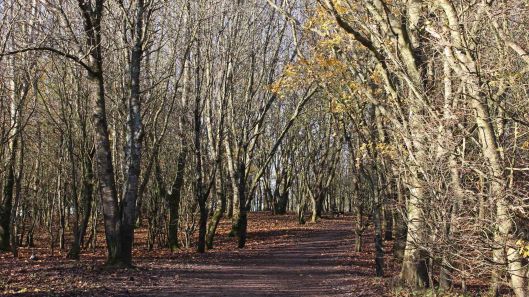
Although you might read in some corners of the internet that werifesteria is a word with its origins in Old English, this word will not be found in any dictionary. It seems it was invented in late 2014 and can now be found most commonly on social media, overlaying images of trees and forests.

171213 werifesteria (1)

Despite this, I like the word and the meaning that has been attached to it: ‘to wander longingly through the forest in search of mystery’. That’s my kind of verb!

171213 werifesteria (2)


A walk in Nant Fawr

Tags

, , , , , , , , , , , ,

There was snow on the hills north of Cardiff on Saturday morning so I thought I’d try to get closer to take some photos but also combine that with a good walk. So, I jumped on a train and went a’stomping. Unfortunately, by the time I got closer, the snow had mostly melted away, which wasn’t helped by the fact that the footpath I had intended to follow, along the eastern side of the Llanishen and Lisvane reservoirs, was closed. So, I contented myself with a wander through the Nant Fawr woodlands and, afterwards, a circuit of Roath Park Lake.

171212 Nant Fawr (1)

I was rewarded with the sight, albeit distant, of my very first Brambling – my shots are heavily cropped so you’ll just have to take my word for it!

A small group of House sparrows was dotting about in bushes at the woodland edge.

I always thought Carrion crows were mostly solitary birds but this flock of about 20 proved me wrong.

171212 Nant Fawr (8) Crow171212 Nant Fawr (9) Crow

The wood-tapping of this Great spotted woodpecker helped direct my lens in its direction, as did the singing of this little Dunnock.

And Song thrushes and Blackbirds were enjoying a hearty lunch of berries along the hedgerows.

Bryophytes and lichens

Tags

, , , , , ,

Over the summer months my eye has been distracted by all the little creatures that move – butterflies and moths, dragonflies and beetles, and all manner of other insects – but now that it’s winter and those creatures have mostly disappeared (you’ll notice one crept in to one of my photos!), my eye is again drawn to the more static beauty that surrounds me. Take, for example, this small grove of trees at Cosmeston Lakes Country Park.

171211 lichens and bryophytes (1)

I spent perhaps an hour here the other day, looking in wonder at the incredible variety of tiny lichens and bryophytes to be found on the tree trunks. I haven’t tried to identify these but I’m determined to return to them over the coming months to see which I can put names to and find out more about. For now, I just want to share their beauty.


Cotoneaster

Tags

, ,

Am I the only person who used to pronounce this word wrongly: coton-easter instead of cot-own-e-aster?

cotoneaster (2)

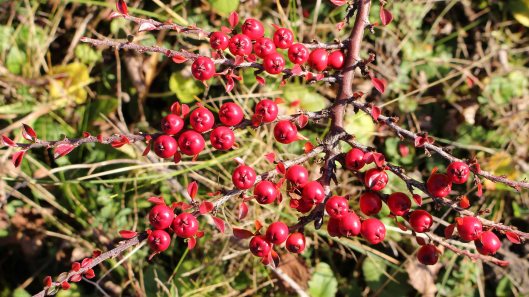
Now that I’ve got the pronunciation right, I want to have a moan about the plant itself. Don’t get me wrong – with those charming, heart-shaped leaves and luscious red berries, it’s very attractive … when it’s in a garden. The problem is that birds find its berries luscious and attractive too, and they eat them, and they fly away, and they poop. And a few months later, up pops another Cotoneaster plant but not always where it’s wanted. (There are Cotoneaster plants by the score at Cosmeston Lakes Country Park, where I regularly go walking.)

So, now, because it has a habit of spreading easily, damaging native vegetation, and is difficult to get rid of, the Cotoneaster has been classified as a ‘non-native invasive’ on Schedule 9 of the Wildlife and Countryside Act in England and Wales making it an offence to plant or otherwise cause to grow these species in the wild. And it’s going to take a lot of back-breaking effort by someone to get rid of all the plants growing where they’re not wanted.

cotoneaster (4)

Mr and Mrs Sprawk

Tags

, , , , , , ,

On Thursday I showed you many of the lovely birds I had seen at Forest Farm Nature Reserve the previous week but I left out two of them, the male and female Sparrowhawk I saw several times during my meanderings.

171209 sparrowhawk (3)

The Sparrowhawk (Accipiter nissus) is a bird of prey and it was easy to tell when this pair was near by as all the other birds froze, no movement, no sound. A hawker of sparrows it may be but, as Buczacki points out in Fauna Britannica, they could just as easily be called finchhawk, larkhawk or tithawk ‘because this bird really is a scourge of small feathered things’. That sounds like bad news for the smaller birds but, interestingly, the RSPB reports that ‘long term scientific studies have shown that sparrowhawks generally have no or little impact on songbird populations’. (Read more here.)

I only managed to get distant fuzzy photos (above) of the male bird, with his distinctive blue-grey back and wings, but my shots of the female are a little better. I’ve seen Sparrowhawks many times before but have not had views as close as these, and they were magnificent to watch as they flew at high speed through the thick spreading branches in the woodland by the canal.

171209 sparrowhawk (4)

Blast from the past

Tags

, , , , , , , , ,

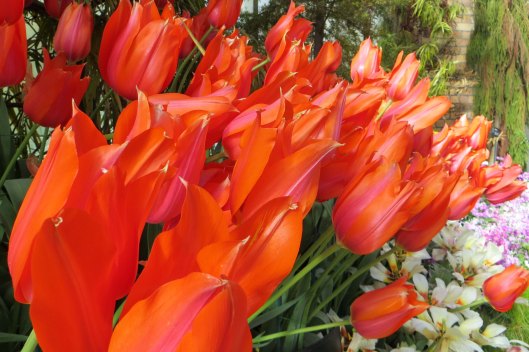
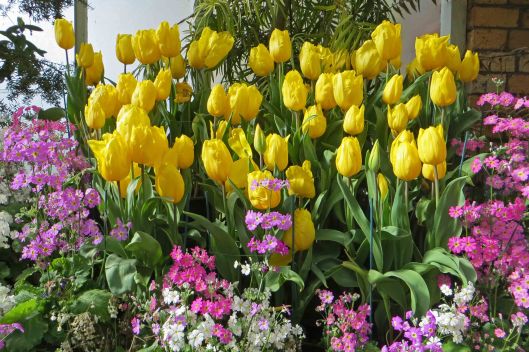
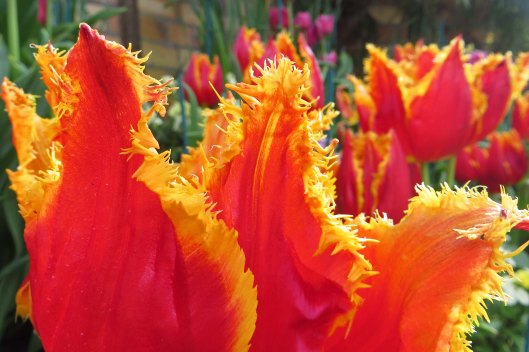
I was sorting through / clearing out files on my laptop earlier this week when, amongst my New Zealand images, I came across a temp folder of flowers. The shots were taken on 20 September 2014, when I was back in New Zealand for a couple of months, and the setting is the glasshouses of the Wintergardens in Auckland Domain, the photos taken, no doubt, on one of my many long strolls in that magnificent park. So, on this, the coldest day of winter so far here in Wales, here are some bright and cheerful hothouse flowers to offset any chill you might be feeling. Enjoy!

171208 Auckland Wintergarden flowers (1)171208 Auckland Wintergarden flowers (2)171208 Auckland Wintergarden flowers (3)171208 Auckland Wintergarden flowers (4)171208 Auckland Wintergarden flowers (5)171208 Auckland Wintergarden flowers (6)

Birds of Forest Farm

Tags

, , , , , , , , , , , , ,

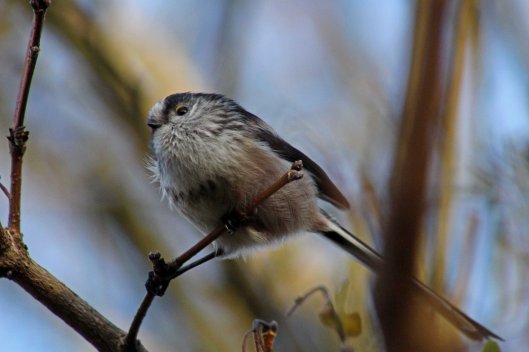
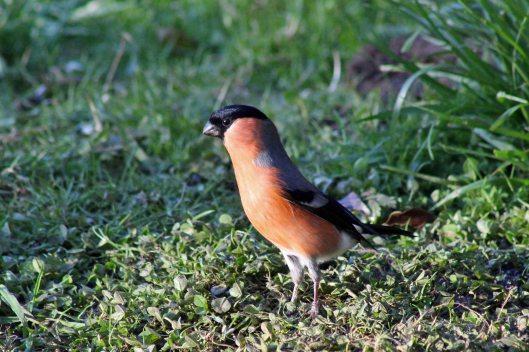
I had a meeting at Forest Farm last Friday so, of course, I took the opportunity while I was there to have a wander around the trails and along the Glamorganshire Canal. And it was wonderful, though I did come away feeling a little guilty. We’d had a week of low temperatures, with overnight frosts, and there was a bitterly cold wind blowing. It was obvious the wee birds were cold and hungry but I hadn’t taken any seed with me. Here are a Long-tailed tit, a male Bullfinch, a Dunnock, a Robin and a Great tit.

171207 Forest farm birds (1)171207 Forest farm birds (2)171207 Forest farm birds (3)171207 Forest farm birds (4)171207 Forest farm birds (5)

The water of the canal was sheltered from the breeze and very still, making for some stunning reflections (thank you little Moorhen). And I was treated to excellent views of a female Kingfisher, who sat for at least 15 minutes on her branch. From the way her feathers were fluffed up and she was hunched over her ‘toes’, I figure she was feeling the cold as well.

171207 Forest farm birds (8)171207 Forest farm birds (7)

The Great spotted woodpecker was a treat, as were the Treecreepers – at least four of them, perhaps a family group, were actively scuttling up the branches in one small area by the canal. It was a grand day – my meeting went well and the birding was even better than expected!

171207 Forest farm birds (9)171207 Forest farm birds (6)