As our hot dry summer draws to a close, flowers are in short supply so, sometimes, hungry critters just have to share. Here, a male Red-tailed bumblebee (Bombus lapidarius), left, shares with a Common carder bee (Bombus pascuorum). (Yes, I know the Red-tailed doesn’t actually have a red tail and it certainly doesn’t look like the images I had been searching through when trying to put a name to it, but my friendly local Twitter expert tells me ‘males get sun bleached rather quickly’ and assures me this identification is correct. This is precisely why I don’t really ‘do’ bees!)
In recent weeks, when the weather has been fine and the air relatively still, I’ve been spending time searching the Devil’s-bit scabious for bees. Not just any bees, but four scarce and endangered bees. This is part of Buglife’s ‘Searching for Scabious’ project, which
aims to improve our understanding of the distribution and conservation status of some of Wales’ rarest and most threatened solitary bees – the Large Scabious Mining Bee (Andrena hattorfiana) and its associated cuckoo, the Armed nomad bee (Nomada armata), and Small Scabious Mining Bee (Andrena marginata) and its cuckoo, the Silver-sided nomad bee (Nomada argentata).
I wasn’t familiar with these bees and am not very good at bee identification in general but Liam Olds, Buglife’s local conservation officer, has put together an excellent explainer video, which can be accessed on YouTube, so I thought I’d join the search.
Unfortunately, I haven’t managed to find any of the scarce bees at the two local sites where Devil’s-bit scabious grows in abundance (and neither has Liam, which was reassuring for me re my search skills but bad news for the bees). The bees I did find most commonly were the appropriately named Common carder (Bombus pascuorum) (below, left) and the Buff-tailed bumblebee (Bombus terrestris) (below, right).
Liam very kindly helped to identify the other small bees I found. These lovely little furrow bees are either the White-zoned furrow bee (Lasioglossum leucozonium) or the Bull-headed furrow bee (Lasioglossum zonulum) – the two species are too similar to tell them apart without closer examination.
I also found several of these more distinctive individuals, the Wood-carving leafcutter bee (Megachile ligniseca). You can find out more about them, and watch a little video of their nest-building skills, on the BWARS website. Meantime, I’m heading back to the scabious for another look.
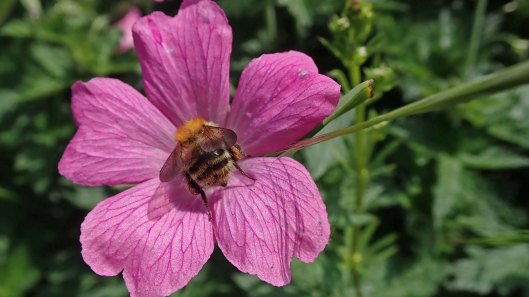
This photo was actually taken yesterday because, being the occasional numpty that I am, I didn’t take my camera with me when I went out for a stroll and some groceries this afternoon, after the rain had cleared. The bee is a Common carder (Bombus pascuorum) but I’m not sure about the geranium. Although it’s growing beneath a hedgerow in a rural lane, I think it’s a garden escape, as its description doesn’t fit with the native geraniums in my plant book. Whatever it is, it’s obviously tasty … if you’re a bee.



 earthstar
You must be logged in to post a comment.