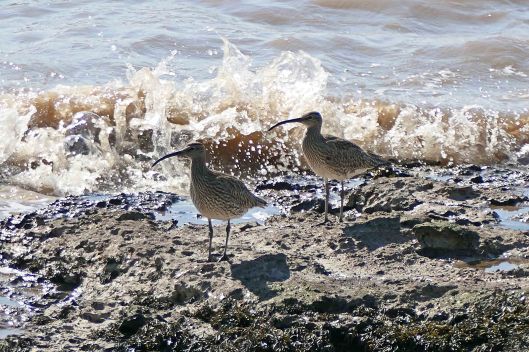
I was just leaving the local country park yesterday when these two Jays flew across my path and in to the trees and scrub behind the boundary fence.
Surprisingly, they weren’t bothered about my presence, continuing to flit about the branches and ferret about in the undergrowth. As they had a somewhat frantic air about them, I suspect they were searching for titbits to feed young ones nearby.
Terns of any description rarely visit Cardiff Bay but, if they’re ever going to, now, on Spring passage, is the time of year for it to happen … and it did, for two days at the end of last week. (Terns do sometimes pop in on Autumn passage as well, depending on the weather.) The Bay has some very keen and knowledgeable resident birders so when one of those, Gareth, put out the word that he’d seen a tern in the Bay, thought it was an Arctic tern but didn’t have his ‘scope with him, other locals quickly headed down with their equipment to check it out. Arctic tern it was! (Common and Arctic terns can be tricky to tell apart, and the term ‘commic’, a combination of their names, is used by birders when uncertain.)
Unfortunately, I couldn’t get there that afternoon so imagine my delight when word came through from Gareth again the next day that the tern was still showing. Though rain threatened and did, in fact, interrupt play a couple of times, I managed to find the tern. Sadly, it wasn’t giving the close views it had the day before and was mostly a small dot on the other side of the water until, when it decided to fly onwards, it flew almost directly over my head. A head-terning moment!
In Welsh the Blue tit is Titw Tomos Las. Titw presumably translates as tit and las is blue but I’ve no idea what tomos means. If there are any Welsh speakers out there who can explain the name, I’d appreciate hearing from you in the comments.
This was a rare moment of silence and stillness in a bird that’s rarely either of those things, and it didn’t last long. Perhaps it was curiosity about me and my camera that caused this Goldfinch to pause, momentarily, but it was soon off to flit with the flock, chattering all the while.
Was there ever a more aptly named bird? The Treecreeper does exactly what its name implies: it uses its long claws to creep expertly up trees, poking and probing into every nook and cranny in its constant search for niblits. If its name could be improved, ever so slightly, it would be with the addition of the word spiral, thus Spiralling treecreeper, as anyone would agree who has ever tried to watch or photograph one of these busy birds and been led a merry dance round and round a tree in an attempt to follow the bird.
There hasn’t been a lot of Turnstone activity around Cardiff Bay this winter, perhaps because the milder weather has allowed them to forage and rest in more exposed locations, so it was delightful to see a flock of 13 birds on the River Ely embankment on Thursday. Several were showing signs of the colour changes, those splodges of rusty red that come as they moult into their breeding plumage.
Judging by previous years, these superb little waders will be heading north to their breeding sites in the next few weeks and I won’t see them again until sometime in August, when they and their fledged youngsters will return to our shores.
Another birder reported seeing two Wheatears in this particular field so I went for a look. And lo and behold, there weren’t just two Wheatears but three, happily lined up along the fenceposts (when they weren’t flitting down into the grass on either side, grabbing any insects they spotted).
And then, blow me down, I spotted a fourth bird lurking on top of the bushes in the background – only a blurry photo of that one, so here’s the line-up again from a different angle, from when they flitted up to the top of the field. Birding magic!
Trichomonosis, a disease that spreads through the birds’ contact with contaminated surfaces (like bird feeders – please clean them weekly!), has decimated the Greenfinch population in Britain, leading to a huge decline in numbers and to the bird being red-listed.
As I’ve only been in my current location for just over seven years, I don’t know how badly the local birds were hit, though birding friends say it got to the stage where they rarely saw a Greenfinch. Fortunately, that dire situation does seem to be improving hereabouts, and I can now be fairly confident that I’ll see or hear a Greenfinch during my daily walks.
At this time of year, I usually hear them before I see them, particularly males like the two pictured here, sitting in prominent spots atop a bush or in a tree, making their odd wheezing sound. They make other sounds too, of course, but it’s that odd buzzy wheeze that catches my attention – and, hopefully, also the attention of potential mates. If you haven’t heard the sound, I made a short video of one of these chaps giving it their all.
These photos are hot off the memory card, as we’ve had a lovely visitor in Cardiff Bay today, this beautiful first winter Little gull. The gull’s presence is not a huge surprise to local birders, as this is the time of year we often see one in the Bay. As the BTO website reports ‘This dainty gull is most often seen during its northward spring migration, when small parties can turn up along the coast or even at inland waters.’
Little gulls are incredibly active birds: while the Black-headed gulls were happy to bob about on the water, pecking at titbits as they floated past, the Little gull was almost constantly in flight, skilfully weaving and diving despite the strong winds, dipping down to the water’s surface when it spotted something to eat. It was magical to watch, though the other gulls weren’t as happy to see this stranger as we birders were!
There’s a Chiffchaff in my tree, chiffchaffing happily!
That was my tweet this morning after I’d spent a joyous 20 minutes standing by the open window, watching this little bird flit about the cherry tree outside my living room, catching tiny insects and singing almost the entire time.
Although some Chiffchaffs now overwinter in the warmer parts of Britain, most still migrate, and they began arriving back in my area in good number last Friday. After this morning’s home-based Chffichaff encounter, I went for a walk around Cosmeston Lakes Country Park, during which I heard and/or saw at least 23 more Chiffchaffs. Their song will soon become one of the commonplace sounds of spring/summer but, for now, it’s pure magic!
You must be logged in to post a comment.