• ABOUT
  • BIRDING 2018
  • Birding 2019
  • BLOG POSTS
  • Butterflies 2018
  • Resources

earthstar

~ a celebration of nature

earthstar

Tag Archives: British flora

The Pimpernels

21 Friday Jul 2017

Posted by sconzani in flowers, nature, plants, wildflowers

≈ 5 Comments

Tags

Anagallis arvensis, Anagallis arvensis ssp. foemina, Anagallis tenella, Blue pimpernel, Bog pimpernel, British flora, Lysimachia nemorum, pimpernel, Scarlet pimpernel, Yellow pimpernel

For Floral Friday this week I bring you the Pimpernels.
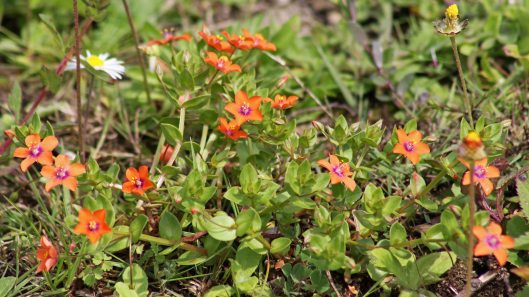
170721 Scarlet pimpernel

First, the pimpernel flower many of you will be familiar with, Scarlet pimpernel (Anagallis arvensis), also known as Old man’s weathervane and Poor man’s weatherglass due to its habit of shutting its petals when the weather becomes wet or dull. (I imagine they will be very firmly shut against today’s wind and rain!) The flower also functions as a timekeeper as it opens its petals around 8am and closes them at 2pm, even when the weather’s fine.

170721 Blue-flowered Scarlet pimpernel (1)
170721 Blue-flowered Scarlet pimpernel (2)

I only learned quite recently that the Scarlet has a subspecies, the Blue pimpernel (Anagallis arvensis ssp. foemina). This is supposedly quite rare and mostly found in southern England, though the one in my photographs is growing in my friend Hilary’s south Wales garden.

170721 Bog pimpernel

As its name suggests, the Bog pimpernel (Anagallis tenella) prefers watery places, marshy areas and soggy peat bogs. Its delicate pink flowers sprinkle the ground like petals under a blossoming cherry tree.

170721 Yellow pimpernel

There is also a yellow-flowered pimpernel – you guessed it, the Yellow pimpernel (Lysimachia nemorum) – that is commonly seen in established deciduous woodland and alongside shaded streams. Although it carries the name pimpernel, this lovely little plant is actually a separate genus and is more closely related to plants like Creeping-Jenny (Lysimachia nummularia) and Yellow loosestrife (L. vulgaris).

How many of these lovely pimpernels have you managed to see?

Like Loading...

A tale of three bindweeds

18 Tuesday Jul 2017

Posted by sconzani in flowers, nature, wildflowers

≈ 8 Comments

Tags

bindweed, Bindweed flower, British flora, British wildflowers, Field bindweed, Hedge bindweed, Large bindweed

170718 Bindweed (3)

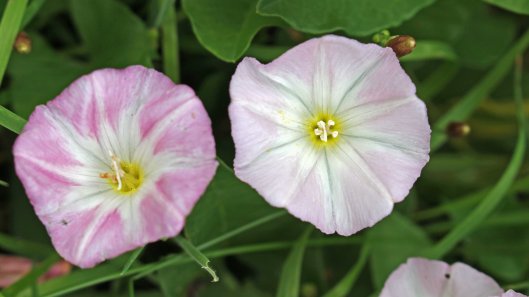
There are, in fact, five species of bindweed in Britain but I’ve only encountered three so far. One, the Field bindweed (Convolvulus arvensis) is, I think, the easiest to identify: it’s quite small, and its flowers are a delicate swirl of pink and white (as shown below).

170718 Field bindweed

Then there are the two bindweeds that have large white flowers, Hedge bindweed (Calystegia sepium) and the aptly named Large bindweed (Calystegia silvatica). To my untrained eye, these two look remarkably similar but I have recently learnt how to tell them apart so I thought I’d share that little snippet of knowledge. My wildflower key tells me that Hedge bindweed has an epicalyx of 2 bracteoles that don’t (or scarcely) overlap, whereas the Large bindweed has strongly inflated, overlapping bracteoles. Okay, so you might now be thinking, “Huh?” Well, the photos below show the difference: Hedge, left, and Large, right. Easy now, right?

170718 Bracteoles Hedge bindweed
170718 Bracteoles Large bindweed

Oh, and one more thing I found out while looking at all those bindweeds. The flowers often look like a little fairy has come along and snipped pretty patterns in their petals with miniature scissors. A fanciful idea I admit, but it’s almost true – these have been created by bees and other insects desperate to get at the sweet nectar inside so they cut their way into the flower bud before it opens.

170718 Bindweed (1)
170718 Bindweed (2)
Like Loading...

Fireweed, Bombweed

14 Friday Jul 2017

Posted by sconzani in nature, wildflowers

≈ 16 Comments

Tags

Bombweed, British flora, British wildflowers, Chamerion angustifolium, Fireweed, Rosebay willowherb

170714 Rosebay willowherb (5)

It takes a while to learn the differences between the different willowherbs (and the ease with which they hybridise doesn’t help!) but this, the Rosebay willowherb (Chamerion angustifolium), is probably the one most people know best. It was a garden escapee originally, first recorded growing in the wild in 1769, and was considered quite scarce until World War I, when the plant took advantage of woodland areas where timber had been felled (and the area burned) to assist the war effort. Rosebay willowherb’s liking for areas that have been burned is the reason for its common name of Fireweed and is why, during World War II, it thrived in London’s bomb craters, thus earning the plant its other common name of Bombweed. Some people curse it for its invasive tendencies but, for me, there is no prettier sight that a stand of Rosebay willowherb glowing in the bright summer sunshine.

170714 Rosebay willowherb (1)
170714 Rosebay willowherb (2)
170714 Rosebay willowherb (3)
170714 Rosebay willowherb (4)
170714 Rosebay willowherb (6)
170714 Rosebay willowherb (7)
170714 Rosebay willowherb (8)
Like Loading...

Purr-plish

07 Friday Jul 2017

Posted by sconzani in flowers, nature, wildflowers

≈ Leave a comment

Tags

#FloralFriday, British flora, British wildflowers, lilac flowers, pink wildflowers, purple flowers, wildflowers

For those of you who are not overly fond of yellow flowers – you know who you are! – I’ve been out and about looking for other hues, and the result this Floral Friday is a selection of blooms in shades of pink, lilac and purple. The flowers include Betony (Stachys officinalis), Bush vetch (Vicia sepium), Centaury (Centaurium erythraea), Devil’s-bit scabious (Succisa pratensis), Foxglove (Digitalis purpurea), Hedge woundwort (Stachys sylvatica), Herb-Robert (Geranium robertianum), Red clover (Trifolium pratense), Common restharrow (Ononis repens), Rosebay willowherb (Chamerion angustifolium), Tufted vetch (Vicia cracca) and a couple of thistley thingies. Enjoy!

170707 another thistle
170707 Betony
170707 Bush vetch
170707 Centaury
170707 Devil's-bit scabious
170707 Foxglove
170707 Hedge woundwort
170707 Herb-Robert
170707 Red clover
170707 Restharrow
170707 Rosebay willowherb
170707 thistle
170707 Tufted vetch
Like Loading...

In praise of hogweed

30 Friday Jun 2017

Posted by sconzani in insects, nature, plants, wildflowers

≈ 2 Comments

Tags

British flora, British wildflowers, food for insects, Heracleum sphondylium, Hogweed

170630 hogweed (1)

Hogweed is so named because the flowers are said to have a pig-like smell, though I can’t say that I’ve noticed. It has a ton of interesting-sounding common names, of which Bilers, Caddy, Eltrot, Limperscrimps, Cow-weed, Kirk, Chirk and Kek are just a few. Its Latin name, Heracleum sphondylium, is also interesting: Heracleum is a reference to the mythical Greek hero Heracles, who was said to have introduced the medicinal use of the plant to humans, and sphondylium comes from the Greek sphondylo, meaning backbone, and refers to the plant’s segmented stem.

170630 hogweed (3)

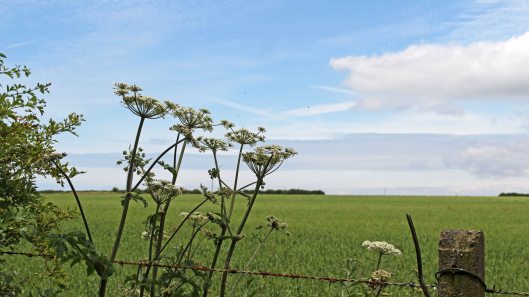
Hogweed is just coming in to flower now, adorning the roadsides, hedgerows and track edges in many of the parts of south Wales that I’ve visited recently.

170630 hogweed (2)

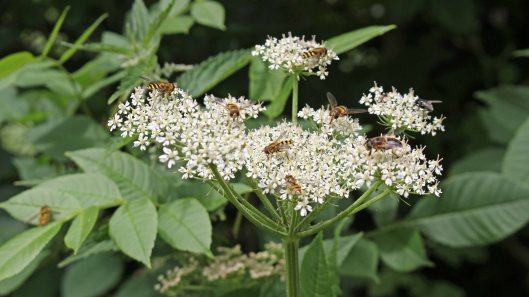
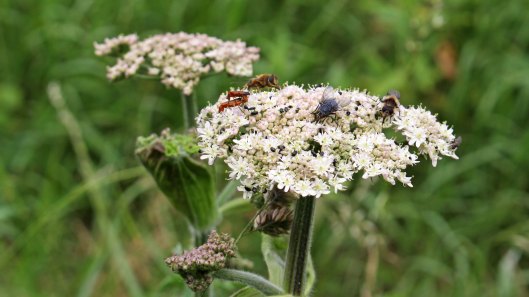
The statuesque purple-coloured-when-young stalks and those large white flower heads are glorious, indeed, but the very best thing about Hogweed, I think, is the food it provides for all manner of creatures, from flies and hoverflies to ants, bees and wasps, bugs and beetles.

170630 1 Common red soldier beetle
170630 2 Swollen-thighed beetle
170630 3 Cheilosia illustrata
170630 4 Noon fly
170630 5 Hogweed
170630 6 Broad centurion female
170630 7 Willow mason-wasp
170630 8 Stilt bug
170630 9 Hogweed leafminer
Like Loading...

Waving the yellow flag

16 Friday Jun 2017

Posted by sconzani in flowers, nature, wildflowers

≈ 3 Comments

Tags

British flora, British native flowers, British wildflowers, Iris pseudacorus, Segg, Yellow flag iris, Yellow iris

The Yellow iris (Iris pseudacorus), also known as the Yellow flag iris, is really a spring bloomer but I’m still seeing some flowers in the damper boggy and waterside areas during my countryside wanders so I thought I’d share some photos of them before they all disappear for the summer.

170616 Yellow iris (3)

Of course, the wonderfully green, spear-like leaves don’t disappear and they are, in fact, where this plant got one of its common names, Segg. According to Richard Mabey’s Flora Britannica, Segg is a variant of sedge and is derived from the Anglo-Saxon word for a short sword, though I have also seen Segg spelt secg and the Oxford Dictionary says sedge came originally from the Old English word secg, which has Germanic origins and whence also came the Latin secare meaning ‘to cut’ – hence secateurs. Here endeth today’s lesson!

170616 Yellow iris (2)
170616 Yellow iris (4)
170616 Yellow iris (1)
Like Loading...

Orchid overdose!

09 Friday Jun 2017

Posted by sconzani in flowers, nature, wildflowers

≈ 6 Comments

Tags

Anacamptis pyramidalis, Bee orchid, British flora, British orchids, Common spotted orchid, Cosmeston Lakes Country Park, Dactylorhiza fuchsii, Greater butterfly-orchid, native orchids, Ophrys apifera), orchid, Platanthera chlorantha, Pyramidal orchid

170609 Orchids Cosmeston

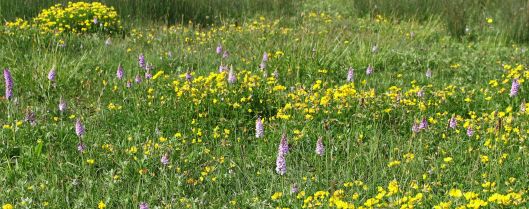
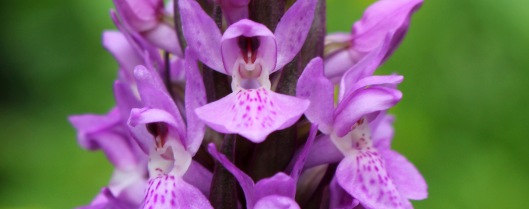
The meadows at Cosmeston Lakes Country Park are awash with orchids, Common spotted-orchids, (Dactylorhiza fuchsii), Bee orchids (Ophrys apifera), Pyramidal orchids (Anacamptis pyramidalis) and, in a secluded location off the beaten track, a tiny smattering of Greater butterfly-orchids (Platanthera chlorantha). To walk along the paths amongst these beauties is simply magical!

170609 Greater butterfly-orchid Cosmeston (3)
170609 Common spotted-orchid Cosmeston (3)
170609 Pyramidal orchids Cosmeston (3)
170609 Common spotted-orchid Cosmeston (1)
170609 Pyramidal orchids Cosmeston (2)
170609 Pyramidal orchids Cosmeston (1)
170609 Greater butterfly-orchid Cosmeston (1)
170609 Bee orchid Cosmeston (3)
170609 Greater butterfly-orchid Cosmeston (2)
170609 Bee orchid Cosmeston (2)
170609 Bee orchid Cosmeston (1)
170609 Common spotted-orchid Cosmeston (2)
Like Loading...

Marsh orchids at Kenfig

07 Wednesday Jun 2017

Posted by sconzani in flowers, nature, wildflowers

≈ 3 Comments

Tags

British flora, British orchids, Dactylorhiza incarnata, Dactylorhiza praetermissa, Dactylorhiza purpurella, Early Marsh-orchid, Kenfig National Nature Reserve, native orchids, Northern Marsh-orchid, orchid, Southern marsh orchid

170607 Southern marsh-orchid (2)

Apart from 18 species of rust, there wasn’t a lot of fungi to be found during our foray at Kenfig National Nature Reserve last Saturday but what we did see was a lot of stunning marsh orchids.

170607 Southern marsh-orchid (4)
170607 Southern marsh-orchid (5)
170607 Southern marsh-orchid (3)
170607 Southern marsh-orchid (1)

Identifying these beauties can be extremely tricky, even for trained botanists, partly because they look very similar, partly because their colouration can vary quite a lot within species, and partly because they hybridise easily with each other. So, although the chances are that these are Southern Marsh-orchids (Dactylorhiza praetermissa), there may also be some Northern Marsh-orchids (Dactylorhiza purpurella) or a mixture of both. Whatever they are, they’re beautiful!

170607 Early marsh-orchid (1)
170607 Early marsh-orchid (2)

I am, however, quite sure about these next pictures. These are Early Marsh-orchids (Dactylorhiza incarnata). They thrive in damp calcareous habitats so the dune systems at Kenfig suit them perfectly – or, at least they will as long as the dune systems are managed to prevent scrub and trees taking hold: the orchids actually grow best when wind and rain are allowed to destabilise the dunes and move sand and plants around a bit.

Like Loading...

Looking frazzled!

03 Saturday Jun 2017

Posted by sconzani in flowers, nature, wildflowers

≈ Leave a comment

Tags

British flora, British native flowers, British wildflowers, Ragged robin, Silene flos-cuculi

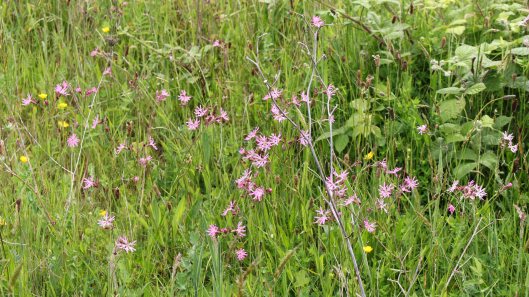
Ragged robin (Silene flos-cuculi) certainly lives up to its name. To me, it always looks a tad stressed, a touch frayed around the edges, a bit frazzled, as if it’s had a long hard day in the meadows, but its distinctive ragged shape does at least make it one of the easiest British wildflowers to identify.

Ragged robin (4)

I say ‘always’ but I don’t actually see this pretty native very often. Perhaps that’s because it prefers to dip its feet into the damper grass- and woodlands, though the word is that it has declined in recent years in many parts of Britain, mostly due to agriculture taking over its habitats.

Ragged robin (2)
Ragged robin (3)

It was, then, even more special to spot these plants in one of my local wild places this week, and I wasn’t the only one smiling at the sight. The bees were obviously pleased to see them too! Ragged Robin flowers from May through to August so I hope you’re lucky enough to spot some too.

Ragged robin (1)

Like Loading...

Botanising: A walk above Brynna

28 Sunday May 2017

Posted by sconzani in nature, plants, wildflowers

≈ 5 Comments

Tags

botany mentee, British flora, Bush vetch, Common vetch, Field horsetail, Glamorgan Botany Group, Mouse-ear hawkweed, Welsh poppy, Zigzag clover

Last weekend I enjoyed another full day’s walk with the Glamorgan Botany Group in the hills and vales above Brynna, in south Wales, and, though I am the first to admit that I came home with more photos of insects than plants, I am learning. It’s just that, for someone who wasn’t brought up in Britain and so didn’t learn from an early age the names of even the most common wildflowers, there’s a huge amount to take in.

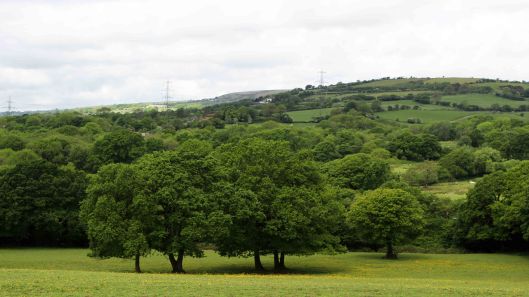
170528 Brynna

So, what have I learnt? I can now tell the difference between Common vetch (Vicia sativa), on the left, and Bush vetch (Vicia sepium), on the right below.

170528 2 Common vetch
170528 3 Bush vetch

I know this is Field horsetail (Equisetum arvense) because the first joints of the leaves (which form a skirt around the stem when you break them off) are longer than the stem section (the little dark v-shaped marks on the stem in this photo).

170528 1 Field horsetail

Though the two species are very similar, I know this is not Red clover (Trifolium pratense) but rather Zigzag clover (Trifolium medium) partly because the white marks on its leaves are not as obvious but, most definitively, because at the widest part of the leaf the veins meet the edge at a 90 degree angle.

170528 4 Zigzag clover (1)
170528 4 Zigzag clover (2)

I know that the plant on the left is Mouse-ear hawkweed (Hieracium pilosella) and that beautiful flower on the right is my very first Welsh poppy (Meconopsis cambrica) growing in the wild!

170528 Mouse-ear hawkweed
170528 Welsh poppy
Like Loading...
← Older posts
Newer posts →

About me

sconzani

sconzani

I'm a writer and photographer; researcher and blogger; birder and nature lover; countryside rambler and city strider; volunteer and biodiversity recorder.

View Full Profile →

Follow earthstar on WordPress.com

Enter your email address to follow this blog and receive notifications of new posts by email.

Recent blog posts

  • Birch polypore January 30, 2026
  • The Marl Med gull January 29, 2026
  • Recording Grey squirrels January 28, 2026
  • Jimmy Wren January 27, 2026
  • Millipede: Nanogona polydesmoides January 26, 2026

From the archives

COPYRIGHT

Unless otherwise acknowledged, the text and photographs on this blog are my own and are subject to international copyright. Nothing may be downloaded or copied without my permission.

Fellow Earth Stars!

  • Unknown's avatar
  • Unknown's avatar
  • Unknown's avatar
  • Unknown's avatar
  • Unknown's avatar
  • Unknown's avatar
  • Unknown's avatar
  • Unknown's avatar
  • Unknown's avatar
  • Unknown's avatar
  • Unknown's avatar
  • Unknown's avatar
  • Unknown's avatar
  • Unknown's avatar
  • Unknown's avatar
  • Unknown's avatar
  • Unknown's avatar
  • Unknown's avatar
  • Unknown's avatar
  • Unknown's avatar
  • Unknown's avatar
  • Unknown's avatar
  • Unknown's avatar
  • Unknown's avatar
  • Unknown's avatar
  • Unknown's avatar
  • Unknown's avatar
  • Unknown's avatar
  • Unknown's avatar
  • Unknown's avatar
  • Unknown's avatar
  • Unknown's avatar
  • Unknown's avatar
  • Unknown's avatar
  • Unknown's avatar
  • Unknown's avatar
  • Unknown's avatar
  • Unknown's avatar
  • Unknown's avatar
  • Unknown's avatar
  • Unknown's avatar
  • Unknown's avatar
  • Unknown's avatar
  • Unknown's avatar
  • Unknown's avatar
  • Unknown's avatar
  • Unknown's avatar
  • Unknown's avatar
  • Unknown's avatar
  • Unknown's avatar

Blog at WordPress.com.

Privacy & Cookies: This site uses cookies. By continuing to use this website, you agree to their use.
To find out more, including how to control cookies, see here: Cookie Policy
  • Subscribe Subscribed
    • earthstar
    • Join 670 other subscribers
    • Already have a WordPress.com account? Log in now.
    • earthstar
    • Subscribe Subscribed
    • Sign up
    • Log in
    • Report this content
    • View site in Reader
    • Manage subscriptions
    • Collapse this bar
 

Loading Comments...
 

You must be logged in to post a comment.

    %d