• ABOUT
  • BIRDING 2018
  • Birding 2019
  • BLOG POSTS
  • Butterflies 2018
  • Resources

earthstar

~ a celebration of nature

earthstar

Tag Archives: British insects

Insects of the zigzag path

23 Saturday Jun 2018

Posted by sconzani in flowers, insects, nature, walks, wildflowers

≈ 3 Comments

Tags

#30DaysWild, British butterflies, British insects, flowers for pollinators, National Insect Week, Penarth, wildflowers, Zigzag path

180623 zigzag insects (1)

For day 23 of #30DaysWild, as it’s National Insect Week, I went seeking insects along one my local trails, the zigzag path that runs from upper Penarth down to the marina. This was once a heavily wooded hillside but now has a concrete path that gives pedestrians and cyclists easy access up and down the steep hill. Of course, people sometimes want a more direct route and you can see that the frequent stomping of feet has worn alternate paths down the hillside.

180623 zigzag path

Though it looks quite grassy in this photo from a couple of weeks ago, the hillside is now a mass of self-sown native wildflowers and today it was alive with insects, from bees and hoverflies to butterflies, beetles and damselflies. This is a perfect site for wildflowers to grow – it is steep so difficult and presumably expensive to mow, and its steepness means it can’t be safely used by children playing (though, with a covering of snow, it is perfect for sledging!).

180623 zigzag insects (2)
180623 zigzag insects (3)
180623 zigzag insects (4)
180623 zigzag insects (5)

Though the local council usually strim this slope to death, utterly destroying the wildflowers and the wildlife, they have recently – and rather ironically – ploughed up a small flat area and dumped upon it soil seeded with wildflowers. That might sound hopeful, a positive action, but the ploughed area has not been maintained and, though I may be wrong, I doubt whether the wildflowers were locally sourced. I wonder too why the council would go to the expense of ploughing up perfectly good local wildflowers to plant others – do they think wildflowers should only be of the type they prescribe and only grow within a prescribed rectangular area? Surely they misunderstand the very essence of WILDflowers.

180623 zigzag insects (6)
180623 zigzag insects (7)
180623 zigzag insects (8)
180623 zigzag insects (9)

This blog post, then, is partly a celebration of the amazing variety of insects that enjoy the wildflowers that grow naturally around the zigzag path and partly a plea to the council not to kill those wildflowers and their pollinators but instead to celebrate and foster this wonderfully biodiverse area of Penarth.

180623 zigzag insects (10)
180623 zigzag insects (11)
180623 zigzag insects (12)
180623 zigzag insects (13)
180623 zigzag insects (14)
180623 zigzag insects (15)
Like Loading...

The bug called Grypo

20 Wednesday Jun 2018

Posted by sconzani in insects, nature

≈ Leave a comment

Tags

#30DaysWild, 30 Days Wild, British insects, Grypocoris stysi, National Insect Week, plant bug

180620 Grypocoris stysi (1)

On day 20 of #30DaysWild, I went looking for plant bugs – it is National Insect Week after all – and I found newly opened umbellifer flower heads fairly swarming with the unmistakeable plant bug, Grypocoris stysi. Look for them during June and July, mostly feasting on the pollen of umbellifer and nettle flowers, though they’re also quite partial to the occasional aphid. There are over 10,000 species of plant / leaf / grass bugs, but little Grypo’s distinctive markings mean it’s one that’s easy to identify.

180620 Grypocoris stysi (2)
180620 Grypocoris stysi (3)
180620 Grypocoris stysi (4)
180620 Grypocoris stysi (5)
Like Loading...

Fat thighs are cool!

19 Tuesday Jun 2018

Posted by sconzani in flowers, insects, nature, wildflowers

≈ 2 Comments

Tags

#30DaysWild, 30 Days Wild, British beetles, British insects, Common spotted orchid, National Insect Week, Oedemera nobilis, Swollen-thighed beetle

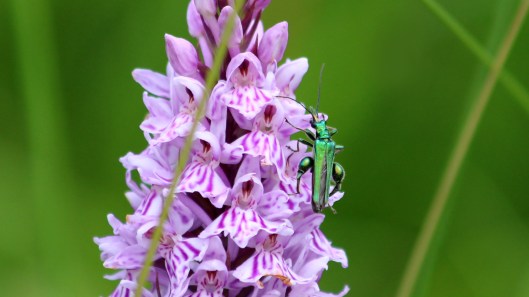
Not only is this day 19 of #30DaysWild, but today is also the second day of National Insect Week. To celebrate, here is one of my favourite British insects, the Swollen-thighed Beetle (Oedemera nobilis). I see these little guys on almost every type of flower at this time of year  – this one’s on a Common spotted-orchid – and they always make me smile. It’s the male beetles that have those fat thighs – I haven’t been able to find out why, so if you know, please do tell.

180619 Swollen-thigh beetle

Like Loading...

Practising stealth

07 Thursday Jun 2018

Posted by sconzani in insects, nature, nature photography

≈ 2 Comments

Tags

#30DaysWild, 30 Days Wild, British insects, insects, practising macro photography

For day 7 of #30DaysWild I decided to spend a couple of hours practising my stealth tactics during a walk along the coastal path from Penarth to Lavernock. Sometimes I photograph wildlife with my DSLR camera but I also have a point-and-shoot camera with a macro feature that is good for capturing close-up detail. The only trouble is that you need to get the camera as close as possible to your subject – and I am talking close – no more than a couple of inches away. As you might imagine, this tends to freak out and frighten off a lot of creatures, but I find that if I approach slowly, watch the light and shadow, make no noise, then I can often get very close. Here are the ones I didn’t freak out or frighten off today. I think I did quite well.

180607 creatures (1)
180607 creatures (2)
180607 creatures (3)
180607 creatures (4)
180607 creatures (5)
180607 creatures (6)
180607 creatures (7)
180607 creatures (8)
180607 creatures (9)
180607 creatures (10)
180607 creatures (11)
180607 creatures (12)
180607 creatures (13)
180607 creatures (14)
180607 creatures (15)
180607 creatures (16)
180607 creatures (17)
180607 creatures (18)
180607 creatures (19)
180607 creatures (20)
180607 creatures (21)
180607 creatures (22)
180607 creatures (23)
180607 creatures (24)
180607 creatures (25)
180607 creatures (26)
180607 creatures (27)
180607 creatures (28)
Like Loading...

The Shieldbug red-light district

22 Tuesday May 2018

Posted by sconzani in insects, nature

≈ Leave a comment

Tags

British insects, Dolycoris baccarum, Green shieldbug, Hairy shieldbug, Palomena prasina, shield bugs, shieldbug

There’s a little track I often walk down, or up, between my home and Penarth Marina, that’s not been touched by the Council’s destructive strimmers (so far), so it’s a great place to look for wildflowers and critters, and it can take me 30 minutes or more to walk its 100 metres.

OLYMPUS DIGITAL CAMERA

When I walked this way the other day, I came across this little Green shieldbug (Palomena prasina). Just look at that innocent-looking face … but don’t be fooled. It was probably the only one of maybe 30 Green shieldbugs I saw that was on its own – all the others were working on ensuring the continuation of their species.

OLYMPUS DIGITAL CAMERA

Even the Hairy shieldbugs (Dolycoris baccarum) I found (only 3 of those) were at it! Given all the bad news we hear these days about declining insect populations, I hope this means the shieldbugs are doing okay.

OLYMPUS DIGITAL CAMERA
Like Loading...

Cool craneflies

10 Thursday May 2018

Posted by sconzani in insects, nature

≈ Leave a comment

Tags

British insects, crane fly, cranefly, Nephrotoma appendiculata, Tipula oleracea, Tipula species

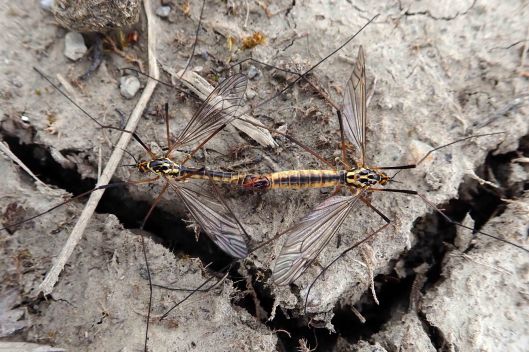
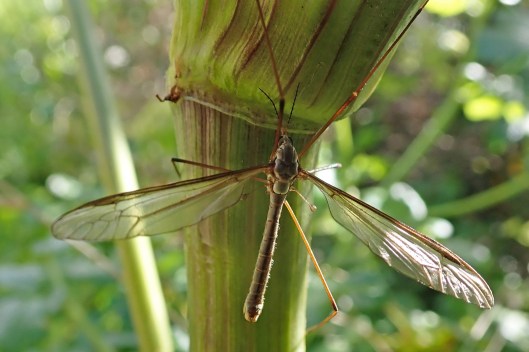
When I was a kid I always knew these insects as Daddy long legs and thought they were a bit creepy the way they fluttered wildly around. Now I know them as Craneflies and think they’re really cool. Incredibly, there are around 300 species of Cranefly in Britain – yet another insect species to try to learn – sometimes my brain hurts! Luckily, there is a Cranefly Recording Scheme (CRS) and they’re on Twitter so I’ve been able to get expert and very friendly help with my IDs for these recent sightings, and a little bit of information about each as well.

180510 Nephrotoma appendiculata

For this one, CRS said: ‘That will be Nephrotoma appendiculata at this time of the year. A side on photo would definitely confirm it but given it is still April I’m happy with this species, one of rough grassland, verges etc.’ And very soon there will be many more of them!

180510 Tipula oleracea

And this one is ‘Tipula oleracea, the other common Tipula (Tipula) species. [I had wrongly thought it might be Tipula paludosa.] Typically a May species in dampish grassland. Larvae feed on grass roots.’

So, if you’re fascinated by Craneflies, why not give the Cranefly Recording Scheme a follow on Twitter?

Like Loading...

Wild word: phototaxis

02 Wednesday May 2018

Posted by sconzani in insects, nature

≈ 2 Comments

Tags

#WildWords, attracted to light, British insects, Chironomidae species, non-biting midge, phototaxis, repelled by light, wild words

Phototaxis: noun; biology; the bodily movement of a motile organism in response to light, either towards the source of light (positive phototaxis) or away from it (negative phototaxis) (Oxford Dictionary).
I hadn’t realised that some creatures suffer from negative phototaxis but, apparently, cockroaches are repelled by light – I thought they were just scurrying away from the humans who want to kill them. The example of positive phototaxis (i.e. an attraction to a light source) that immediately springs to mind is the moth – I’m sure we’ve all noticed them fluttering around a bright light at night – though there are many other examples. One of these is the insect in my photos: it’s one of the large family of non-biting midges (Chironomidae species). I found perhaps 30 of them on a wall near a street light recently.

OLYMPUS DIGITAL CAMERA
Like Loading...

Signs of spring: Bee-flies

07 Saturday Apr 2018

Posted by sconzani in insects, nature, spring

≈ 6 Comments

Tags

Bee-fly, Bombylius major, British insects, signs of spring

Last Wednesday was a ‘B’ day – not ‘B’ as in ‘B-rated’ or in any way inferior – in fact, in that sense, it was an A+ day. I named it a ‘B’ day because I saw my first Butterflies of 2018, my first Blackcap, and my first Bee-flies – and not just one Bee-fly, but a total of seven!

180407 bee-flies (7)

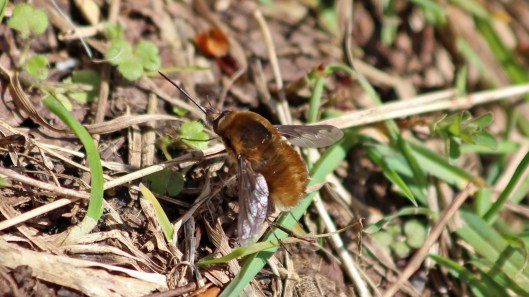
The Bee-fly (officially Bombylius major) is a strange-looking mini-beastie, a weird and wonderful combination, all the cuteness of a furry teddy-bear but with the sinister look of a sword fish. Never fear, it is entirely harmless to humans, though it does lay its eggs in the nests of bees and wasps, where the bee-fly larvae feast on the bee and wasp larvae. Its sword-shaped proboscis is no stinging machine – it’s used exclusively for drinking nectar from flowers. These are springtime mini-beasties, out now in sunny spots in your garden or local hedgerow.

180407 bee-flies (1)
180407 bee-flies (2)
180407 bee-flies (3)
180407 bee-flies (4)
180407 bee-flies (5)
180407 bee-flies (6)
Like Loading...

Leafmines 101

13 Saturday Jan 2018

Posted by sconzani in insects, leaves, nature, plants, trees

≈ 5 Comments

Tags

British insects, homes of insect larvae, insect larvae in leaves, leaf mine, leafmine, leafminer, mines on leaves

Leafmines and their miners are a subject I started to look at last summer but I quickly discovered that, in order to identify the miner, you had to know the plant they were mining, so I needed to improve my botanical knowledge before I could go much further. That effort has begun, and is ongoing, so I will start to look again at the miners in the coming months.

180113 leafmines (1)
180113 leafmines (2)

Firstly though, in case you don’t know, leafmines are made by the larvae of various insects. The mines are their homes and their larders – as well as providing them with some degree of protection from predators, the larvae eat the tissue of the leaves they live within, thus creating their mines. The larvae can be the immature stages of various species of flies, sawflies or moths, and, apparently, some beetles also mine leaves.

180113 leafmines (3)
180113 leafmines (4)

If you look at a mine, you will often see a tiny hole at one end, which means the creature that made it has left the premises, to pupate or to being life as an adult. Sometimes, you can still see the larva within, and you can often also see the pooh (known as frass) it has left behind as it eats and tunnels.

180113 leafmines (5)
180113 leafmines (6)

The shapes of the mines can vary considerably, from long meandering or straight lines to roundish blotches, and these shapes, plus the placement of the mine within the leaf (some occupy just the upper or lower surface, some go right through) and the identity of the plant, are the main ways to determine which creature has made the mine.

**p.s. Since posting this, I’ve been told what I thought was a leaf mine on ivy (the photo on the right in the middle) is actually caused by a fungus, possibly Phoma hedericola, the most common leaf spot of ivy. I can see these leafmines are going to be even more tricky than I anticipated!

Like Loading...

Keeping it in the family

12 Tuesday Sep 2017

Posted by sconzani in insects, nature

≈ 3 Comments

Tags

British insects, Green shieldbug, Lesser burdock, shield bugs, shieldbug

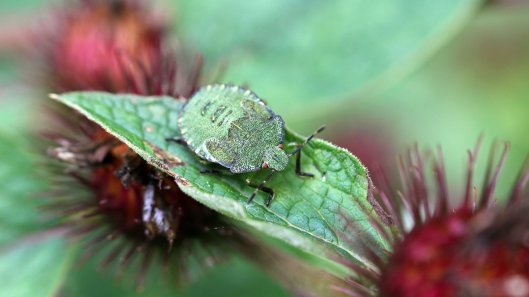
I was checking out a Burdock plant the other day (I rather like their flowers and seed heads, and they have their own special fly) when I suddenly noticed this Green shieldbug and then another one, and another one, and another one …

170912 Green shield bug family (1)

Turns out there was at least one adult and six nymphs, though more may have been lurking undiscovered. I’m assuming they were all members of the same family, but that is pure surmise.

170912 Green shield bug family (2)
170912 Green shield bug family (3)
170912 Green shield bug family (4)
170912 Green shield bug family (5)
170912 Green shield bug family (6)
170912 Green shield bug family (7)
Like Loading...
← Older posts
Newer posts →

About me

sconzani

sconzani

I'm a writer and photographer; researcher and blogger; birder and nature lover; countryside rambler and city strider; volunteer and biodiversity recorder.

View Full Profile →

Follow earthstar on WordPress.com

Enter your email address to follow this blog and receive notifications of new posts by email.

Recent blog posts

  • My first moth of the year February 18, 2026
  • Three Common sandpipers February 17, 2026
  • Beetle: Athous bicolor February 16, 2026
  • Crocus flower power February 15, 2026
  • Delightful doves February 14, 2026

From the archives

COPYRIGHT

Unless otherwise acknowledged, the text and photographs on this blog are my own and are subject to international copyright. Nothing may be downloaded or copied without my permission.

Fellow Earth Stars!

  • Unknown's avatar
  • Unknown's avatar
  • Unknown's avatar
  • Unknown's avatar
  • Unknown's avatar
  • Unknown's avatar
  • Unknown's avatar
  • Unknown's avatar
  • Unknown's avatar
  • Unknown's avatar
  • Unknown's avatar
  • Unknown's avatar
  • Unknown's avatar
  • Unknown's avatar
  • Unknown's avatar
  • Unknown's avatar
  • Unknown's avatar
  • Unknown's avatar
  • Unknown's avatar
  • Unknown's avatar
  • Unknown's avatar
  • Unknown's avatar
  • Unknown's avatar
  • Unknown's avatar
  • Unknown's avatar
  • Unknown's avatar
  • Unknown's avatar
  • Unknown's avatar
  • Unknown's avatar
  • Unknown's avatar
  • Unknown's avatar
  • Unknown's avatar
  • Unknown's avatar
  • Unknown's avatar
  • Unknown's avatar
  • Unknown's avatar
  • Unknown's avatar
  • Unknown's avatar
  • Unknown's avatar
  • Unknown's avatar
  • Unknown's avatar
  • Unknown's avatar
  • Unknown's avatar
  • Unknown's avatar
  • Unknown's avatar
  • Unknown's avatar
  • Unknown's avatar
  • Unknown's avatar
  • Unknown's avatar
  • Unknown's avatar

Blog at WordPress.com.

Privacy & Cookies: This site uses cookies. By continuing to use this website, you agree to their use.
To find out more, including how to control cookies, see here: Cookie Policy
  • Subscribe Subscribed
    • earthstar
    • Join 670 other subscribers
    • Already have a WordPress.com account? Log in now.
    • earthstar
    • Subscribe Subscribed
    • Sign up
    • Log in
    • Report this content
    • View site in Reader
    • Manage subscriptions
    • Collapse this bar
 

Loading Comments...
 

You must be logged in to post a comment.

    %d