• ABOUT
  • BIRDING 2018
  • Birding 2019
  • BLOG POSTS
  • Butterflies 2018
  • Resources

earthstar

~ a celebration of nature

earthstar

Tag Archives: British moth

Two in two days

04 Tuesday Sep 2018

Posted by sconzani in insects, nature

≈ 4 Comments

Tags

Aplocera plagiata, British moth, moth, moths, Treble-bar

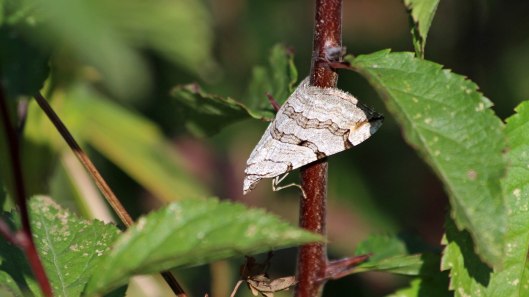
I’d only ever seen this beautifully patterned moth once before so it was a treat last week to see two of them on two consecutive days. Despite having a guide book, I always find moths difficult to identify but this one, the Treble-bar (Aplocera plagiata), lives up to its name rather nicely. Having said that, there is a chance these could be Lesser Treble-bars but they are much less common so I’m assuming they’re not (and I wasn’t able to check the ends of their abdomens to be sure!).

180904 treble bar (1)

These are probably second generation moths, the first having emerged, mated, laid, munched, pupated during May and June, and the second now going through that process during August and September.

180904 treble bar (2)

Like Loading...

A Jersey tiger!

12 Saturday Aug 2017

Posted by sconzani in insects, nature

≈ 7 Comments

Tags

British moth, Euplagia quadripunctaria, Jersey tiger, Lavernock Nature Reserve, moth

170812 Jersey tiger (1)

Ooo look, a Red admiral … hang on a minute … what’s that???!!!

I went looking for migrant birds at high tide at Sully beach – and found nothing more exotic than some Rock pipits and Turnstones – but my walk home, along the coastal path, took me through Lavernock Nature Reserve and there I got lucky. There I found an altogether different migrant, a beautiful Jersey tiger (Euplagia quadripunctaria).

170812 Jersey tiger (3)

Obviously, it’s not a mammal that’s swum across the Channel from Jersey: it’s a moth. It may also not have been an immigrant, as colonies have become established in a couple of places along the southern English coast in recent years. It is still, however, not so common in Wales, with only 24 records in the national database.

170812 Jersey tiger (4)
170812 Jersey tiger (5)

As you can see, it has gorgeous and quite distinctive markings – just look at that bright orange underwing! – so there was no mistaking what it was. Let’s hope a few other Jersey tigers arrive to establish a colony in Lavernock’s wonderful wildflower meadows.

170812 Jersey tiger (2)

Like Loading...

Hilary’s moths

06 Tuesday Jun 2017

Posted by sconzani in insects, nature

≈ 9 Comments

Tags

Bright-line Brown-eye, British moth, Buff ermine, Garden Grass-veneer, Ingrailed clay, moth, moths, The Spectacle

When I arrived at my friend Hilary’s house early Saturday morning, to hitch a ride to our monthly fungi foray, she had a wonderful surprise for me. She had put her moth trap out the previous night and had kept the moths for me to have a look at before she released them. (In case you’re wondering, trapping is really the only way to record and monitor the moth population, and it’s done in a way that usually causes no harm to the moths.) Here are some of the beauties I saw …

170606 Agriphila geniculea

One of the Crambidae or grass moths, the Garden Grass-veneer (Chrysoteuchia culmella)

170606 Buff ermine

I blogged about the White ermine recently – this is its cousin the Buff ermine (Spilosoma lutea).

170606 Heart and Dart (1)
170606 Heart and Dart (2)

Heart & Dart (Agrotis exclamationis), named for the heart- and dart-shaped markings on its wings.

170606 Ingrailed clay (1)
170606 Ingrailed clay (2)

Ingrailed clay (Diarsia mendica). Its name is a mystery but its caterpillars live on brambles and bilberries.

170606 Bright-line brown-eye

Bright-line Brown-eye (Lacanobia oleracea). Don’t you just love the common names of moths?

170606 Spectacle (1)
170606 Spectacle (2)

And, last but certainly not least, this amazing creature, for fairly obvious reasons, is called The Spectacle (Abrostola tripartita).

Like Loading...

Moths in the light of day

01 Thursday Jun 2017

Posted by sconzani in insects, nature

≈ 5 Comments

Tags

British moth, Camptogramma bilineata, Euclidia mi, moth, Mother Shipton, Silver-ground Carpet, Spilosoma lubricipeda, White Ermine, Xanthorhoe montanata, Yellow Shell

In the absence of butterflies, I seem to be discovering more moths. (I’m not sure why I’m not seeing many butterflies, though a friend says there’s often a May lull before a June explosion – let’s hope that’s true.)

170601 White ermine (1)
170601 White ermine (2)

White Ermine (Spilosoma lubricipeda)
I found this beauty, wearing the rather regal furry coat that gives it its name, lurking in a clump of tall grass. Flying between May and July, with an occasional second generation appearing in September–October, the White Ermine can be found throughout Britain in a variety of habitats, from heath- and moorland to gardens, hedgerows and woodlands.

170601 Silver-ground Carpet

Silver-ground Carpet (Xanthorhoe montanata)
This pretty member of the carpet group of moths was a lucky find at Cosmeston Lakes Country Park, where I chanced to spot it resting in a clump of grass in a small woodland area. It’s another May to July flier, and its caterpillars enjoy nothing better than a good munch on bedstraws, the plants of the Galium species.

170601 Yellow shell
170601 Mother Shipton

Yellow Shell and Mother Shipton
Both of these images were grab shots from a recent walk around the former rubbish tip that is now Grangemoor Park, in Cardiff. Moths have a habit of not wanting to be disturbed by camera lenses thrust in their direction, I notice, so my apologies that my photos are not very sharp.

I wish the Yellow shell (Camptogramma bilineata) (above left) hadn’t flitted off so quickly as I love its bright markings that resemble the line patterns found on some seashells, hence its name. It’s another common find throughout Britain, though it does have a preference for damper places. Its larvae feed on low-growing plants like sorrel and chickweed so look for it around that type of vegetation, usually between May and August.

Can you see why Mother Shipton (Euclidia mi) (above right) is so named? Those markings on her wings supposedly resemble a witch’s face and she is named for Old Mother Shipton, a 16th-century witch from Yorkshire who produced a series of dire prophecies. The moth, on the other hand, can be found all over Britain and Ireland, though has a particular fondness for the flower-rich meadows where grow the clovers, medics and lucernes its caterpillars like to eat.

Like Loading...

A bumper day for butterflies, and a moth

13 Saturday May 2017

Posted by sconzani in insects, nature, parks

≈ Leave a comment

Tags

Aglais io, Brimstone, British butterflies, British moth, butterflies, butterfly, Common blue, Cyclophora annularia, Dingy Skipper, Erynnis tages, Gonepteryx rhamni, moth, Pararge aegeria, Peacock, Polyommatus icarus, Speckled wood, The Mocha

Blue skies, warm temperatures, wildflowers in bloom – what more could a butterfly want? Not much it seems as they were out in force at Cosmeston Lakes Country Park and I spent several happy hours following them around, trying to get photographs but also just intrigued by their flight patterns, the food plants they were choosing and their general behaviour. The Whites, large and small, eluded my lens, as did several Orange-tips and one Red Admiral but I did manage to snap these six.

170513 (1) Brimstone
170513 (2) Common blue
170513 (3) Peacock

The first is a Brimstone butterfly (Gonepteryx rhamni), not to be confused with the moth of the same name. I saw two flying together, land together and then the male heading purposefully towards the female. Turns out though that her spreading her wings and raising her abdomen in the air was not a ‘come hither’ signal but rather the opposite. She was indicating that she had already mated and was rebuffing the male. I saw several Common blues (Polyommatus icarus), also easily confused with other very similar small blue butterflies. They are so vibrant! And seeing a Peacock (Aglais io) is always a treat, though this one was looking a little battered.

170513 (4) Speckled wood
170513 (5) Dingy skipper
170513 (6) Mocha moth

Speckled woods (Pararge aegeria) seem to be the butterflies I see most often wherever I go but I love their pretty dappling of brown and cream. The next was a new one for me and I saw two of them – it’s a Dingy Skipper (Erynnis tages), a butterfly whose caterpillars feed on Bird’s-foot trefoil so it’s often found on the short impoverished grasslands of former coal tips, rubbish tips and quarries. I’ve just learnt that it’s called Dingy because ‘it loses scales alarmingly as it get older so looks, well, dingy’ (thanks, Steven). The last is not a butterfly but a moth and rather a special moth, The Mocha (Cyclophora annularia). This moth is nationally scarce but more frequent in the woodlands of southern Britain so I was well pleased with this sighting.

Like Loading...

Lackey me!

29 Saturday Apr 2017

Posted by sconzani in insects, nature

≈ 3 Comments

Tags

British moth, caterpillar, Lackey caterpillars, Malacosoma neustria, moth, moth caterpillar web, The Lackey

To the arachnophobes out there, I just want to reassure you that not all webs are made by spiders. Some are home to really cute caterpillars like these that I was lucky enough to spot on a recent walk.

170429 Lackey moth Malacosoma neustria caterpillars (3)

Native to central Europe and southern Britain, these are Lackey moth (Malacosoma neustria) caterpillars, pretty little blue-and-orange-and-white-striped crawlies that live happily together in a silken web they’ve spun for themselves amongst the blackthorn, hawthorn and other trees and shrubs that are their food plants. They began life as eggs that were laid towards the end of last summer but didn’t hatch until this spring, meaning these little creatures will have spent around half their lives as eggs. In a few weeks, when they’re munched their way through plenty of leaves and moulted a few times, these caterpillars will drop to the ground and pupate. Once the summer comes, they’ll hatch and the adult moths will be seen flying in and around these hedgerows during July and August – something to look forward to, though the moth is a little drab in comparison to its offspring.

170429 Lackey moth Malacosoma neustria caterpillars (1)
170429 Lackey moth Malacosoma neustria caterpillars (2)

p.s. I cannot take the credit for today’s catchy title. I pinched it from my friend Mark, who used it to comment on another friend’s Lackey web find on Facebook.

Like Loading...

Check out these shades

25 Tuesday Apr 2017

Posted by sconzani in insects, nature

≈ 8 Comments

Tags

Angle shades, British moth, moth, Phlogophora meticulosa

170425 Phlogophora meticulosa Angle shades moth (1)

Isn’t this a beauty? I don’t manage to see many moths (and, as I live in a first-floor flat, I can’t use a moth trap) so I was delighted to see my first Angle shades moth (Phlogophora meticulosa), sunbathing on south-facing stone wall the other day. Its common name is a reference both to the sharp angle of the darker patterns on its wings and to the numerous shades of colour in those patterns. The UK Moths website likens it to a withered autumn leaf, not a very flattering comparison for such a lovely creature.

170425 Phlogophora meticulosa Angle shades moth (2)

Angle shades moths are usually seen flying from May through to October so this one, like so many insects this year, is out and about a little early. They can be found throughout Europe and in parts of the Middle East and are, apparently, strongly migratory, as a result of which they are sometimes seen in large numbers in southern coastal areas of Britain. Wouldn’t that be a sight to see!

Like Loading...

The Silver Y moth

18 Monday Jul 2016

Posted by sconzani in insects, nature

≈ 6 Comments

Tags

Autographa gamma, British moth, migratory moth, moth, Silver Y, Silver Y moth

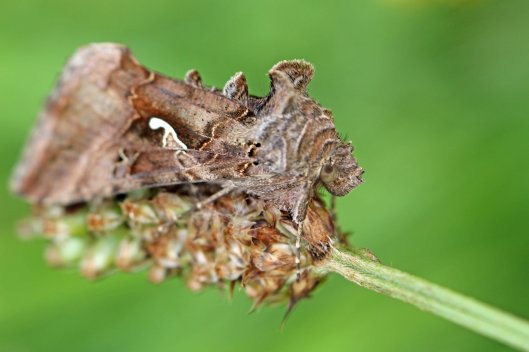
When I first spotted this little moth clinging upside down to a flowerhead of Ribwort plantain, I thought it was a pupa of some kind. It was only when I got really close with my camera that I noticed a little eye watching me. Though it must’ve been a bit shocked to see a giant with a black box looming over it, it didn’t move. Even as I rotated the stem this way and that to get photos from different angles, it stayed perfectly still. Maybe it was petrified or maybe it just felt assured that its perfect camouflage meant it wouldn’t be harmed – and it certainly wasn’t harmed. And I was overjoyed to see such a gorgeous creature.

160718 silver y moth (2)

It’s a Silver Y moth (Autographa gamma), named for the little white marking on its forewings that looks like a Y or, if you know your Greek alphabet, a gamma. Though they can be found in the warmer parts of Britain all year round, these little creatures (with a wingspan of 30-45mm) are also migratory. In spring, they fly from the southern parts of Europe and from north Africa as far north as Greenland, Iceland and the Scandinavian countries, sometimes arriving in Britain in their thousands. Look for them on their favourite food plants, the clovers, Common nettle, and the peas and cabbages in your vegetable garden.

160718 silver y moth (1)
160718 silver y moth (3)
Like Loading...

About me

sconzani

sconzani

I'm a writer and photographer; researcher and blogger; birder and nature lover; countryside rambler and city strider; volunteer and biodiversity recorder.

View Full Profile →

Follow earthstar on WordPress.com

Enter your email address to follow this blog and receive notifications of new posts by email.

Recent blog posts

  • M is for mite December 18, 2025
  • L is for lepidopteran lifers December 17, 2025
  • K is for Keeled skimmers December 16, 2025
  • J is for Jersey tiger December 15, 2025
  • I is for Ichneumon December 14, 2025

From the archives

COPYRIGHT

Unless otherwise acknowledged, the text and photographs on this blog are my own and are subject to international copyright. Nothing may be downloaded or copied without my permission.

Fellow Earth Stars!

  • Unknown's avatar
  • Unknown's avatar
  • Unknown's avatar
  • Unknown's avatar
  • Unknown's avatar
  • Unknown's avatar
  • Unknown's avatar
  • Unknown's avatar
  • Unknown's avatar
  • Unknown's avatar
  • Unknown's avatar
  • Unknown's avatar
  • Unknown's avatar
  • Unknown's avatar
  • Unknown's avatar
  • Unknown's avatar
  • Unknown's avatar
  • Unknown's avatar
  • Unknown's avatar
  • Unknown's avatar
  • Unknown's avatar
  • Unknown's avatar
  • Unknown's avatar
  • Unknown's avatar
  • Unknown's avatar
  • Unknown's avatar
  • Unknown's avatar
  • Unknown's avatar
  • Unknown's avatar
  • Unknown's avatar
  • Unknown's avatar
  • Unknown's avatar
  • Unknown's avatar
  • Unknown's avatar
  • Unknown's avatar
  • Unknown's avatar
  • Unknown's avatar
  • Unknown's avatar
  • Unknown's avatar
  • Unknown's avatar
  • Unknown's avatar
  • Unknown's avatar
  • Unknown's avatar
  • Unknown's avatar
  • Unknown's avatar
  • Unknown's avatar
  • Unknown's avatar
  • Unknown's avatar
  • Unknown's avatar
  • Unknown's avatar

Blog at WordPress.com.

Privacy & Cookies: This site uses cookies. By continuing to use this website, you agree to their use.
To find out more, including how to control cookies, see here: Cookie Policy
  • Subscribe Subscribed
    • earthstar
    • Join 667 other subscribers
    • Already have a WordPress.com account? Log in now.
    • earthstar
    • Subscribe Subscribed
    • Sign up
    • Log in
    • Report this content
    • View site in Reader
    • Manage subscriptions
    • Collapse this bar
 

Loading Comments...
 

You must be logged in to post a comment.

    %d