• ABOUT
  • BIRDING 2018
  • Birding 2019
  • BLOG POSTS
  • Butterflies 2018
  • Resources

earthstar

~ a celebration of nature

earthstar

Tag Archives: British moths

307/366 Leaf mines: Tischeria ekebladella

02 Monday Nov 2020

Posted by sconzani in autumn, insects

≈ Leave a comment

Tags

blotch mines on Oak, British moths, leaf mines on Oak, moth larvae, moth larvae in leaf mines, moth leafmines, Tischeria ekebladella

I mentioned in a recent post (Gone galling, again, 28 October) that October was a good month to find galls and mines on leaves and, in fact, that also extends into November, or until the deciduous trees have shed their leaves and those fallen leaves have turned to mush, and the leaves of wild plants have also become unrecognisable in the mud under our feet.

201102 Tischeria ekebladella (1)

So, let’s start this mini series on leaf mines with a look at the blotch mines made on Oak (and sometimes Sweet chestnut) by the larvae of the micro moth Tischeria ekebladella. The blotch starts off looking quite white but often browns, from the centre, with age, giving it a look that one astute observer described as a fried egg. The larva creates a cocoon within the blotch and remains there until its ready to pupate in the springtime. The adult moth emerges from pupation and is on the wing in May and June.

201102 Tischeria ekebladella (2)
201102 Tischeria ekebladella (3)

By holding leaves up to the light, I managed to photograph larvae within a couple of mines, though, one of our local moth experts, George, who’s a senior moth ecologist with Butterfly Conservation, told me that the larva in the photo on the right below looks to have been parasitised and a different creature’s larva seems to have emerged from the Tischeria larva. Such is the way of Nature.

201102 Tischeria ekebladella (4)
201102 Tischeria ekebladella (5)
Like Loading...

293/366 Stigmella aceris

19 Monday Oct 2020

Posted by sconzani in autumn, insects, leaves, trees

≈ 5 Comments

Tags

British moths, Field maple, leaf mines on maple, leaf-mining moth larvae, leafminer, Norway maple, Scarce Maple pigmy, Stigmella aceris

I’ve been hunting for leaf mines in recent days, the mines made by the larvae of the micro moth Stigmella aceris, which can be found at this time of year on the leaves of Norway and Field maples. Unfortunately, I haven’t made any finds of my own but my Twitter pal Gareth had the honour of finding the first mines in the Vale of Glamorgan last week so I went and checked out his find site to get a look at the mines for myself.

201019 leafmine (1)

According to the UK Moths website, this moth was classified as rare until 40 years ago, when it began increasing its range ‘dramatically’. It can now be found throughout central and southern England, and also in south Wales – it was found for the first time in Cardiff in November 2019.

201019 leafmine (2)

I’ve never seen the adult moth, which has the common name of Scarce maple pigmy – and probably never will – but you can see a photo of it on the British Lepidoptera weebly site here.
201019 leafmine (3)
201019 leafmine (4)

And now I’m heading out to check more Maple trees before their leaves all fall and turn to mush …

201019 leafmine (5)

Like Loading...

255/366 Knot grass larvae

11 Friday Sep 2020

Posted by sconzani in insects

≈ 2 Comments

Tags

British moths, Knot grass larva, Knot grass moth, Lavernock Nature Reserve, moth caterpillar, moth larvae

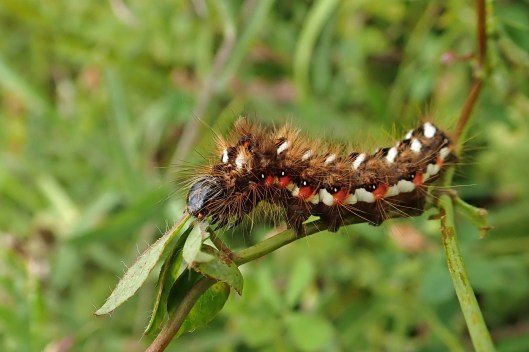
When I spotted this caterpillar yesterday, I didn’t think I’d seen one like it before but, when one of my Twitter pals later identified it for me, I realised I had seen one previously, though a younger model.

200911 knot grass larva (1)
200911 knot grass larva (2)

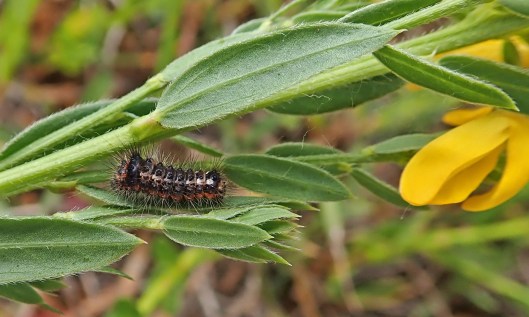
These are the larvae of the Knot grass moth (Acronicta rumicis), a moth I’ve never seen (you can see what the adult moth looks like and read more about it on the UK Moths website). I think the larva above, found munching on Dyer’s greenweed at Cosmeston on 4 June, is an early instar, whereas the larva below, found feeding on Common ragwort at Lavernock Nature Reserve on 10 September and a real stunner, is almost ready to pupate for the winter.

200911 knot grass larva (3)

Like Loading...

234/366 Tiger hunting

21 Friday Aug 2020

Posted by sconzani in insects, nature

≈ 2 Comments

Tags

British moths, Euplagia quadripunctaria, Jersey tiger, Lavernock Nature Reserve, moth, tiger moths

As many local events in Nature’s calendar have been tracking a couple of weeks earlier than usual this year, I first started this year’s tiger hunting ten days ago but it took three visits to Lavernock Nature Reserve and much staring at the flowers of Hemp-agrimony before I finally found a tiger.

200821 jersey tiger (1)

I am not, of course, talking about the big cats – I am vehemently opposed to all hunting! My hunt was for the gorgeous moth that is the Jersey tiger (Euplagia quadripunctaria).

200821 jersey tiger (2)

Having spread northwards in southern England, from Devon in to Somerset, these moths tackled the watery expanse of the Bristol Channel in stages, recorded on the island of Flat Holm in 2008 but not making the final flight across to the south Wales coast until 2012.

200821 jersey tiger (3)

Though they have avoided big city Cardiff – the single Cardiff record thus far was in 2017, the Jersey tiger now appears to be well established along a section of the Vale of Glamorgan coastline, from Penarth to Barry, and presumably it will spread further as climate and environmental conditions allow.

200821 jersey tiger (4)

Last Monday, 17 August, I spotted these two, feeding quite close together, at Lavernock (the first two photos here are one moth; the other three show the second tiger). Though they have been recorded on various flowers, I’ve only ever seen them on Hemp-agrimony, which is one of the food plants used by their larvae. I live in hope of finding one of their funky-looking caterpillars but I was over the moon to see my first tigers of the year.
200821 jersey tiger (5)

Like Loading...

228/366 Mothing, accidentally

15 Saturday Aug 2020

Posted by sconzani in insects, nature

≈ Leave a comment

Tags

Agriphila tristella, Autographa gamma, British moths, Common grass-veneer, Common purple & gold, moths, Pyrausta purpuralis, Scotopteryx chenopodiata, Shaded broad-bar, Silver Y

It seems surprising to me that a rainy day walk can turn up moth sightings. I’m not talking about heavy rain – I probably wouldn’t be out in that – just a very slight drizzle, which in this week’s heat was actually quite refreshing. Only a few hardy Meadow brown butterflies flitted up as I passed by but the moths were more frequent than I expected.

200815 silver y

Silver Y (Autographa gamma)
Late summer through to mid autumn is probably the best time to see these distinctive immigrants, though some hardy souls do manage to breed in Britain. I imagine this one wafting in from the Continent on last week’s hot southerly winds.

200815 pyrausta purpuralis

Common purple-and-gold (Pyrausta purpuralis)
I’ve seen quite a few of these tiny moths during my daily meanders, presumably because they have two broods each year and the second brood emerges right about now, July-August.

200815 Shaded broad-bar

Shaded broad-bar (Scotopteryx chenopodiata)
Two of these beauties have popped up for me recently, one at Grangemoor Park, the other at Cosmeston, both quite light in colour, though a quick look at the images on the Butterfly Conservation website will show how variable they can be.

200815 Agriphila tristella

Common grass-veneer (Agriphila tristella)
I tend to avoid photographing the many grass moths that, like crickets and grasshoppers, flit up as my legs disturb them when I’m walking through longish grass or wildflowers, because they can be difficult to identify. Luckily, my local Twitter pal George, a senior moth ecologist at Butterfly Conservation, was able to put a name to this one very quickly. It’s a common grassland species that flies from June through to September.

Like Loading...

217/366 Lep larvae

04 Tuesday Aug 2020

Posted by sconzani in insects, nature

≈ 2 Comments

Tags

British butterflies, British moths, butterfly larvae, Cinnabar moth, Lepidoptera, moth larvae, Small tortoiseshell

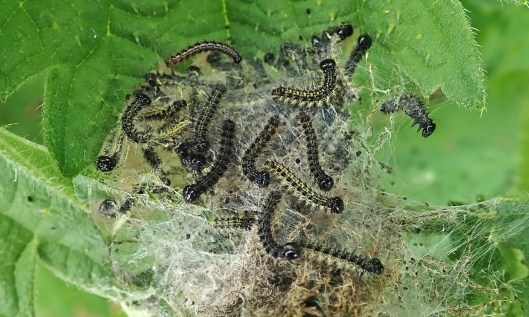
Last week we had a closer look at a couple of butterfly eggs; today we have some Lepidoptera larvae. First up, the caterpillars of the beautiful Small tortoiseshell butterfly, which has two generations of eggs and larvae each year – these will be second generation. The eggs are laid in batches and, when they hatch, the caterpillars stay together to create a communal web where they shelter when they’re not out basking in the sun or munching on nettles. The caterpillars go through five stages (instars) before pupating – these look to be 3rd instars.

200804 small tortoiseshell (1)

200804 small tortoiseshell (2)
200804 small tortoiseshell (3)

In total contrast to the Small tortoiseshell larvae, which are subtle and subdued in their colour and patterns, the larvae of the Cinnabar moth are vibrant, even flamboyant. Their bright orange and black stripes are designed to be seen, warning predators not to eat them as they are poisonous.

200804 cinnabar moth (1)200804 cinnabar moth (2)

Like Loading...

193/366 Moth macro

11 Saturday Jul 2020

Posted by sconzani in insects, nature

≈ 4 Comments

Tags

British moths, macro photography, moth, Silver Y, Silver Y moth

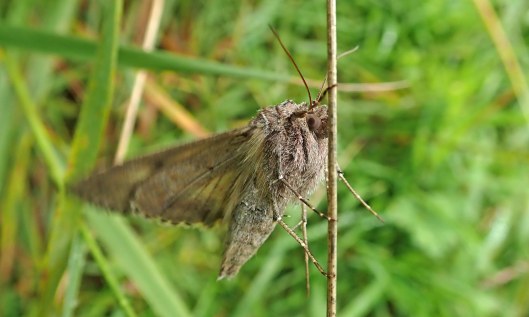
We’ve had cooler, greyer, wetter weather in recent days, which isn’t so good for seeing hosts of butterflies and other insects flying around the wildflowers but, if you can find them, it does slow those insects down a bit making macro photography a little easier … sometimes. A slow, quiet, stealthy approach is still required as, to take macro photos with my Olympus camera, I need to get as close as an inch to my subject. Mostly, the insects fly or scuttle off, but this stunning Silver Y moth was a rather lovely exception to my usual failures.

200711 Silver Y moth

Like Loading...

183/366 It’s a Burnet’s life

01 Wednesday Jul 2020

Posted by sconzani in insects, nature

≈ 3 Comments

Tags

5-spot Burnet, 6-spot Burnet, British moths, Burnet moth, Five-spot burnet, Six-spot burnet, Zygaena species

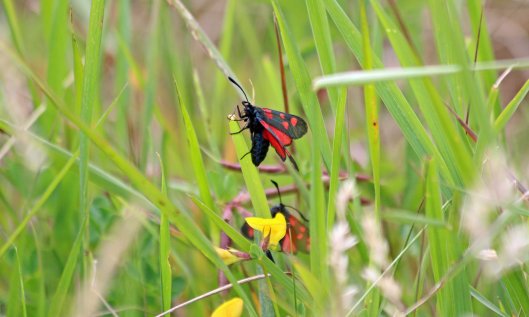
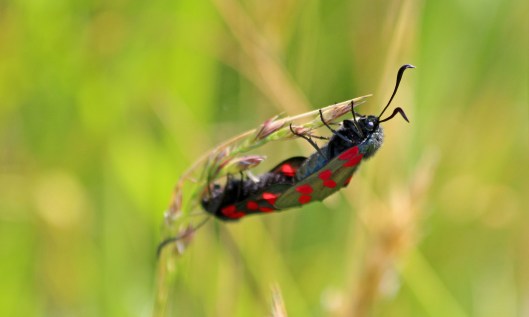
My new favourite field has a healthy population of Burnet moths, some of which are 6-spot Burnets (Zygaena filipendulae) and the others could either be 5-spot Burnets (Zygaena trifolii) or Narrow-bordered 5-spot Burnets (Zygaena lonicerae) – it’s almost impossible to tell these latter two species apart. Over the past few weeks, I’ve been lucky enough to see almost every part of their life cycle – only the eggs have eluded me.

200701 1 5spot and 6spot

A 5-spot above, a 6-spot below

200701 2 6spot burnets

6-spot Burnets mating

Today I spotted this larva, looking very close to pupating, and, nearby, a very fresh-looking cocoon.

200701 3 burnet larva
200701 4 burnet cocoon
200701 5 6spot burnet

A freshly emerged 6-spot Burnet moth

200701 6 5spot burnet

A pristine 5-spot Burnet moth

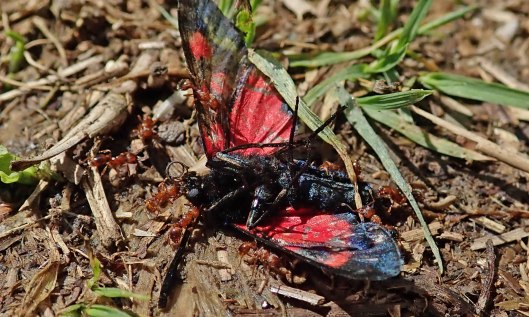
200701 7 5spot burnet dead n ants

Death is always sad to see but, in this case, the moth will support the life cycle of other creatures.


Like Loading...

157/366 Tufty

05 Friday Jun 2020

Posted by sconzani in insects, nature

≈ Leave a comment

Tags

Acronicta rumicis, British moths, Knot grass larva, Knot grass moth, moth caterpillar, moth larva

This tiny tufty character was a surprise find during yesterday’s walk.

200605 knot grass moth larva (1)

I guessed it was a moth caterpillar but had no idea which, so posted some photos on Twitter. It only took a few minutes for my moth-er contacts to give it a name – this is the larva of the Knot grass moth (Acronicta rumicis).

200605 knot grass moth larva (2)
200605 knot grass moth larva (3)

I’ve never seen the adult moth but it looks to be a beauty – you can see photos, and read more about both moth and larva, on the UK Moths website.

200605 knot grass moth larva (4)


Like Loading...

142/366 Moths made my day

21 Thursday May 2020

Posted by sconzani in insects, nature

≈ 1 Comment

Tags

British moths, Grangemoor Park, Latticed heath, moth

I’d hoped the sunny skies and warmth would bring out more butterflies during yesterday’s exercise walk but they were few and far between at Grangemoor Park, and I think that’s weather related.

200521 latticed heath (1)

Earlier this year, we had almost constant, often heavy rain that saturated the ground and turned everywhere to mud, and now the ground is being baked dry and hard by a subsequent lack of rain. This cycle seems to be having a marked effect on plant growth and insect emergence – at least that’s what I’m seeing, or, rather, not seeing.

200521 latticed heath (2)

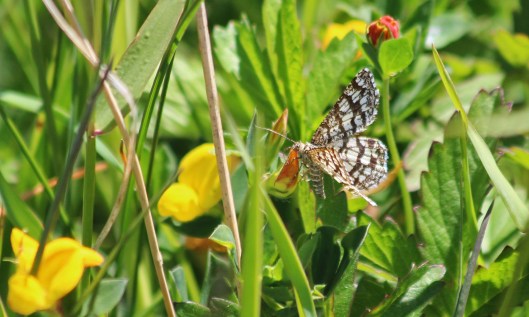
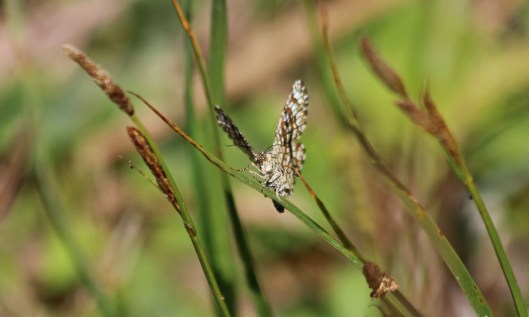
The good news at Grangemoor, though, was the abundance of Latticed heath moths, more than I’ve spotted in one day before. Though they do have a habit of flitting very quickly away just as I get ready to take their photo, they are lovely creatures, and seeing so many certainly made my day.

200521 latticed heath (3)

Like Loading...
← Older posts
Newer posts →

About me

sconzani

sconzani

I'm a writer and photographer; researcher and blogger; birder and nature lover; countryside rambler and city strider; volunteer and biodiversity recorder.

View Full Profile →

Follow earthstar on WordPress.com

Enter your email address to follow this blog and receive notifications of new posts by email.

Recent blog posts

  • Cormorants, young and old March 12, 2026
  • Bay bunnies March 11, 2026
  • Beating the gloom March 10, 2026
  • No booming Bittern but … March 9, 2026
  • Danish scurvygrass March 8, 2026

From the archives

COPYRIGHT

Unless otherwise acknowledged, the text and photographs on this blog are my own and are subject to international copyright. Nothing may be downloaded or copied without my permission.

Fellow Earth Stars!

  • Unknown's avatar
  • Unknown's avatar
  • Unknown's avatar
  • Unknown's avatar
  • Unknown's avatar
  • Unknown's avatar
  • Unknown's avatar
  • Unknown's avatar
  • Unknown's avatar
  • Unknown's avatar
  • Unknown's avatar
  • Unknown's avatar
  • Unknown's avatar
  • Unknown's avatar
  • Unknown's avatar
  • Unknown's avatar
  • Unknown's avatar
  • Unknown's avatar
  • Unknown's avatar
  • Unknown's avatar
  • Unknown's avatar
  • Unknown's avatar
  • Unknown's avatar
  • Unknown's avatar
  • Unknown's avatar
  • Unknown's avatar
  • Unknown's avatar
  • Unknown's avatar
  • Unknown's avatar
  • Unknown's avatar
  • Unknown's avatar
  • Unknown's avatar
  • Unknown's avatar
  • Unknown's avatar
  • Unknown's avatar
  • Unknown's avatar
  • Unknown's avatar
  • Unknown's avatar
  • Unknown's avatar
  • Unknown's avatar
  • Unknown's avatar
  • Unknown's avatar
  • Unknown's avatar
  • Unknown's avatar
  • Unknown's avatar
  • Unknown's avatar
  • Unknown's avatar
  • Unknown's avatar
  • Unknown's avatar
  • Unknown's avatar

Blog at WordPress.com.

Privacy & Cookies: This site uses cookies. By continuing to use this website, you agree to their use.
To find out more, including how to control cookies, see here: Cookie Policy
  • Subscribe Subscribed
    • earthstar
    • Join 668 other subscribers
    • Already have a WordPress.com account? Log in now.
    • earthstar
    • Subscribe Subscribed
    • Sign up
    • Log in
    • Report this content
    • View site in Reader
    • Manage subscriptions
    • Collapse this bar
 

Loading Comments...
 

You must be logged in to post a comment.

    %d