• ABOUT
  • BIRDING 2018
  • Birding 2019
  • BLOG POSTS
  • Butterflies 2018
  • Resources

earthstar

~ a celebration of nature

earthstar

Tag Archives: British wildflowers

Field woundwort

06 Sunday Aug 2023

Posted by sconzani in wildflowers

≈ Leave a comment

Tags

British wildflowers, Field woundwort, pavement plants, Stachys arvensis

During Friday’s walk I was vaguely hoping to see the Otter that’s been visiting Cardiff Bay wetlands during recent weeks (I didn’t – and I’m not one to stand around for hours on the off chance) but my secondary purpose was to look for pavement plants, those wildflowers that manage to colonise the cracks between bricks or slabs of tarmac and the subject of today’s Wildflower Hour on social media.

230806 field woundwort (2)

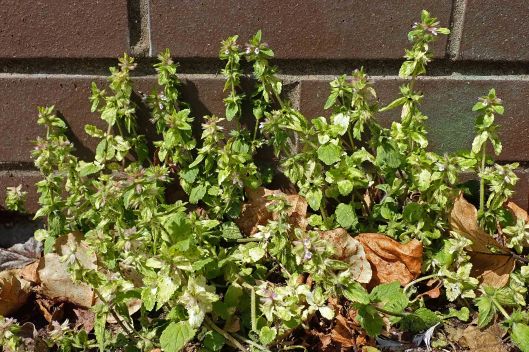
Fortunately, I bumped in to a local birding friend who is also a keen botanist and he was able to point me in the direction of this plant, a new one for me, Field woundwort (Stachys arvensis). Though its natural habitat is fields and hedge edges, especially on sandy soils and mostly in the southern parts of Britain, this plant has extended its range to include some urban locations, like allotments and, as shown here, the tiny cracks between a building and the pavement.

230806 field woundwort (1)

Like Loading...

Jersey cudweed

30 Sunday Jul 2023

Posted by sconzani in plants, wildflowers

≈ Leave a comment

Tags

British wildflowers, Gnaphalium luteoalbum, Jersey cudweed

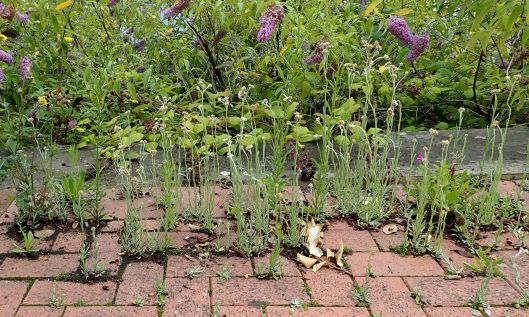
A year ago, one of my local birding acquaintances, who is also a keen botanist, discovered a small area of Jersey cudweed (Gnaphalium luteoalbum) growing along the edge of the Cardiff Bay walking and cycling trail. Though he quickly reported his find to Cardiff Council in an attempt to protect it, their contractors soon obliterated the plants in a typical ‘kill the weeds’ operation. So, I didn’t get to see this new plant then but I made myself a note to check back in a year’s time, which I did, last week, and was very pleased to see the plants have reappeared.

230730 jersey cudweed (1)

The NatureSpot website notes that Jersey cudweed is likely to have been ‘an ancient introduction’ to Britain that then ‘became almost extinct’ but is now bouncing back (despite the anti-weed brigade!). And, though traditionally a plant of sandy fields and dune slacks, it is now adapting to life as a pavement plant in our towns and cities.

230730 jersey cudweed (2)

Like Loading...

Yellow loosestrife

23 Sunday Jul 2023

Posted by sconzani in flowers, wildflowers

≈ 2 Comments

Tags

British wildflowers, Lysimachia vulgaris, medicinal plant, yellow flowers, Yellow loosestrife

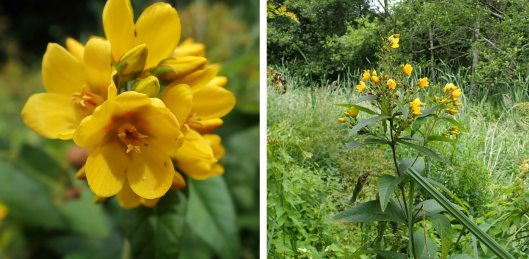
With their roots in the water along the edge of a local canal, these Yellow loosestrife (Lysimachia vulgaris) plants were so exuberant and lush I initially thought they were some other species. They had obviously found the damp niche that suited them best.

230723 yellow loosestrife (1)

Though I would never advocate the use of herbal medicine (just being cautious about matters I don’t understand or have knowledge of), Yellow loosestrife did, apparently, have a large number of traditional uses as a medicinal plant, from treating diarrhoea and haemorrhaging to cleaning wounds and being used as a mouthwash. And the First Nature website reports on other common uses:

Yellow Loosestrife tied around the necks of oxen was reputed to keep irritating flies away from them. In the distant past these and several other kinds of ‘loosestrife’ plants were also used to get rid of infestations of flies in houses. The plants were dried and burned indoors, and toxins in the smoke drove out the flies (and no doubt also any human occupants).

230723 yellow loosestrife (2)

Like Loading...

Back lane wildflowers

16 Sunday Jul 2023

Posted by sconzani in flowers, wildflowers

≈ 2 Comments

Tags

British wildflowers, summer wildflowers, urban wildflowers

I almost want to whisper this post, as it’s a miracle the local council hasn’t poisoned these wildflowers out of existence as they usually do a couple of times over the summer months, this despite the dangers of those herbicides to humans, insects and birds, even the dogs that get walked along the back lanes, and despite the council having declared a ‘nature emergency’! So, for now, the back lane between my street and the next is alive with wildflowers, some of which I’ve featured in this little video.

Like Loading...

A couple of mallows

09 Sunday Jul 2023

Posted by sconzani in wildflowers

≈ Leave a comment

Tags

British wildflowers, Common mallow, Mallow, Malva moschata, Malva sylvestris, Musk mallow

There are a lot of wildflowers I can recognise at a glance – ‘Oh, that’s a forget-me-not, knapweed, mallow …’ – but, in many cases, there are several species of these flowers and I’m not sure which I’m seeing. So, I’m trying to make more of an effort to work out which is which. Here’s an example.

These two species of mallow look very similar to me, and they grow in similar habitats, in waste ground, along our road verges, beside footpaths. Their beautiful flowers are much of a muchness, though the flowers of Common mallow have dark purple stripes, whereas those of Musk mallow are finer and pale pink, and their petal shapes are also different. However, it’s the leaves that really clinch their identification, as you can see from the photos below.

230709 common mallow

Common mallow (Malva sylvestris)
According to the Wildlife Trusts website, ‘Certain parts of common mallow are edible (leaves, flowers and seeds) and there is evidence that the Romans may have deliberately cultivated the plant to be used for food and medicine’.

230709 musk mallow

Musk mallow (Malva moschata)
As well as the deeply lobed leaves that distinguish Musk mallow from Common mallow, the flowers also emit a musky perfume, which the Common mallow does not have. And that smell is, of course, how this plant got its common name.

Like Loading...

Lady’s-mantle

02 Sunday Jul 2023

Posted by sconzani in flowers, plants, wildflowers

≈ Leave a comment

Tags

Alchemilla, British wildflowers, Lady's-mantle, wildflowers, yellow flowers

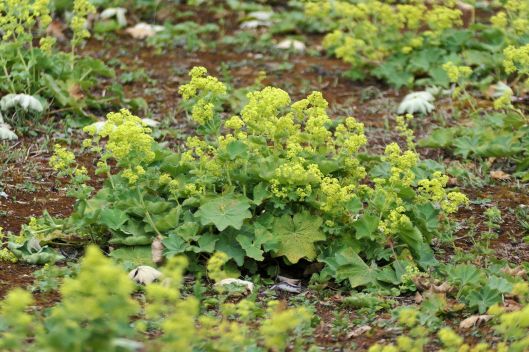
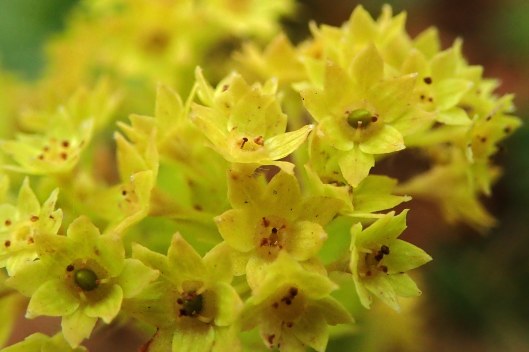
Lady’s-mantle is one of those plants that’s difficult to determine to exact species. The large Garden lady’s-mantle (Alchemilla mollis) has escaped its original garden setting and become naturalised in many places, and, just to increase identification difficulties, some species have hybridised with others. It’s a plant I’ve found growing in a variety of places: in grassland at the local country park, along a nearby woodland ride, on a former coal spoil tip and, below, in a former quarry.

230702 Lady's-mantle (1)

Richard Mabey provides some interesting information about this plant in Flora Britannica:

The often nine-lobed leaves of lady’s-mantle, like cloaks or umbrellas, fold up overnight and catch the dew on their soft hairs. Plant-dew was highly valued by early herbalists … and this made Alchemilla prized as a simple [sic], prescribed for wounds, infertility, and impotence. The alchemists also required the purest dew for turning base metal into gold – hence the name Alchemilla, ‘little alchemist’. Such a powerful and magical herb was bound to be christianised, and some time in the Middle Ages it was named Our Lady’s Mantle, and eventually lady’s-mantle.

230702 Lady's-mantle (2)

Like Loading...

Monkeyflower

25 Sunday Jun 2023

Posted by sconzani in flowers, wildflowers

≈ 2 Comments

Tags

British wildflowers, Mimulus guttatus, Monkeyflower, yellow wildflower

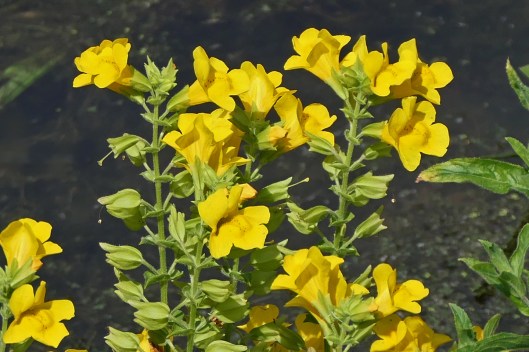
In my Flora Britannica, Richard Mabey relates

Monkeyflower, Mimulus guttatus, was first discovered and brought to English gardens from the damp and foggy islands off the Alaskan coast in 1812. But it crops up in damp places right down the west coast of America, as far south as the mountains of New Mexico, and it has been just as catholic in its choice of British habitats since it was first naturalised in the 1820s. It now occurs by the banks of burns, streams, lowland lakes, rivers and canals throughout Britain.

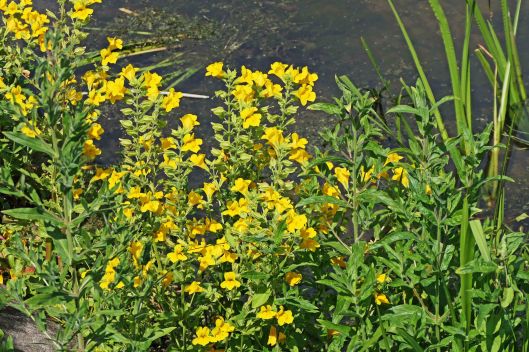
230625 Monkeyflower (1)

Given that last sentence, I can’t believe it’s taken me so many years to see Monkeyflower for myself but, during Wednesday’s walk around Cardiff’s Roath Park, I saw several of these plants, both around Roath Lake and along Roath Brook.

230625 Monkeyflower (2)

Like Loading...

Grasslands wildflowers

18 Sunday Jun 2023

Posted by sconzani in flowers, wildflowers

≈ 5 Comments

Tags

Aberbargoed Grasslands, British wildflowers, Common milkwort, Devil's-bit scabious, Marsh lousewort, Ragged robin

Presumably as a result of our lingering hot dry weather, the wildflowers at Aberbargoed Grasslands NNR were neither as prolific nor as exuberant as I’ve seen in previous years. The Bluebells had already gone over, the Heath spotted-orchids were looking as frazzled as I was soon feeling but there were some floral highlights I enjoyed seeing.

230618 devil's-bit scabious

  • Devil’s-bit scabious (Succisa pratensis)

230618 marsh lousewort

  • Marsh lousewort (Pedicularis palustris)

230618 milkwort

  • Common Milkwort (Polygala vulgaris)

230618 ragged robin

  • Ragged-robin (Silene flos-cuculi) and butterfly friend (Small pearl-bordered fritillary)
Like Loading...

Common rock-rose

11 Sunday Jun 2023

Posted by sconzani in flowers, wildflowers

≈ Leave a comment

Tags

British wildflowers, Common rock-rose, Helianthemum nummularium, yellow wildflowers

This lovely wildflower was another new find for me last Thursday, growing along the roadside on the walk to and from Charlton King’s Common near Cheltenham. I couldn’t help but notice these glorious, bright yellow flowers that looked superficially like the many buttercups all around them but their leaves were quite different, slim, oblong and quite hairy. You can read more about the Common rock-rose (Helianthemum nummularium) on the Naturespot website here.

230611 common rock-rose

Like Loading...

Common gromwell

21 Sunday May 2023

Posted by sconzani in wildflowers

≈ Leave a comment

Tags

British wildflowers, Common gromwell, European stoneseed, Lithospermum officinale, Slade Wood

This was the third highlight of my visit to Slade Wood on Wednesday, a plant I’d never seen before. It wasn’t too difficult to identify once I got home, as the flowers looked a lot like those of Forget-me-not so I turned straight to that section of my wildflower guide. Say hello to Common gromwell (Lithospermum officinale) (also known as European stoneseed).

230521 common gromwell (1)

It’s a perennial, flowers from May to August, and is quite prominent in the landscape, a rough hairy plant growing up to one metre tall, so must’ve been in situ during my previous visits to this woodland. Perhaps I was so focused on butterflies, I didn’t notice it. Woodland rides – and rough, stony scrubby areas – are where this native plant thrives, but only in the southern parts of Britain, so any northerners out there will have to come south to see it.

230521 common gromwell (2)

Like Loading...
← Older posts
Newer posts →

About me

sconzani

sconzani

I'm a writer and photographer; researcher and blogger; birder and nature lover; countryside rambler and city strider; volunteer and biodiversity recorder.

View Full Profile →

Follow earthstar on WordPress.com

Enter your email address to follow this blog and receive notifications of new posts by email.

Recent blog posts

  • First beetles January 13, 2026
  • City Hall Peregrine January 12, 2026
  • Blackthorn in bloom January 11, 2026
  • Weevil: Mecinus pyraster January 10, 2026
  • Red in beak and claw January 9, 2026

From the archives

COPYRIGHT

Unless otherwise acknowledged, the text and photographs on this blog are my own and are subject to international copyright. Nothing may be downloaded or copied without my permission.

Fellow Earth Stars!

  • Unknown's avatar
  • Unknown's avatar
  • Unknown's avatar
  • Unknown's avatar
  • Unknown's avatar
  • Unknown's avatar
  • Unknown's avatar
  • Unknown's avatar
  • Unknown's avatar
  • Unknown's avatar
  • Unknown's avatar
  • Unknown's avatar
  • Unknown's avatar
  • Unknown's avatar
  • Unknown's avatar
  • Unknown's avatar
  • Unknown's avatar
  • Unknown's avatar
  • Unknown's avatar
  • Unknown's avatar
  • Unknown's avatar
  • Unknown's avatar
  • Unknown's avatar
  • Unknown's avatar
  • Unknown's avatar
  • Unknown's avatar
  • Unknown's avatar
  • Unknown's avatar
  • Unknown's avatar
  • Unknown's avatar
  • Unknown's avatar
  • Unknown's avatar
  • Unknown's avatar
  • Unknown's avatar
  • Unknown's avatar
  • Unknown's avatar
  • Unknown's avatar
  • Unknown's avatar
  • Unknown's avatar
  • Unknown's avatar
  • Unknown's avatar
  • Unknown's avatar
  • Unknown's avatar
  • Unknown's avatar
  • Unknown's avatar
  • Unknown's avatar
  • Unknown's avatar
  • Unknown's avatar
  • Unknown's avatar
  • Unknown's avatar

Blog at WordPress.com.

Privacy & Cookies: This site uses cookies. By continuing to use this website, you agree to their use.
To find out more, including how to control cookies, see here: Cookie Policy
  • Subscribe Subscribed
    • earthstar
    • Join 669 other subscribers
    • Already have a WordPress.com account? Log in now.
    • earthstar
    • Subscribe Subscribed
    • Sign up
    • Log in
    • Report this content
    • View site in Reader
    • Manage subscriptions
    • Collapse this bar
 

Loading Comments...
 

You must be logged in to post a comment.

    %d