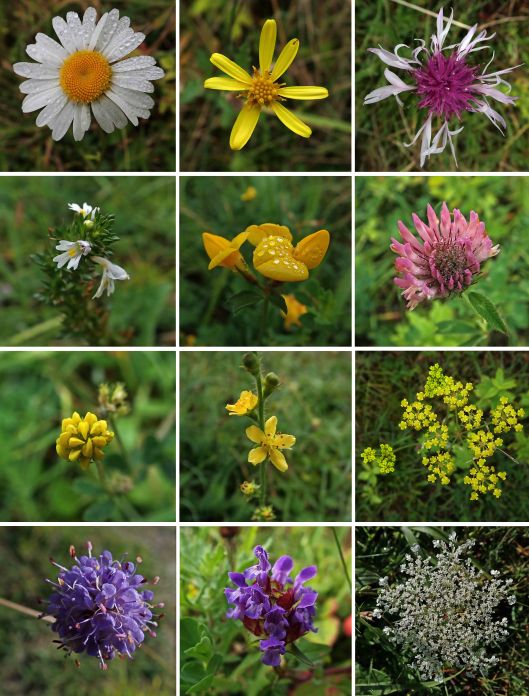
The wet and windy weather may have passed but now it feels more like proper winter, with daytime high temperatures in single digits. Still, there are wildflowers to be found in bloom, some that we would usually see in a couple of months time rather than this early in the year. These sixteen are those I found on a walk around the outskirts of my town yesterday and this morning.
Viviparity: noun; (of seeds) germinating before separating from the parent plant (from the Latin words vīvus, meaning alive, and parere, meaning to bring forth) (the adjective is viviparous), (Collins Concise Dictionary).
I’d seen a couple of photographic examples of viviparity on Twitter but had never seen this myself until a walk at Cosmeston Lakes Country Park on 28 December. The tiny green shoots on this Teasel are its own seeds which, for some reason, have not been released from the seed head and have now begun to sprout.
Wildflowers: they brighten dull, grey and rainy days; they encourage me to expand my botanical knowledge, which is much needed; they provide a reason to get out of the house when I’m feeling lazy; they cheer me when the world feels sad, bad and mad. As the year draws to a close, I thought I’d share some wildflower collages from throughout the year, to brighten your winter day (at least, for those of you in the northern hemisphere) and also to encourage you to take part in this year’s New Year Plant Hunt, which is running from 30 December 2023 to 4 January 2024 (details on the Botanical Society of Britain & Ireland website). This first image is from 8 January.
This second assembly, in the form of a video slideshow, contains the flowers I found during the week ending 26 February, an end-of-winter selection.
Next up, in 3 images, are the many flowers found on 24 September, an early autumn abundance of colour.
And this final series is very recent – these are the flowers I found during my meanderings for the week ending 17 December, an amazing and most unexpected 31 species. They certainly brightened up the short grey days!
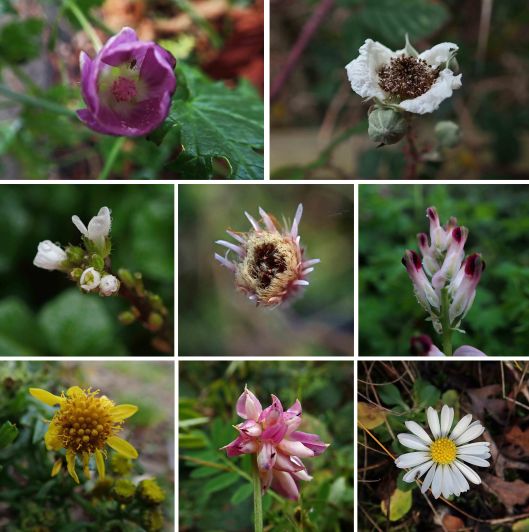
Full disclosure: these are not actually flowers, they’re seedheads. I just loved the way yesterday’s very heavy frost had coated them with tiny ice crystals giving them the appearance of frosty flowers.
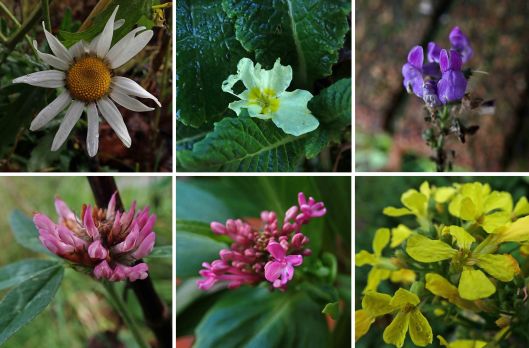
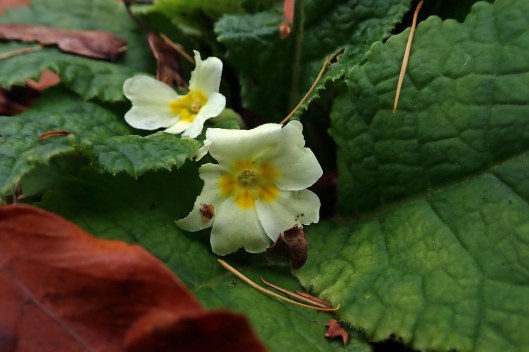
Spring? Oh, wait. We haven’t had winter yet. Well, I found my first flowering Primrose – the traditional harbinger of springtime –lurking under the trees and shrubs in the scruffier part of a local park during today’s walk. Although it has been even wetter than usual this autumn, it has been very mild so perhaps that has fooled some plants into thinking spring is just around the corner.
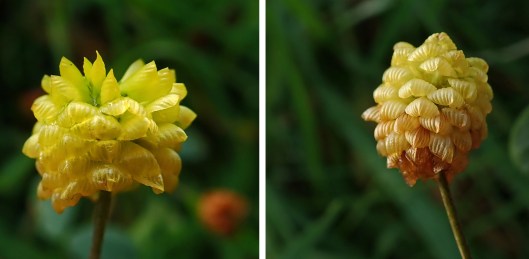
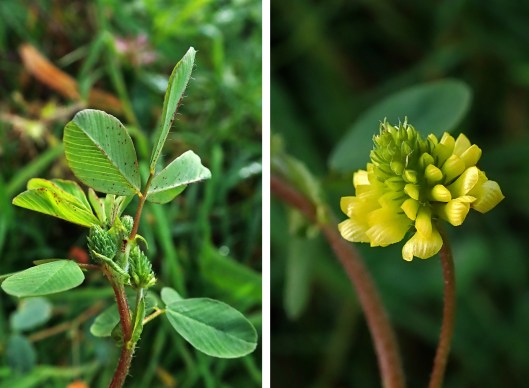
At first I hesitated to name this Hop trefoil (Trifolium campestre) as it’s a new plant for me but, when I posted some photos online, I got a thumbs up from a botanist and, looking at the ID guidance on the Naturespot website, I think it meets the criteria:
Short, hairy, erect plant. Trifoliate, leaflets oval, narrowed towards the base, the central one short stalked. Flowers pale yellow, becoming pale brown eventually, 4 to 5 mm long in small, globose, stalked heads to 15 mm across
And
… Larger and paler than Lesser Hop-trefoil, and turns brownish with age. Both trefoils are similar to Black Medick in flower, but Black Medick leaves are much more hairy and have an apiculate point (i.e a short fine ‘needle’ from the end of the leaflet)
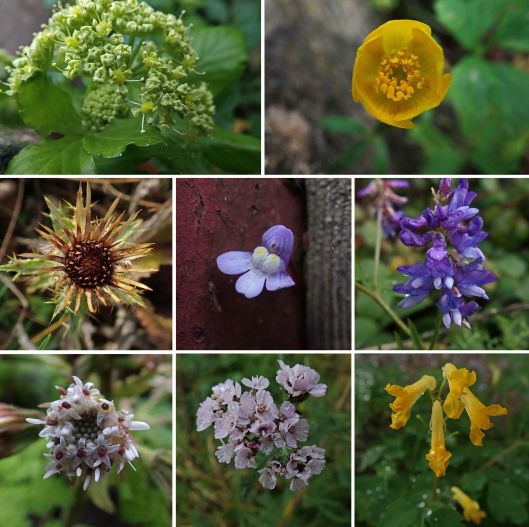
I was surprised at the start of the week to find wildflowers blooming that should long since have gone to seed and that inspired me to see just how many wild flowers I could find during this week’s walks. The answer, of course, is in the title of this post – 59! That is to say, I have 59 images to share but there were a few more plants in flower that I didn’t manage, for one reason or another, to photograph. Some wildflowers were quite unexpected, like the Carline thistle that had one flower open and 3 more buds still to develop; some were abundant, like the Yellow-wort still standing tall in a field at Cosmeston; others, like the Common stork’s-bill, were the last survivors of the strimmers that have been very active this month. Here they all are …
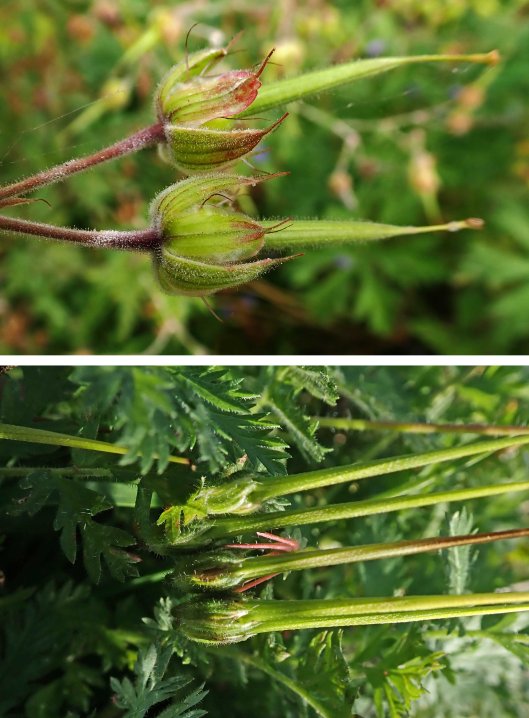
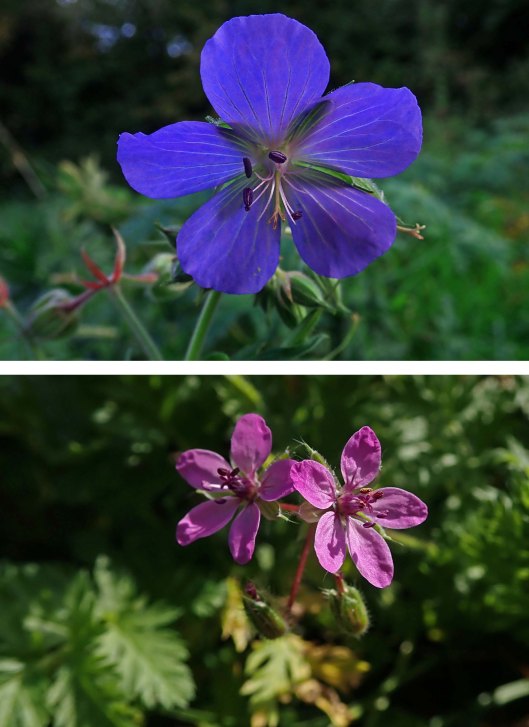
It occurred to me today, after seeing both Common stork’s-bill (Erodium cicutarium) and Meadow crane’s-bill (Geranium pratense) still flowering locally, to wonder what the difference is between stork’s-bills and crane’s-bills. According to my Flora Britannica, it’s to do with the length of the birds’ bills, i.e. the seed cases of the stork’s-bills are longer than those of the crane’s-bills. The photos below show the relative differences, Meadow crane’s-bill above, Common stork’s-bill below.
And because they both have lovely flowers, albeit of very different sizes (Common stork’s-bill is a tiny plant compared to Meadow crane’s bill), here they are, again Meadow crane’s-bill above, Common stork’s-bill below.
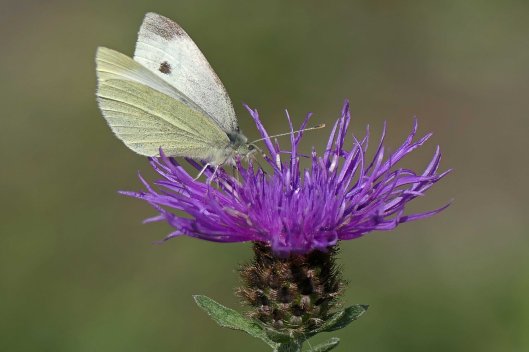
I had something different planned for today but ‘the best laid plans’ and all that. So, here is the first scene that greeted when I arrived at the local country park this chilly autumn morning, a lovely little Small white butterfly sipping from a pretty purple Common knapweed flower.
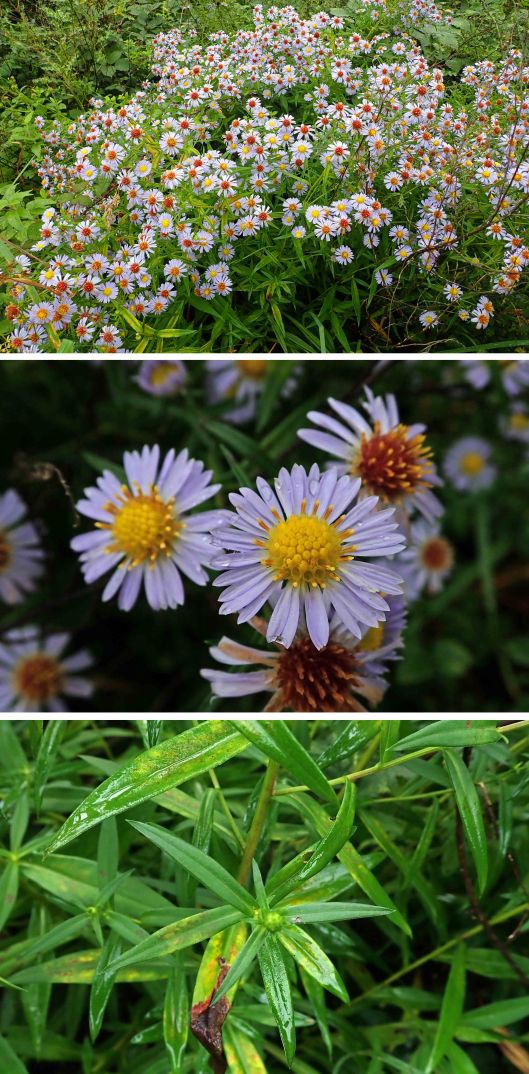
When I spotted these plants during a walk to a new place last week, I thought perhaps they were Sea asters (Tripolium pannonicum) and, indeed, they might be, but I’ve since heard how frequently other species of Aster self-seed on waste ground, which has cast doubt on my identification. These were growing in rough ground near a very busy road but quite close to the banks of a tidal creek. I’m going to have to ‘phone a friend’ but, in the meantime, if you’re familiar with Sea aster, please do venture an opinion in the comments.







 earthstar
You must be logged in to post a comment.