
Be it ever so umbel, there’s no place …
better to enjoy a snack of nectar and pollen.



17 Friday Aug 2018
Posted in insects, nature, plants, wildflowers
Be it ever so umbel, there’s no place …
better to enjoy a snack of nectar and pollen.
03 Friday Aug 2018
Posted in flowers, insects, nature, wildflowers
Tags
British butterflies, British wildflowers, butterflies, Common fleabane, fleabane, insects on fleabane, Lavernock Nature Reserve, Pulicaria dysenterica
The flower of the moment is Fleabane (Pulicaria dysenterica) or, at least it is at Lavernock Nature Reserve.
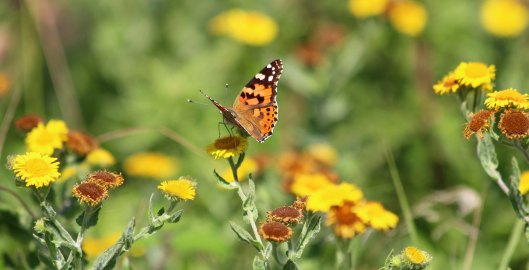
I’ve read that Fleabane usually grows in ditches and damp meadows so, despite the recent drought conditions, I guess there must be water somewhere below the wildflower meadows at Lavernock, as they are currently awash with these bright golden flowers. And, at a time when most other wildflowers have dried up and died off, the Fleabane is providing a much-needed source of pollen and nectar for butterflies and other assorted mini-beasties.


25 Friday May 2018
Posted in flowers, nature, wildflowers
Tags
British wildflowers, Bush vetch, Common vetch, Herb Bennet, Oxeye daisy, Ragged robin, Russian comfrey, Wood avens
Time to catch up on which wildflowers are currently flowering in the waysides …

I often see the mottled purplish flowers of Bush vetch (Vicia sepium) in the wonderfully scruffy areas on the edges of roads and paths.

Often accompanying its Bush cousin, the Common vetch (Vicia sativa) has a delicate pink, often single flower, very much like the popular garden plant the Sweet pea, to which it is also related.

There’s something innately cheerful about the Oxeye daisy (Leucanthemum vulgare), which also goes by the common names of Dog daisy, Horse daisy, Moon daisy and Moonpenny (I almost typed Moneypenny!).

The perfectly named Ragged-Robin (Lychnis flos-cuculi) likes to have its feet in damp places so look for it in marshy areas, near drains and streams.

Given the deep purple of its flowers, I think this might be Russian comfrey (Symphytum x uplandicum), a hybrid of Common and Creeping comfrey. I found it growing well in a coastal location near where I live.
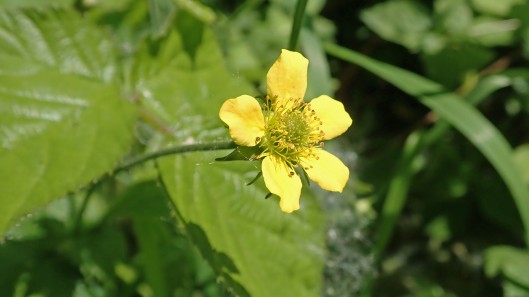
Though officially known as Wood avens (Geum urbanum) I always think of this plant as Herb Bennet, which, according to Flora Britannica, is a corruption of the medieval Latin herba benedicta, meaning the blessed herb. Its roots were widely used in herbal medicine.
17 Thursday May 2018
Posted in birds, nature, plants, wildflowers
Tags
British flora, British wildflowers, Cefn Cadlan, Common butterwort, Cwm Cadlan, Dog violet, Greater stitchwort, Green-veined white butterfly, Marsh lousewort, marsh marigold, Micropterix calthella, Native bluebell, Opposite-leaved golden saxifrage, Redstart, Water avens, Wood sorrel
You may be surprised to learn that birding trips aren’t always dominated by birdwatching.
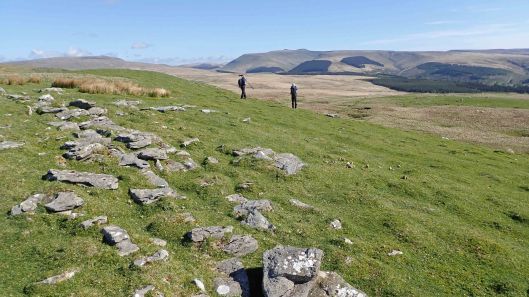
Last Sunday’s Glamorgan Bird Club trip saw 22 people striding firstly around the high moorland near Cefn Cadlan, north of Cardiff on the way to Brecon, and then exploring nearby Cwm Cadlan National Nature Reserve, an area renowned for the rare plants that thrive in its wet grasslands.

Of course, we were on the trip primarily to look for birds – and I saw my first Redstarts for the year (always on distant tree tops) and heard my first Cuckoo (exactly a year since my very first Cuckoo).
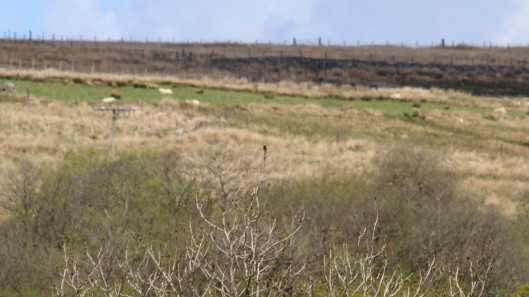
You’ll just have to believe me when I say that the dot in the centre of this photo is a Redstart
But, when the birds proved elusive, our team of talented amateur naturalists turned their attention to all the other wildlife and wildflowers that surrounded us. We saw frogs and a hare; speculated on what had left its footprints in the mud; enjoyed all the Green-veined white and Orange-tip butterflies that were nectaring on the abundant Cuckkoflowers …
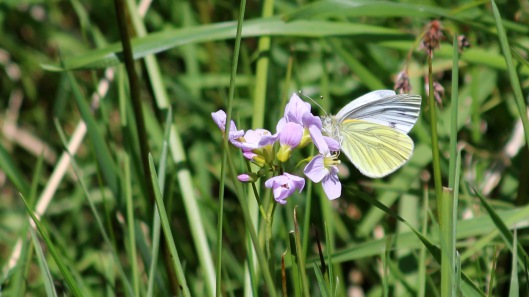
and we turned our heads downwards to admire all the special wildflowers that surrounded us. It was a glorious sunny day, the scenery was stunning, and the flora and fauna superb.
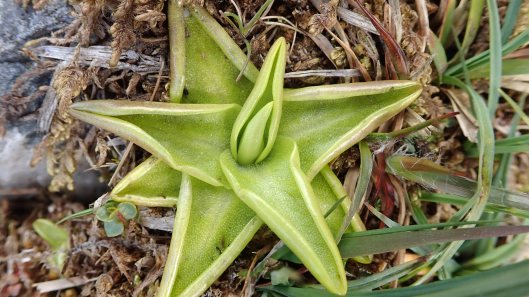
Common butterwort, not yet in flower

Dog violet
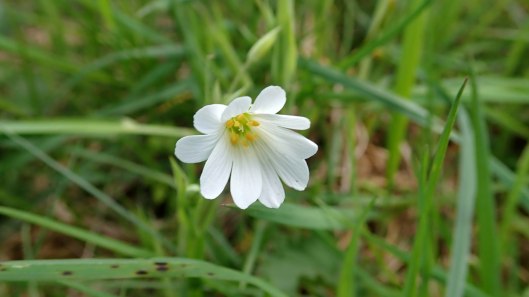
Greater stitchwort

Lousewort
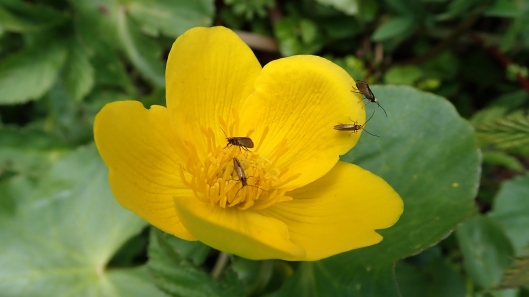
Marsh marigold, and the tiny moths are Micropterix calthella
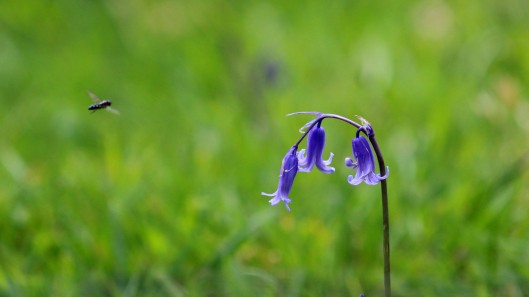
Native bluebell

Opposite-leaved golden saxifrage

Water avens, a very beautiful plant and a new one for me
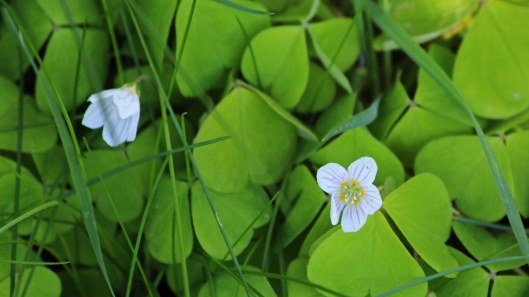
Wood sorrel
11 Friday May 2018
Posted in flowers, nature, spring, wildflowers
Tags
British wildflowers, crane's bills, geranium, Geranium lucidum, Geranium Robertianum, Geranium rotundifolium, Herb Robert, Round-leaved crane's-bill, Shining crane's-bill, spring flowers, spring wildflowers
The word geranium comes from the Greek geranos, meaning crane, so named because of the likeness of the plant’s seed case to the bill of the bird. Thus, in the plant world, the crane’s-bills are the wild geraniums.
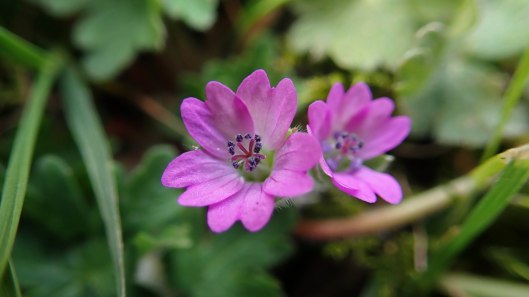
’Tis the time the geraniums begin to bloom and I’m trying to learn which is which, so I thought I’d share a few I’ve found during recent perambulations. The first is the Round-leaved crane’s-bill (Geranium rotundifolium).
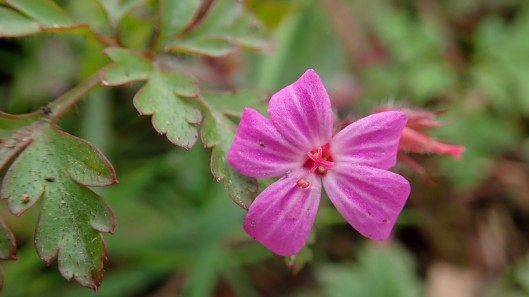
This next is the one most people can name. It seems to grow almost anywhere and makes even a rubbish heap look beautiful: Herb Robert (Geranium robertianum).

At a quick glance, this Shining crane’s-bill (Geranium lucidum) looks a lot like Herb Robert … and then you notice how different the leaves are.
04 Friday May 2018
Posted in flowers, nature, spring, wildflowers
Tags
Bluebell, British wildflowers, Cowslip, Garlic mustard, Ground ivy, Ivy-leaved toadflax, Sow thistle, spring wildflowers, Wild garlic
The Spring sunshine has been a little sparse in recent weeks but the wildflowers are slowly continuing to appear. Here are some recent finds …
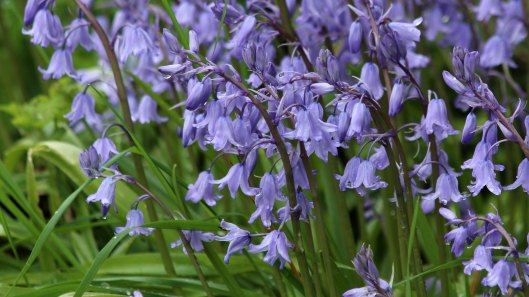
I couldn’t resist including more Bluebells (Hyacinthoides sp.) as they really encapsulate Spring for so many people.
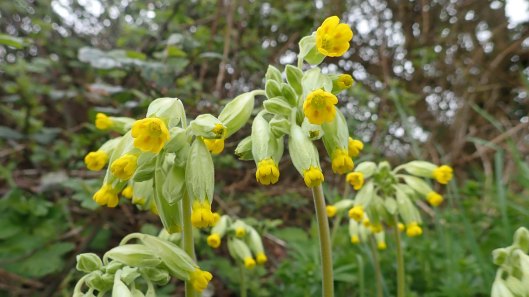
First come the primroses, then these beauties take over: Cowslips (Primula veris).
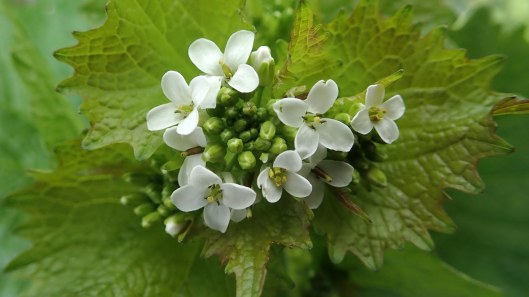
You may know it as ‘Jack-by-the-hedge’, so-named for its love of a shady spot by a hedge, this is Garlic mustard (Alliaria petiolata).
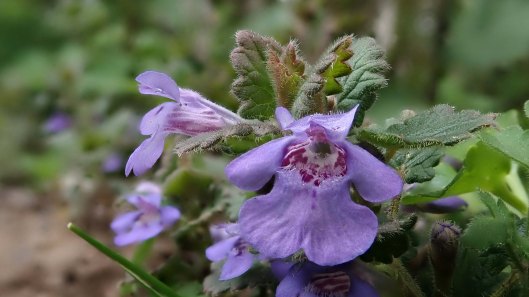
Don’t forget to look down low for this burst of purple goodness. It’s Ground ivy (Glechoma hederacea).
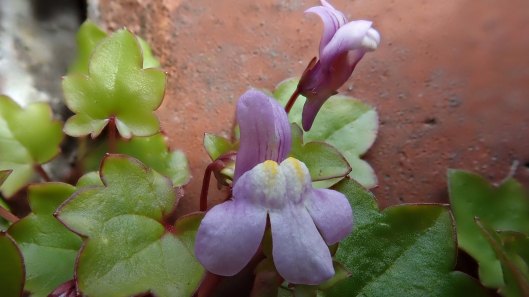
Blooming now on a wall near you, Ivy-leaved toadflax (Cymbalaria muralis).

Part of the large and mightily confusing dandelion family, this is one of the Sow thistles (Sonchus sp.).
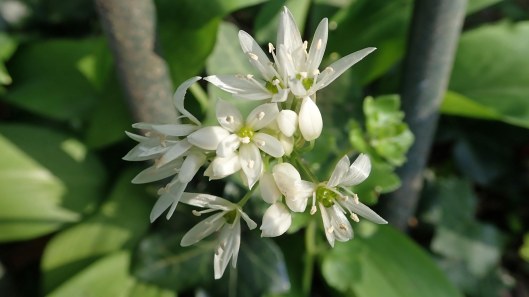
If you go down to the woods today, make sure you take a peg for your nose … unless, like me, you love the smell of Wild garlic (Allium ursinum).
27 Friday Apr 2018
Posted in flowers, nature, spring, wildflowers
Tags
British wildflowers, Cardamine pratensis, Cuckooflower, Lady's smock, Meadow bittercress, spring flowers
‘Any flower that comes with a host of local names is likely to be of human use, either as food or as medicine’, writes John Lewis-Stempel, in his truly wonderful book Meadowland: The Private Life of an English Field (Doubleday, London, 2014; highly recommended, if you haven’t already read it). And he goes on to mention just a few of the local names that have been given to Cardamine pratensis, namely Cuckooflower (because the pale pink flowers tend to appear around the same time the Cuckoo returns to Britain from its winter sojourn in warmer climes); and Lady’s smock, Lady’s gloves, and Lady’s mantle (due to the flower’s resemblance to those articles of clothing) (though I don’t really see the gloves).
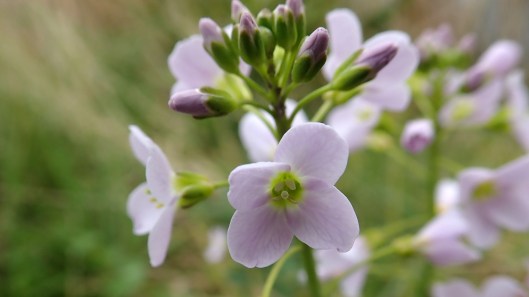
Lewis-Stempel also notes the vernacular Meadow bittercress, so named because ‘the needle-thin leaves … make a peppery edible that used to be sold on medieval market stalls’, which I never knew before. I also didn’t realise that Cuckooflower is the food plant of the caterpillar of the Orange-tip butterfly – reason enough for me not to eat those peppery leaves as I’d love to see more Orange-tips fluttering around.


20 Friday Apr 2018
Posted in flowers, nature, spring, wildflowers
Tags
Anemone nemorosa, British wildflowers, Grandmother's nightcap, Moggie nightgown, Smell foxes, spring flowers, Windflower, Wood anemone

I’m not sure my grandmother ever wore a nightcap quite like this but Grandmother’s nightcap is just one of the vernacular names for the luminous Wood anemone (Anemone nemorosa). Others include Windflower, and, in parts of Deryshire, where a moggie is a mouse not a cat, Moggie nightgown, as well as Smell foxes, due to the musky smell a large colony of Wood anemones will sometimes emit.


15 Sunday Apr 2018
Posted in flowers, nature, plants, spring, wildflowers
Are you up for a challenge? Do you like wildflowers? Well, then get following Wildflowerhour on Twitter and / or Facebook, and join in the weekly wildflower challenge fun. Not only will your newsfeed be filled with glorious colour every Sunday night from 8 to 9pm (and throughout the week, as well) but I guarantee you will also learn something new each week.

The verge
This week’s challenge was titled ‘On the verge’, and we were challenged to see what wildflowers we could discover on roadside verges. Rather than a busy highway, I chose a quiet local side road at Penarth Marina – I already get lots of odd looks for taking a close look at flowers and insects, so tried to avoid too much attention. The Marina area is a relatively new environment, my verge an area that had previously been a dock, where ocean-going ships brought goods from near and far to Cardiff, but this particular dock was filled with household rubbish and turned into a park back in the 1980s. So, I didn’t find anything particularly exciting on my verge but it was interesting to see what plants had become established.

Common cornsalad (Valerianella locusta)

Creeping buttercup (Ranunculus repens)
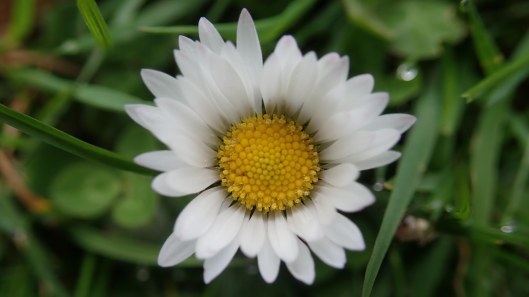
The ever reliable Daisy (Bellis perennis)

Partly devoured Dandelion (Taraxacum sp.) and slug friend

Field Wood-rush (Luzula campestris)
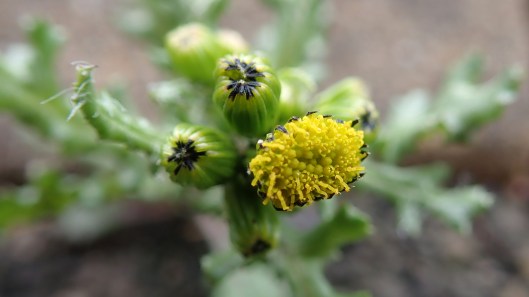
Groundsel (Senecio vulgaris)

Not quite open yet, but close – Ribwort plantain (Plantago lanceolata)

Wavy Bitter-cress (Cardamine flexuosa)
13 Friday Apr 2018
Posted in flowers, nature, spring, wildflowers
Tags
Barren strawberry, Bluebell, British flora, British wildflowers, Common Stork's-bill, Cornsalad, Danish scurvygrass, gorse, Grape hyacinth, Petty spurge, Ragwort, Red dead-nettle, Three-cornered leek
Though the weather has been pretty miserable most of this week, I have been seeing more and more wildflowers when I’m out on my wanders.
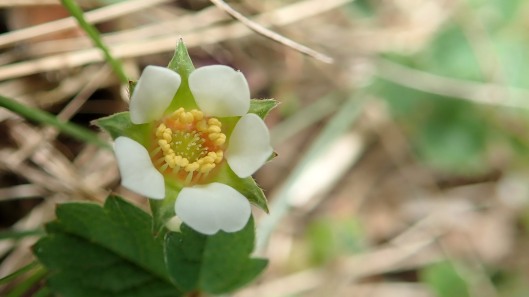
There will be no big fat juicy red berries from this little strawberry as this is a Barren strawberry (Potentilla sterilis) (it has fruit but they don’t become ‘fleshy and red’). I can tell which species it is from the top of the leaf that’s showing – the ‘terminal tooth’ is shorter than those on either side of it.

Last Sunday I saw my first Bluebells (Hyacinthoides sp.) of the year, almost certainly Spanish or hybrids rather than native Bluebells, but still beautiful to my eye.

I think this is Common stork’s-bill (Erodium cicutarium), a nice surprise growing amongst the grass at Cardiff Bay Wetland Reserve.
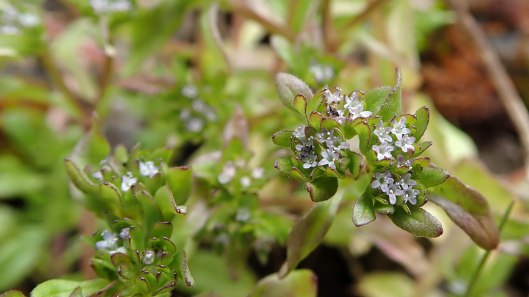
Cornsalad is such a dainty little plant, with very delicate, pale blue flowers. I almost missed these growing by the path at Grangemoor Park and have since seen them in a couple of places. This is probably Common cornsalad (Valerianella locusta), but the only way to be sure it’s not one of the other four varieties is to check the fruit, which won’t be possible till later in the season.
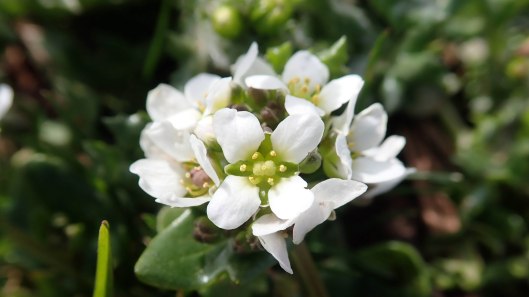
This is Danish scurvygrass (Cochlearia danica), originally a seaside plant that has now become widespread by following the road-salting trucks along the roads of Britain.

Gorse (Ulex sp.) never seems to stop flowering, though the truth is that there are two Gorse species and, when one stops flowering, the other takes over.

These Grape hyacinth (Muscari sp.) have become naturalised in my local cemetery, probably spreading from one or two deliberate grave-top plantings, or from nearby home gardens. I love their blue.

Petty spurge (Euphorbia peplus) is a very common little wildflower that’s often overlooked.

Spotting this flowering Ragwort by the roadside near Cardiff Bay was a bright surprise. It’s probably Common ragwort (Senecio jacobaea).

Red dead-nettle (Lamium purpureum). I’m a big fan of all the dead-nettles – the ‘dead’ in their name refers to the fact that they aren’t covered in stinging hairs!

Allium triquetrum, the Three-cornered leek, is a pretty, if somewhat smelly flower but considered an alien invasive plant species here in Britain.
 earthstar
You must be logged in to post a comment.