At this time of year the ornamental cherry tree outside my flat is awash with blossom, of a warm white shade flushed with the merest tinge of pink.
It looks glorious, especially on sunny days, and, at a time when there are few flowers in bloom, it’s a magnet for newly emerging, hungry insects of the flying kind.
Yesterday, as well as a few Honey bees, I spotted half a dozen, all Buff-tailed, bumblebees doddering from one flower to the next, before lurching haphazardly to the next branch, dislodging the delicate petals as they passed.
Despite the appalling weather – frequent heavy rain and occasional strong winds – we’ve been experiencing over the last couple of weeks, I have managed still to find a few hardy insects, persisting by cunningly finding sheltered places to avoid the worst of the inclement conditions.
These bees seem to have the right idea. On the left is a Buff-tailed bumblebee, which I watched emerging from inside the cosy, fluffy duvet of an Old man’s beard seedhead and, on the right, a Common carder that seems to have the same idea and be looking for a place to snuggle down.
Also looking cosy, these Common earwigs were huddling in the cups of umbellifer seedheads.
Common darters have still been active in the more sheltered spots during the occasional sunny periods, these at Cosmeston Lakes Country Park.
The last of this year’s brood of Ivy bees were still feeding their grubs. They had made use of a rabbit scrape to excavate the underground burrows where their eggs are laid, grubs hatch and pupate and will remain until emerging as adult bees next autumn.
In recent weeks, when the weather has been fine and the air relatively still, I’ve been spending time searching the Devil’s-bit scabious for bees. Not just any bees, but four scarce and endangered bees. This is part of Buglife’s ‘Searching for Scabious’ project, which
aims to improve our understanding of the distribution and conservation status of some of Wales’ rarest and most threatened solitary bees – the Large Scabious Mining Bee (Andrena hattorfiana) and its associated cuckoo, the Armed nomad bee (Nomada armata), and Small Scabious Mining Bee (Andrena marginata) and its cuckoo, the Silver-sided nomad bee (Nomada argentata).
I wasn’t familiar with these bees and am not very good at bee identification in general but Liam Olds, Buglife’s local conservation officer, has put together an excellent explainer video, which can be accessed on YouTube, so I thought I’d join the search.
Unfortunately, I haven’t managed to find any of the scarce bees at the two local sites where Devil’s-bit scabious grows in abundance (and neither has Liam, which was reassuring for me re my search skills but bad news for the bees). The bees I did find most commonly were the appropriately named Common carder (Bombus pascuorum) (below, left) and the Buff-tailed bumblebee (Bombus terrestris) (below, right).
Liam very kindly helped to identify the other small bees I found. These lovely little furrow bees are either the White-zoned furrow bee (Lasioglossum leucozonium) or the Bull-headed furrow bee (Lasioglossum zonulum) – the two species are too similar to tell them apart without closer examination.
I also found several of these more distinctive individuals, the Wood-carving leafcutter bee (Megachile ligniseca). You can find out more about them, and watch a little video of their nest-building skills, on the BWARS website. Meantime, I’m heading back to the scabious for another look.
Bumblebees and Teasels – I’m not sure why but they seem to be a match made in heaven.
In fact, bumblebees are the insects I see most often nectaring on Teasels, though the Burnet moths also find Teasel to their taste, as did this Meadow brown butterfly yesterday.
Actually, it rained before my walk, during my walk and after I got home, but ‘Small creatures between showers’ was a bit long for a title. Here, then, are the said creatures …
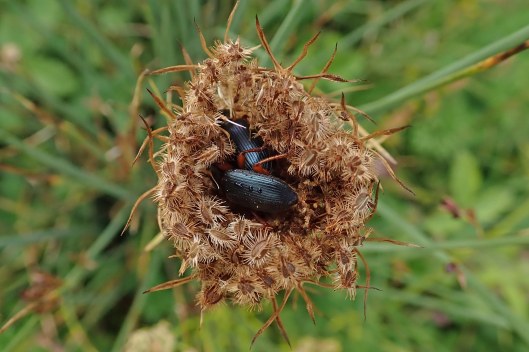
First up, these beetles were cosying up in an umbellifer flower head. I couldn’t see enough to identify them and wasn’t going to disturb their comfort to find out more.
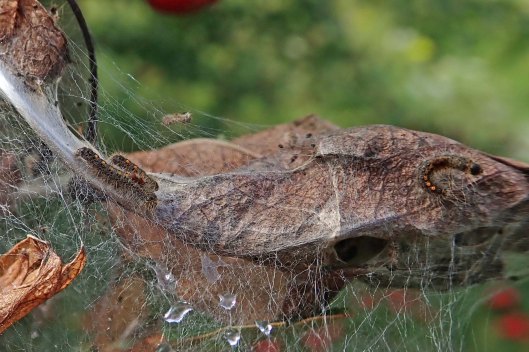
This is a web of Brown-tail moth larvae, the ones some people freak out about because their hairs can irritate the skin. The solution to that problem is, of course, easy: look, enjoy, wonder, admire, but don’t touch!
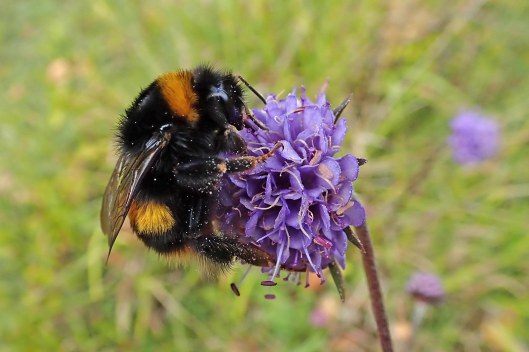
There weren’t many flying critters about but bumblebees will fly whatever the weather, as shown by this gorgeous queen Buff-tailed bumble.
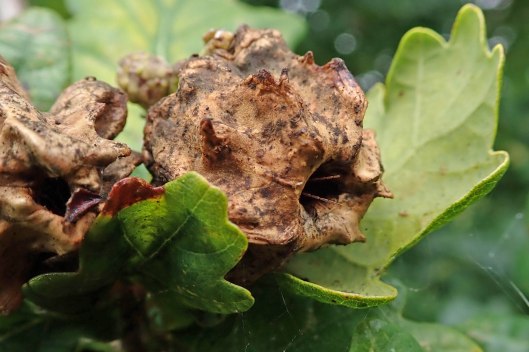
Perhaps the littlest creature, though I didn’t look in to investigate, was the one that was lurking in this Knopper gall (spot the antennae!).
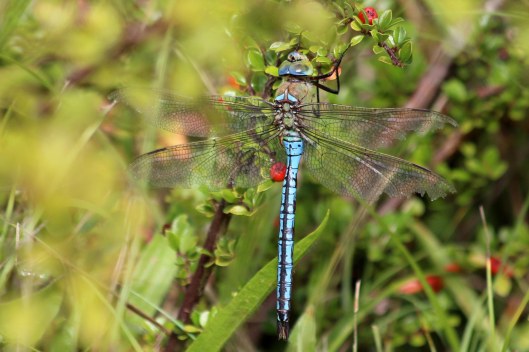
And, the prize for the most magnificent, was this male Emperor dragonfly. I had to linger a while, waiting for him to settle, and then sneak up behind the bushes, but His Imperial Majesty was definitely worth the wait. What a handsome creature he is, despite his somewhat ragged wings.
I always have a little smile to myself when I see a Hebe because, of course, it’s a New Zealand native plant and reminds me of my homeland (though I was surprised to read today that they’re also native to South America, the Falkland Islands and one island in French Polynesia).
They’re tough plants. The two species shown here were photographed in 0° Celsius, in between hail showers, yet they show no signs of being affected by the Welsh winter and, in fact, are providing much-needed food for the few bees (that’s a Buff-tailed bumblebee in my photo) and other insects that are still out and about. As well as the cold, they’re also very tolerant of salty sea air so they’re a good plant for coastal gardens like those here in Penarth.
In case you didn’t know, the plant is named after the Greek goddess Hebe, daughter of chief god Zeus and his wife Hera. Hebe was barista on Mt Olympus, serving ambrosia and nectar to all the other gods and goddesses, until she married Heracles and became a stay-at-home mum to their two kids.
As the Mary Kay Ash quote goes: ‘Aerodynamically, the bumblebee shouldn’t be able to fly but the bumblebee doesn’t know it so it goes on flying anyway.’ And flying they are, now that spring is here. The warmer weather brings the bumblebees – all queens – out of their long sleep, to begin the process of nest building and egg laying. In the past week I’ve seen several in flight and managed to get photos of two different species.
Though it’s common in Europe and Asia, this Tree bumblebee (Bombus hypnorum) is not a British native. In fact, its ancestors only arrived in Britain in 2001. It has, however, made itself right at home and, as far as scientists can tell, is not damaging the native bee populations. It’s important we monitor its spread and population though, so please help by reporting your sightings to the Bees, Wasps and Ants Recording Society (BWARS).
The Buff-tailed bumblebee (Bombus terrestris) is often the first to be seen each year, emerging as early as February if the weather’s warm enough. Its nests, occupying old mouse and vole holes underground, can house as many as 500 individuals.
You will notice in my photo that this bumblebee has some hitchhikers. These are mites but please do not be concerned for this little creature. The mites are normal, they actually help keep bumblebee nests clean, and only in extreme cases do they affect the bumblebee’s health and welfare. You can read more here.





 earthstar
You must be logged in to post a comment.