• ABOUT
  • BIRDING 2018
  • Birding 2019
  • BLOG POSTS
  • Butterflies 2018
  • Resources

earthstar

~ a celebration of nature

earthstar

Tag Archives: Burnet companion

Moths matter

04 Friday Aug 2023

Posted by sconzani in insects

≈ Leave a comment

Tags

#MothsMatter, Autographa gamma, British moths, Burnet companion, Chiasmia clathrata, Euclidia glyphica, Hummingbird hawk-moth, Large Yellow Underwing, Latticed heath, Macroglossum stellatarum, moth, Noctua pronuba, Silver Y, Six-spot burnet, Zygaena filipendulae

Some recent mothy goodness …
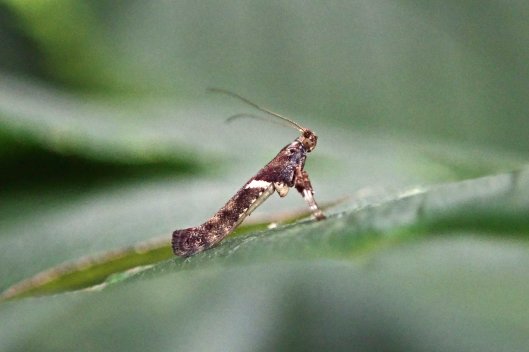
230804 1 Caloptilia semifascia

First, the micro moth Caloptilia semifascia, which I found perched on a leaf during a local meander and which, miraculously, stayed still for some photos.
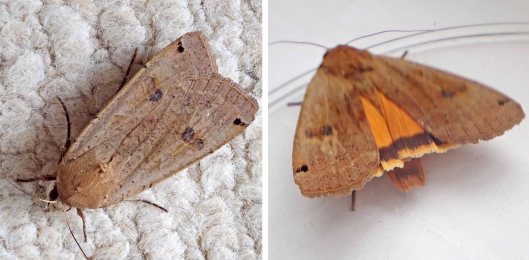
230804 2 large yellow underwing

I grabbed the rain parka I’d left drying on the back of a chair and this beauty flew up. Either I’d brought it home from the previous day’s walk or it had flown in an open window during the night. Whichever it was, this Large yellow underwing (Noctua pronuba) was a welcome visitor.

230804 3 6-spot burnet

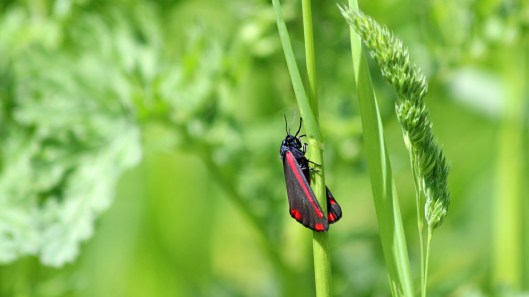
I always enjoy watching the Five- and Six-spot burnets during the summer months. This is one of the latter (Zygaena filipendulae).
230804 4 silver y

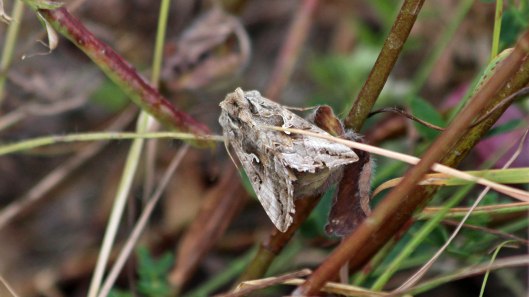
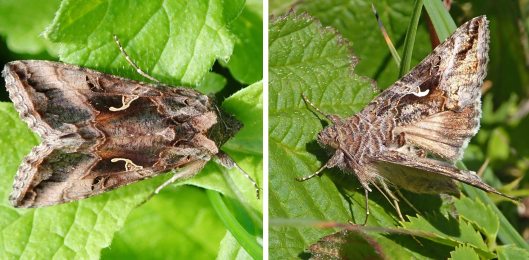
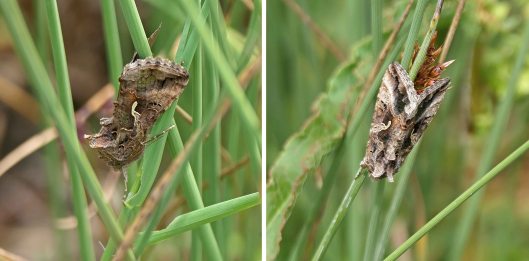
Most of the Silver Ys (Autographa gamma) I see are constantly fluttering about in the long grass but these two were much more cooperative.

230804 5 burnet companion

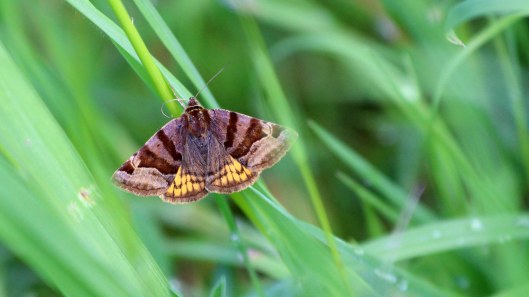
Burnet companions (Euclidia glyphica) are also frequently camera shy but I got lucky with this beauty that was more intent on feeding than on the lurking photographer.

230804 6 humming-bird hawk-moth

Hummingbird hawk-moths (Macroglossum stellatarum) are most often seem hovering in front of flowers, their long tongues seeking out the tasty nectar within, but this one whizzed past during a recent walk then, luckily for me, settled on the path in front of me.

230804 7 latticed heath

This lovely is another summertime treat. Last but certainly not least, a Latticed heath (Chiasmia clathrata).

Like Loading...

Flitting about in the grass

24 Saturday Jun 2023

Posted by sconzani in insects

≈ Leave a comment

Tags

Autographa gamma, British moths, Burnet companion, Chrysoteuchia culmella, Euclidia glyphica, Garden Grass-veneer, moth, Silver Y

During my recent wanders, particularly through areas of long grass, moths tiny and large have been flitting up and flying a short distance, before fluttering back into the grass. Ninety-nine percent of the time, the moths have seemingly disappeared, so capable of stillness have they been and so well camouflaged. Fortunately for me, in the other one percent of instances I’ve managed to get photographs. Here are some of these flitters …

230624 burnet companion

– Burnet companion (Euclidia glyphica)

230624 silver y

– Silver Y (Autographa gamma)

230624 Chrysoteuchia culmella

– Garden grass-veneer (Chrysoteuchia culmella)

Like Loading...

148/365 The one that got away

28 Tuesday May 2019

Posted by sconzani in 365DaysWildin2019, insects, nature

≈ 3 Comments

Tags

#365DaysWild, Bird’s-foot trefoil, British moths, Burnet companion, Cosmeston, Cosmeston Lakes Country Park, moth, moths

I mentioned in yesterday’s post about the amazing Narrow-bordered Bee Hawk-moth that I had actually been trying to re-find a Burnet Companion moth when I spotted the Hawk-moth. Well, today I got the one that got away yesterday – not the actual moth, as today I was at Cosmeston not Lavernock, and not just one but three Burnet Companions appeared for my camera today.

190528 burnet companion (1)

I felt a bit sad for the first one I saw (below left). Either it hadn’t developed properly in its pupa or something had happened to it since hatching, as its wings appeared damaged and it didn’t seem able to fly.

190528 burnet companion (2)
190528 burnet companion (3)

But the other two were flitting merrily from flower to flower, drinking in as much Bird’s-foot trefoil nectar as their tiny tongues could manage. And not only do they have lovely markings on the top side of their wings but they’re a wonderful buttery yellow underneath as well (above right).

190528 burnet companion (4)

Like Loading...

Some recent moths

16 Monday Jul 2018

Posted by sconzani in insects, nature

≈ 2 Comments

Tags

Blood-vein, British moths, Burnet companion, Common purple & gold, Glyphipterix thrasonella, moths, Orange-spot piercer, Riband wave, Riband wave banded form, Scarlet tiger

Though they seem to have disappeared now, the Burnet companions (Euclidia glyphica) were out in force at Cosmeston for about six weeks, from the last day of May until early July.

180716 1 Burnet companion

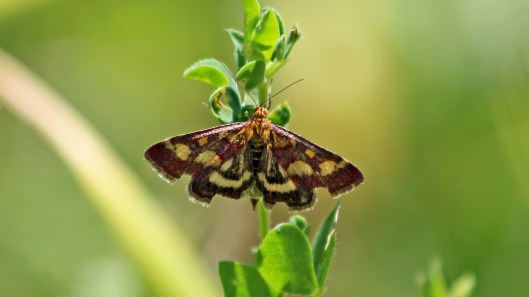
The Common purple & gold (Pyrausta purpuralis) is a tiny but very colourful moth – a rich maroon-purple base with pretty gold markings.

180716 2 Pyrausta purpuralis

With a thin red line running horizontally from one wing tip to the other, it’s easy to see how the Blood-vein (Timandra comae) got its name.

180716 3 Blood-vein

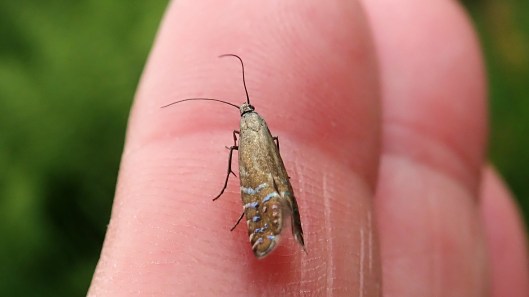
Glyphipterix thrasonella (no common name) is another very small moth, as you can tell from its size relative to my fingers, and is another with attractive markings, this time bright light blue on a gold base.

OLYMPUS DIGITAL CAMERA

In Bute Park recently I spotted two different species of moth. The first was this tiny micro on Hogweed, an Orange-spot piercer (Pammene aurana).

180716 5 Orange-spot piercer

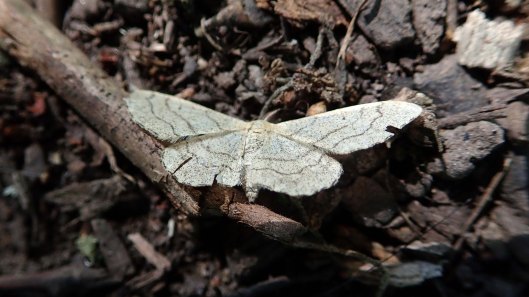
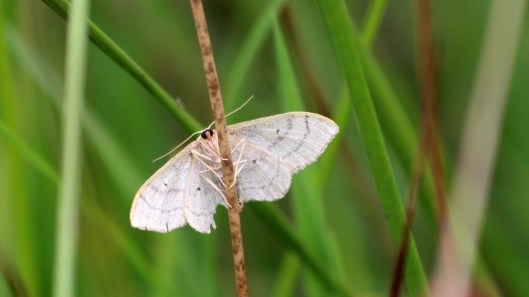
I didn’t have to try hard to see the second moth as it fluttered down from a tree on to the earth in front of me. This is a Riband wave (Idaea aversata).

OLYMPUS DIGITAL CAMERA

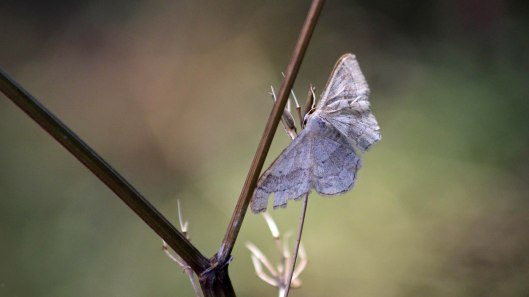
And, while we’re on the subject of Riband waves, here’s another but this is the banded form – note how the area between the two lines on its wings has been ‘coloured in’.

180716 7 Riband wave banded form

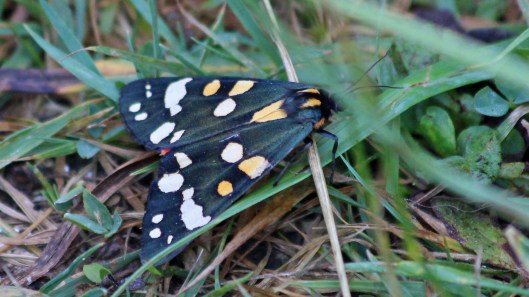
Last but certainly not least is this stunning Scarlet tiger (Callimorpha dominula), which was sitting on the grassy path in front of me during a recent meander around Lavernock Nature Reserve.

180716 8 Scarlet tiger

Like Loading...

Aberbargoed Grasslands revisited

06 Friday Jul 2018

Posted by sconzani in insects, nature

≈ 2 Comments

Tags

Aberbargoed Grasslands, British butterflies, British moths, Burnet companion, butterflies, Common purple & gold, Large skipper, moths, Riband wave, Ringlet, Silver Y, Small heath, Small skipper

On Wednesday I made my second visit to Aberbargoed Grasslands National Nature Reserve with my friend Sharon. Last time we dipped on seeing the Marsh fritillaries because it was too overcast; this time, we dipped again because the recent spell of hot dry weather has meant their season has finished for the year. Still, we have now walked most of the paths around the reserve so we’ll know exactly where to look next year. And, though we missed out the fritillaries, there were still plenty of other butterflies and moths to charm and delight us.

180705 1 small heath

Small heath (Coenonympha pamphilus)

180705 2 Ringlet

Ringlet (Aphantopus hyperantus)

180705 3 Small skipper

Small skipper (Lycaena phlaeas)

180705 4 Large skipper

Large skipper (Lycaena dispar)

180705 5 Burnet companion

Burnet companion (Euclidia glyphica)

180705 6 Pyrausta purpuralis

Common purple & gold (Pyraustra purpuralis)

180705 7 Riband wave

Riband wave (Idaea aversata)

180705 8 Silver Y

Silver Y (Autographa gamma)


Like Loading...

Random acts of wildness

01 Friday Jun 2018

Posted by sconzani in insects, nature

≈ 2 Comments

Tags

#30DaysWild, British butterflies, British moths, Burnet companion, butterflies, Cinnabar, Common blue, Latticed heath, moths, random acts of wildness, Silver Y, Small white

From today until the end of June, I’m taking part in 30 Days Wild, a month-long nature challenge run by the Wildlife Trusts. The idea is to do something wild every day for 30 days, whether ‘you take time out to simply smell a wildflower, listen to birdsong, explore a local wild place or leave a part of your garden to grow wild for a month’ and the aim is that by ‘making nature part of your life for 30 days’, you will feel ‘happier, healthier and more connected to nature’. This is pretty much what I do most days anyway but this month I’m going to ensure I go wild every single day! You can join in too, if you want – the info is here.

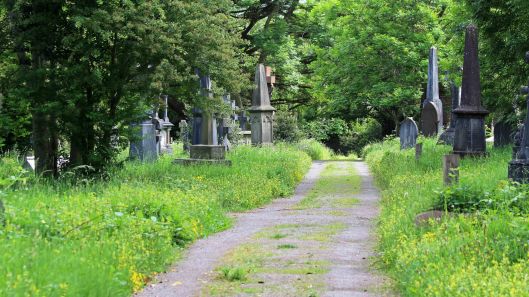
180601 (1) Cathays Cemetery

So, today, on day one, I went for a lovely long wander in Cathays Cemetery, Cardiff’s magnificent, huge, Victorian cemetery. Sadly, some parts of the cemetery are poorly managed – large areas without gravestones, which could be easily become wildflower meadows, are savagely mown, the clippings not removed. But there are a couple of areas where the grasses and wildflowers have been allowed to grow, and additional wildflowers – in particular, a lot of Yellow rattle – have been sewn. These two areas were alive with insects today: bees and hoverflies, bugs and beetles, and damselflies galore. My favourites, though, were all the lovely Lepidoptera: here are some I saw …

180601 (2) Latticed heath

Latticed heath moth

180601 (3) Common blue female

Common blue butterfly (female)

180601 (4) Common blue male

Common blue butterfly (male)

180601 (5) Silver Y

Silver Y moth

180601 (6) Burnet companion

Burnet companion moth

180601 (7) Small white

Small white butterfly

180601 (8) Cinnabar

Cinnabar moth

Like Loading...

Three moths in one day

20 Monday Jun 2016

Posted by sconzani in insects, nature, nature photography

≈ 6 Comments

Tags

Brimstone moth, Burnet companion, Cathays Cemetery, Cinnabar moth, Euclidia glyphica, moth, Opisthograptis luteolata, Tyria jacobaeae

The day I did my biodiversity hunt at Cathays Cemetery was a bumper day for moths, with three new species spotted.

brimstone (1)
brimstone (2)

The first was this beautiful Brimstone (Opisthograptis luteolata), not to be confused with the butterfly of the same name, though both are a mellow buttery yellow. I was flat out on the grass photographing this when a group of young school children passed by. ‘Teacher, what’s that lady doing?’ ‘I don’t know, David’, came the reply, as the teacher quickly ushered her charges past the mad lady lying down in the cemetery!

cinnabar (1)
cinnabar (2)
cinnabar (3)

The Cinnabar moth (Tyria jacobaeae) is a colourful character. It starts out life as a bright orange and black caterpillar, then transforms into a bright red and black moth – it gets its name from the bright red mineral mercury sulphide, also known as cinnabar. The caterpillars can be cannibalistic when their food source is scarce and, though I never saw them there, these moths were introduced to New Zealand in an attempt to control the invasive ragwort plant on which their caterpillars feed.

160620 burnet companion (3)
160620 burnet companion (4)
160620 burnet companion (5)

Last but certainly not least, as I saw several of these in one small area, was the Burnet companion (Euclidia glyphica). It apparently gets its common name from the fact that it’s often seen in the company of Burnet moths – not on this day! I make no excuses for showing its bottom, as the colour of its underside is a rich orange, almost more attractive than its top. Though they were mostly skittish, one very obligingly remained still long enough to get a head-on shot, which I love.

Like Loading...

About me

sconzani

sconzani

I'm a writer and photographer; researcher and blogger; birder and nature lover; countryside rambler and city strider; volunteer and biodiversity recorder.

View Full Profile →

Follow earthstar on WordPress.com

Enter your email address to follow this blog and receive notifications of new posts by email.

Recent blog posts

  • N is for nest December 19, 2025
  • M is for mite December 18, 2025
  • L is for lepidopteran lifers December 17, 2025
  • K is for Keeled skimmers December 16, 2025
  • J is for Jersey tiger December 15, 2025

From the archives

COPYRIGHT

Unless otherwise acknowledged, the text and photographs on this blog are my own and are subject to international copyright. Nothing may be downloaded or copied without my permission.

Fellow Earth Stars!

  • Unknown's avatar
  • Unknown's avatar
  • Unknown's avatar
  • Unknown's avatar
  • Unknown's avatar
  • Unknown's avatar
  • Unknown's avatar
  • Unknown's avatar
  • Unknown's avatar
  • Unknown's avatar
  • Unknown's avatar
  • Unknown's avatar
  • Unknown's avatar
  • Unknown's avatar
  • Unknown's avatar
  • Unknown's avatar
  • Unknown's avatar
  • Unknown's avatar
  • Unknown's avatar
  • Unknown's avatar
  • Unknown's avatar
  • Unknown's avatar
  • Unknown's avatar
  • Unknown's avatar
  • Unknown's avatar
  • Unknown's avatar
  • Unknown's avatar
  • Unknown's avatar
  • Unknown's avatar
  • Unknown's avatar
  • Unknown's avatar
  • Unknown's avatar
  • Unknown's avatar
  • Unknown's avatar
  • Unknown's avatar
  • Unknown's avatar
  • Unknown's avatar
  • Unknown's avatar
  • Unknown's avatar
  • Unknown's avatar
  • Unknown's avatar
  • Unknown's avatar
  • Unknown's avatar
  • Unknown's avatar
  • Unknown's avatar
  • Unknown's avatar
  • Unknown's avatar
  • Unknown's avatar
  • Unknown's avatar
  • Unknown's avatar

Blog at WordPress.com.

Privacy & Cookies: This site uses cookies. By continuing to use this website, you agree to their use.
To find out more, including how to control cookies, see here: Cookie Policy
  • Subscribe Subscribed
    • earthstar
    • Join 667 other subscribers
    • Already have a WordPress.com account? Log in now.
    • earthstar
    • Subscribe Subscribed
    • Sign up
    • Log in
    • Report this content
    • View site in Reader
    • Manage subscriptions
    • Collapse this bar
 

Loading Comments...
 

You must be logged in to post a comment.

    %d