• ABOUT
  • BIRDING 2018
  • Birding 2019
  • BLOG POSTS
  • Butterflies 2018
  • Resources

earthstar

~ a celebration of nature

earthstar

Tag Archives: butterfly

204/365 The summer Holly blues

23 Tuesday Jul 2019

Posted by sconzani in 365DaysWildin2019, insects, nature

≈ 6 Comments

Tags

#365DaysWild, British butterflies, butterfly, Holly blue, Holly blue butterfly, Lavernock Nature Reserve, summer butterflies

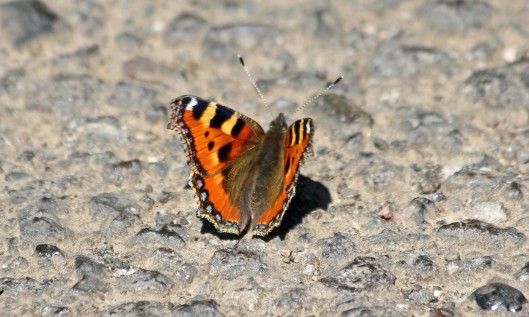
The Holly blue is one of several British butterflies that goes through more than one life cycle per year (you can read more about them here), and the second generation of these stunning little butterflies is now on the wing in my local reserves and wild places.

190723 summer holly blue (1)190723 summer holly blue (4)

I saw my first of the summer brood on 14 July at Grangemoor Park, and this perfect little female was feeding on bramble flowers when I visited Lavernock Nature Reserve on Saturday, 20 July. Look out for them on ivy bushes, as that’s where the second generation females lay their eggs.

190723 summer holly blue (2)190723 summer holly blue (3)

Like Loading...

202/365 Sexing Gatekeepers

21 Sunday Jul 2019

Posted by sconzani in 365DaysWildin2019, insects, nature

≈ 1 Comment

Tags

British butterflies, butterfly, Gatekeeper, Sexing Gatekeepers, working out gender of Gatekeepers

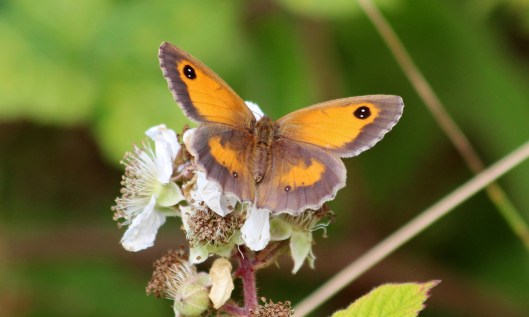
The orange-and-brown Gatekeepers have been brightening my local wanderings for a couple of weeks now, eclipsing the now-fading Meadow browns and Ringlets with their newly emerged vibrancy, but I’m struggling to tell which are the males and which the females.

190721 gatekeeper male

It’s easy when they sit with their wings open, as the males have  dark streaks of colour through the centre of their upper wings. So, that’s a male posing perfectly in the photograph above and a female being not quite as co-operative in the image below.

190721 gatekeeper female

For some reason though – and I have spent several hours lately observing them – I don’t see females sitting open-winged very often. As butterfly observers in other parts of south Wales tell me they frequently see females perched open-winged in their areas, I’m wondering why there’s a difference locally. Is there an imbalance in the local population, with many more males than females? Are the males more aggressive here, so the females prefer not to advertise their presence? I don’t know the answers so if someone does, I’d love to know.

190721 gatekeeper female (2)
190721 gatekeeper underwing (1)
190721 gatekeeper underwing (2)

In the meantime, I’ve been trying to spot which are male and female when their wings are closed. The females should be lighter in colour, I believe, but lightness and darkness are so subjective and very changeable, depending on the prevailing weather conditions and the habitat. Females are also a little larger but, again, it’s difficult to make that comparison unless you see the two sexes sitting side by side. Take the three butterflies above – I know the one of the left is a female as I saw her upper wings, and I would guess that the individual on the right is a male as it does look quite dark, but the one in the middle?

190721 gatekeeper female very faded

I’ll keep trying to improve my observation skills but, in a couple of weeks, the Gatekeepers will be looking as faded as the Meadow browns and Ringlets are now – like the female above, photographed in mid August – and then my queries will have to wait until the cycle begins again next year.

Like Loading...

197/365 Butterflying at Slade Wood

16 Tuesday Jul 2019

Posted by sconzani in 365DaysWildin2019, insects, nature, walks

≈ 7 Comments

Tags

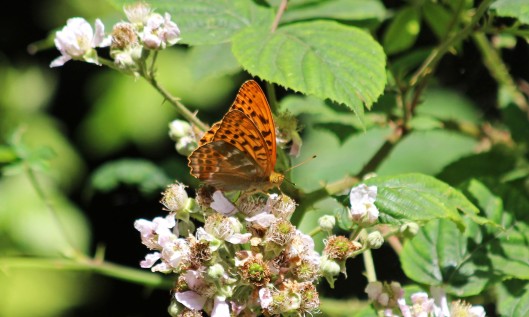
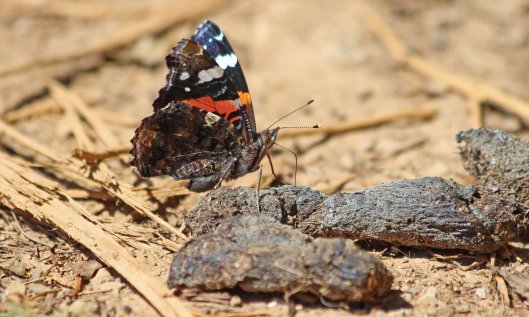
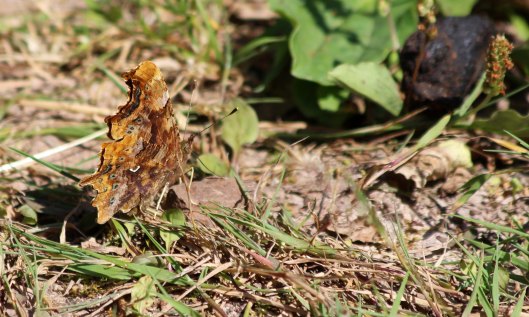
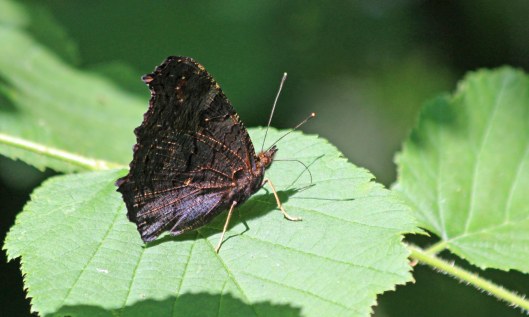
#365DaysWild, British butterflies, butterfly, butterflying, Comma, Peacock, Red Admiral, Silver-washed fritillary, Slade Wood, Small tortoiseshell, White admiral

Yesterday, with my friend Sharon, I went to Slade Wood, in the neighbouring county of Gwent, for a walk and some butterflying.

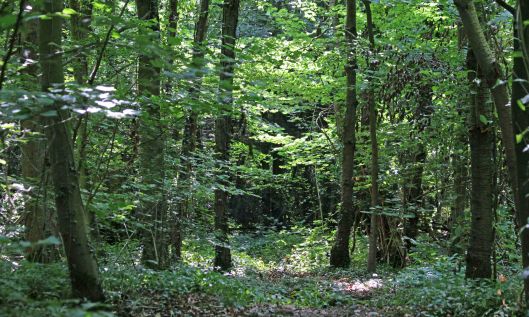
190716 Slade Wood

The woodland was lovely and a haven from the hot sun but, for us, the best butterflying was to be had just wandering along the country lane leading to the woodland. With high hedges, abundant wildflowers and occasional blooming Buddleia bushes, backed by the tall woodland trees, it was heaven for butterflies. These are a few of the 12 species we saw …

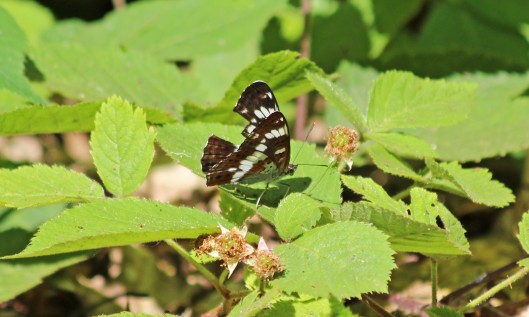
190716 white admiral

My first White admirals of the year, the first I’ve seen in Wales; they seem to float over the vegetation.

190716 silver-washed fritillary

Those giant orange-and-brown speedsters, the Silver-washed fritillaries.

190716 red admiral

Red admiral extracting minerals from poo … mmmmm, delicious!

190716 comma

Comma, incredibly well camouflaged amongst the grasses and leaf litter, also heading for a slurp at the poo.

190716 peacock

Peacock, hiding its glorious bold colours away behind those closed wings.

190716 small tortoiseshell

Small tortoiseshell, a pretty little butterfly that I don’t see very often, so a delight to spot one of these.

Like Loading...

194/365 On the top of the tip

13 Saturday Jul 2019

Posted by sconzani in 365DaysWildin2019, insects, nature

≈ 2 Comments

Tags

#365DaysWild, Aberbargoed spoil tip, British butterflies, butterfly, colliery spoil tip, Grayling

The coal-mining spoil tip in Aberbargeod was once 400 feet high, a disaster waiting to happen, until the tragedy at Aberfan in 1966 (when 144 people, mostly children in the town’s primary school, were killed by the local spoil tip sliding down the valley) caused an urgent re-evaluation of the dangers of these tips. Aberbargoed’s was reduced in size, walkways and culverts were built around it, trees have been planted on it, and it’s now a wondrous place for biodiversity.

190713 grayling (1)

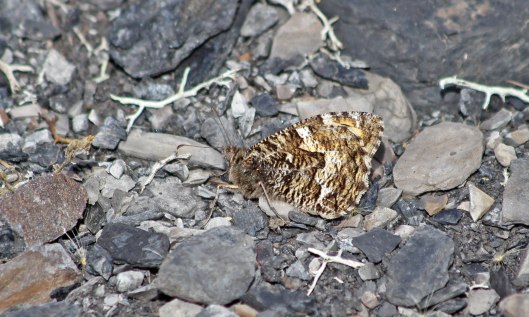
It is, however, still a steep huffing-puffing walk to the top on a hot summer’s day, particularly when, as I did yesterday, you walk straight up, instead of using one of the longer zigzagging paths. But it was worth every drop of sweat I exuded as, not only are the panoramic views superb, but Aberbargoed tip is also home to a colony of Grayling butterflies.

190713 grayling (2)

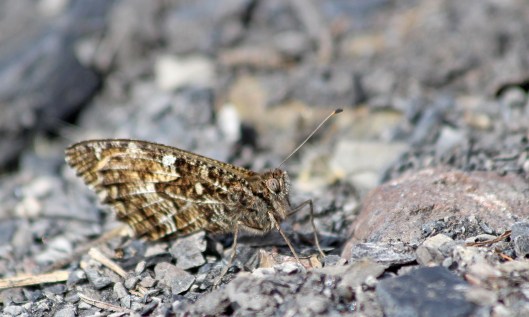
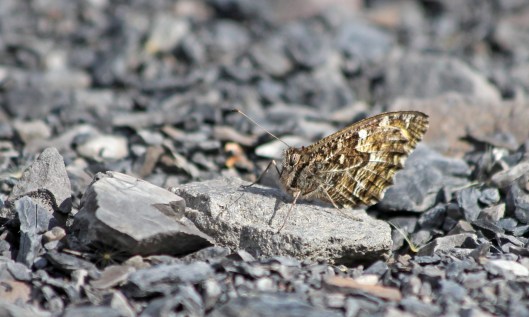
Graylings prefer dry, well-drained locations with sparse vegetation, so a spoil tip is the perfect spot for them. And, as they like to hunker down with the bright eye spots on their forewings well hidden, the mottled colouring on their hind wings means they’re incredibly well camouflaged on the stone chippings.

190713 grayling (3)

I was lucky, though, that a couple of the Graylings I spotted yesterday seemed curious about this stranger who had invaded their territories. So, I plonked myself down on a slope next to a path and waited. And sure enough, first one, then a second butterfly came to investigate. If it hadn’t been as hot as hell, I could’ve stayed there for hours.

190713 grayling (4)

You can read more about the environmental importance of preserving the spoil tip sites on Liam Old’s excellent website, Colliery Spoil Biodiversity Initiative.

Like Loading...

193/365 Hairstreaks

12 Friday Jul 2019

Posted by sconzani in 365DaysWildin2019, insects, nature

≈ 2 Comments

Tags

#365DaysWild, British butterflies, butterfly, hairstreaks, Purple hairstreak, record shots only, White-letter hairstreak

Record shots only! Have you heard that term? Well, these photos are extremely good examples of what it means – really lousy photos, sometimes taken at long distance and then heavily cropped, often blurry, possibly adjusted in Photoshop or similar image processing software to try to enhance the features, but really only retained as proof that you did actually see what you say you saw. (So you can actually see what lovely butterflies these are, I’ve linked their names to the relevant pages on the Butterfly Conservation website.)

190712 white-letter hairstreak

Luckily, with this shot of a White-letter hairstreak, I was with another person, who actually showed me the location, so I have a witness to the sighting. From my ‘record shot’ you probably can’t even tell that the small blob in the sky is a butterfly flitting around in the top canopy of this Wych elm.

190712 purple hairstreak (1)

I did a little better with the Purple hairstreak. Again, this is a known location, where other people have seen and photographed these lovely little butterflies in recent days. The first time I visited, all I could see were small flutterings at the very top of the tall old oak trees where the Purple hairstreaks live. Luckily, on my second visit, some of the butterflies were moving around further down the tree. I just needed to be patient and wait for one to fly, then try to follow where it went – believe me, that’s not easy as they almost seem to disappear amongst the leaves and they really are quite small (a wing span of 37-39mm).

190712 purple hairstreak (2)

Like Loading...

192/365 Essex skippers

11 Thursday Jul 2019

Posted by sconzani in 365DaysWildin2019, insects, nature

≈ 2 Comments

Tags

#365DaysWild, British butterflies, butterflies, butterfly, Essex skipper, skipper identification

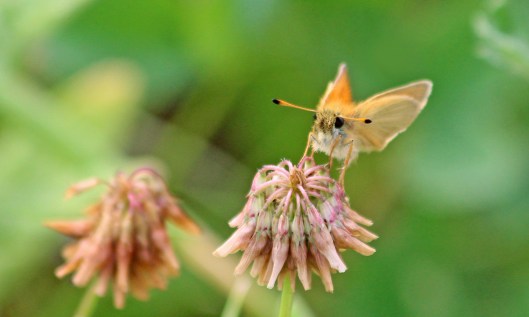
Tuesday was the first time I have knowingly seen and photographed Essex skippers. I visited a location where there’s been a colony in previous years so my chances were high but I knew they were tricksy little butterflies to identify – the only photo I have of one was taken two years ago in a different place and I didn’t realise what it was till I checked it more carefully a year later.

190711 essex skipper (1)

You see, the Essex looks superficially very similar to the Small skipper. They’re the same size, the same general colour and can be found in the same habitats. The defining feature for a novice like me is the tips of the butterfly’s antennae – in the Essex skipper these are black, both on top and below. And therein lies the difficulty! Because you just try seeing the colour on the underside of the antennae of very small butterflies that spend most of their time skilfully weaving their way in and around tall grasses in a meadow full of similar butterflies. It ain’t easy!

190711 essex skipper (2)

Still, it was a pleasant day, the meadow was full of lovely wildflowers, and I was surrounded by butterflies of several types and sizes – what could be nicer? It was really just a matter of time and patience, and eventually I had two definite sightings. One very cute little Essex even decided to pose for me, repeatedly settling on grass stems so I could get the front-on photos that I needed to be sure of its identity.

190711 essex skipper (3)

Like Loading...

188/365 Silver-washed fritillary

07 Sunday Jul 2019

Posted by sconzani in 365DaysWildin2019, insects, nature

≈ 2 Comments

Tags

#365DaysWild, British butterflies, butterflies, butterfly, fritillaries, Silver-washed fritillary

As well as the endangered High brown fritillaries and their cousins the Dark greens, Friday’s butterflying day out also turned up a couple of these beauties, the equally glorious members of the family, the Silver-washed fritillaries (Argynnis paphia).

190707 silver-washed fritillary (1)

If you’re wondering how an orange-and-black-patterned butterfly got the name silver-washed, it’s because the underside of its wings are streaked silver. Unfortunately, my photos don’t show that very clearly … next time.

190707 silver-washed fritillary (2)

Like Loading...

181/365 An aberrant Meadow brown

30 Sunday Jun 2019

Posted by sconzani in 365DaysWildin2019, insects, nature

≈ 2 Comments

Tags

#365DaysWild, aberrant butterfly, aberrant Meadow brown, British butterflies, butterflies, butterfly, Cosmeston, Cosmeston Lakes Country Park, Meadow Brown, pathological aberration

I feel like I should be apologising for featuring butterflies three days in a row but this little butterfly is so interesting that I just had to share it. There are a ton of Meadow browns flitting around the wildflower fields at Cosmeston right now and they mostly look like this – or, at least, the females do.

190630 Meadow brown normal female

So, I think you can see why the butterfly in this next photo caught my eye. Unfortunately, I wasn’t able to get a really clear shot of it, as it kept flying further into the flowers and I didn’t want to trample them, but you get the idea. Thanks to a tweet from UK Butterflies, I now know “This aberration is referred to as ‘pathological’, where wing scales fail to pigment – thought to be caused by some type of damage (physical or chemical) to the pupa. Asymmetrical examples are known too where only 1 wing is affected.” Isn’t it fascinating?

190630 Meadow brown aberrant female

Like Loading...

180/365 Butterflying in Somerset, part II

29 Saturday Jun 2019

Posted by sconzani in 365DaysWildin2019, insects, nature, wildflowers

≈ 2 Comments

Tags

British butterflies, butterflies, butterfly, butterflying, Collard Hill, Large blue, Large blue butterfly, Marbled white, Wild thyme

Scenario: Three friends go seeking rare butterflies across the border in England.

190629 Collard Hill view

Second location: Collard Hill, in Somerset. A hot walk up the steep hill for more incredible views across picturesque Somerset. And we weren’t far from the legendary Glastonbury Tor.

190629 Glastonbury Tor

Support act: Marbled white. My first sightings of these little beauties for the year, and we saw several flitting back and forth above the long grass.

190629 marbled white

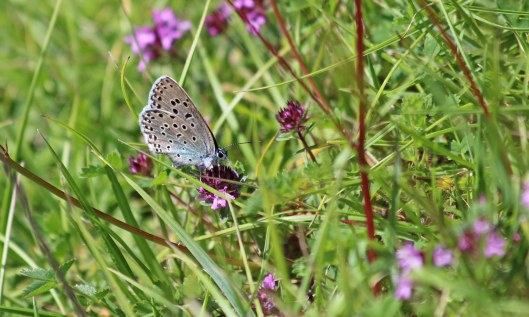
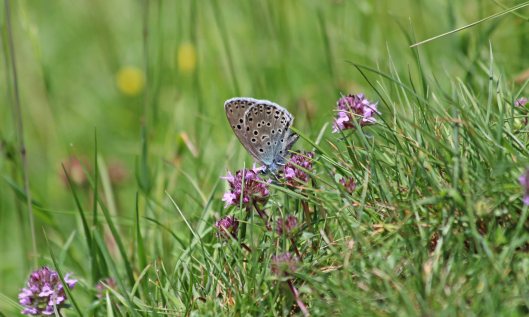
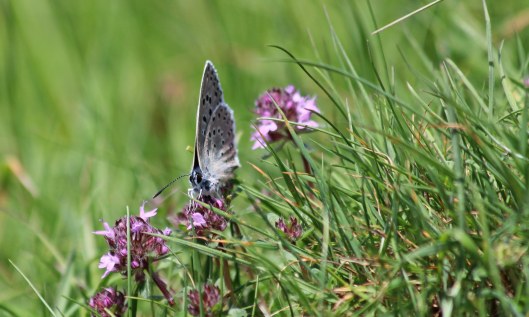
Star attraction: Large blue. Incredibly, this butterfly was declared extinct in Britain in the 1970s but was reintroduced from Sweden to Green Down, a Somerset Wildlife Trust site, in 1992. Since then the butterflies have mostly thrived (though they are affected by weather, habitat and ant conditions – for more on that, check out the National Trust Large blue blog) and they’ve been reintroduced to several other areas, including this site at Collard Hill.
190629 large blue (2)

During our visit, it was very windy at the top and very hot in the lee of the hill, not ideal conditions for seeing the butterflies but, after following the animal tracks back and forth across the hillside, we finally had good sightings of three Large blues on their favourite food plant, Wild thyme. One female was even ovipositing, which bodes well for the coming years.

190629 large blue (3)

It was amazing to see both these Large blues and, earlier in the day, the Heath fritillaries, both lifers for me, and I want to say a huge thank you to Gareth and Alan for letting me join their butterflying expedition. It was a truly magical day!

190629 large blue (4)

Like Loading...

179/365 Butterflying in Somerset, part I

28 Friday Jun 2019

Posted by sconzani in 365DaysWildin2019, insects, nature

≈ 5 Comments

Tags

British butterflies, butterflies, butterfly, butterflying, Exmoor ponies, Green hairstreak, Haddon Hill, Heath fritillary

Scenario: Three friends go seeking rare butterflies across the border in England.

190628 Haddon Hill views

First location: Haddon Hill, in Somerset, offering superb views across the surrounding countryside and grazed by Exmoor ponies.

190628 exmoor ponies

Support act: A Green hairstreak. This was a superb spot by Alan almost as soon as we crossed the stile into the reserve, as this gorgeous little butterfly was incredibly well camouflaged sitting on the grass.

190628 green hairstreak

Star attraction: Heath fritillary. What a cracking little butterfly this is, with its elaborate orange and dark brown upperwing markings, and its equally lovely and intricate underwings. Sadly, this is a rare butterfly in Britain these days but it is being helped along by the sterling efforts of Butterfly Conservation and others. Luckily, at this site, Heath fritillaries are very numerous – we must’ve seen at least 25, and they were literally fluttering in the bushes and brambles all around us. One even landed briefly on my hand – an incredibly special moment.

190628 heath fritillary (1)190628 heath fritillary (2)190628 heath fritillary (3)190628 heath fritillary (4)190628 heath fritillary (5)

Like Loading...
← Older posts
Newer posts →

About me

sconzani

sconzani

I'm a writer and photographer; researcher and blogger; birder and nature lover; countryside rambler and city strider; volunteer and biodiversity recorder.

View Full Profile →

Follow earthstar on WordPress.com

Enter your email address to follow this blog and receive notifications of new posts by email.
Recent blog posts

  • Beating the gloom March 10, 2026
  • No booming Bittern but … March 9, 2026
  • Danish scurvygrass March 8, 2026
  • Four weeks early March 7, 2026
  • Three shieldbug species March 6, 2026

From the archives

COPYRIGHT

Unless otherwise acknowledged, the text and photographs on this blog are my own and are subject to international copyright. Nothing may be downloaded or copied without my permission.

Fellow Earth Stars!

  • Unknown's avatar
  • Unknown's avatar
  • Unknown's avatar
  • Unknown's avatar
  • Unknown's avatar
  • Unknown's avatar
  • Unknown's avatar
  • Unknown's avatar
  • Unknown's avatar
  • Unknown's avatar
  • Unknown's avatar
  • Unknown's avatar
  • Unknown's avatar
  • Unknown's avatar
  • Unknown's avatar
  • Unknown's avatar
  • Unknown's avatar
  • Unknown's avatar
  • Unknown's avatar
  • Unknown's avatar
  • Unknown's avatar
  • Unknown's avatar
  • Unknown's avatar
  • Unknown's avatar
  • Unknown's avatar
  • Unknown's avatar
  • Unknown's avatar
  • Unknown's avatar
  • Unknown's avatar
  • Unknown's avatar
  • Unknown's avatar
  • Unknown's avatar
  • Unknown's avatar
  • Unknown's avatar
  • Unknown's avatar
  • Unknown's avatar
  • Unknown's avatar
  • Unknown's avatar
  • Unknown's avatar
  • Unknown's avatar
  • Unknown's avatar
  • Unknown's avatar
  • Unknown's avatar
  • Unknown's avatar
  • Unknown's avatar
  • Unknown's avatar
  • Unknown's avatar
  • Unknown's avatar
  • Unknown's avatar
  • Unknown's avatar

Blog at WordPress.com.

Privacy & Cookies: This site uses cookies. By continuing to use this website, you agree to their use.
To find out more, including how to control cookies, see here: Cookie Policy
  • Subscribe Subscribed
    • earthstar
    • Join 668 other subscribers
    • Already have a WordPress.com account? Log in now.
    • earthstar
    • Subscribe Subscribed
    • Sign up
    • Log in
    • Report this content
    • View site in Reader
    • Manage subscriptions
    • Collapse this bar
 

Loading Comments...
 

You must be logged in to post a comment.

    %d